
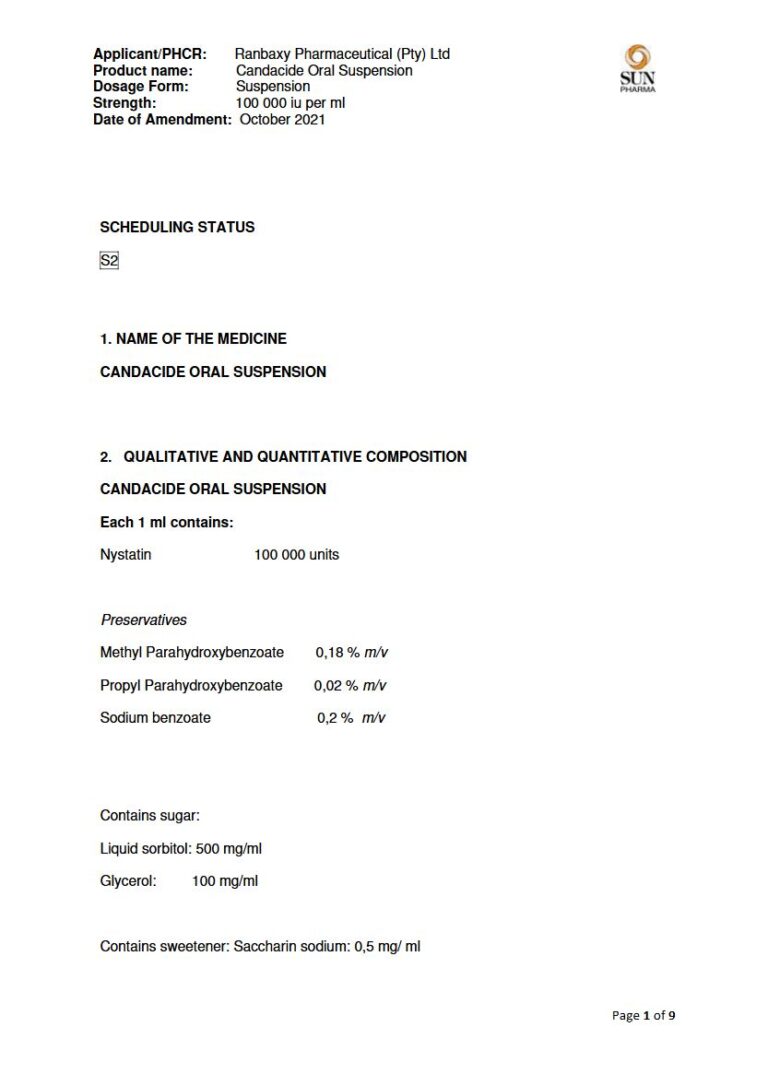
Candacide Oral Suspension
PDF Leaflet Revision Date: 24 January 2022
Clinical Summary
Quick overview from the medicine insert
Indication
Treatment of candidal infections of the oral cavity.
Dosage (summary)
1-2 ml (100,000-200,000 units) four times daily; may increase to 4-6 ml for severe infections.
Special Populations
- Infants
- Children
- Elderly
Pregnancy & Breastfeeding
Use during pregnancy only if benefits outweigh risks; caution in breastfeeding.
Contraindications
- Hypersensitivity to nystatin or excipients
- Hereditary fructose intolerance
Common side effects
- Hypersensitivity
- Gastrointestinal disturbances
- Rash
Counselling Points
- Shake well before use
- Retain in mouth before swallowing
- Continue for 48 hours after symptoms resolve
Serious warnings
- Not for systemic mycoses
- Discontinue if irritation develops
Important Disclaimer
The Candacide Oral Suspension professional information leaflet below is the property of Ranbaxy Pharmaceutical and is provided on Medinsert exactly as issued, with no.. alterations or editorial changes. We make every effort to keep content current by updating documents as soon as new versions become available. Medinsert serves as a trusted access point for healthcare professionals, but does not replace official sources or clinical judgement. For more details, please read our full disclaimer. read more>>
 Healthcare Professionals Only
This content is for registered healthcare professionals
Sign in or create a free account to read the full package insert.
Free for HPCSA-registered professionals. Powered by Medinsert.
Clinical Particulars
Section 4 of the official insert — extracted exactly as issued, no alterations
4.1 Therapeutic indication
u2022 Treatment of candidal (monilial) infections of the oral cavity.
4.2 Posology and Method of Administration
INFANTS: The usual dose is 1 ml to 2 ml (100 000 to 200 000 units) four times daily, dropped into the mouth.
CHILDREN AND ADULTS: The usual dose is 1 ml to 2 ml (100 000 to 200 000 units) four times daily, dropped into the mouth and held for some time before swallowing. This dose may be increased to 4 ml to 6 ml (400 000 to 600 000 units) four times daily for more severe infections. (On administration by dropper, the suspension readily disperses throughout the mouth and is a compatible with commonly used systemic antimicrobial agents and may be given concomitantly with these agents).
The suspension should be retained in the mouth for a long as possible (e g. several minutes) before swallowing. In infants and young children, apply one half of the dose in each side of the mouth.
The dosage regimen for CANDACIDE ORAL SUSPENSION should be continued for at least 48 hours after symptoms have disappeared.
NOTE: If significant regeneration or repair of oral tissue has not occurred in seven days, additional investigation into the etiology of the oral lesion is advised
Method of Administration SHAKE THE BOTTLE BEFORE USE.
4.3 Contraindications:
u2022 Hypersensitivity to nystatin or any of the excipients listed in section 6.1
4.4 Special warnings and precautions for use
Candacide Oral Suspension should not be used for the treatment of systemic mycoses. If irritation or sensitization develops, treatment should be discontinued . CANDACIDE ORAL SUSPENSION contains propyl p-hydroxybenzoate and methyl p- hydroxybenzoate which may cause allergic reactions (possibly delayed). Sorbitol: CANDACIDE ORAL SUSPENSION contains liquid sorbitol non crystallising. Patients with hereditary fructose intolerance (HFI) should not take/be given CANDACIDE ORAL SUSPENSION
Glycerol: CANDACIDE ORAL SUSPENSION contains glycerol which may cause headache, stomach upsets and diarrhoea
4.5 Interaction with other medicines and other forms of Interaction
No interaction studies have been performed.
4.6 Fertility, pregnancy and lactation
Pregnancy Animal reproductive studies have not been conducted with nystatin. It is not known whether nystatin can cause foetal harm when administered to a pregnant woman or can affect reproductive capacity; however absorption of nystatin from the gastro-intestinal tract is negligible. Nystatin should be prescribed during pregnancy only if the potential benefits to be derived outweigh the possible risks involved.
Lactation It is not known whether Nystatin is excreted in human milk. Although gastrointestinal absorption is insignificant, caution should be exercised when Nystatin is prescribed for a breast-feeding woman.
4.7 EFFECTS ON ABILITY TO DRIVE AND USE MACHINES:
Not relevant
4.8 Undesirable effects
MedDRA System Organ Class Frequent Less Frequent Frequency Unknown Immune system disorders hpersensitivity -Angioedema including facial oedema Gastrointestinal disorders Gastrointestinal disturbances -nausea -vomiting -diarrhoea Skin and subcutaneous tissue disorders -Rash including - Urticaria -Steven Johnson syndrome
Reporting of suspected adverse reactions Reporting suspected adverse reactions after authorisation of the medicine is important. It allows continued monitoring of the benefit/risk balance of the medicine. Healthcare professionals are asked to report any suspected adverse reactions to SAHPRA via the u201c6.04 Adverse Drug Reactionu201d Reporting Formu201d, found online under SAHPRAu2019s publications : https://www.sahpra.org.za/Publications/Index/
4.9 Overdose
Treatment is symptomatic and supportive Since the absorption of nystatin from the gastro-intestinal tract is negligible, overdosage or accidental ingestion causes no systemic toxicity. Oral doses of nystatin in excess of 5 million units daily have caused nausea and gastrointestinal upset.
