
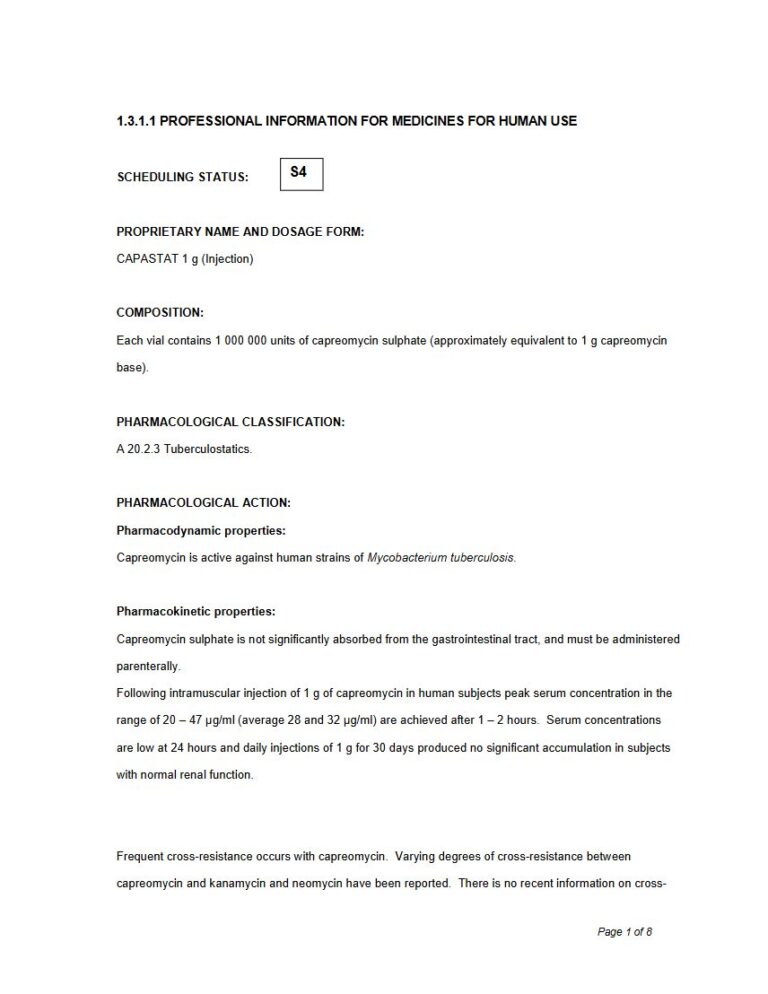
Capastat 1g Injection
PDF Leaflet Revision Date: 14 August 2009
Clinical Summary
Quick overview from the medicine insert
Indication
Treatment of pulmonary infections caused by resistant Mycobacterium tuberculosis.
Dosage (summary)
1 g daily IM for 60-120 days, then 1 g 2-3 times a week.
Onset of Action / Duration
Onset: 1-2 hours, Duration: Not specified.
Special Populations
- Renal impairment
- Elderly
Pregnancy & Breastfeeding
Use only if benefits outweigh risks; safety not established.
Key Drug Interactions
- Streptomycin
- Amikacin
- Gentamicin
Contraindications
- Hypersensitivity to CAPASTAT
Common side effects
- Elevation of serum creatinine
- Auditory loss
- Eosinophilia
Counselling Points
- Monitor for renal function and electrolytes
- Audiometry before and during treatment
Serious warnings
- Ototoxicity risk
- Renal function monitoring required
Important Disclaimer
The Capastat 1g Injection professional information leaflet below is the property of Aspen Pharmacare and is provided on Medinsert exactly as issued, with no.. alterations or editorial changes. We make every effort to keep content current by updating documents as soon as new versions become available. Medinsert serves as a trusted access point for healthcare professionals, but does not replace official sources or clinical judgement. For more details, please read our full disclaimer. read more>>
 Healthcare Professionals Only
This content is for registered healthcare professionals
Sign in or create a free account to read the full package insert.
Free for HPCSA-registered professionals. Powered by Medinsert.
Clinical Particulars
Section 4 of the official insert — extracted exactly as issued, no alterations
4.1 Therapeutic indications
CAPASTAT should be used concomitantly with other appropriate antituberculous agents for the treatment of pulmonary infections caused by CAPASTAT-susceptible strains of Mycobacterium tuberculosis when the primary agents (isoniazid, rifampicin, streptomycin and ethambutol) have been ineffective because of the presence of resistant tubercle bacilli.
4.2 Posology and method of administration
The usual dose is 1 g daily (but 20 mg/kg/day should not be exceeded) given by deep intramuscular injection only for 60 to 120 days, followed by 1 g intramuscularly two or three times a week. CAPASTAT is always administered in combination with at least two other antituberculous agents to which the patientu2019s strain of tubercle bacillus is susceptible.
CAPASTAT should be dissolved in 2 ml of 0.9% Sodium Chloride Intravenous Infusion or Water for Injections. Two to three minutes should be allowed for complete solution. The reconstituted solution must be used immediately. Any unused portion of the reconstituted solution should be discarded.
For administration of a 1 g dose, the entire contents of the vial should be given. For dosages of less than 1 g the following dilution table may be used:
- 2.15 ml - 370mg/ml
- 2.63 ml - 315 mg/ml
- 3.3 ml - 260mg/ml
- 4.3 ml - 210 mg/ml
The elderly: As for adults. Reduce dosage if renal function is impaired.
Patients with reduced renal function: A reduced dosage should be given based on creatinine clearance using the guidance given in the following table. These dosages are designed to achieve a mean steady-state CAPASTAT level of 10 micrograms/ml, at various levels of renal function:
Creatinine clearance (ml/min) - CAPASTAT clearance (l/kg/h x 10 u2013 2) - Half life (hours) - Dose (mg/kg) for these dosing intervals (24h, 48h, 72h)
- 0 - 0.54 - 55.5 - 1.29 - 2.58 - 3.87
- 10 - 1.01 - 29.4 - 2.43 - 4.87 - 7.30
- 20 - 1.49 - 20.0 - 3.58 - 7.16 - 10.70
- 30 - 1.97 - 15.1 - 4.72 - 9.45 - 14.20
- 40 - 2.45 - 12.2 - 5.87 - 11.70
- 50 - 2.92 - 10.2 - 7.01 - 14.00
- 60 - 3.40 - 8.8 - 8.16
- 80 - 4.35 - 6.8 - 10.40
- 100 - 5.31 - 5.6 - 12.7
- 110 - 5.78 - 5.2 - 13.9
Infants and children: Not for paediatric use since the safety of CAPASTAT for use in infants and children has not been established.
4.3 Contraindications
Hypersensitivity to CAPASTAT.
4.4 Special warnings and precautions for use
The use of CAPASTAT in patients with renal insufficiency or pre-existing, auditory impairment must be undertaken with great caution, and the risk of additional eighth cranial nerve impairment or renal injury should be weighed against the benefits to be derived from treatment. CAPASTAT must be used only in conjunction with adequate doses of other antituberculous drugs. The use of CAPASTAT alone allows the rapid development of strains resistant to it. As CAPASTAT is potentially ototoxic, audiometry and assessment of vestibular function should be performed before starting treatment and at regular intervals during treatment. Regular tests of renal function should be made throughout the period of treatment. Elevation of urea above 10.7 mmol/litre or any other evidence of decreasing renal function with or without a rise in urea levels calls for careful evaluation of the patient, and the dosage should be reduced or completely withdrawn.
4.5 Interactions with other medicines
Simultaneous administration of other antituberculous drugs which also have ototoxic and nephrotoxic potential (e.g. streptomycin, viomycin) is not recommended. Also use with other medicines that are not given for the treatment of tuberculosis but have ototoxic or nephrotoxic potential (e.g. amikacin, gentamycin, tobramycin, vancomycin and kanamycin) should also be undertaken only with great caution.
4.6 Fertility, pregnancy and lactation
The safety of this preparation in pregnancy and lactation has not been established. CAPASTAT has been shown to be teratogenic in rats when given at 3.5 times the human dose. There are no adequate and well controlled studies in pregnant women. CAPASTAT should be used during pregnancy only if the potential benefit justifies the potential risk to the foetus. It is not known whether CAPASTAT is excreted in human milk. Caution should be exercised when administering CAPASTAT to a breastfeeding woman. Studies have not been performed to determine potential for carcinogenicity, mutagenicity, or impairment of fertility.
4.7 Effects on ability to drive and use machines
Not specified in the provided text.
4.8 Undesirable effects
Side effects: Renal and urinary disorders: Frequent: Elevation of serum creatinine or blood urea and abnormal urine sediment. Less frequent: Toxic nephritis was reported in one patient with tuberculosis and portal cirrhosis who was treated with CAPASTAT (1 g) and para-aminosalicylic acid (PAS) daily for one month. This patient developed renal insufficiency and oliguria and died. The post-mortem showed subsiding acute tubular necrosis. Electrolyte disturbances resembling Bartteru2019s syndrome have been reported in one patient. Nephrotoxicity u2013 Cases of serious electrolyte disturbances including hypokalaemia, hypomagnesaemia and hypocalcaemia, some of which can be fatal may occur during treatment with CAPASTAT. Serum Potassium, magnesium and calcium levels must be monitored.
Hepatobiliary disorders: Less frequent: Abnormal results in liver function tests have occurred in many patients receiving CAPASTAT in combination with other antituberculous agents which are also known to cause changes in hepatic function, periodic determinations of liver function are recommended.
Blood and lymphatic system disorders: Frequent: Most patients receiving daily CAPASTAT have had eosinophilia exceeding 5%, but this has subsided with the reduction of CAPASTAT dosage to two or three times weekly. Less frequent: Leucocytosis and leucopenia have been observed. Rare cases of thrombocytopenia have been reported.
Ear and labyrinth disorders: Less frequent: Clinical and subclinical auditory loss has been noted. Some audiometric changes have proved reversible and other with permanent loss has not been progressive following withdrawal of CAPASTAT. Tinnitus and vertigo have occurred.
General disorders and administration site conditions: Less frequent: Hypersensitivity: Urticaria and maculopapular rashes associated in some cases with febrile reactions have been reported when CAPASTAT and other antituberculous medicines were given concomitantly. Pain and induration at injection sites have been observed. Excessive bleeding and sterile abscesses have also been reported at these sites.
4.9 Overdose
Hypokalaemia, hypocalcaemia, hypomagnesaemia and an electrolyte disturbance resembling Bartteru2019s syndrome have been reported to occur in patients with CAPASTAT toxicity. Nephrotoxicity, including acute tubular necrosis; and ototoxicity including dizziness, tinnitus, vertigo and loss of high-tone acuity. Neuromuscular blockage or respiratory paralysis may occur following rapid intravenous administration. If CAPASTAT is ingested, toxicity is unlikely because less than 1% is absorbed from an intact gastrointestinal system. Treatment is symptomatic and supportive therapy is recommended. Activated charcoal may be more effective than emesis or lavage in reducing absorption. Patients who have received an overdose of CAPASTAT and have normal renal function should be hydrated to maintain a urine output of 3 u2013 5 ml/kg/hr. Fluid balance electrolytes and creatinine clearance should be monitored. Haemodialysis may be effectively used to remove CAPASTAT in patients with significant renal disease.
