
Cardirest 50 & 100 50 mg, 100 mg Tablet
PDF Leaflet Revision Date: 11 July 2023
Clinical Summary
Quick overview from the medicine insert
Indication
Control of sustained ventricular dysrhythmias and AV nodal reciprocating tachycardia.
Dosage (summary)
Starting 50 mg twice daily for supra-ventricular; 100 mg twice daily for ventricular dysrhythmias.
Special Populations
- Renal impairment
- Hepatic impairment
- Elderly
Pregnancy & Breastfeeding
Contraindicated in pregnancy and breastfeeding.
Key Drug Interactions
- CYP2D6 inhibitors/inducers
- Class 1 anti-dysrhythmics
- Calcium channel blockers
Contraindications
- Hypersensitivity to flecainide
- Cardiac failure
- Recent myocardial infarction
- Structural heart disease
Common side effects
- Dizziness
- Visual disturbances
- Pro-dysrhythmic effects
Counselling Points
- Monitor for dizziness and visual disturbances.
- Avoid use with certain anti-dysrhythmics.
- Regular plasma level monitoring recommended.
Serious warnings
- Increased mortality risk in post-myocardial infarction patients
- Pro-dysrhythmic effects
- QT prolongation
Important Disclaimer
The Cardirest 50 & 100 50 mg, 100 mg Tablet professional information leaflet below is the property of Dr Reddy’S Laboratories and is provided on Medinsert exactly as issued, with no.. alterations or editorial changes. We make every effort to keep content current by updating documents as soon as new versions become available. Medinsert serves as a trusted access point for healthcare professionals, but does not replace official sources or clinical judgement. For more details, please read our full disclaimer. read more>>
 Healthcare Professionals Only
This content is for registered healthcare professionals
Sign in or create a free account to read the full package insert.
Free for HPCSA-registered professionals. Powered by Medinsert.
Clinical Particulars
Section 4 of the official insert — extracted exactly as issued, no alterations
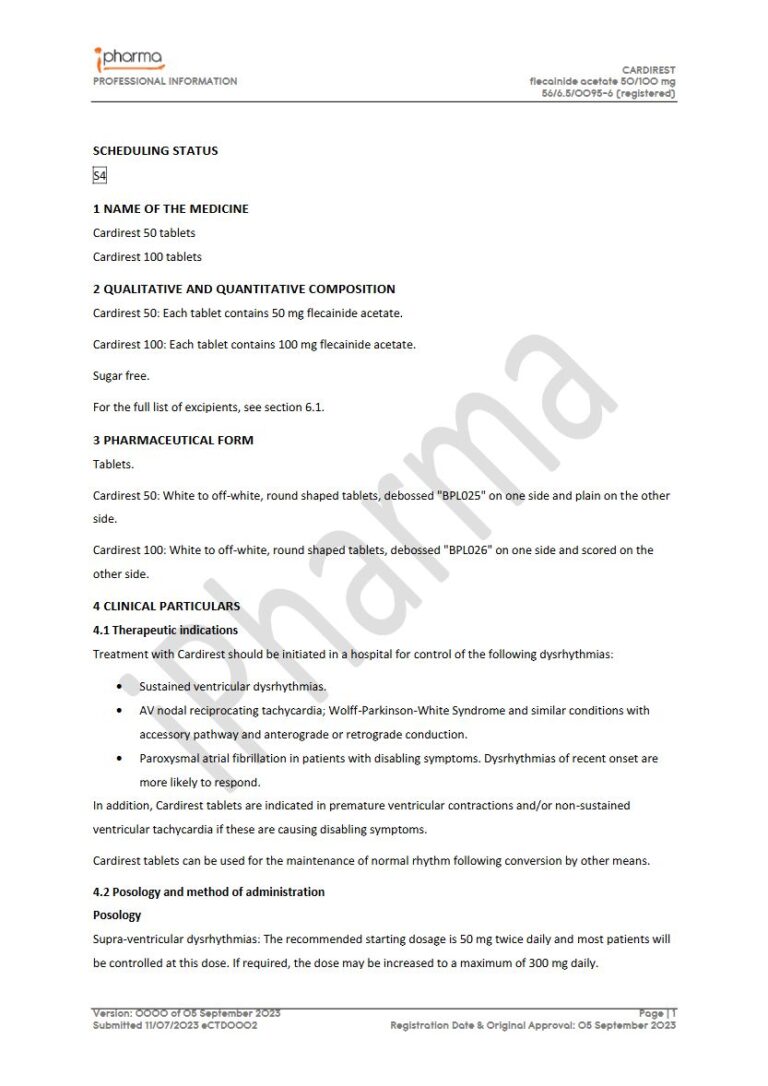
4.1 Therapeutic indications
Treatment with Cardirest should be initiated in a hospital for control of the following dysrhythmias:
- Sustained ventricular dysrhythmias.
- AV nodal reciprocating tachycardia; Wolff-Parkinson-White Syndrome and similar conditions with accessory pathway and anterograde or retrograde conduction.
- Paroxysmal atrial fibrillation in patients with disabling symptoms. Dysrhythmias of recent onset are more likely to respond.
In addition, Cardirest tablets are indicated in premature ventricular contractions and/or non-sustained ventricular tachycardia if these are causing disabling symptoms. Cardirest tablets can be used for the maintenance of normal rhythm following conversion by other means.
4.2 Posology and method of administration
Posology
Supra-ventricular dysrhythmias: The recommended starting dosage is 50 mg twice daily and most patients will be controlled at this dose. If required, the dose may be increased to a maximum of 300 mg daily.
Ventricular dysrhythmias: The recommended starting dosage is 100 mg twice daily. The maximum daily dose is 400 mg daily and this is normally reserved for patients of large build or where rapid control of the dysrhythmia is required. After 3 u2013 5 days it is recommended that the dosage be progressively adjusted to the lowest level which maintains control of the dysrhythmia. It may be possible to reduce the dosage during long-term treatment.
Plasma levels: Based on premature ventricular contractions (PVC) suppression, it appears that plasma levels of 200 u2013 1 000 ng/ml may be needed to obtain the maximum therapeutic effect. Plasma levels above 700 u2013 1 000 ng/ml are associated with increased likelihood of adverse experiences.
Special populations
Paediatric population: Cardirest is not recommended in children under 18 years of age, as there is insufficient evidence of its use in this age group.
Renal impairment: In patients with significant renal impairment (creatinine clearance of 35 ml/min/1.73 sq.m or less) the maximum initial dosage should be 100 mg daily (or 50 mg twice daily). When used in such patients, frequent plasma level monitoring is strongly recommended.
Elderly patients: The rate of flecainide elimination from plasma may be reduced in elderly people and doses may need to be adjusted accordingly.
Method of administration: Oral use.
4.3 Contraindications
Cardirest is contraindicated in:
- Hypersensitivity to flecainide or any excipients of Cardirest see section 6.1.
- Patients with cardiac failure, and in patients with a recent myocardial infarction or a history of myocardial infarction who have either asymptomatic ventricular ectopics or asymptomatic non-sustained ventricular tachycardia.
- Pregnancy and lactation (see section 4.6).
- Patients with long standing atrial fibrillation and in patients with haemodynamically significant valvular heart disease. Unless pacing rescue is available, Cardirest should not be given to patients with sinus node dysfunction, atrial conduction defects, second degree or greater atrio-ventricular block, bundle branch block or distal block.
- Cardirest is also contra-indicated in the presence of cardiogenic shock.
4.4 Special warnings and precautions for use
Increased mortality risk: Cardirest has been shown to increase mortality risk of post-myocardial infarction patients with asymptomatic ventricular dysrhythmia. In post-myocardial infarction patients with asymptomatic ventricular dysrhythmia, oral flecainide was associated with a 2.2 fold higher incidence of mortality or non-fatal cardiac arrest as compared with its matching placebo. An even higher incidence of mortality was observed in flecainide-treated patients with more than one myocardial infarction. There is no evidence that the use of Cardirest favourably affects survival or the incidence of sudden death.
Structural Heart Disease: Cardirest should be avoided in patients with structural organic heart disease or abnormal left ventricular function.
Effects on Pacemaker Thresholds: Cardirest is known to increase endocardial pacing thresholds, i.e. to decrease endocardial pacing sensitivity. This effect is reversible and is more marked on the acute pacing threshold than on the chronic. Cardirest should thus be used with caution in all patients with permanent pacemakers or temporary pacing electrodes, and not be administered to patients with existing poor thresholds or non-programmable pacemakers unless suitable pacing rescue is available. Generally, threshold changes are within the range of multiprogrammable pacemakers and when these changes occur, usually a doubling of either voltage or pulse width is sufficient to regain capture. It may be difficult to obtain ventricular thresholds less than 1 volt at initial implantation in the presence of Cardirest.
The negative inotropic effect of Cardirest may be important in patients predisposed to cardiac failure. Difficulty has been experienced in defibrillating some patients. Most of the cases reported had pre-existing heart disease with cardiac enlargement, a history of myocardial infarction, arteriosclerotic heart disease and cardiac failure.
Pro-dysrhythmic Effects: Cardirest may cause pro-dysrhythmic effects. It may, for example, cause the appearance of a more severe type of dysrhythmia, increase the frequency of an existing dysrhythmia or increase the severity of the symptoms (see section 4.8).
Atrial fibrillation: Cardirest should be used with caution in patients with acute onset of atrial fibrillation following cardiac surgery.
Cardiac conduction: Cardirest prolongs the QT interval and widens the QRS complex by 12 - 20 %. The effect on the JT interval is insignificant.
Brugada syndrome: Brugada syndrome may be unmasked due to Cardirest therapy. In the case of development of ECG changes during treatment with Cardirest that may indicate Brugada syndrome, discontinuation of treatment is advised.
Bradycardia: Severe bradycardia or pronounced hypotension should be corrected before using Cardirest.
Electrolyte Disturbances: The presence of a potassium excess or deficit may alter the effects of Class I anti-dysrhythmic medicines. Any pre-existing hypokalaemia or hyperkalaemia or other electrolyte disturbances should be corrected before administration of Cardirest.
Switching to different formulation: Cardirest, as a narrow therapeutic index medicine, requires caution and close monitoring when switching a patient to a different formulation. Refer to section 4.5.
Use in hepatic impairment: Since flecainide elimination from the plasma can be markedly slower in patients with hepatic impairment, Cardirest should not be used in such patients unless the potential benefits clearly outweigh the risks. Plasma monitoring is strongly recommended in these circumstances.
Use in renal impairment: Cardirest should be used with caution in patients with impaired renal function (creatinine clearance u2264 35 ml/min/1.73 m2) and therapeutic monitoring is recommended.
Use in the elderly: The rate of flecainide elimination from plasma may be reduced in the elderly. This should be taken into consideration when making dose adjustments.
Paediatric population: Cardirest is not recommended in children under 18 years of age, as there is insufficient evidence of its use in this age group.
4.5 Interaction with other medicines and other forms of interaction
Use of Cardirest with other class 1 anti-dysrhythmics or calcium channel blockers with anti-dysrhythmic activity is not recommended. Life-threatening or even lethal adverse events due to interactions causing increased plasma concentrations may occur (see section 4.9). Flecainide is metabolised by CYP2D6 to a large extent, and concurrent use of medicines inhibiting (e.g. antidepressants, neuroleptics, propranolol, ritonavir, some antihistamines) or inducing (e.g. phenytoin, phenobarbital, carbamazepine) this iso-enzyme can increase or decrease plasma concentrations of flecainide, respectively. An increase of plasma levels may also result from renal impairment due to a reduced clearance of flecainide.
Anti-histamines: Avoid concomitant use with mizolastine and terfenadine it may increase the risk of ventricular dysrhythmias.
Antivirals: Plasma concentration of flecainide is increased by ritonavir, lopinavir and indinavir (increased risk of ventricular dysrhythmias); avoid concomitant use.
Diuretics: Class effect due to hypokalaemia giving rise to cardiac toxicity. Hypokalaemia, but also hyperkalaemia or other electrolyte disturbances should be corrected before administration of flecainide. Hypokalaemia may result from the concomitant use of diuretics, corticosteroids or laxatives (see section 4.4).
Anti-depressants: Fluoxetine, paroxetine and other antidepressants increase plasma flecainide concentration; increased risk of dysrhythmias with tricyclics, caution is also advised with the concomitant administration of reboxetine.
Bupropion: Co-administration of bupropion with medicines that are metabolized by CYP2D6 isoenzyme including flecainide should be approached with caution and should be initiated at the lower end of the dose range of the concomitant medication. If bupropion is added to the treatment regimen of a patient already receiving flecainide, the need to decrease the dose of the original medication should be considered.
Cardiac glycosides: Cardirest can cause the plasma digoxin level to rise by about 15 %, which is unlikely to be of clinical significance for patients with plasma levels in the therapeutic range. It is recommended that the digoxin plasma level in digitalised patients should be measured not less than six hours after any digoxin dose, before or after administration of Cardirest.
Class II anti-dysrhythmics: The possibility of additive negative inotropic effects of beta-blockers and other cardiac depressants such as verapamil with flecainide should be considered.
Amiodarone: When Cardirest is given in the presence of amiodarone, the usual dose of Cardirest should be reduced by 50 % and the patient monitored closely for adverse effects. Plasma level monitoring is strongly recommended in these circumstances.
Cimetidine: Cimetidine inhibits metabolism of flecainide. In healthy subjects receiving cimetidine (1g daily) for one week, plasma flecainide levels increased by about 30% and the half-life increased by about 10 %.
Enzyme inducers: Limited data in patients receiving known enzyme inducers (phenytoin, phenobarbital, carbamazepine) indicate a 30 % increase in the rate of flecainide elimination. In healthy subjects receiving cimetidine (1 g daily) for one week, plasma flecainide levels increased by about 30 % and the half-life increased by about 10 %. When amiodarone is added to Cardirest therapy, plasma flecainide levels may increase two-fold or more. Therefore, the usual flecainide dosage should be reduced by at least 50 % and the patients monitored closely for adverse effects. Plasma level monitoring is strongly recommended in these circumstances.
Anti-malarial medicines: Quinine increases plasma concentration of flecainide.
Anti-psychotics: Concomitant use of Cardirest with clozapine may increase the risk of dysrhythmias.
Anticoagulants: Treatment with Cardirest is compatible with use of oral anti-coagulants.
4.6 Fertility, pregnancy and lactation
Pregnancy: Cardirest is contraindicated in pregnancy (see section 4.3). Safety in pregnancy has not been established. Cardirest should not be administered in the case of suspected pregnancy or during the first three months of pregnancy.
Breastfeeding: Cardirest is contraindicated in breastfeeding women (see section 4.3). Safety in breastfeeding has not been established.
4.7 Effects on ability to drive and use machines
Cardirest tablets have no or negligible influence on the ability to drive and use machines. However, driving ability, operation of machinery may be affected by adverse reactions such as dizziness and visual disturbances (if present).
4.8 Undesirable effects
System organ class Frequency
- Blood and lymphatic system disorders: Less frequent - Decreased red blood cell count, white blood cell count and platelet count.
- Immune system disorders: Less frequent - Antinuclear antibody increased with and without systemic inflammation.
- Psychiatric disorders: Less frequent - Hallucination, depression, confusion, anxiety, amnesia and insomnia.
- Nervous system disorders: Frequent - Giddiness, dizziness and light-headedness. Less frequent - Paraesthesia, ataxia, hypoaesthesia, hyperhidrosis, syncope, tremor, flushing, somnolence, headache, neuropathy peripheral, convulsion and dyskinesia.
- Eye disorders: Frequent - Visual disturbances, such as diplopia and blurred vision. Less frequent - Corneal deposits.
- Ear and labyrinth disorders: Less frequent - Tinnitus, vertigo.
- Cardiac disorders: Frequent - Pro-dysrhythmic effects, occurs more frequently in patients with structural heart disease and/or significant left ventricular impairment (see section 4.4). Less frequent - Patients with atrial flutter can develop a 1:1 AV conduction with increased heart rate. Frequency unknown - Dose-related increases in PR and QRS intervals may occur (see section 4.4). Altered pacing threshold (see section 4.4). Atrioventricular block second degree and atrioventricular block third degree, cardiac arrest, bradycardia, cardiac failure/cardiac failure congestive, chest pain, hypotension, myocardial infarction, palpitations, sinus pause or arrest, and tachycardia (AT or VT) or ventricular fibrillation. Demasking of a pre-existing Brugada syndrome.
- Respiratory, thoracic and mediastinal disorders: Frequent - Dyspnoea. Less frequent - Pulmonary fibrosis, interstitial lung disease, pneumonitis.
- Gastrointestinal disorders: Less frequent - Nausea, vomiting, constipation, abdominal pain, decreased appetite, diarrhoea, dyspepsia, flatulence.
- Hepatobiliary disorders: Less frequent - Elevated hepatic enzymes with or without jaundice. Frequency unknown - Hepatic dysfunction.
- Skin and subcutaneous tissue disorders: Less frequent - Allergic dermatitis, including rash, alopecia, serious urticaria and photosensitivity reaction.
- Musculoskeletal and connective tissue disorders: Frequency unknown - Arthralgia and myalgia.
- General disorders and administration site conditions: Frequent - Asthenia, fatigue, pyrexia, oedema.
a In patients with atrial flutter the use of Cardirest has been associated with 1:1 AV conduction following initial arterial slowing with resultant ventricular acceleration. This has been seen frequently following the use of the injection for acute conversion. This effect is usually short lived and abates quickly following cessation of therapy. The rate of flecainide elimination from plasma may be reduced in elderly people and doses may need to be adjusted accordingly. The occurrence of cardiac arrest and symptomatic conduction disturbances is higher in the elderly.
Reporting of suspected adverse reactions: Reporting suspected adverse reactions after authorisation of the medicine is important. It allows continued monitoring of the benefit/risk balance of the medicine. Health care providers are asked to report any suspected adverse reactions to SAHPRA via the u201c6.04 Adverse Drug Reactions Reporting Formu201d, found online under SAHPRAu2019s publications: htps://www.sahpra.org.za/Publications/Index/8.
4.9 Overdose
Overdosage with Cardirest is a potentially life-threatening medical emergency. Increased susceptibility and plasma levels exceeding therapeutic levels may also result from medicine interaction (see section 4.5). No specific antidote is known. There is no known way to rapidly remove flecainide from the system. Neither dialysis nor haemoperfusion is effective. Treatment should be supportive and may include removal of unabsorbed medicine from the GI tract. Further measures may include inotropic agents or cardiac stimulants such as dopamine, dobutamine or isoproterenol, as well as mechanical ventilation and circulatory assistance (e.g. balloon pumping). Temporarily inserting a transvenous pacemaker in the event of conduction block should be considered. Assuming a plasma half-life of approximately 20 h, these supportive treatments may need to be continued for an extended period of time. Forced diuresis with acidification of the urine theoretically promotes excretion.
