
Cephtrifect 0,5 g/1,0 g/2,0 g Solution
PDF Leaflet Revision Date: 05 May 2023
Clinical Summary
Quick overview from the medicine insert
Indication
Treatment of various bacterial infections.
Dosage (summary)
Adults: 1-2 g once daily; severe cases: up to 4 g once daily.
Special Populations
- Elderly
- Renal impairment
- Hepatic impairment
Pregnancy & Breastfeeding
Caution in pregnancy; excreted in breast milk.
Key Drug Interactions
- Calcium-containing products
- Oral anticoagulants
Contraindications
- Hypersensitivity to ceftriaxone
- Premature neonates
- Neonates requiring calcium IV solutions
Common side effects
- Diarrhoea
- Rash
- Eosinophilia
- Dizziness
Counselling Points
- Avoid calcium-containing solutions
- Monitor for allergic reactions
- Use alternative contraception during treatment
Serious warnings
- Serious hypersensitivity reactions
- Risk of ceftriaxone-calcium precipitation in neonates
Important Disclaimer
The Cephtrifect 0,5 g/1,0 g/2,0 g Solution professional information leaflet below is the property of Ipharma and is provided on Medinsert exactly as issued, with no.. alterations or editorial changes. We make every effort to keep content current by updating documents as soon as new versions become available. Medinsert serves as a trusted access point for healthcare professionals, but does not replace official sources or clinical judgement. For more details, please read our full disclaimer. read more>>
 Healthcare Professionals Only
This content is for registered healthcare professionals
Sign in or create a free account to read the full package insert.
Free for HPCSA-registered professionals. Powered by Medinsert.
Clinical Particulars
Section 4 of the official insert — extracted exactly as issued, no alterations
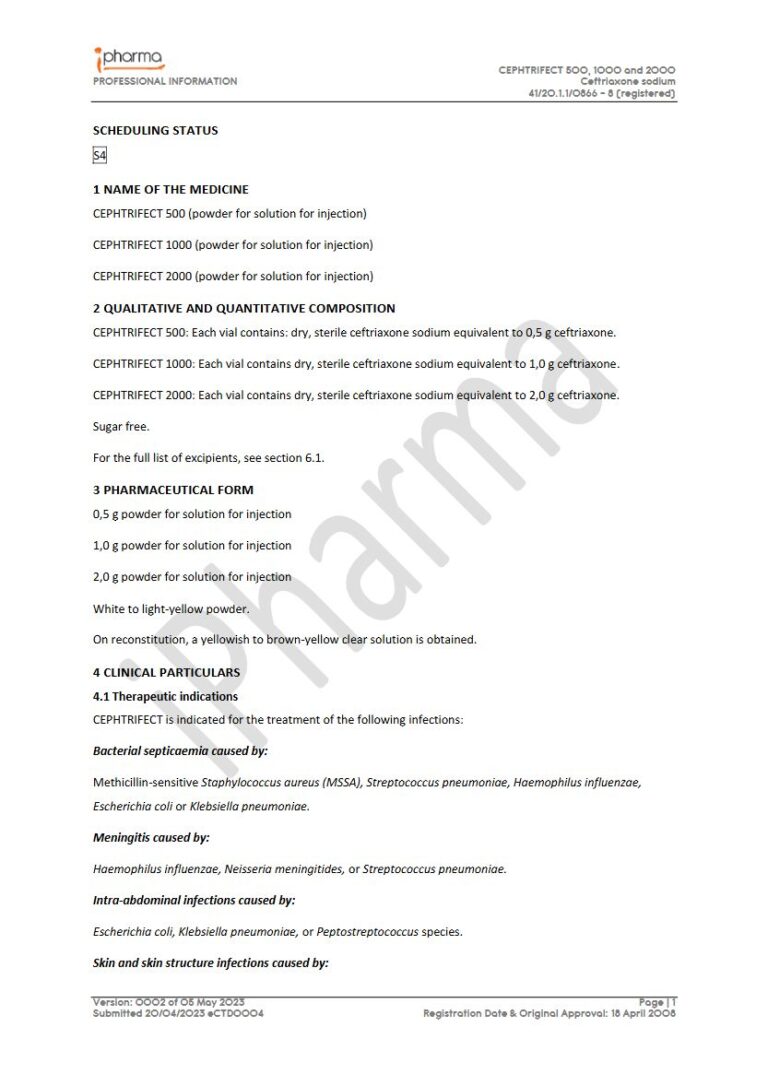
4.1 Therapeutic indications
CEPHTRIFECT is indicated for the treatment of the following infections:
- Bacterial septicaemia caused by: Methicillin-sensitive Staphylococcus aureus (MSSA), Streptococcus pneumoniae, Haemophilus influenzae, Escherichia coli or Klebsiella pneumoniae.
- Meningitis caused by: Haemophilus influenzae, Neisseria meningitides, or Streptococcus pneumoniae.
- Intra-abdominal infections caused by: Escherichia coli, Klebsiella pneumoniae, or Peptostreptococcus species.
- Skin and skin structure infections caused by: Methicillin-sensitive Staphylococcus aureus (MSSA), Streptococcus pyogenes, Streptococcus viridans group, Escherichia coli, Enterobacter cloacae, Klebsiella oxytoca, Klebsiella pneumoniae, Proteus mirabilis, Morganella morganii, Serratia marcescens, or Peptostreptococcus species.
- Bone- and joint infections caused by: Methicillin-sensitive Staphylococcus aureus (MSSA), Streptococcus pneumoniae, Escherichia coli, Proteus mirabilis, Klebsiella pneumoniae, or Enterobacter species.
- Renal and urinary tract infections caused by: Escherichia coli, Proteus mirabilis, Proteus vulgaris, Morganella morganii, or Klebsiella pneumoniae.
- Respiratory tract infections caused by: Streptococcus pneumoniae, Methicillin-sensitive Staphylococcus aureus (MSSA), Haemophilus influenzae, Haemophilus parainfluenzae, Klebsiella pneumoniae, Escherichia coli, Enterobacter aerogenes, Proteus mirabilis, or Serratia marcescens.
- Ear, nose and throat infections (acute bacterial otitis media) caused by: Streptococcus pneumoniae, Haemophilus influenzae (including beta-lactamase-producing strains), or Moraxella catarrhalis (including beta-lactamase-producing strains).
- Uncomplicated gonorrhoea (cervical/urethral and rectal) caused by: Neisseria gonorrhoeae, including both beta-lactamase-, and non-beta-lactamase-producing strains, and pharyngeal gonorrhoea caused by non-beta-lactamase-producing strains of Neisseria gonorrhoeae.
- Peri-operative infection prophylaxis.
4.2 Posology and method of administration
Posology
Do not use diluents containing calcium, such as Ringeru2019s solution or Hartmannu2019s solution to reconstitute CEPHTRIFECT vials or to further dilute a reconstituted vial for IV administration because a precipitate can form. Precipitation of ceftriaxone-calcium can also occur when ceftriaxone is mixed with calcium-containing solutions in the same IV administration line. Therefore, ceftriaxone and calcium-containing solutions must not be mixed or administered simultaneously. CEPHTRIFECT and calcium-containing infusions such as parental nutrition should not be mixed or co-administered to any patient irrespective of age even via different infusion lines at different infusion times at different sites (see section 4.3, 4.4 and 6.2).
Standard dosage:
Adults and children over 12 years: The usual dosage is 1 to 2 g CEPHTRIFECT once daily. In severe cases or in infections caused by moderately sensitive organisms, the dosage may be raised to 4 g, once daily.
Neonates, infants and children up to 12 years: The following dosage schedules are recommended for once daily administration:
- Neonates (up to 14 days): 20 to 50 mg/kg body weight once daily. The daily dose should not exceed 50 mg/kg. CEPHTRIFECT is contraindicated in premature neonates up to a corrected age of 41 weeks (gestational age + chronological age) (see section 4.3). CEPHTRIFECT is contraindicated in neonates (u2264 28 days) if they require (or are expected to require) treatment with calcium-containing IV solutions, including continuous calcium-containing infusions such as parenteral nutrition because of the risk of precipitation of ceftriaxone-calcium (see sections 4.3, 4.4 and 4.8).
- Infants and children (15 days to 12 years): 20 to 80 mg/kg once daily. For children with bodyweights of 50 kg or more, the usual adult dose should be used. Intravenous doses of u2265 50 mg/kg body weight should be given by infusion over at least 30 minutes.
- Elderly patients: No dose modification is needed in the elderly.
Duration of therapy: The duration of therapy varies according to the course of the disease. Administration of CEPHTRIFECT should be continued for a minimum of 48 to 72 hours after the patient has become afebrile or evidence of bacterial eradication has been obtained.
Special dosage instructions:
- Meningitis: In bacterial meningitis in infants and children, treatment begins with doses of 100 mg/kg (not to exceed 4 g) once daily. As soon as the causative organism has been identified and its sensitivity determined, the dose can be adapted accordingly. For bacterial meningitis in adults, the recommended dose is 4 g once daily.
- Gonorrhoea: For the treatment of uncomplicated gonorrhoea (both beta-lactamase-producing and non-beta-lactamase-producing strains), a single intramuscular (IM) dose of 250 mg CEPHTRIFECT is recommended.
- Peri-operative infection prophylaxis: A single dose of 1 to 2 g CEPHTRIFECT administered 30 to 90 minutes prior to surgery. In colorectal surgery, administration of CEPHTRIFECT with or without a 5-nitroimidazole, e.g. metronidazole, has been proven effective (separate administration: see u201cMethod of administrationu201d).
Impaired renal and hepatic function: In patients with impaired renal function, there is no need to reduce the dosage of CEPHTRIFECT provided that hepatic function is intact. In cases of severe renal failure (creatinine clearance < 10 ml/min) the CEPHTRIFECT dosage should not exceed 2 g daily. In patients with liver damage, there is no need for the dosage to be reduced, provided that renal function is intact.
Method of administration: CEPHTRIFECT must be reconstituted prior to use. Reconstituted solutions retain their physical and chemical stability for 24 hours when kept below 25 u221eC or 48 hours in the refrigerator at 2 to 8 u221eC. As a general rule, however, the solutions should be used immediately after preparation. The solutions range in colour from pale yellow to amber, depending on the concentration and length of storage. The colouration of the solutions is of no significance for the efficacy or tolerance of the medicine. For instructions on reconstitution of the medicine before administration, see section 6.6.
4.3 Contraindications
- Hypersensitivity to ceftriaxone, to any other cephalosporin or to any of the excipients listed in section 6.1.
- History of severe hypersensitivity (e.g. anaphylactic reaction) to any other type of beta-lactam antibacterial medicine (penicillins, monobactams and carbapenems).
- Hyperbilirubinemic neonates, especially prematures, should not be treated with CEPHTRIFECT. In vitro studies have shown that ceftriaxone can displace bilirubin from its binding to serum albumin and bilirubin encephalopathy can possibly develop in the patients.
- CEPHTRIFECT is contraindicated in:
- Premature neonates up to a corrected age of 41 weeks (gestational age + chronological age).
- Full-term neonates (up to 28 days of age) with jaundice, or who are hypoalbuminaemic or acidotic because these are conditions in which bilirubin binding is likely to be impaired.
- Neonates (u2264 28 days) if they require (or are expected to require) treatment with calcium-containing IV solutions, including continuous calcium-containing infusions such as parenteral nutrition because of the risk of precipitation of ceftriaxone-calcium (see sections 4.4 and 4.8).
- Contraindications of lignocaine must be excluded before intramuscular injection of CEPHTRIFECT when lignocaine is used as solvent.
4.4 Special warnings and precautions for use
Hypersensitivity reactions
As with all beta-lactam antibacterial medicines, serious and occasionally fatal hypersensitivity reactions have been reported (see section 4.8). In case of severe hypersensitivity reactions, treatment with ceftriaxone must be discontinued immediately and adequate emergency measures must be initiated. Before beginning treatment, it should be established whether the patient has a history of severe hypersensitivity reactions to ceftriaxone, to other cephalosporins or to any other type of beta-lactam medicine. Caution should be used if ceftriaxone is given to patients with a history of non-severe hypersensitivity to other beta-lactam medicines.
Severe cutaneous adverse reactions (Stevens-Johnson syndrome or Lyell's syndrome/toxic epidermal necrolysis and drug reaction with eosinophilia and systemic symptoms (DRESS)) which can be life-threatening or fatal have been reported in association of ceftriaxone treatment; however, the frequency of these events is not known (see section 4.8).
Interaction with calcium containing products
Cases of fatal reactions with calcium-ceftriaxone precipitates in lungs and kidneys in premature and full-term neonates aged less than 1 month have been described. At least one of them had received ceftriaxone and calcium at different times and through different intravenous lines. In the available scientific data, there are no reports of confirmed intravascular precipitations in patients, other than neonates, treated with ceftriaxone and calcium-containing solutions or any other calcium-containing products.
In vitro studies demonstrated that neonates have an increased risk of precipitation of ceftriaxone-calcium compared to other age groups. In patients of any age, ceftriaxone must not be mixed or administered simultaneously with any calcium-containing intravenous solutions, even via different infusion lines or at different infusion sites. However, in patients older than 28 days of age, ceftriaxone and calcium-containing solutions may be administered sequentially one after another if infusion lines at different sites are used, or if the infusion lines are replaced or thoroughly flushed between infusions with physiological salt-solution to avoid precipitation. In patients requiring continuous infusion with calcium-containing total parenteral nutrition (TPN) solutions, healthcare professionals may wish to consider the use of alternative antibacterial treatments which do not carry a similar risk of precipitation. If the use of ceftriaxone is considered necessary in patients requiring continuous nutrition, TPN solutions and ceftriaxone can be administered simultaneously, albeit via different infusion lines at different sites. Alternatively, infusion of TPN solution could be stopped for the period of ceftriaxone infusion and the infusion lines flushed between solutions (see sections 4.3, 4.8, 5.2 and 6.2).
Paediatric population
Safety and effectiveness of ceftriaxone in neonates, infants and children have been established for the dosages described under Posology and Method of Administration (see section 4.2). Studies have shown that ceftriaxone, like some other cephalosporins, can displace bilirubin from serum albumin. Ceftriaxone is contraindicated in premature and full-term neonates at risk of developing bilirubin encephalopathy (see section 4.3).
Immune mediated haemolytic anaemia
An immune mediated haemolytic anaemia has been observed in patients receiving cephalosporin class antibacterials including ceftriaxone (see section 4.8). Severe cases of haemolytic anaemia, including fatalities, have been reported during ceftriaxone treatment in both adults and children. If a patient develops anaemia while on ceftriaxone, the diagnosis of a cephalosporin-associated anaemia should be considered and ceftriaxone discontinued until the aetiology is determined.
Long term treatment
During prolonged treatment complete blood count should be performed at regular intervals.
Colitis/overgrowth of non-susceptible microorganisms
Antibacterial medicine-associated colitis and pseudo-membranous colitis have been reported with nearly all antibacterial medicines, including ceftriaxone, and may range in severity from mild to life-threatening. Therefore, it is important to consider this diagnosis in patients who present with diarrhoea during or subsequent to the administration of ceftriaxone (see section 4.8). Discontinuation of therapy with ceftriaxone and the administration of specific treatment for Clostridium difficile should be considered. Medicines that inhibit peristalsis should not be given.
Superinfections with non-susceptible micro-organisms may occur as with other antibacterial medicines.
Severe renal and hepatic insufficiency
In severe renal and hepatic insufficiency, close clinical monitoring for safety and efficacy is advised (see section 4.2).
Interference with serological testing
Interference with Coombs tests may occur, as ceftriaxone may lead to false-positive test results. Ceftriaxone can also lead to false-positive test results for galactosaemia (see section 4.8). Non-enzymatic methods for the glucose determination in urine may give false-positive results. Urine glucose determination during therapy with ceftriaxone should be done enzymatically (see section 4.8).
The presence of ceftriaxone may falsely lower estimated blood glucose values obtained with some blood glucose monitoring systems. Please refer to instructions for use for each system. Alternative testing methods should be used if necessary.
Antibacterial spectrum
Ceftriaxone has a limited spectrum of antibacterial activity and may not be suitable for use as a single medicine for the treatment of some types of infections unless the pathogen has already been confirmed (see section 4.2). In polymicrobial infections, where suspected pathogens include organisms resistant to ceftriaxone, administration of an additional antibiotic should be considered.
Use of lidocaine
In case a lidocaine solution is used as a solvent, ceftriaxone solutions must only be used for intramuscular injection. Contraindications to lidocaine, warnings and other relevant information as detailed in the professional information of lidocaine must be considered before use (see section 4.3). The lidocaine solution should never be administered intravenously.
Biliary lithiasis
When shadows are observed on sonograms, consideration should be given to the possibility of precipitates of calcium ceftriaxone. Shadows, which have been mistaken for gallstones, have been detected on sonograms of the gallbladder and have been observed more frequently at ceftriaxone doses of 1 g per day and above. Caution should be particularly considered in the paediatric population. Such precipitates disappear after discontinuation of ceftriaxone therapy. Rarely precipitates of calcium ceftriaxone have been associated with symptoms. In symptomatic cases, conservative nonsurgical management is recommended and discontinuation of ceftriaxone treatment should be considered by the physician based on specific benefit risk assessment (see section 4.8).
Biliary stasis
Cases of pancreatitis, possibly of biliary obstruction aetiology, have been reported in patients treated with ceftriaxone (see section 4.8). Most patients presented with risk factors for biliary stasis and biliary sludge e.g. preceding major therapy, severe illness and total parenteral nutrition. A trigger or cofactor of ceftriaxone-related biliary precipitation cannot be ruled out.
Renal lithiasis
Cases of renal lithiasis have been reported, which is reversible upon discontinuation of ceftriaxone (see section 4.8). In symptomatic cases, sonography should be performed. Use in patients with history of renal lithiasis or with hypercalciuria should be considered by the physician based on specific benefit risk assessment.
Jarisch-Herxheimer Reaction (JHR)
Some patients with spirochete infections may experience a Jarisch-Herxheimer Reaction (JHR) shortly after ceftriaxone treatment is started. JHR is usually a self-limiting condition or can be managed by symptomatic treatment. The antibiotic treatment should not be discontinued if such reaction occurs.
Encephalopathy
Encephalopathy has been reported with the use of ceftriaxone (see section 4.8), particularly in elderly patients with severe renal impairment (see section 4.2) or central nervous system disorders. If ceftriaxone-associated encephalopathy is suspected (e.g. decreased level of consciousness, altered mental state, myoclonus, convulsions), discontinuation of ceftriaxone should be considered.
4.5 Interaction with other medicines and other forms of interaction
Interactions of CEPHTRIFECT with calcium containing diluents, such as Ringer's solution or Hartmann's solution, should not be used to reconstitute ceftriaxone vials or to further dilute a reconstituted vial for intravenous administration because a precipitate can form. Precipitation of ceftriaxone-calcium can also occur when ceftriaxone is mixed with calcium-containing solutions in the same intravenous administration line. Ceftriaxone must not be administered simultaneously with calcium-containing intravenous solutions, including continuous calcium-containing infusions such as parenteral nutrition via a Y-site. However, in patients other than neonates, ceftriaxone and calcium-containing solutions may be administered sequentially of one another if the infusion lines are thoroughly flushed between infusions with a compatible fluid.
In vitro studies using adult and neonatal plasma from umbilical cord blood demonstrated that neonates have an increased risk of precipitation of ceftriaxone-calcium (see sections 4.2, 4.3, 4.4, 4.8 and 6.2).
Concomitant use with oral anticoagulants may increase the anti-vitamin K effect and the risk of bleeding. It is recommended that the International Normalised Ratio (INR) is monitored frequently and the posology of the anti-vitamin K medicine adjusted accordingly, both during and after treatment with ceftriaxone (see section 4.8).
Renal function impairment has not been observed after concurrent administration of large doses of CEPHTRIFECT and potent diuretics (e.g. furosemide). There is no evidence that CEPHTRIFECT increases renal toxicity of aminoglycosides.
In an in vitro study antagonistic effects have been observed with the combination of chloramphenicol and ceftriaxone. The clinical relevance of this finding is unknown.
There have been no reports of an interaction between ceftriaxone and oral calcium-containing products or interaction between intramuscular ceftriaxone and calcium-containing products (intravenous or oral).
Interaction with laboratory tests: In patients treated with CEPHTRIFECT the Coombs test and tests for galactosaemia may in rare cases be false-positive.
4.6 Fertility, pregnancy and lactation
Pregnancy
Safety in human pregnancy has not been established. CEPHTRIFECT crosses the placental barrier.
Breastfeeding
CEPHTRIFECT is excreted into human milk in low concentrations. Caution is advised in nursing mothers.
Fertility
Reproductive studies have shown no evidence of adverse effects on male or female fertility.
4.7 Effects on ability to drive and use machines
Since CEPHTRIFECT sometimes induces dizziness, the ability to drive and use machines can be impaired (see section 4.8). Patients should be cautious when driving or operating machinery.
4.8 Undesirable effects
Infections and infestations:
- Less frequent: Genital fungal infection, Pseudo-membranous colitis.
- Frequency unknown: Superinfection.
Blood and lymphatic system disorders:
- Frequent: Eosinophilia, leucophilia, thrombocytopenia.
- Less frequent: Granulocytopenia, anaemia, coagulopathy.
- Frequency unknown: Haemolytic anaemia, agranulocytosis.
Immune system disorders:
- Frequency unknown: Anaphylactic shock, anaphylactoid reaction, hypersensitivity, Jarisch-Herxheimer reaction.
Nervous system disorders:
- Less frequent: Headache, dizziness, encephalopathy.
- Frequency unknown: Convulsions.
Ear and labyrinth disorders:
- Frequency unknown: Vertigo.
Respiratory, thoracic and mediastinal disorders:
- Less frequent: Bronchospasm.
Gastrointestinal disorders:
- Frequent: Loose stools/diarrhoea.
- Less frequent: Nausea, vomiting.
- Frequency unknown: Pancreatitis, stomatitis, glossitis, pseudomembranous colitis.
Hepatobiliary disorders:
- Frequent: Increased hepatic enzymes.
- Frequency unknown: Gall bladder precipitation, kernicterus, hepatotoxicity.
Skin and subcutaneous tissue disorders:
- Frequent: Rash.
- Less frequent: Urticaria, exanthema, allergic dermatitis, pruritus, oedema.
- Frequency unknown: Isolated cases of severe cutaneous adverse reactions (erythema multiforme, Stevens-Johnson syndrome or Lyellu2019s syndrome/toxic epidermal necrolysis, acute generalised exanthematous pustulosis, drug reaction with eosinophilia and systemic symptoms (DRESS)).
Renal and urinary disorders:
- Less frequent: Genital mycosis, haematuria, glycosuria.
- Frequency unknown: Oliguria, renal precipitation (reversible).
General disorders and administration site conditions:
- Less frequent: Phlebitis, injection site pain, pyrexia, oedema, chills. Phlebitic reactions may occur after IV administration. These may be minimised by slow (2 to 4 minutes) injection of the medicine. Intramuscular injection without lignocaine solution is painful.
Investigations:
- Less frequent: Fever, increase in serum creatinine, shivering.
- Frequency unknown: Coombs test false positive, galactosaemia test false positive, non-enzymatic methods for glucose determination false positive.
Based on post-marketing reports. Since these reactions are reported voluntarily from a population of uncertain size, it is not possible to reliably estimate their frequency which is therefore categorised as frequency unknown.
CEPHTRIFECT must not be mixed or administered simultaneously with calcium-containing solutions or products, even via different infusion lines.
Description of selected adverse reactions:
Infections and infestations: Reports of diarrhoea following the use of ceftriaxone may be associated with Clostridium difficile. Appropriate fluid and electrolyte management should be instituted (see section 4.4).
Ceftriaxone-calcium salt precipitation: Rarely, severe, and in some cases, fatal, adverse reactions have been reported in pre-term and full-term neonates (aged < 28 days) who had been treated with intravenous ceftriaxone and calcium. Precipitations of ceftriaxone-calcium salt have been observed in lung and kidneys post-mortem. The high risk of precipitation in neonates is a result of their low blood volume and the longer half-life of ceftriaxone compared with adults (see sections 4.3, 4.4, and 5.2).
Cases of ceftriaxone precipitation in the urinary tract have been reported, mostly in children treated with high doses (e.g. u2265 80 mg/kg/day or total doses exceeding 10 grams) and who have other risk factors (e.g. dehydration, confinement to bed). This event may be asymptomatic or symptomatic, and may lead to ureteric obstruction and post renal acute renal failure, but is usually reversible upon discontinuation of ceftriaxone (see section 4.4).
Precipitation of ceftriaxone calcium salt in the gallbladder has been observed, primarily in patients treated with doses higher than the recommended standard dose. In children, prospective studies have shown a variable incidence of precipitation with intravenous application - above 30 % in some studies. The incidence appears to be lower with slow infusion (20 to 30 minutes). This effect is usually asymptomatic, but the precipitations have been accompanied by clinical symptoms such as pain, nausea and vomiting in rare cases. Symptomatic treatment is recommended in these cases. Precipitation is usually reversible upon discontinuation of ceftriaxone (see section 4.4).
4.9 Overdose
In the case of overdosage nausea, vomiting, diarrhoea, can occur. CEPHTRIFECT concentrations cannot be reduced by haemodialysis or peritoneal dialysis. There is no specific antidote. Treatment is symptomatic.
