
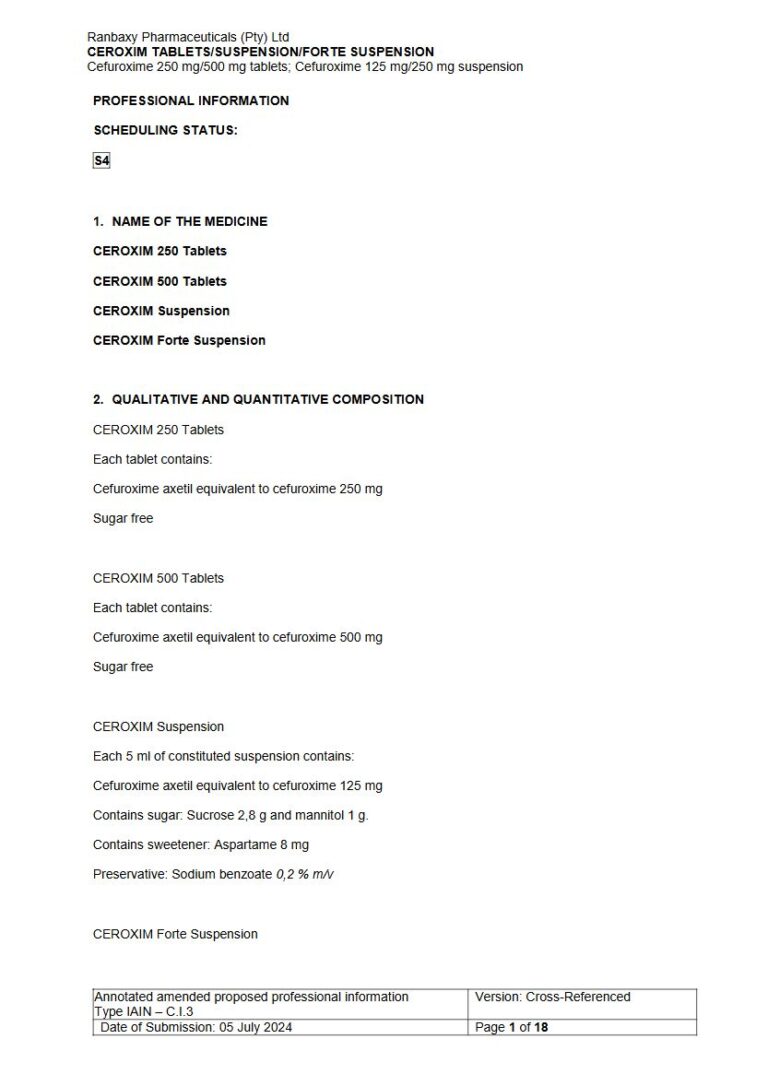
Ceroxim 250 mg/500 mg/125 mg/5 ml Tablets
PDF Leaflet Revision Date: 30 May 2025
Clinical Summary
Quick overview from the medicine insert
Indication
Treatment of infections caused by susceptible organisms.
Dosage (summary)
Adults: 250-500 mg twice daily for 7 days; Lyme disease: 500 mg twice daily for 14 days.
Special Populations
- Renal impairment
- Hepatic impairment
Pregnancy & Breastfeeding
Safety in pregnancy and lactation not established; may cause diarrhea and fungal infections in breastfeeding.
Key Drug Interactions
- Probenecid
- Furosemide
- Oral contraceptives
Contraindications
- Hypersensitivity to cephalosporins
- Hypersensitivity to penicillin
- Pregnancy and breastfeeding
Common side effects
- Candida overgrowth
- Nausea
- Diarrhea
- Headache
- Dizziness
Counselling Points
- Take with food for optimal absorption
- Shake suspension before use
- Report severe diarrhea immediately
Serious warnings
- Serious hypersensitivity reactions
- Pseudomembranous colitis
- Jarisch-Herxheimer reaction
Important Disclaimer
The Ceroxim 250 mg/500 mg/125 mg/5 ml Tablets professional information leaflet below is the property of Ranbaxy and is provided on Medinsert exactly as issued, with no.. alterations or editorial changes. We make every effort to keep content current by updating documents as soon as new versions become available. Medinsert serves as a trusted access point for healthcare professionals, but does not replace official sources or clinical judgement. For more details, please read our full disclaimer. read more>>
 Healthcare Professionals Only
This content is for registered healthcare professionals
Sign in or create a free account to read the full package insert.
Free for HPCSA-registered professionals. Powered by Medinsert.
Clinical Particulars
Section 4 of the official insert — extracted exactly as issued, no alterations
4.1 Therapeutic indications
CEROXIM is indicated for the treatment of infections caused by susceptible organisms in the following infections:
- Pharyngitis and tonsillitis caused by Streptococcus pyogenes. Penicillin is the usual medicine of choice in the treatment and prevention of streptococcal infections including the prophylaxis of rheumatic fever. CEROXIM is generally effective in the eradication of streptococci from the oral pharynx. CEROXIM is not indicated for the prophylaxis of subsequent rheumatic fever due to insufficient data available to support such use.
- Otitis media caused by Streptococcus pneumoniae, Haemophilus influenzae (methicillin-sensitive strains), Moraxella (Branhamella) catarrhalis, and Streptococcus pyogenes.
- Sinusitis caused by Streptococcus pneumoniae and Haemophilus influenzae.
- Bronchitis caused by Streptococcus pneumoniae, Haemophilus influenzae (methicillin-sensitive strains) and Haemophilus parainfluenzae (ampicillin-sensitive strains).
- Acute uncomplicated cystitis caused by Escherichia coli and Klebsiella pneumoniae.
- Lyme disease caused by Borrelia burgdorferi. CEROXIM is indicated for the treatment of early Lyme disease and subsequent prevention of late Lyme disease in adults and children over the age of 12 years.
4.2 Posology and method of administration
Posology
Adults
- Pharyngitis and tonsillitis: 250 mg twice daily for seven days (range 5-10 days).
- Otitis media: 500 mg twice daily for seven days (range 5-10 days).
- Sinusitis and bronchitis: 250 mg twice daily for seven days (range 5-10 days).
- Acute, uncomplicated cystitis: 250 mg twice daily for seven days (range 5-10 days).
- Lyme disease: Adults and children over 12 years of age: 500 mg twice daily for 14 days (range 10-21 days).
Children
Usual dose: 125 mg twice daily for 7 days (range 5-10 days). There is no experience with CEROXIM in children under 3 months of age.
- Pharyngitis and tonsillitis: 10 mg/kg twice daily to a maximum of 125 mg twice daily for seven days (range 5-10 days).
- For otitis media in children 3 months to 2 years of age the usual dose is: 10 mg/kg twice daily to a maximum of 125 mg twice daily (range 5-10 days).
- For otitis media in children over 2 years of age the usual dose is: 15 mg/kg twice daily to a maximum of 250 mg twice daily for seven days (range 5-10 days).
- Sinusitis and bronchitis: 10 mg/kg twice daily to a maximum of 125 mg twice daily for seven days (range 5-10 days).
- Acute, uncomplicated cystitis: 15 mg/kg twice daily to a maximum of 250 mg twice daily for seven days (range 5-10 days).
Directions for use of the CEROXIM Suspension and CEROXIM Forte Suspensions:
- Shake the bottle to loosen the granules and remove the cap. Use the measure cup to add water to the bottle (23 or 22 mL water for the 50 mL pack of CEROXIM Suspension or CEROXIM Forte Suspension respectively; and 44 or 43 ml water for the 100 mL pack of CEROXIM Suspension or CEROXIM Forte Suspension respectively) and replace the cap.
- Invert and shake the bottle vigorously until the sound of granules in the bottle disappear.
- Turn the bottle into an upright position and shake vigorously.
- Patient Instructions: SHAKE THE BOTTLE BEFORE USE.
Method of administration
Oral use. Because of the bitter taste of cefuroxime axetil, tablets should not be crushed. CEROXIM should be taken half an hour after food for optimum absorption.
4.3 Contraindications
- Hypersensitivity to cephalosporin antibiotics, cefuroxime or to any of excipients listed in section 6.1.
- Hypersensitivity to penicillin and other beta-lactam antibiotics.
- Pregnancy and breastfeeding (see section 4.6)
4.4 Special warnings and precautions for use
CEROXIM should be used with caution in patients with:
- a history of gastro-intestinal disease, especially ulcerative colitis, regional enteritis or pseudomembranous colitis.
- renal function impairment a reduced dose may be required.
- porphyria, as safety has not been established.
Hypersensitivity reactions
Special care is indicated in patients who have experienced an allergic reaction to penicillins or other beta-lactam antibiotics because there is a risk of cross-sensitivity. As with all beta-lactam antibacterial medicines, serious and occasionally fatal hypersensitivity reactions have been reported. There have been reports of hypersensitivity reactions which progressed to Kounis syndrome (acute allergic coronary arteriospasm that can result in myocardial infarction, see section 4.8). In case of severe hypersensitivity reactions, treatment with cefuroxime must be discontinued immediately and adequate emergency measures must be initiated. Before beginning treatment, it should be established whether the patient has a history of severe hypersensitivity reactions to cefuroxime, to other cephalosporins or to any other type of beta-lactam medicine. Caution should be used if cefuroxime is given to patients with a history of non-severe hypersensitivity to other beta-lactam medicines.
Jarisch-Herxheimer reaction
The Jarisch-Herxheimer reaction has been seen following cefuroxime axetil treatment of Lyme disease. It results directly from the bactericidal activity of cefuroxime axetil on the causative bacteria of Lyme disease, the spirochaete Borrelia burgdorferi. Patients should be reassured that this is a common and usually self-limiting consequence of antibiotic treatment of Lyme disease (see section 4.8).
Overgrowth of non-susceptible microorganisms
As with other antibiotics, use of cefuroxime axetil may result in the overgrowth of Candida. Prolonged use may also result in the overgrowth of other non-susceptible microorganisms (e.g. enterococci and Clostridium difficile), which may require interruption of treatment (see section 4.8). Antibacterial medicineu2013associated pseudomembranous colitis have been reported with nearly all antibacterial medicines, including cefuroxime and may range in severity from mild to life threatening. This diagnosis should be considered in patients with diarrhoea during or subsequent to the administration of cefuroxime (see section 4.8). Discontinuation of therapy with cefuroxime and the administration of specific treatment for Clostridium difficile should be considered. Medicines that inhibit peristalsis should not be given (see section 4.8). Pseudomembranous colitis may occur. Patients who develop abdominal or stomach cramps, abdominal tenderness, severe and watery diarrhoea (which may be bloody) and fever should be investigated for this diagnosis. If the diagnosis of pseudomembranous colitis is suspected, CEROXIM should be stopped immediately and appropriate therapy initiated.
Interactions with Laboratory Tests
It is recommended that either glucose oxidase or hexokinase methods be used to determine blood/plasma glucose levels in patients receiving CEROXIM. CEROXIM may give false-negative test results with ferricyanide blood glucose test. CEROXIM does not interfere in the alkaline picrate assay for creatinine. A false-positive Coombs reaction may appear in patients who receive large doses of CEROXIM (see Section 4.8)
Excipients
CEROXIM Suspension contains 2,8 g of sucrose per 5 mL and CEROXIM Forte Suspension contains 2,5 g of sucrose per 5 ml. The sucrose content of CEROXIM should be taken into account when treating diabetic patients. Appropriate advice should be provided. Patients with rare hereditary problems of fructose intolerance, glucose-galactose malabsorption or sucrase isomaltase insufficiency should not take CEROXIM.
CEROXIM Suspension and CEROXIM Forte suspensions contain aspartame, which is a source of phenylalanine and should be used with caution in patients with phenylketonuria. CEROXIM Suspension and CEROXIM Forte suspensions contain mannitol which may have a mild laxative effect.
4.5 Interaction with other medicines and other forms of interaction
Concurrent administration of probenecid increases the area under the mean serum concentration time-curve by 50%. Concomitant use of CEROXIM and furosemide should be avoided when possible, due to enhanced nephrotoxicity. The combined use of cephalosporins and aminoglycosides should be undertaken with caution, due to nephrotoxicity. The efficacy of combined oral contraceptives may be decreased by concomitant use with CEROXIM.
4.6 Fertility, pregnancy and lactation
Pregnancy
Safety and efficacy in pregnancy has not been established (see section 4.3). Studies in animals have shown no harmful effects on pregnancy, embryonal or foetal development, parturition or postnatal development.
Breastfeeding
Safety and efficacy in lactation has not been established (see section 4.3). CEROXIM is excreted in human milk in small quantities. Adverse effects at therapeutic doses are not expected, although a risk of diarrhoea and fungus infection of the mucous membranes cannot be excluded. Breastfeeding might have to be discontinued due to these effects. The possibility of sensitisation should be taken into account.
Fertility
There are no data on the effects of cefuroxime axetil on fertility in humans. Reproductive studies in animals have shown no effects on fertility.
4.7 Effects on ability to drive and use machines
As CEROXIM may cause dizziness, patients should be warned to be cautious when driving or operating machinery.
4.8 Undesirable effects
Tabulated list of adverse reactions
MedDRA System organ class
Frequency
Adverse reactions
- Infections and infestations
- Frequent: Candida overgrowth, oral thrush, vaginitis.
- Frequency unknown: Clostridium difficile overgrowth
- Blood and lymphatic system disorders
- Frequent: Eosinophilia
- Less frequent: Thrombocytopenia, leukopenia (sometimes profound), neutropenia,
- Frequency unknown: haemolytic anaemia
- Cardiac disorders
- Frequency unknown: Kounis syndrome
- Immune system disorders
- Less frequent: Hypersensitivity reactions including, cutaneous vasculitis, bronchospasm, drug fever, serum sickness and anaphylaxis, Jarisch-Hexheimer reaction
- Nervous system disorders
- Frequency unknown: convulsions.
- Frequent: Headache, dizziness
- Ear and labyrinth disorders
- Less frequent: Hearing loss in children with meningitis.
- Gastrointestinal disorders
- Frequent: Nausea, diarrhoea, abdominal pain.
- Less frequent: A particular form of enterocolitis (pseudomembranous colitis) (see section 4.4
- Frequency unknown: Vomiting, diarrhoea accompanied by blood in the stools which may be a symptom of enterocolitis.
- Hepatobiliary disorders
- Frequency unknown: Transient increases in hepatic enzyme levels, alanine aminotransferase (serum glutamic pyruvic acid transaminase), aspartate aminotransferase (serum glutamic oxaloacetic transaminase), LDH (lactate dehydrogenase) levels, cholestatic jaundice, hepatitis, rise in bilirubin.
- Skin and subcutaneous tissue disorders
- Less frequent: porphyria, skin rashes.
- Frequency unknown: Urticarial, pruritus, erythema multiforme, Stevens-Johnson syndrome, toxic epidermal necrolysis (exanthematic necrolysis) (see Immune system disorders), angioneurotic oedema, linear IgA disease
- Renal and urinary disorders
- Less frequent: Acute interstitial nephritis, nephrotoxicity when CEROXIM is used in combination with aminoglycosides or furosemide.
- Reproductive system and breast disorders
- Frequency unknown: Vaginal candidiasis.
- Investigations
- Frequency unknown: Positive antiglobulin (Coombsu2019) test.
Description of selected adverse reactions
Cephalosporins as a class tend to be absorbed onto the surface of red cells membranes and react with antibodies directed against the medicine to produce a positive Coombs test (which can interfere with cross-matching of blood) and very rarely haemolytic anaemia. Transient rises in serum liver enzymes have been observed which are usually reversible.
Paediatric population
The safety profile for cefuroxime axetil in children is consistent with the profile in adults.
Reporting of suspected adverse reactions
Reporting suspected adverse reactions after authorisation of the medicine is important. It allows continued monitoring of the benefit/risk balance of the medicine. Health care providers are requested to report any suspected adverse drug reactions to SAHPRA via the Med Safety App (Medsafety X SAHPRA) and eReporting platform (who-umc.org) found on SAHPRA website
4.9 Overdose
See section 4.8.
Symptoms of overdose
Seizures have been reported. Overdose can lead to neurological sequelae including encephalopathy, convulsions and coma. Symptoms of overdose can occur if the dose is not reduced appropriately in patients with renal impairment (see sections 4.2 and 4.4).
Treatment of overdose
Treatment is symptomatic and supportive. Serum levels of CEROXIM can be reduced by haemodialysis or peritoneal dialysis.
