
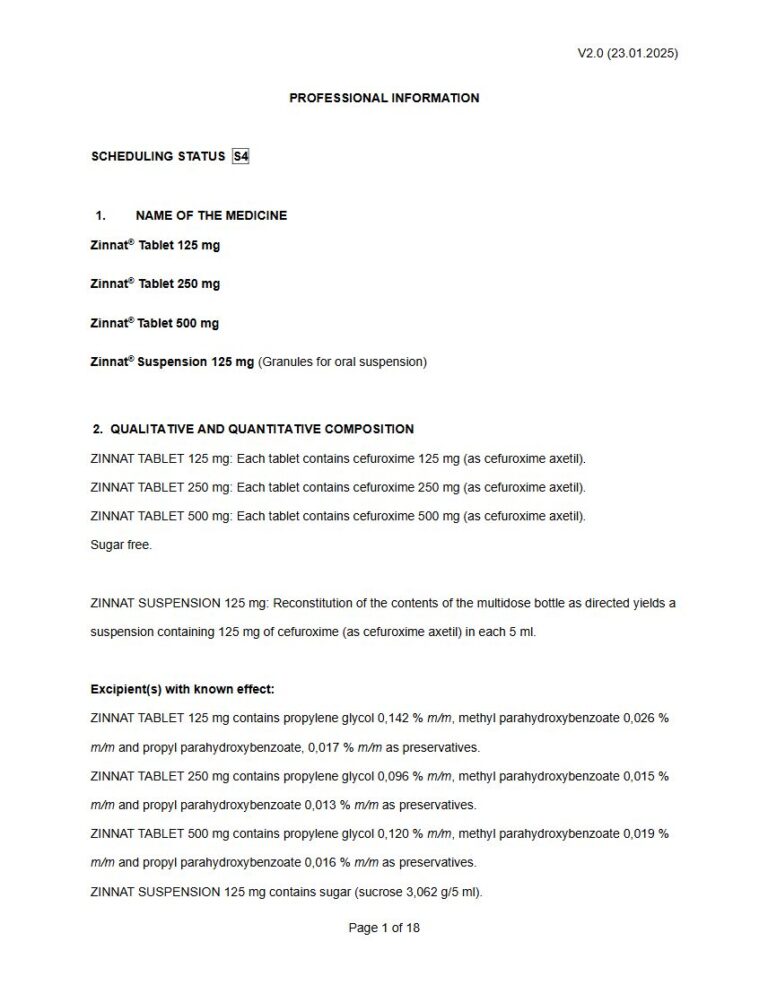
Zinnat 125 mg, 250 mg, 500 mg (Tablet & Suspension)
PDF Leaflet Revision Date: 23 January 2025
Clinical Summary
Quick overview from the medicine insert
Indication
Treatment of infections caused by susceptible organisms.
Dosage (summary)
Adults: 125-500 mg twice daily; Children: 125 mg twice daily.
Special Populations
- Elderly
- Renal impairment
- Hepatic impairment
Pregnancy & Breastfeeding
Safety not established; excreted in breast milk.
Key Drug Interactions
- Reduced efficacy of oral contraceptives
- Avoid furosemide
- Caution with aminoglycosides
Contraindications
- Hypersensitivity to cefuroxime
- History of severe hypersensitivity to beta-lactams
Common side effects
- Candida overgrowth
- Eosinophilia
- Headache
- Dizziness
- Gastrointestinal disturbances
Counselling Points
- Take after food for better absorption
- Monitor for allergic reactions
- Report severe skin reactions immediately
Serious warnings
- Serious hypersensitivity reactions
- Severe cutaneous adverse reactions
- Pseudomembranous colitis
Important Disclaimer
The Zinnat 125 mg, 250 mg, 500 mg (Tablet & Suspension) professional information leaflet below is the property of Sandoz Sa 1 and is provided on Medinsert exactly as issued, with no.. alterations or editorial changes. We make every effort to keep content current by updating documents as soon as new versions become available. Medinsert serves as a trusted access point for healthcare professionals, but does not replace official sources or clinical judgement. For more details, please read our full disclaimer. read more>>
 Healthcare Professionals Only
This content is for registered healthcare professionals
Sign in or create a free account to read the full package insert.
Free for HPCSA-registered professionals. Powered by Medinsert.
Clinical Particulars
Section 4 of the official insert — extracted exactly as issued, no alterations
4.1 Therapeutic indications
ZINNAT is indicated for the treatment of patients with infections caused by susceptible organisms in the following diseases:
- Pharyngitis and Tonsillitis caused by Streptococcus pyogenes. (Penicillin is the usual medicine of choice in the treatment and prevention of Streptococcal infections, including the prophylaxis of rheumatic fever. ZINNAT is generally effective in the eradication of streptococci from the oral pharynx. ZINNAT is not indicated for the prophylaxis of subsequent rheumatic fever because data to support such use is not available.)
- Otitis Media caused by Streptococcus pneumoniae, Haemophilus influenzae (ampicillin-susceptible and ampicillin-resistant strains), Moraxella (Branhamella) catarrhalis, and Streptococcus pyogenes.
- Sinusitis caused by Streptococcus pneumoniae and Haemophilus influenzae.
- Acute and chronic bronchitis caused by Streptococcus pneumoniae, Haemophilus influenzae (ampicillin-susceptible strains), and Haemophilus parainfluenzae (ampicillin-susceptible strains).
- Acute uncomplicated cystitis caused by Escherichia coli and Klebsiella pneumoniae.
- Lyme Disease caused by the spirochaete Borrelia burgdorferi. ZINNAT is indicated for the treatment of early Lyme disease and subsequent prevention of late Lyme disease in adults and children over 12 years old.
4.2 Posology and method of administration
Adults:
- Sinusitis: 250 mg twice daily.
- Acute and chronic bronchitis: 250 mg twice daily.
- Acute uncomplicated cystitis: 125 mg twice daily.
- Lyme disease: 500 mg twice daily for 20 days.
Children:
- Usual dose - 125 mg twice daily.
- For otitis media in children less than 2 years of age the usual dose is 125 mg twice daily and in children over 2 years of age 250 mg twice daily.
- For Lyme disease in children over the age of 12 years the usual dose is 500 mg twice daily for 20 days.
There is no experience in children under the age of 3 months. The usual course of therapy is seven days (range 5-10 days).
Method of administration
Because of the bitter taste of cefuroxime axetil, ZINNAT tablets should not be crushed. Note: Cefuroxime axetil should be taken half an hour after food for optimum absorption. Patient Instructions: Shake the bottle vigorously until the suspension can be heard moving in the bottle before each dose is withdrawn.
4.3 Contraindications
- Hypersensitivity to cefuroxime or to any of the excipients listed in section 6.1.
- Patients with known hypersensitivity to cephalosporin antibiotics.
- History of severe hypersensitivity (e.g., anaphylactic reaction) to any other type of beta-lactam antibacterial medicine (penicillins, monobactams and carbapenems).
4.4 Special warnings and precautions for use
Hypersensitivity reactions
Special care is indicated in patients who have experienced an allergic reaction to penicillins or other beta-lactam antibiotics because there is a risk of cross-sensitivity. As with all beta-lactam antibacterial medicines, serious and occasionally fatal hypersensitivity reactions have been reported. There have been reports of hypersensitivity reactions which progressed to Kounis syndrome (acute allergic coronary arteriospasm that can result in myocardial infarction, see section 4.8). In case of severe hypersensitivity reactions, treatment with cefuroxime must be discontinued immediately and adequate emergency measures must be initiated.
Before beginning treatment, it should be established whether the patient has a history of severe hypersensitivity reactions to cefuroxime, to other cephalosporins or to any other type of beta-lactam medicine. Caution should be used if cefuroxime is given to patients with a history of non-severe hypersensitivity to other beta-lactam medicines.
Severe cutaneous adverse reactions (SCARS)
Severe cutaneous adverse reactions including Stevens-Johnson syndrome (SJS), toxic epidermal necrolysis (TEN) and drug reaction with eosinophilia and systemic symptoms (DRESS), which can be life-threatening or fatal, have been reported in association with cefuroxime treatment (see section 4.8). At the time of prescription patients should be advised of the signs and symptoms and monitored closely for skin reactions. If signs and symptoms suggestive of these reactions appear, cefuroxime should be withdrawn immediately, and an alternative treatment considered. If the patient has developed a serious reaction such as SJS, TEN or DRESS with the use of cefuroxime, treatment with cefuroxime must not be restarted in this patient at any time.
Overgrowth of non-susceptible microorganisms
Use of ZINNAT may result in the overgrowth of candida. Prolonged use may also result in the overgrowth of other non-susceptible organisms (e.g. Enterococci and Clostridium difficile), which may require discontinuation of treatment. Antibacterial agentu2013associated pseudomembranous colitis have been reported with nearly all antibacterial medicines, including cefuroxime (ZINNAT) and may range in severity from mild to life threatening. This diagnosis should be considered in patients with diarrhoea during or subsequent to the administration of cefuroxime. Discontinuation of therapy with cefuroxime and the administration of specific treatment for Clostridium difficile should be considered. Medicines that inhibit peristalsis should not be given.
Jarisch-Herxheimer reaction
The Jarisch-Herxheimer reaction has been seen following ZINNAT treatment of Lyme disease. It results directly from the bactericidal activity of ZINNAT on the causative organism of Lyme disease, the spirochaete Borrelia burgdorferi. Patients should be reassured that this is a common and usually self-limiting consequence of antibiotic treatment of Lyme disease.
Interference with diagnostic tests
ZINNAT does not interfere in the alkaline picrate assay for creatinine. Serum levels of cefuroxime are reduced by dialysis. The development of a positive Coomb's Test associated with the use of cefuroxime may interfere with cross matching of blood. As a false negative result may occur in the ferricyanide test, it is recommended that either glucose oxidase or hexokinase methods are used to determine blood/plasma glucose levels in patients receiving ZINNAT.
Important information about excipients
ZINNAT SUSPENSION contains aspartame, which is a source of phenylalanine and so should be used with caution in patients with phenylketonuria. ZINNAT SUSPENSION contains sucrose. Patients with rare hereditary conditions such as fructose intolerance, glucose-galactose mal-absorption or sucrose-isomaltase insufficiency should not take ZINNAT SUSPENSION. Sucrose may have an effect on the glycaemic control of patients with diabetes mellitus.
4.5 Interaction with other medicines and other forms of interaction
Cefuroxime axetil may affect the gut flora, leading to lower oestrogen reabsorption and reduced efficacy of combined oral contraceptives. Concomitant use of ZINNAT and furosemide should be avoided when possible, and the combined use of cephalosporins and aminoglycosides should be undertaken with caution. ZINNAT must not be administered simultaneously with other medicines. Cefuroxime does not interfere in enzyme-based tests for glucosuria. Slight interference with copper reduction methods (Benedict's, Fehling's, Clinitest) may be observed. However, this should not lead to false-positive results. Cefuroxime may cause false-negative reactions in the ferricyanide test. ZINNAT can cause a falsely high reading in the alkaline picrate assay for creatinine, although the degree of elevation is unlikely to be of clinical importance. It is possible that cefuroxime may also interfere with this determination. Medicines which reduce gastric acidity may result in a lower bioavailability of cefuroxime axetil compared with that of the fasting state and tend to cancel the effect of enhanced absorption after food. Cefuroxime is excreted by glomerular filtration and tubular secretion. Concomitant use of probenecid is not recommended. Concurrent administration of probenecid significantly increases the peak concentration, area under the serum concentration time curve and elimination half-life of cefuroxime. Concomitant use with oral anticoagulants may give rise to increased INR.
4.6 Fertility, pregnancy and lactation
Pregnancy
Safety in pregnancy and lactation has not been established. There are limited data from the use of cefuroxime in pregnant women. Studies in animals have shown no harmful effects on pregnancy, embryonal or foetal development, parturition or postnatal development.
Breastfeeding
Cefuroxime is excreted in human milk in small quantities. Adverse effects at therapeutic doses are not expected, although a risk of diarrhoea and fungus infection of the mucous membranes cannot be excluded. Breastfeeding might have to be discontinued due to these effects. The possibility of sensitisation should be taken into account.
Fertility
There are no data on the effects of cefuroxime axetil on fertility in humans. Reproductive studies in animals have shown no effects on fertility.
4.7 Effects on ability to drive and use machines
No studies on the effects on the ability to drive and use machines have been performed. However, as this medicine may cause dizziness, patients should be warned to be cautious when driving or operating machinery.
4.8 Undesirable effects
The most common adverse reactions are Candida overgrowth, eosinophilia, headache, dizziness, gastrointestinal disturbances, and transient rise in liver enzymes.
The following convention has been used for the classification of frequency: very common u2265 1/10, common u2265 1/100 to <1/10, uncommon u2265 1/1 000 to <1/100, rare u2265 1/10 000 to <1/1 000, very rare <1/10 000.
System organ class
| Common | Uncommon | Not known |
|---|---|---|
| Infections and infestations | Candida overgrowth | Clostridium difficile overgrowth |
| Blood and lymphatic system disorders | eosinophilia | positive Coomb's test, thrombocytopenia, leukopenia (sometimes profound) |
| Cardiac disorders | Kounis syndrome | |
| Immune system disorders | drug fever, serum sickness, anaphylaxis, Jarisch-Herxheimer reaction | |
| Nervous system disorders | headache, dizziness | |
| Gastrointestinal disorders | diarrhoea, nausea, abdominal pain, vomiting | pseudomembranous colitis (see section 4.4) |
| Hepatobiliary disorders | transient increases of hepatic enzyme levels [alanine aminotransferase, (serum glutamic pyruvic acid transaminase), aspartate aminotransferase (serum glutamic oxaloacetic transaminase), and LDH] | jaundice (predominantly cholestatic), hepatitis |
| Skin and subcutaneous tissue disorders | skin rashes | urticaria, pruritus, erythema multiforme, Stevens-Johnson syndrome, toxic epidermal necrolysis (exanthematic necrolysis) (see Immune system disorders), angioneurotic oedema, Drug Reactions with Eosinophilia and Systemic Symptoms (DRESS) |
Description of selected adverse reactions
Cephalosporins as a class tend to be absorbed onto the surface of red cells membranes and react with antibodies directed against the medicine to produce a positive Coombs' test (which can interfere with cross-matching of blood) and very rarely haemolytic anaemia. Transient rises in serum liver enzymes have been observed which are usually reversible.
Reporting of suspected adverse reactions:
Reporting suspected adverse reactions after authorisation of the medicine is important. It allows continued monitoring of the benefit/risk balance of the medicine. Health care providers are requested to report any suspected adverse drug reactions to SAHPRA via the Med Safety APP (Medsafety X SAHPRA) and eReporting platform (who-umc.org) found on SAHPRA website. Suspected adverse reactions can also be reported directly to the HCR via the link: pvi1j.solutions.iqvia.com or the e-mail address, [email protected].
4.9 Overdose
Symptoms of overdose: Overdose can lead to neurological sequelae including encephalopathy, convulsions and coma. Symptoms of overdose can occur if the dose is not reduced appropriately in patients with renal impairment.
Treatment of overdose: Treatment is symptomatic and supportive. Serum levels of cefuroxime can be reduced by haemodialysis or peritoneal dialysis.
