
Pharma-Q Cimetidine Injection 200 mg/2 ml Solution for injection.
PDF Leaflet Revision Date: 29 August 2022
Clinical Summary
Quick overview from the medicine insert
Indication
Treatment of gastric and duodenal ulcers, oesophageal reflux, Zollinger-Ellison syndrome.
Dosage (summary)
Adults: 200 mg IV every 4-6 hours; max 2.4 g/day.
Special Populations
- Renal impairment
- Elderly
Pregnancy & Breastfeeding
Contraindicated in pregnancy and lactation; safety not established.
Key Drug Interactions
- Warfarin
- Phenytoin
- Theophylline
- Ciclosporin
Contraindications
- Hypersensitivity to cimetidine
- Under 1 year of age
- Pregnancy
- Lactation
Common side effects
- Headache
- Dizziness
- Diarrhoea
- Skin rashes
Counselling Points
- Avoid hazardous tasks until effects are known.
- Monitor for signs of adverse reactions.
- Report any unusual symptoms.
Serious warnings
- Risk of cardiac arrest with rapid IV injection
- May mask gastric cancer symptoms
- Increased risk of pneumonia in certain patients
Important Disclaimer
The Pharma-Q Cimetidine Injection 200 mg/2 ml Solution for injection. professional information leaflet below is the property of Pharma-Q Holdings and is provided on Medinsert exactly as issued, with no.. alterations or editorial changes. We make every effort to keep content current by updating documents as soon as new versions become available. Medinsert serves as a trusted access point for healthcare professionals, but does not replace official sources or clinical judgement. For more details, please read our full disclaimer. read more>>
 Healthcare Professionals Only
This content is for registered healthcare professionals
Sign in or create a free account to read the full package insert.
Free for HPCSA-registered professionals. Powered by Medinsert.
Clinical Particulars
Section 4 of the official insert — extracted exactly as issued, no alterations
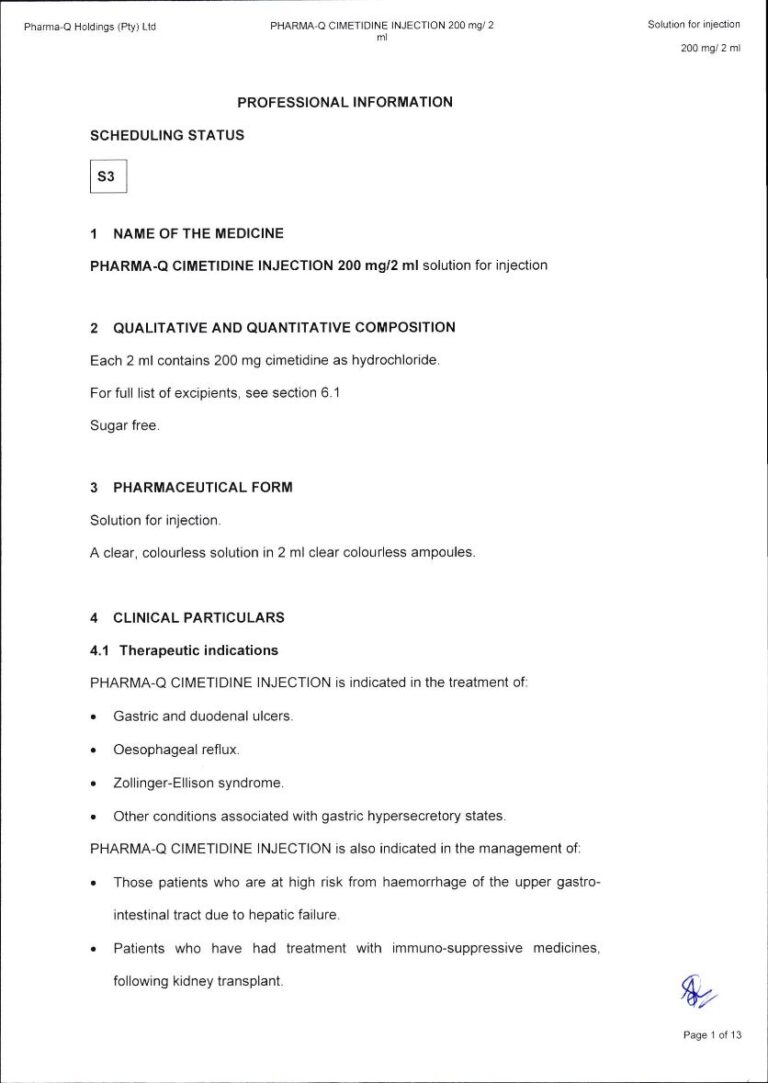
4.1 Therapeutic indications
PHARMA-Q CIMETIDINE INJECTION is indicated in the treatment of:
- Gastric and duodenal ulcers.
- Oesophageal reflux.
- Zollinger-Ellison syndrome.
- Other conditions associated with gastric hypersecretory states.
PHARMA-Q CIMETIDINE INJECTION is also indicated in the management of:
- Those patients who are at high risk from haemorrhage of the upper gastrointestinal tract due to hepatic failure.
- Patients who have had treatment with immuno-suppressive medicines, following kidney transplant.
4.2 Posology and method of administration
Posology
Doses are expressed in terms of the base. The total daily dose by any route should not normally exceed 2.4 g.
Adults:
Intravenous injection:
- The usual dose by intravenous injection is 200 mg.
- It should be given slowly over at least 2 minutes.
- Rapid intravenous injection may be associated with cardiac arrest and arrhythmias (see section 4.4).
- It may be repeated every 4 to 6 hours.
- If a larger dose is required, or if the patient has cardiovascular impairment, intravenous infusion is recommended (see section 4.4).
Intravenous infusion:
- For an intermittent intravenous infusion, the recommended dose is 400 mg (in 100 ml of sodium chloride 0.9%), given over 30 minutes to 1 hour and repeated every 4 to 6 hours if necessary.
- For a continuous intravenous infusion, the recommended rate is 50 to 100 mg per hour.
- Prepared infusion must be stored in a refrigerator at 4 u00b0C.
Intramuscular injection:
The usual intramuscular dose is 200 mg which may be repeated at intervals of 4 to 6 hours.
Special populations:
- Patients with impaired renal function:
- The dosage of PHARMA-Q CIMETIDINE INJECTION should be reduced in patients with impaired renal function (see section 4.4).
- Suggested reduction in doses should be according to creatinine clearance.
- If the creatinine clearance is 0 to 15 ml per minute, the suggested dose is 200 mg twice daily.
- If the creatinine clearance is 15 to 30 ml per minute, the suggested dose is 200 mg three times daily.
- If the creatinine clearance is 30 to 50 ml per minute, the suggested dose is 200 mg four times daily.
- If the creatinine clearance is over 50 ml per minute, then normal dosages should be used.
- Elderly:
- The normal adult dosage may be used unless renal function is markedly impaired.
- Paediatric population:
- Children: Clinical experience in children is limited. Therefore, PHARMA-Q CIMETIDINE INJECTION therapy cannot be recommended in children. In limited experience, 20 to 40 mg/kg per day has been administered in divided doses orally or parenterally. There is no evidence of clinical use in babies and PHARMA-Q CIMETIDINE INJECTION should therefore not be given to infants under one year of age (see section 4.3).
4.3 Contraindications
PHARMA-Q CIMETIDINE INJECTION is contraindicated in:
- Patients who are hypersensitive to cimetidine or to any of the excipients (see section 6.1).
- Patients who are under one year of age.
- Patients who are pregnant or lactating as the safety in pregnancy and lactation has not been established.
4.4 Special warnings and precautions for use
PHARMA-Q CIMETIDINE INJECTION:
- Before giving this injection to patients with gastric ulcers, the possibility of malignancy should be excluded since PHARMA-Q CIMETIDINE INJECTION may mask the symptoms and allow transient healing of gastric cancer and delay diagnoses.
- Dosages should be reduced in patients with impaired renal function according to their creatinine clearance.
- Rapid intravenous injection should be avoided, as it may lead to cardiac arrest, dysrhythmias and transient hypotension in critically ill patients.
- Intravenous infusion is recommended in patients with cardiovascular involvement.
- There may be an increased risk of developing community acquired pneumonia in patients who are elderly, patients with chronic lung disease, diabetic or immunocompromised patients.
- Due to possible interaction with coumarins, close monitoring of prothrombin time is recommended when cimetidine is concurrently used.
- Co-administration of therapeutic medicines with a narrow therapeutic index, such as phenytoin or theophylline, may require dosage adjustment when starting or stopping concomitantly administered cimetidine (see Section 4.5).
4.5 Interactions with other medicines
Cimetidine binds to cytochrome P450 and may inhibit the hepatic metabolism of many medicines. This may prolong the elimination of medicines which are metabolised by oxidation in the liver and cause increases in their plasma concentrations. Although many interactions may occur, only few are clinically significant; particularly those which have a narrow therapeutic index where the risk of toxicity may require a dosage adjustment. Significant or potentially significant interactions occur with:
- Anti-dysrhythmic medicines such as lignocaine and procainamide.
- Anti-epileptics such as phenytoin and carbamazepine.
- Oral sulphonylurea antidiabetics such as glipizide.
- Warfarin and other oral anti-coagulants.
- Tricyclic antidepressants such as amitriptyline.
- Calcium channel blockers such as nifedipine.
- Ciclosporin.
- Chloramphenicol.
- Chlorpromazine.
- Theophylline.
- Suxamethonium.
- Pethidine.
Close monitoring of plasma concentrations is required, and dosage adjustment may be necessary. Interactions may occur by several mechanisms including:
- Competition for renal tubular secretion; This may result in increased plasma levels of certain medicines including procainamide, metformin, ciclosporin and tacrolimus.
- Alteration of gastric pH; The bioavailability of certain medicines may be affected. This can result in either an increase in absorption (e.g., atazanavir) or a decrease in absorption (e.g., some azole antifungals such as ketoconazole, itraconazole or posaconazole).
- Unknown mechanisms: Cimetidine may potentiate the myelosuppressive effects (e.g., neutropenia, agranulocytosis) of chemotherapeutic medicines such as carmustine, fluorouracil, epirubicin, or therapies such as radiation. Data shows that isolated cases of clinically relevant interactions have been documented with narcotic analgesics (e.g., morphine).
Cimetidine as in PHARMA-Q CIMETIDINE INJECTION reduces gastric acid and secretion and can therefore impair absorption of iron from the gastrointestinal tract. It is also associated with malabsorption of protein-bound vitamin B12. The risk of deficiency anaemias during long-term therapy cannot be excluded. In view of a report that glucose handling was impaired after long-term cimetidine administration, caution should be observed in the treatment of diabetics or elderly patients with cimetidine as in PHARMA-Q CIMETIDINE INJECTION.
4.6 Fertility, pregnancy and lactation
PHARMA-Q CIMETIDINE INJECTION is contra-indicated for use:
- During pregnancy and lactation as the safety in pregnancy and lactation has not been established (see section 4.3).
Breastfeeding: Cimetidine crosses the placental barrier and is excreted into breast milk.
4.7 Effects on ability to drive and use machines
Patients should be instructed that they should avoid potentially hazardous tasks such as driving and operating machinery until they know how PHARMA-Q CIMETIDINE INJECTION affects them.
4.8 Undesirable effects
a. Summary of the safety profile
PHARMA-Q CIMETIDINE INJECTION may have side effects although not everyone gets them.
b. Tabulated summary of adverse reactions
The frequency of adverse reactions listed below is defined using the following convention: frequent; less frequent or frequency unknown (cannot be estimated from the available data).
Frequency Adverse reactions
Blood and lymphatic system disorders
- Less frequent: Agranulocytosis, neutropenia, thrombocytopenia, leukopenia, aplastic anaemia, pancytopenia.
Immune system disorders
- Less frequent: Anaphylaxis.
Psychiatric disorders
- Less frequent: Depression, hallucinations and reversible confusional states, especially in the elderly or in seriously ill patients such as those with renal failure.
Nervous system disorders
- Frequent: Headache, dizziness.
Cardiac disorders
- Less frequent: Tachycardia, sinus bradycardia and heart block.
Gastrointestinal disorders
- Frequent: Diarrhoea.
- Less frequent: Pancreatitis.
Hepato-biliary disorders
- Less frequent: Hepatotoxicity, hepatitis and increases in serum transaminase levels.
Skin and subcutaneous tissue disorders
- Frequent: Skin rashes.
- Less frequent: Reversible alopecia and hypersensitivity reactions.
Musculoskeletal and connective tissue disorders
- Frequent: Myalgia.
- Less frequent: Increases in plasma creatinine and interstitial nephritis.
Reproductive system and breast disorders
- Less frequent: Gynaecomastia, reversible impotence in men, galactorrhoea.
General disorders and administration site conditions
- Frequent: Tiredness, arthralgia.
4.9 Overdose
PHARMA-Q CIMETIDINE INJECTION 200 mg/2 ml overdose:
Treatment is supportive and symptomatic.
Description of selected adverse reactions: Anaphylaxis is usually cleared on withdrawal of the medicine. Interstitial nephritis cleared on withdrawal of the medicine. Small increases in plasma creatinine have been reported, unassociated with changes in glomerular filtration rate. The increases do not progress with continued therapy and disappear at the end of therapy. Cimetidine as in PHARMA-Q CIMETIDINE INJECTION has a weak anti-androgenic effect and gynaecomastia, and reversible impotence in men receiving relatively high doses for conditions such as Zollinger-Ellison syndrome and galactorrhoea, have occurred. However, at regular dosage, the incidence is similar to that in the general population.
