
Mexiena 200 mg FC tablets
PDF Leaflet Revision Date: 20 August 2024
Clinical Summary
Quick overview from the medicine insert
Indication
Short-term relief of heartburn, dyspepsia, and hyperacidity.
Dosage (summary)
1 tablet 3-4 times daily, max 4 tablets (800 mg) per day, for up to 2 weeks.
Special Populations
- Renal impairment
Pregnancy & Breastfeeding
Not established; should not be used during pregnancy and breastfeeding.
Key Drug Interactions
- Warfarin
- Phenytoin
- NSAIDs
Contraindications
- Hypersensitivity to cimetidine
- Pregnancy
- Breastfeeding
Common side effects
- Headache
- Dizziness
- Diarrhoea
- Skin rashes
Counselling Points
- Take with meals
- Do not exceed recommended dose
- Report any unusual symptoms
Serious warnings
- Potential for malignancy in gastric ulcers
- Monitor renal function
Important Disclaimer
The Mexiena 200 mg FC tablets professional information leaflet below is the property of Biotech Laboratories and is provided on Medinsert exactly as issued, with no.. alterations or editorial changes. We make every effort to keep content current by updating documents as soon as new versions become available. Medinsert serves as a trusted access point for healthcare professionals, but does not replace official sources or clinical judgement. For more details, please read our full disclaimer. read more>>
 Healthcare Professionals Only
This content is for registered healthcare professionals
Sign in or create a free account to read the full package insert.
Free for HPCSA-registered professionals. Powered by Medinsert.
Clinical Particulars
Section 4 of the official insert — extracted exactly as issued, no alterations
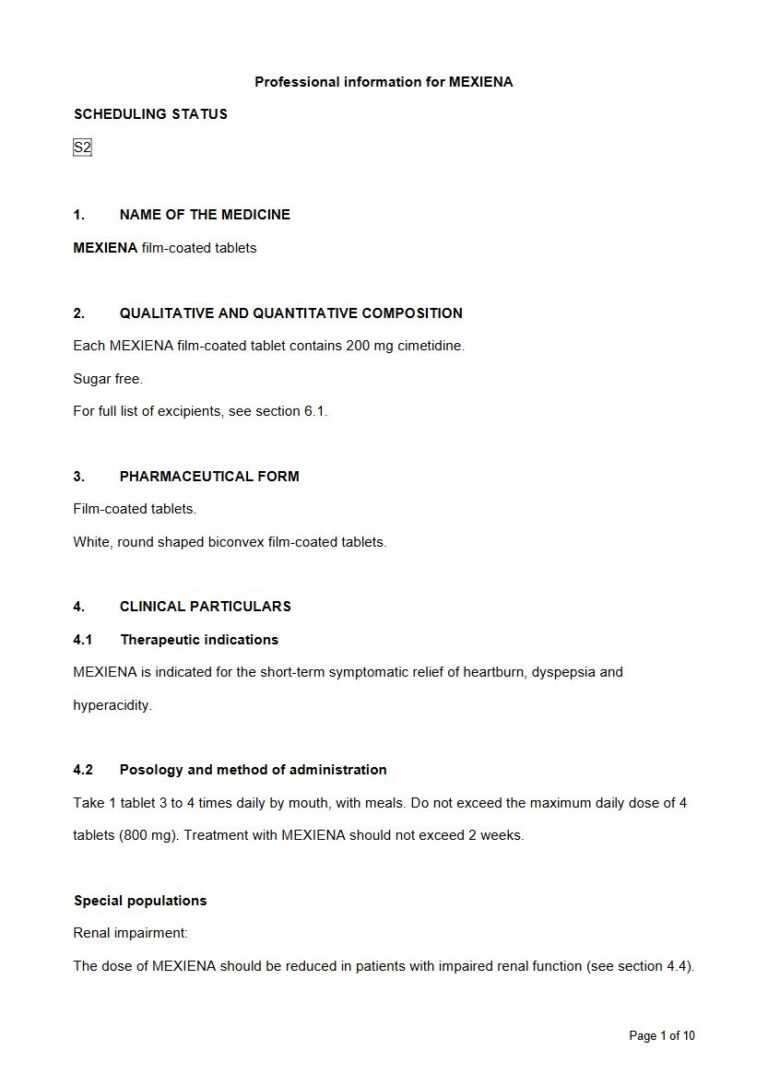
4.1 Therapeutic indications
MEXIENA is indicated for the short-term symptomatic relief of heartburn, dyspepsia and hyperacidity.
4.2 Posology and method of administration
Take 1 tablet 3 to 4 times daily by mouth, with meals. Do not exceed the maximum daily dose of 4 tablets (800 mg). Treatment with MEXIENA should not exceed 2 weeks.
Special populations
Renal impairment: The dose of MEXIENA should be reduced in patients with impaired renal function (see section 4.4).
Paediatric population
Safety and/or efficacy of MEXIENA in children have not been established.
4.3 Contraindications
- Patients with a known hypersensitivity to cimetidine or to any of the excipients (see section 6.1).
- Pregnancy and breastfeeding (see section 4.6).
4.4 Special warnings and precautions for use
The dosage of MEXIENA should be reduced in patients with impaired renal function according to creatinine clearance. Suggested doses according to creatinine clearance are creatinine clearance of 0 u2013 15 mL per minute, 200 mg twice daily; 15 u2013 30 mL per minute, 200 mg three times daily; 30 u2013 50 mL per minute, 200 mg four times daily; over 50 mL per minute, normal dosage.
Before giving MEXIENA to patients with gastric ulcer, the possibility of malignancy should be excluded by endoscopy and biopsy, if possible, because MEXIENA can relieve the symptoms and help the superficial healing of the gastric cancer. The consequences of potential delay in diagnosis should be borne in mind especially in middle aged patients or over, with new or recently changed dyspeptic symptoms.
Care should be taken that patients with a history of peptic ulcer, particularly the elderly, being treated with MEXIENA and a nonsteroidal anti-inflammatory drug (NSAID) are observed regularly.
Due to possible interaction with coumarins (e.g. warfarin), close monitoring of prothrombin time is recommended when MEXIENA is concurrently used (see section 4.5).
Co-administration of medicines with a narrow therapeutic index, such as phenytoin or theophylline, may require dosage adjustment when starting or stopping concomitantly administered MEXIENA (see section 4.5).
MEXIENA contains less than 1 mmol sodium (23 mg) per dosage unit, that is to say essentially sodium-free.
4.5 Interaction with other medicines and other forms of interaction
MEXIENA can prolong the elimination of medicines metabolised by oxidation in the liver. Close monitoring of patients on MEXIENA receiving oral anticoagulants (e.g. warfarin) or phenytoin is recommended and a reduction in the dosage of these medicines may be necessary.
In patients on treatment or with illnesses that could cause falls in blood cell count, the possibility that H2-receptor antagonism could potentiate this effect, should be borne in mind.
MEXIENA has the potential to affect absorption, metabolism or renal excretion of other medicines which is particularly important when medicines with a narrow therapeutic index are administered concurrently. The altered pharmacokinetics may necessitate dosage adjustment of the affected medicine or discontinuation of treatment (see section 4.4).
Interactions may occur by several mechanisms, including:
- MEXIENA inhibits the activity of cytochrome P450 in the liver, thereby slowing the hepatic metabolism of many medicines. Inhibition of certain cytochrome P450 enzymes (including CYP1A2, CYP2C9, CYP2D6 and CYP3A3/A4, and CYP2C18): Inhibition of these enzymes may result in increased plasma levels of certain medicines including warfarin-type coumarin anticoagulants (e.g. warfarin), tricyclic antidepressants (e.g. amitriptyline), class I antidysrhythmics (e.g. lignocaine, lidocaine), calcium channel blockers (e.g. nifedipine, diltiazem), oral sulfonylureas (e.g. glipizide), phenytoin, suxamethonium, theophylline and metoprolol.
- Competition for renal tubular secretion: This may result in increased plasma levels of certain medicines including procainamide, metformin, ciclosporin and tacrolimus.
- Alteration of gastric pH: The bioavailability of certain medicines may be affected. This can result in either an increase in absorption (e.g. atazanavir) or a decrease in absorption (e.g. some azole antifungals such as ketoconazole, itraconazole or posaconazole).
- Unknown mechanisms: MEXIENA may potentiate the myelosuppressive effects (e.g. neutropenia, agranulocytosis) of chemotherapeutic medicines such as carmustine, fluorouracil, epirubicin, or therapies such as radiation. Isolated cases of clinically relevant interactions have been documented with narcotic analgesics (e.g. morphine).
4.6 Fertility, pregnancy and lactation
Safety and efficacy in pregnancy and breastfeeding has not been established. Although tests in animals and clinical evidence have not revealed any hazards from the administration of cimetidine as contained in MEXIENA during pregnancy or breastfeeding, both animal and human studies have shown that it does cross the placental barrier and is excreted in breast milk. MEXIENA should not be used during pregnancy and breastfeeding (see section 4.3).
4.7 Effects on ability to drive and use machines
Confusion, headache and dizziness have been reported with MEXIENA (see section 4.8). Patients should not drive or use machines until it has been established that MEXIENA does not affect their ability to do so safely.
4.8 Undesirable effects
Blood and lymphatic system disorders
Less frequent: Leukopenia, thrombocytopenia, aplastic anaemia, pancytopenia and agranulocytosis or neutropenia.
Immune system disorders
Less frequent: Hypersensitivity reactions, anaphylaxis. Anaphylaxis is usually cleared on withdrawal of cimetidine as contained in MEXIENA.
Psychiatric disorders
Less frequent: Depression, confusion, hallucinations. Confusional states, reversible within a few days of withdrawing cimetidine as contained in MEXIENA, have been reported, usually in elderly or ill patients (such as those with renal failure).
Nervous system disorders
Frequent: Headache, dizziness.
Cardiac disorders
Less frequent: Tachycardia, sinus bradycardia and heart block.
Gastrointestinal disorders
Frequent: Diarrhoea.
Less frequent: Pancreatitis. Pancreatitis cleared on withdrawal of cimetidine as contained in MEXIENA.
Hepato-biliary disorders
Less frequent: Hepatitis, increased serum transaminase levels, hepatotoxicity. Hepatitis and increased serum transaminase levels cleared on withdrawal of cimetidine as contained in MEXIENA.
Skin and subcutaneous tissue disorders
Frequent: Skin rashes.
Less frequent: Reversible alopecia and hypersensitivity vasculitis. Hypersensitivity vasculitis usually cleared on withdrawal of cimetidine as contained in MEXIENA.
Musculoskeletal and connective tissue disorders
Frequent: Myalgia.
Less frequent: Arthralgia.
Renal and urinary disorders
Less frequent: Increases in plasma creatinine and interstitial nephritis. Interstitial nephritis cleared on withdrawal of the medicine. Small increases in plasma creatinine have been reported, unassociated with changes in glomerular filtration rate. The increases do not progress with continued therapy and disappear at the end of therapy.
Reproductive system and breast disorders
Less frequent: Gynaecomastia and reversible impotence. Gynaecomastia is usually reversible upon discontinuation of cimetidine therapy. Reversible impotence has been reported particularly in patients receiving high doses (e.g. in Zollinger-Ellison syndrome). However, at regular dosage, the incidence is similar to that in the general population. Galactorrhoea.
General disorders and administration site conditions
Frequent: Tiredness.
Less frequent: Fever. Fever cleared on withdrawal of cimetidine as contained in MEXIENA.
Reporting of suspected adverse reactions
Reporting suspected adverse reactions after authorisation of MEXIENA is important. It allows continued monitoring of the benefit/risk balance of MEXIENA. Health care providers are asked to report any suspected adverse reactions to SAHPRA via the Adverse Drug Reactions Reporting Form, found online under SAHPRAu2019s publications: https://www.sahpra.org.za/Publications/Index/8.
4.9 Overdose
Symptoms of overdose
Acute overdosage of up to 20 grams has been reported several times with no significant ill effects.
Management
Treatment of overdosage should consist of emesis, if ingestion occurred not more than four hours before, followed by symptomatic and supportive measures only.
