
Clopidogrel 75 Mg Film-Coated Tablets
PDF Leaflet Revision Date: 24 October 2025
Clinical Summary
Quick overview from the medicine insert
Indication
Reduction of atherosclerotic events and management of acute coronary syndrome.
Dosage (summary)
75 mg once daily; 300 mg loading dose for acute coronary syndrome.
Onset of Action / Duration
Onset: 2 hours, Duration: 7-10 days.
Special Populations
- Elderly
- Renal impairment
- Hepatic impairment
Pregnancy & Breastfeeding
Not recommended during pregnancy or lactation.
Key Drug Interactions
- Aspirin
- Warfarin
- NSAIDs
- SSRIs
- CYP2C19 inhibitors
Contraindications
- Hypersensitivity
- Active bleeding
- Severe liver impairment
- Thrombocytopenia
Common side effects
- Bleeding
- Bruising
- Abdominal pain
- Headache
Counselling Points
- Report unusual bleeding
- Inform healthcare providers before surgery
- Avoid double dosing
Serious warnings
- Thrombotic Thrombocytopenic Purpura (TTP)
- Increased bleeding risk
Important Disclaimer
The Clopidogrel 75 Mg Film-Coated Tablets professional information leaflet below is the property of Pharma Dynamics and is provided on Medinsert exactly as issued, with no.. alterations or editorial changes. We make every effort to keep content current by updating documents as soon as new versions become available. Medinsert serves as a trusted access point for healthcare professionals, but does not replace official sources or clinical judgement. For more details, please read our full disclaimer. read more>>
 Healthcare Professionals Only
This content is for registered healthcare professionals
Sign in or create a free account to read the full package insert.
Free for HPCSA-registered professionals. Powered by Medinsert.
Clinical Particulars
Section 4 of the official insert — extracted exactly as issued, no alterations
4.1 Therapeutic indications
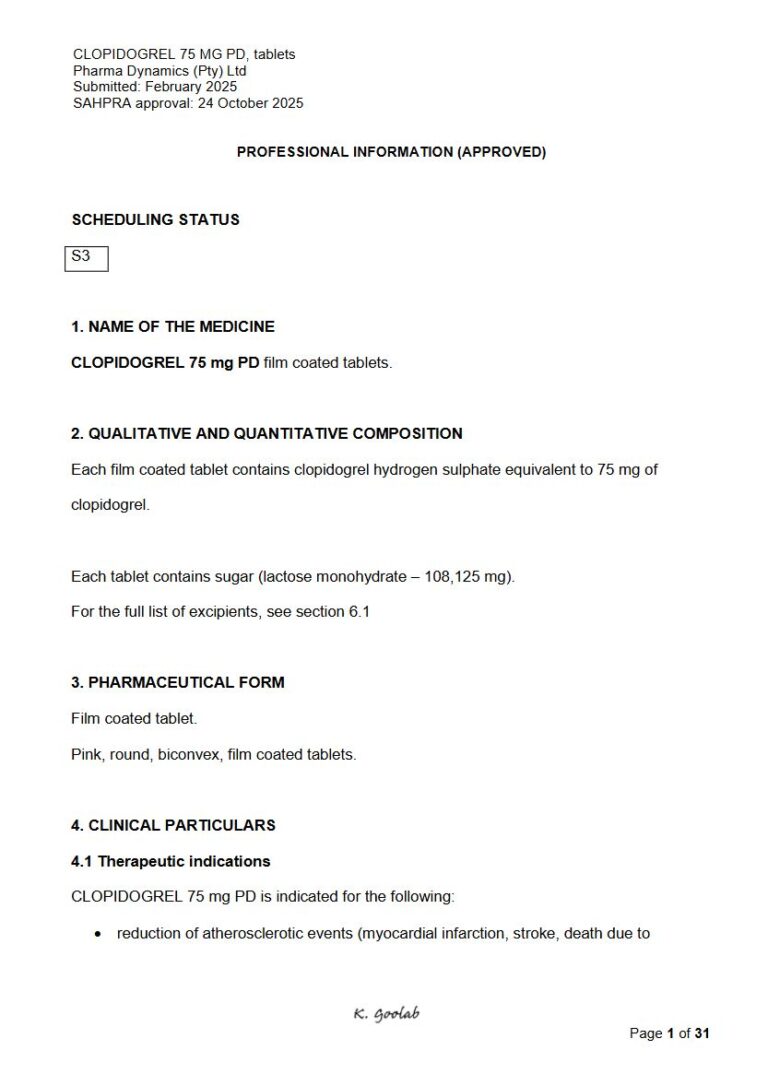
CLOPIDOGREL 75 mg PD is indicated for the following:
- reduction of atherosclerotic events (myocardial infarction, stroke, death due to vascular causes) in patients with a history of symptomatic atherosclerotic disease defined by ischaemic stroke (from 7 days until less than 6 months), myocardial infarction (from a few days until less than 35 days) or established peripheral arterial disease
- for patients with non-ST-segment elevation acute coronary syndrome (unstable angina/non-Q-wave myocardial infarction [MI]) including patients who are to be managed medically and those who are to be managed with percutaneous coronary intervention (with or without stent) or CABG (coronary artery bypass graft), CLOPIDOGREL 75 mg PD in combination with ASA has been shown to decrease the rate of a combined endpoint of cardiovascular death, myocardial infarction (MI), or stroke as well as the rate of a combined endpoint of cardiovascular death, MI, stroke, or refractory ischaemia
- for patients with ST-segment elevation acute myocardial infarction, CLOPIDOGREL 75 mg PD in combination with ASA has been shown to reduce the rate of death from any cause and the rate of a combined endpoint of death, re-infarction or stroke.
4.2 Posology and method of administration
Posology
Adults:
Recent Myocardial Infarction (MI), Recent Stroke, or Established Peripheral Arterial Disease: CLOPIDOGREL 75 mg PD should be given as a single daily dose of 75 mg.
Acute Coronary Syndrome: For patients with non-ST-segment elevation acute coronary syndrome (unstable angina/non-Q-wave MI), CLOPIDOGREL 75 mg PD should be initiated with a single 300-mg loading dose and then continued at 75 mg once daily. Aspirin (75 mg - 325 mg once daily) should be initiated and continued in combination with CLOPIDOGREL 75 mg PD. For patients with ST-segment elevation acute myocardial infarction, the recommended dose of CLOPIDOGREL 75 mg PD is one tablet, once daily, administered in combination with aspirin, with or without thrombolytics. CLOPIDOGREL 75 mg PD may be initiated with or without a loading dose.
Special populations
Elderly: No dosage adjustment is necessary for elderly patients.
Renal disease: No dosage adjustment is necessary for patients with renal disease.
Pharmacogenetics: CYP2C19 poor metaboliser status is associated with diminished antiplatelet response to clopidogrel. An appropriate dose regimen for this patient population has not been established in clinical outcome trials.
Paediatric population: CLOPIDOGREL 75 mg PD should not be used in children below the age of 18 years because of efficacy concerns.
Method of administration: For oral use. CLOPIDOGREL 75 mg PD can be taken with or without food. Missed dose: Doctors should advise patients who forget to take CLOPIDOGREL 75 mg PD to take a dose as soon as possible and then continue with the normal dose. Patients should not take a double dose to compensate for the missed dose.
4.3 Contraindications
- hypersensitivity to clopidogrel or to any of the ingredients of CLOPIDOGREL 75 mg PD (see section 6.1)
- active bleeding such as peptic ulcer and intracranial haemorrhage
- safety and efficacy in patients below the age of 18 have not been established
- pregnancy and lactation
- severe liver impairment
- thrombocytopenia
- platelet dysfunction
- haemophilia, congenital or acquired, or history of acquired haemophilia related to clopidogrel.
4.4 Special warnings and precautions for use
Thrombotic Thrombocytopenic Purpura (TTP): The clinical diagnosis of TTP is characterised by the presence of thrombocytopenia, haemolytic anaemia, neurological symptoms, renal dysfunction and fever. Due to the risk of fatal outcome, in the event of suspected thrombotic thrombocytopenic purpura, CLOPIDOGREL 75 mg PD should be stopped. The management of a patient with thrombotic thrombocytopenic purpura is complex. Early treatment with plasmapheresis is indicated in TTP. THROMBOTIC THROMBOCYTOPENIC PURPURA (TTP) HAS BEEN REPORTED TO OCCUR WITH CLOPIDOGREL 75 mg PD DURING POST-MARKETING EXPERIENCE. MOST CASES WERE REPORTED IN THE FIRST TWO WEEKS OF TREATMENT. PRESCRIBERS SHOULD WARN PATIENTS ABOUT THE SIGNS AND SYMPTOMS OF THROMBOTIC THROMBOCYTOPENIC PURPURA (TTP).
Recent ischemic stroke: In patients with recent transient ischaemic attack (TIA) or stroke, who are at high risk of recurrent ischaemic events, the combination of aspirin and CLOPIDOGREL 75 mg PD has not been shown to be more effective than CLOPIDOGREL 75 mg PD alone, but the combination has been shown to increase major bleeding. It is therefore recommended that such addition should be undertaken with caution outside of clinical situations where the combination has proven to be beneficial. In view of the lack of data, CLOPIDOGREL 75 mg PD cannot be recommended in acute ischaemic stroke (less than 7 days).
Bleeding and haematological disorders: Due to the risk of bleeding and haematological undesirable effects, blood cell count determination and/or other appropriate testing should be promptly considered whenever such suspected clinical symptoms arise during the course of treatment (see section 4.8). CLOPIDOGREL 75 mg PD should be used with caution in patients who may be at risk of increased bleeding including active bleeding such as peptic ulcer and inter-cranial haemorrhage and from trauma, dental and surgical procedures or other pathological conditions and in patients receiving treatment with acetylsalicylic acid (aspirin), NSAIDs (including COX-2 inhibitors), and anticoagulants such as heparin or glycoprotein lIb/Illa inhibitors, selective serotonin reuptake inhibitors (SSRIs) or thrombolytics or CYP2C19 strong inducers (see section 4.5).
Due to the increased risk of haemorrhage, triple antiplatelet therapy (clopidogrel + ASA + dipyridamole) for stroke secondary prevention is not recommended in patients with acute non-cardioembolic ischemic stroke or transient ischaemic attack (TIA) (see sections 4.5 and 4.8). Clopidogrel produces irreversible inhibition of platelet aggregation for the life of the platelet, which is 7-10 days. If a patient is to undergo elective surgery and an antiplatelet effect is not desired, CLOPIDOGREL 75 mg PD should be discontinued 7 days prior to surgery. Spinal and epidural anaesthesia should not be administered to a patient taking clopidogrel or for 7 days thereafter. No lumber puncture should be done during these 7 days due to risk of haematoma formation following lumber puncture or spinal and epidural anaesthesia. Patients should be monitored carefully for any signs of bleeding, including occult bleeding, especially but not limited to during the first week of treatment and/or after invasive cardiac procedures or surgery. The concomitant administration of CLOPIDOGREL 75 mg PD with warfarin is not recommended since it may increase the intensity of bleedings. CLOPIDOGREL 75 mg PD prolongs bleeding time and should be used with caution in patients who have lesions with a propensity to bleed such as gastrointestinal ulcers and intra-ocular bleeding. Medicines that might induce lesions (such as acetylsalicylic acid and NSAIDs) should be used with caution in patients taking CLOPIDOGREL 75 mg PD. Patients should be told that it may take longer than usual to stop bleeding when they take CLOPIDOGREL 75 mg PD, and that they should report any unusual bleeding to their medical practitioner. Patients should inform medical practitioners and dentists that they are taking CLOPIDOGREL 75 mg PD before any surgery is scheduled and before any new medicine is taken. In view of the possible increased risk of bleeding, the concomitant administration of CLOPIDOGREL 75 mg PD with acetylsalicylic acid, heparin, warfarin or thrombolytics should be undertaken with caution (see section 4.5).
Acquired haemophilia: Acquired haemophilia has been reported following use of clopidogrel. In cases of confirmed isolated activated Partial Thromboplastin Time (aPTT) prolongation with or without bleeding, acquired haemophilia should be considered. Patients with a confirmed diagnosis of acquired haemophilia should be managed and treated by specialists, and CLOPIDOGREL 75 mg PD should be discontinued (see section 4.3).
Cytochrome P450 2C19 (CYP2C19): Pharmacogenetics: In patients who are poor CYP2C19 metabolisers, clopidogrel at recommended doses forms less of the active metabolite of clopidogrel and has a smaller effect on platelet function. Tests are available to identify a patientu2019s CYP2C19 genotype; these tests can be used as an aid in determining therapeutic strategy (see section 4.2 - Pharmacogenetics). Poor metabolisers with acute coronary syndrome or undergoing percutaneous coronary intervention treated with clopidogrel at recommended doses may exhibit higher cardiovascular event rates than do patients with normal CYP2C19 function (see section 5.2).
Use of medicines that induce the activity of CYP2C19 would be expected to result in increased medicine levels of the active metabolite of clopidogrel and might potentiate the bleeding risk. As a precaution, concomitant use of strong CYP2C19 inducers should be discouraged (see section 4.5).
CYP2C8 substrates: Caution is required in patients treated concomitantly with clopidogrel and CYP2C8 substrate medicines (see section 4.5).
Acute myocardial infarction: In patients with acute myocardial infarction, CLOPIDOGREL 75 mg PD therapy should not be initiated within the first few days following myocardial infarction. In view of the lack of data, CLOPIDOGREL 75 mg PD cannot be recommended in coronary artery bypass graft (CABG) and acute ischaemic stroke (less than 7 days). Clinical experience is limited in patients with renal impairment and moderate hepatic disease with bleeding diatheses, CLOPIDOGREL 75 mg PD should be used with caution in these patients.
Cross-reactivity among thienopyridines: Thrombocytopenia, neutropenia, aplastic anaemia and pancytopenia have been reported in patients taking CLOPIDOGREL 75 mg PD (see section 4.8). Patients should be evaluated for history of hypersensitivity to another thienopyridine (such as ticlopidine, prasugrel) since cross-reactivity among thienopyridines has been reported (see section 4.8). Thienopyridines may cause mild to severe allergic reactions such as rash, angioedema or haematological reactions such as thrombocytopenia and neutropenia. Patients who had developed a previous allergic reaction and/or haematological reaction to one thienopyridine may have an increased risk of developing the same or another reaction to another thienopyridine. Monitoring for cross-reactivity is advised.
Insulin autoimmune syndrome (IAS): Insulin autoimmune syndrome (IAS) is characterized by hyperinsulinemic hypoglycaemia with elevated anti-insulin antibodies. The sulfhydryl group of clopidogrel metabolite could induce insulin autoimmune syndrome (IAS) as a rare side effect. Asians, most commonly observed in the Japanese population, have a genetic predisposition for IAS carrying HLA-DRB1*04:06, HLA-DQA1*03:01 and HLA-DQB1*03:02 haplotypes, and are more likely to develop IAS. Clopidogrel-induced-IAS may also cause hypoglycaemia in Caucasian populations, with the HLADRB1*04:03 haplotypes.
Hepatic impairment: Experience is limited in patients with moderate hepatic disease who may have bleeding diatheses. CLOPIDOGREL 75 mg PD should therefore be used with caution in this population.
Renal impairment: Therapeutic experience with clopidogrel is limited in patients with severe renal impairment. Therefore, CLOPIDOGREL 75 mg PD should be used with caution in these patients.
Information on excipients of CLOPIDOGREL 75 mg PD: CLOPIDOGREL 75 mg PD contains lactose. Patients with the rare hereditary conditions of galactose intolerance e.g. galactosaemia, Lapp lactase deficiency or glucose-galactose malabsorption should not take CLOPIDOGREL 75 mg PD. CLOPIDOGREL 75 mg PD contains lactose which may have an effect on the glycaemic control of patients with diabetes mellitus. CLOPIDOGREL 75 mg PD contains hydrogenated castor oil which may cause stomach upset or diarrhoea.
4.5 Interactions with other medicines
Medicines associated with bleeding risk: There is an increased risk of bleeding due to the potential additive effect. The concomitant administration of medicines associated with bleeding risk should be undertaken with caution.
Acetylsalicylic acid (aspirin): Acetylsalicylic acid (ASA) did not modify the clopidogrel-mediated inhibition of ADP-induced platelet aggregation. Concomitant administration of 500 mg of acetylsalicylic acid twice a day for one day did not significantly increase the prolongation of bleeding time induced by clopidogrel intake. CLOPIDOGREL 75 mg PD potentiates the effects of acetylsalicylic acid on collagen-induced platelet aggregation. A pharmacodynamic interaction between clopidogrel and acetylsalicylic acid (aspirin) is possible, leading to increased risk of bleeding. Therefore, concomitant use should be undertaken with caution. However, clopidogrel and ASA (75 - 325 mg once daily) have been administered together for up to one year.
Heparin: In healthy subjects, clopidogrel did not necessitate modification of the heparin dose or alter the effect of heparin on coagulation. Co-administration of heparin had no effect on the inhibition of platelet aggregation induced by clopidogrel. A pharmacodynamic interaction between clopidogrel and heparin is possible, leading to increased risk of bleeding, concomitant use should be undertaken with caution.
Thrombolytics: The safety of the concomitant administration of clopidogrel, as in CLOPIDOGREL 75 mg PD, fibrin or non-fibrin specific thrombolytic medicines and heparins was assessed in patients with acute myocardial infarction. The incidence of clinically significant bleeding was similar to that observed when thrombolytic medicines and heparins are co-administered with acetylsalicylic acid. However, the concomitant use of CLOPIDOGREL 75 mg PD with thrombolytic medicines should be undertaken with caution.
Warfarin: The concomitant administration of clopidogrel with oral anticoagulants, including warfarin, is not recommended since it may increase the intensity of bleedings (see section 4.4). The safety of the co-administration of CLOPIDOGREL 75 mg PD with warfarin has not been established. Consequently, concomitant administration of these two medicines should be undertaken with caution.
Non-Steroidal Anti-Inflammatory Medicines (NSAIDs) including aspirin: There is a potential risk of gastrointestinal bleeding, and NSAIDs, including aspirin, and CLOPIDOGREL 75 mg PD should be co-administered with caution (see section 4.4). In healthy volunteers, the concomitant administration of clopidogrel and naproxen increased occult gastrointestinal blood loss. However, due to the lack of interaction studies with other NSAIDs, it is presently unclear whether there is an increased risk of gastrointestinal bleeding with all NSAIDs. NSAIDs, including COX-2 inhibitors, and CLOPIDOGREL 75 mg PD should be co-administered with caution.
Glycoprotein llb/llla inhibitors: CLOPIDOGREL 75 mg PD should be used with caution in patients who may be at risk of increased bleeding from trauma, surgery or other conditions/disorders that may require concomitant glycoprotein lIb/Illa inhibitors intake.
Selective Serotonin Reuptake Inhibitors (SSRIs): Since SSRIs affect platelet activation and increase the risk of bleeding, the concomitant administration of SSRIs with clopidogrel should be undertaken with caution.
Other concomitant therapy: No clinically significant pharmacodynamic interactions were observed when CLOPIDOGREL 75 mg PD was co-administered with atenolol, nifedipine, or both atenolol and nifedipine. The pharmacodynamic activity of CLOPIDOGREL 75 mg PD was not significantly influenced by the co-administration of phenobarbital, cimetidine, or oestrogen. CLOPIDOGREL 75 mg PD inhibits the activity of cytochrome P450 enzyme: CYP2C9. This leads to increased plasma levels of medicines such as phenytoin, tolbutamide, warfarin, tamoxifen, fluvastatin and many NSAIDs which are metabolised by CYP2C9.
Inducers of CYP2C19: Since clopidogrel is metabolised to its active metabolite partly by CYP2C19, use of medicines that induce the activity of this enzyme would be expected to result in increased medicine levels of the active metabolite of clopidogrel. Rifampicin strongly induces CYP2C19, resulting in both an increased level of clopidogrel active metabolite and platelet inhibition, which might potentiate the risk of bleeding. As a precaution, concomitant use of strong CYP2C19 inducers should be discouraged (see section 4.4).
Inhibitors of CYP2C19: Since clopidogrel is metabolised to its active metabolite partly by CYP2C19, use of medicine that inhibit the activity of this enzyme would be expected to result in reduced medicine levels of the active metabolite of clopidogrel and a reduction in clinical efficacy. Concomitant use of strong or moderate CYP2C19 inhibitors (e.g., omeprazole, esomeprazole, fluvoxamine, fluoxetine, moclobemide, voriconazole, fluconazole, carbamazepine, and efavirenz) should be discouraged (see sections 4.2 and 4.4 u2013 Pharmacogenetics). If a proton pump inhibitor is to be used concomitantly with CLOPIDOGREL 75 mg PD, consider using one with less CYP2C19 inhibitory activity.
The pharmacokinetics of digoxin or theophylline were not modified by the co-administration of clopidogrel, as in CLOPIDOGREL 75 mg PD. Antacids did not modify the extent of clopidogrel absorption.
CYP2C8 substrate medicines: Due to the risk of increased plasma concentrations, concomitant administration of CLOPIDOGREL 75 mg PD and medicines primarily cleared by CYP2C8 metabolism (e.g. repaglinide, paclitaxel) should be undertaken with caution.
Results of additional clinical studies in which patients received a variety of concomitant medications including diuretics, beta-blocking medicines, angiotensin converting enzyme inhibitors, calcium antagonists, cholesterol lowering medicines, coronary vasodilators, anti-diabetic medicines, anti-epileptic medicines and hormone replacement therapy, showed no evidence of clinically significant adverse interactions.
Opioid agonists: Co-administration of opioid agonists has the potential to delay and reduce the absorption of an oral P2Y12 antagonist such as clopidogrel, presumably because of slowed gastric emptying. The clinical relevance is unknown. Consider the use of a parenteral antiplatelet medicine in acute coronary syndrome patients requiring co-administration of morphine or other opioid agonists.
Rosuvastatin: Clopidogrel has been shown to increase rosuvastatin exposure in patients by 2-fold (AUC) and 1,3-fold (C max) after administration of a 300 mg clopidogrel dose and by 1,4-fold (AUC) without effect on C max, after repeated administration of a CLOPIDOGREL 75 mg PD dose.
Boosted anti-retroviral therapy (ART): HIV patients treated with boosted anti-retroviral therapies (ART) are at high-risk of vascular events. A significantly reduced platelet inhibition has been shown in HIV patients treated with ritonavir-or cobicistat-boosted ART. Although the clinical relevance of these findings is uncertain, there have been spontaneous reports of HIV-infected patients treated with ritonavir boosted ART, who have experienced re-occlusive events after de-obstruction or have suffered thrombotic events under a clopidogrel loading treatment schedule. Average platelet inhibition can be decreased with concomitant use of clopidogrel and ritonavir. Therefore, concomitant use of clopidogrel with ART boosted therapies should be discouraged.
4.6 Fertility, pregnancy and lactation
Pregnancy: The use of CLOPIDOGREL 75 mg PD during pregnancy is not recommended as safety and efficacy have not been established (see section 4.3).
Breastfeeding: The use of CLOPIDOGREL 75 mg PD during lactation is not recommended as safety and efficacy have not been established (see section 4.3). Studies in rats have shown that clopidogrel and/or its metabolites are excreted in the milk. It is not known whether clopidogrel is excreted in human breast milk.
Fertility: Clopidogrel was not shown to alter fertility in animal studies.
4.7 Effects on ability to drive and use machines
No impairment of driving or psychometric performance was observed following CLOPIDOGREL 75 mg PD administration. CLOPIDOGREL 75 mg PD has no, or negligible, effect on the ability to drive and use machines.
4.8 Undesirable effects
Summary of the safety profile: Bleeding is the most common reaction reported both in clinical studies where frequencies varied from common to very common, as well as in post-marketing experience.
Tabulated list of adverse effects:
System Organ Class Frequency Side effects
Blood and lymphatic system disorders Frequent Less frequent Frequency unknown Purpura, haematoma Severe neutropenia (including agranulocytosis), severe thrombocytopenia (including thrombotic thrombocytopenic purpura), increased bleeding time, eosinophilia, leucopenia Bruising, haematuria*, ocular bleeding* (mainly conjunctival, but also ocular and retinal), respiratory tract bleeding* and aplastic anaemia (pancytopenia), musculoskeletal bleeding (including haemathrosis), haemorrhagic ulcer, haemothorax, haemorrhage of operative wound* and retroperitoneal haemorrhage* with fatal outcome, serum sickness, gastrointestinal haemorrhage*, intracranial haemorrhage*
Immune system disorders Frequency unknown Hypersensitivity reactions such as bronchospasm, angioedema or anaphylactoid reactions, insulin autoimmune syndrome, which can lead to severe hypoglycaemia, particularly in patients with HLA DRA4 subtype (more frequent in the Japanese population), serum sickness, cross-reactive drug hypersensitivity among thienopyridines (such as ticlopidine, prasugrel) (see section 4.4)
Psychiatric disorders Less frequent Frequency unknown Mental depression Confusion, hallucinations
Nervous system disorders Frequent Less frequent Frequency unknown Headache, dizziness Paraesthesia, intracranial bleeding, syncope, anxiety, hypoaesthesia, insomnia, intracranial bleeding (fatal outcome in some cases) Taste disorders, ageusia*
Eye disorders Less frequent Eye bleeding (conjunctival, ocular, retinal)
Ear and labyrinth disorders Frequency unknown Vertigo*
Cardiac disorders Frequent Less frequent Frequency unknown Chest pain Atrial fibrillation or palpitations Kounis syndrome* (vasospastic allergic angina)
Vascular disorders Less frequent Frequency unknown Hypertension Hypotension, vasculitis, serious haemorrhage, haemorrhage of operative wound
Respiratory, thoracic and mediastinal disorders Frequent Less frequent Frequency unknown Upper respiratory tract infections, epistaxis Bronchitis, dyspnoea, cough, rhinitis Interstitial pneumonitis*, bronchospasm*, eosinophilic pneumonia*, respiratory tract bleeding (haemoptysis, pulmonary haemorrhage)
Gastrointestinal disorders Frequent Less frequent Frequency unknown Abdominal pain, dyspepsia, diarrhoea Gastrointestinal haemorrhage, nausea, constipation, vomiting, peptic, gastric or duodenal ulcer, flatulence, gastritis Colitis* (including ulcerative or lymphocytic colitis), pancreatitis*, stomatitis*
Hepatobiliary disorders Frequency unknown Abnormal liver function tests*, hepatitis*, acute liver failure*
Skin and subcutaneous tissue disorders Frequent Less frequent Frequency unknown Bruising Rash, pruritus, purpura Severe skin reactions (including bullous eruption)*, erythema multiforme*, Stevens-Johnson syndrome*, toxic epidermal necrolysis*, lichen planus*, urticaria*, eczema*, maculopapular, erythematous or exfoliative rash*, urticaria*, angioedema*, bullous dermatitis*, acute generalised exanthematous pustulosis (AGEP)*, drug-induced hypersensitivity syndrome*, drug rash with eosinophilia*, systemic symptoms (DRESS)*
Musculoskeletal, connective tissue and bone disorders Frequent Less frequent Frequency unknown Back pain Gout, leg cramps Myalgia*, arthritis*, arthralgia*
Renal and urinary disorders Less frequent Frequency unknown Urinary tract infection, haematuria Glomerulopathy*, increased creatinine levels*
Reproductive system and breast disorders Frequency unknown Gynaecomastia*
General disorders and administrative site conditions Frequent Frequency unknown Bleeding at injection site Fever*
Investigations Less frequent Bleeding time prolonged, neutrophil count decreased, platelet count decreased
*Post marketing.
Reporting of suspected adverse reactions: Reporting suspected adverse reactions after authorisation of the medicine is important. It allows continued monitoring of the benefit/risk balance of the medicine. Healthcare professionals are requested to report any suspected adverse drug reactions to SAHPRA via the Med Safety APP (Medsafety X SAHPRA) and eReporting platform (who-umc.org) found on SAHPRA website. An email can be sent directly to the company, [email protected], to ensure safety of the product.
4.9 Overdose
Signs and symptoms: Overdose following CLOPIDOGREL 75 mg PD administration may lead to prolonged bleeding time and subsequent bleeding complications.
Management of overdose: No antidote to the pharmacological activity of clopidogrel has been found. If prompt correction of prolonged bleeding time is required, platelet transfusion may reverse the effects of clopidogrel. Treatment is symptomatic and supportive.
