
Deplatt 75 mg FC tablets
PDF Leaflet Revision Date: 19 December 2023
Clinical Summary
Quick overview from the medicine insert
Indication
Reduction of atherosclerotic events in patients with symptomatic atherosclerotic disease.
Dosage (summary)
75 mg once daily.
Onset of Action / Duration
Onset: 1 day, Duration: 7-10 days.
Special Populations
- Renal impairment
- Hepatic impairment
Pregnancy & Breastfeeding
Not recommended during pregnancy and breastfeeding.
Key Drug Interactions
- Warfarin
- Aspirin
- Heparin
- Thrombolytics
- NSAIDs
Contraindications
- Hypersensitivity to clopidogrel
- Active bleeding
- Severe liver impairment
- Thrombocytopenia
Common side effects
- Gastrointestinal haemorrhage
- Epistaxis
- Bruising
- Thrombocytopenia
Counselling Points
- Report unusual bleeding
- Inform healthcare providers before surgery
- Take with or without food
Serious warnings
- Risk of Thrombotic Thrombocytopenic Purpura (TTP)
- Increased bleeding risk
Important Disclaimer
The Deplatt 75 mg FC tablets professional information leaflet below is the property of Trinity Pharma and is provided on Medinsert exactly as issued, with no.. alterations or editorial changes. We make every effort to keep content current by updating documents as soon as new versions become available. Medinsert serves as a trusted access point for healthcare professionals, but does not replace official sources or clinical judgement. For more details, please read our full disclaimer. read more>>
 Healthcare Professionals Only
This content is for registered healthcare professionals
Sign in or create a free account to read the full package insert.
Free for HPCSA-registered professionals. Powered by Medinsert.
Clinical Particulars
Section 4 of the official insert — extracted exactly as issued, no alterations
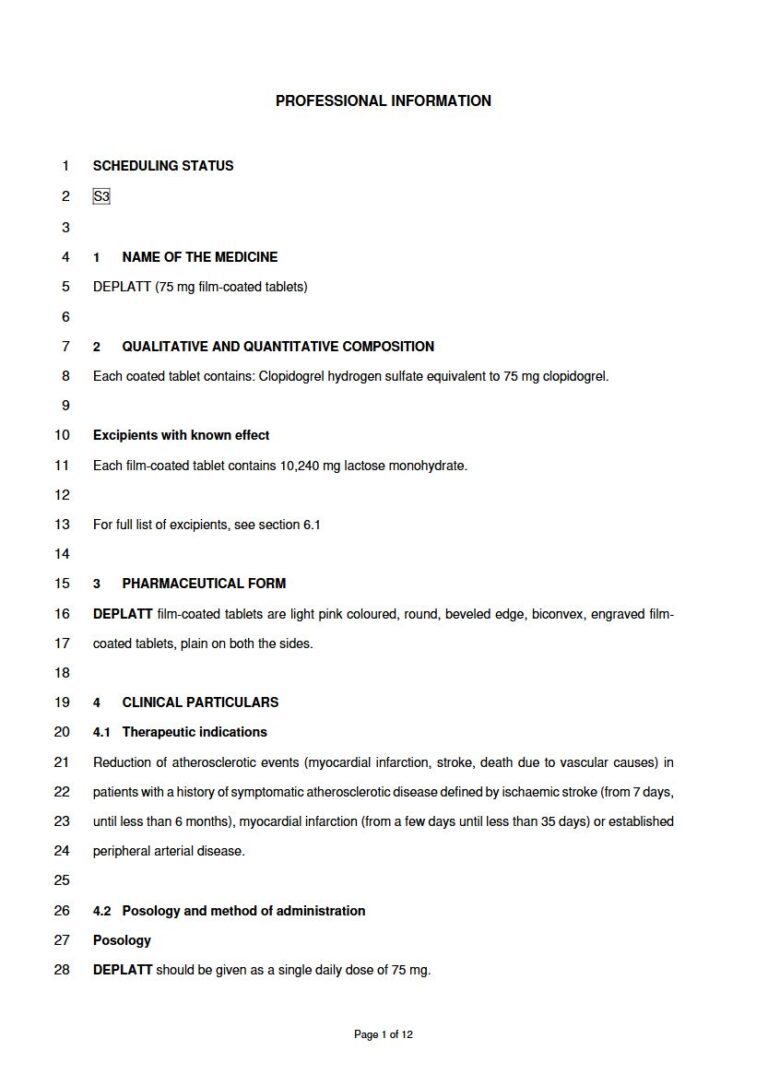
4.1 Therapeutic indications
Reduction of atherosclerotic events (myocardial infarction, stroke, death due to vascular causes) in patients with a history of symptomatic atherosclerotic disease defined by ischaemic stroke (from 7 days, until less than 6 months), myocardial infarction (from a few days until less than 35 days) or established peripheral arterial disease.
4.2 Posology and method of administration
Posology
DEPLATT should be given as a single daily dose of 75 mg.
Paediatric population
The safety and efficacy of DEPLATT in children below 18 years has not yet been established.
Method of administration
For oral use. DEPLATT can be taken at any time of day, with or without food.
4.3 Contraindications
- Hypersensitivity to clopidogrel or to any of the excipients (see section 6.1)
- Active pathological bleeding such as peptic ulcer and intracranial haemorrhage.
- Safety and efficacy in subjects below the age of 18 have not been established.
- Pregnancy and lactation (see Section 4.6).
- Severe liver impairment.
- Thrombocytopenia, neutropenia and other haematopoietic or haemorrhagic disorders.
4.4 Special warnings and precautions for use
THROMBOTIC THROMBOCYTOPENIC PURPURA (TTP) HAS BEEN REPORTED TO OCCUR WITH CLOPIDOGREL AS IN DEPLATT DURING POST-MARKETING EXPERIENCE. MOST CASES WERE REPORTED IN THE FIRST TWO WEEKS OF TREATMENT. PRESCRIBERS SHOULD WARN PATIENTS ABOUT THE SIGNS AND SYMPTOMS OF THROMBOTIC THROMBOCYTOPENIC PURPURA.
The clinical diagnosis of TTP is characterised by the presence of thrombocytopenia, haemolytic anaemia, neurological symptoms, renal dysfunction and fever. Due to the risk of a fatal outcome, DEPLATT should be discontinued in the event of suspected TTP. Early treatment with plasmapheresis is indicated in TTP.
Clopidogrel as in DEPLATT produces irreversible inhibition of platelet aggregation for the life of a platelet, i.e. for 7 - 10 days. Routine surgery is not recommended until a patient has been off DEPLATT for 7 days. Spinal and epidural anaesthesia should not be administered to a patient taking DEPLATT or for 7 days thereafter. No lumbar puncture should be done during these 7 days.
In patients with acute myocardial infarction, DEPLATT therapy should not be initiated within the first few days following myocardial infarction. In view of the lack of data, DEPLATT cannot be recommended in unstable angina, PTCA (stenting), CABG and acute ischaemic stroke (less than 7 days).
Patients should be monitored carefully for any signs of bleeding, including occult bleeding, especially during the first week of treatment and/or after invasive cardiac procedures or surgery. DEPLATT prolongs bleeding time. DEPLATT should be used with caution in patients who have lesions with a propensity to bleed, particularly gastrointestinal and intraocular.
Patients should be told that it may take longer than usual to stop bleeding when they take DEPLATT, and that they should report any unusual bleeding to their physician. Patients should be advised to inform medical practitioners and dentists that they are taking DEPLATT before any surgery is scheduled and before any new medicine is taken.
Risk of haematoma formulation following lumbar puncture or spinal and epidural anaesthesia.
Risk of active bleeding such as bleeding peptic ulcer and intracranial haemorrhage.
Risk of increased blood loss during dental and surgical procedures.
DEPLATT should be used with caution in patients receiving other medicines that increase the risk of bleeding (see Section 4.5).
The concomitant administration of DEPLATT with warfarin is not recommended since it may increase the risk and intensity of bleedings (see Section 4.5). In view of the possible increased risk of bleeding, the concomitant administration of DEPLATT with aspirin (ASA), heparin, or thrombolytics should be undertaken with caution (see section 4.5).
Therapeutic experience with clopidogrel is limited in patients with renal impairment. Therefore, DEPLATT should be used with caution in these patients.
Experience is limited in patients with moderate hepatic disease who may have bleeding diatheses. DEPLATT should therefore be used with caution in this population.
Medicines that might induce gastrointestinal lesions (such as Non-Steroidal Anti-Inflammatory Agents) should be used with caution in patients taking DEPLATT (see Section 4.5).
In patients who are poor CYP2C19 metabolisers, clopidogrel at the recommended dose, forms less of the active metabolite of clopidogrel and has a smaller effect on platelet function.
Since clopidogrel is metabolised to its active metabolite by CYP2C19, concomitant use of DEPLATT and strong or moderate CYP2C19 inhibitors is not recommended (see Section 4.5).
DEPLATT contains lactose. Patients with rare hereditary problems of galactose intolerance, the Lapp lactase deficiency or glucose-galactose malabsorption should not take DEPLATT.
DEPLATT contains mannitol, which may have a mild laxative effect. It also contains hydrogenated castor oil which may cause stomach upset and diarrhoea (see section 4.8).
4.5 Interaction with other medicines and other forms of interaction
Aspirin: Did not modify the clopidogrel mediated inhibition of ADP-induced platelet aggregation. Clopidogrel as in DEPLATT, potentiates the effect of aspirin (acetylsalicylic acid) on collagen-induced platelet aggregation. A pharmacodynamic interaction between DEPLATT and aspirin is possible, leading to an increased risk of bleeding. Therefore, concomitant administration should be undertaken with caution. The safety of the chronic concomitant administration of aspirin and DEPLATT has not been established (see section 4.4).
Heparin: A pharmacodynamic interaction between DEPLATT and heparin is possible, leading to an increased risk of bleeding. As the safety of this combination has not been established, concomitant use should be undertaken with caution.
Thrombolytics: The safety of the concomitant administration of DEPLATT with other thrombolytic agents has not been established and should be undertaken with caution.
Warfarin: The safety of the co-administration of DEPLATT with warfarin has not been established. Consequently, concomitant administration of these two agents should be undertaken with caution.
Non-Steroidal Anti-Inflammatory Agents [NSAlDs]: Due to a potential risk of gastrointestinal bleeding, NSAIDs and DEPLATT should be co-administered with caution (see section 4.4).
Glycoprotein llb/llla inhibitors: DEPLATT should be used with caution in patients who may be at risk of increased bleeding from trauma, surgery or other conditions/disorders that may require concomitant glycoprotein llb/llla inhibitors intake.
CYP2C19: Since clopidogrel is metabolised to its active metabolite partly by CYP2C19, use of medicines that inhibit the activity of this enzyme would be expected to result in reduced levels of the active metabolite of clopidogrel resulting in decreased antiplatelet activity. As a precaution, concomitant use of strong or moderate CYP2C19 inhibitors and DEPLATT is not recommended (see section 4.4).
Medicine products that inhibit CYP2C19 include omeprazole and esomeprazole, fluvoxamine, fluoxetine, moclobemide, voriconazole, fluconazole, ticlopidine, ciprofloxacin, cimetidine, carbamazepine, oxcarbazepine and chloramphenicol.
Other concomitant therapy: No clinically significant pharmacodynamic interactions were observed when clopidogrel as in DEPLATT was co-administered with atenolol, nifedipine, or both atenolol and nifedipine. The pharmacodynamic activity of DEPLATT was not significantly influenced by the co-administration of phenobarbitone, or oestrogen. The pharmacokinetics of digoxin or theophylline was not modified by the co-administration of DEPLATT. Antacids did not modify the extent of clopidogrel absorption.
DEPLATT inhibits the activity of one of the Cytochrome P450 (CYP) enzymes (CYP 2C9). This could lead to increased plasma levels of medicines such as phenytoin, tolbutamide, warfarin, tamoxifen, fluvastatin and NSAIDs which are metabolised by CYP 2C9.
4.6 Fertility, pregnancy and lactation
Pregnancy
The use of DEPLATT during pregnancy and breastfeeding is not recommended (see section 4.3)
Breastfeeding
It is unknown whether clopidogrel is excreted in human breast milk.
4.7 Effects on ability to drive and use machines
No impairment of driving or psychometric performance was observed following clopidogrel administration.
4.8 Undesirable effects
Tabulated summary of adverse reactions
4.1 MedDRA system organ class
Frequency Adverse reactions
4.2 Blood and lymphatic system disorders
Less frequent: Thrombocytopenia; leucopenia; eosinophilia; neutropenia, including severe neutropenia; thrombotic thrombocytopenic purpura (TTP); aplastic anaemia; pancytopenia; agranulocytosis; severe thrombocytopenia; acquired haemophilia A; granulocytopenia; anaemia.
4.3 Immune system disorders
Frequency unknown: Serum sickness; anaphylactoid reactions; cross-reactive drug hypersensitivity among thienopyridines (such as ticlopidine, prasugrel); angioedema, insulin autoimmune syndrome, which can lead to severe hypoglycaemia, particularly in patients with HLA DRA4 subtype (more frequent in the Japanese population).
4.4 Psychiatric disorders
Less frequent: Hallucinations; confusion.
4.5 Nervous system disorders
Less frequent: Intracranial bleeding (some cases were reported with fatal outcome); headache; paraesthesia; dizziness; taste disturbances.
4.6 Eye disorders
Less frequent: Eye bleeding (conjunctival, ocular, retinal).
4.7 Ear and labyrinth disorders
Less frequent: Vertigo.
4.8 Vascular disorders
Frequent: Haematoma. Less frequent: Serious haemorrhage; haemorrhage of operative wound; vasculitis; hypotension.
4.9 Respiratory, thoracic and mediastinal disorders
Frequent: Epistaxis. Less frequent: Respiratory tract bleeding (haemoptysis, pulmonary haemorrhage); bronchospasm; interstitial pneumonitis; eosinophilic pneumonia.
4.10 Gastrointestinal disorders
Frequent: Gastrointestinal haemorrhage; diarrhoea; abdominal pain; dyspepsia.
4.11 Less frequent: Gastric ulcer and duodenal ulcer; gastritis; vomiting; nausea; constipation; flatulence; retroperitoneal haemorrhage; gastrointestinal and retroperitoneal haemorrhage with fatal outcome; pancreatitis; colitis (including ulcerative or lymphocytic colitis); stomatitis.
4.12 Hepato-biliary disorders
Less frequent: Acute liver failure; hepatitis; abnormal liver function test.
4.13 Skin and subcutaneous tissue disorders
Frequent: Bruising. Less frequent: Rash; pruritus; skin bleeding (purpura); bullous dermatitis (toxic epidermal necrolysis, Stevens Johnson Syndrome, erythema multiforme); drug-induced hypersensitivity syndrome; drug rash with eosinophilia and systemic symptoms (DRESS); rash erythematous or exfoliative; urticaria; eczema; lichen planus.
4.14 Musculoskeletal and connective tissue disorders
Less frequent: Musculo-skeletal bleeding (haemarthrosis); arthritis; arthralgia; myalgia.
4.15 Renal and urinary disorders
Less frequent: Haematuria; glomerulonephritis; increased blood creatinine.
4.16 General disorders and administration site conditions
Frequent: Bleeding at puncture site. Less frequent: Fever.
4.17 Investigations
Less frequent: Bleeding time prolonged; decreased neutrophil count; decreased platelet count.
Reporting of suspected adverse reactions
Reporting suspected adverse reactions after authorisation of the medicine is important. It allows continued monitoring of the benefit/risk balance of the medicine. Health care providers are asked to report any suspected adverse reactions to SAHPRA via the u201c6.04 Adverse Drug Reactions Reporting Formu201d, found online under SAHPRAu2019s publications: https://www.sahpra.org.za/Publications/Index/8
4.9 Overdose
An overdose of DEPLATT may lead to prolonged bleeding time and subsequent bleeding complications.
Treatment is symptomatic and supportive.
