
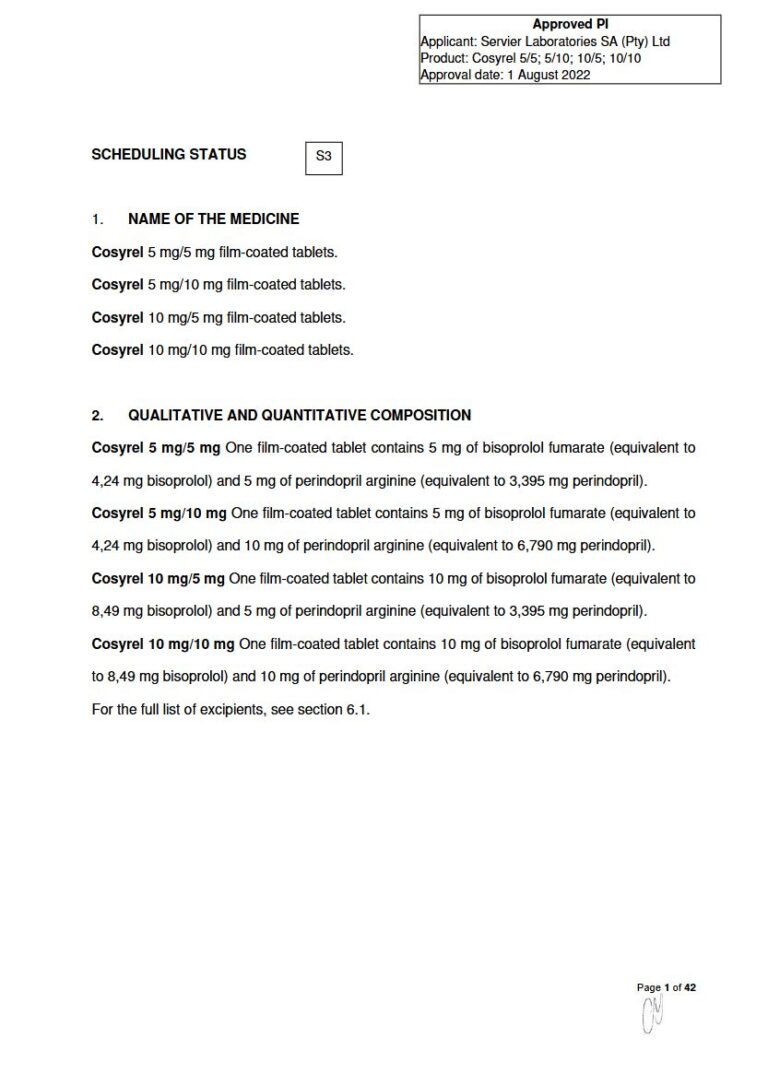
Cosyrel 5 mg/10 mg Film-Coated Tablets
PDF Leaflet Revision Date: 1 August 2022
Clinical Summary
Quick overview from the medicine insert
Indication
Treatment of hypertension and/or stable coronary artery disease and/or stable chronic heart failure.
Dosage (summary)
One tablet once daily; adjust for renal impairment.
Special Populations
- Renal impairment
- Hepatic impairment
- Elderly
Pregnancy & Breastfeeding
Contraindicated in pregnancy and breastfeeding.
Key Drug Interactions
- Potassium-sparing diuretics
- Lithium
- Aliskiren
- Sacubitril/valsartan
Contraindications
- Hypersensitivity
- Acute heart failure
- Cardiogenic shock
- Second or third degree AV block
- Sick sinus syndrome
- Symptomatic bradycardia
- Severe bronchial asthma
Common side effects
- Headache
- Dizziness
- Hypotension
- Nausea
- Vomiting
Counselling Points
- Take in the morning before meals
- Monitor blood pressure regularly
- Report any signs of angioedema immediately
Serious warnings
- Hypotension
- Angioedema
- Neutropenia
- Hepatic failure
Important Disclaimer
The Cosyrel 5 mg/10 mg Film-Coated Tablets professional information leaflet below is the property of Servier Laboratories Sa and is provided on Medinsert exactly as issued, with no.. alterations or editorial changes. We make every effort to keep content current by updating documents as soon as new versions become available. Medinsert serves as a trusted access point for healthcare professionals, but does not replace official sources or clinical judgement. For more details, please read our full disclaimer. read more>>
 Healthcare Professionals Only
This content is for registered healthcare professionals
Sign in or create a free account to read the full package insert.
Free for HPCSA-registered professionals. Powered by Medinsert.
Clinical Particulars
Section 4 of the official insert — extracted exactly as issued, no alterations
4.1 Therapeutic indications
Cosyrel is indicated as substitution therapy for treatment of hypertension and/or stable coronary artery disease (in patients with a history of myocardial infarction and/or revascularisation) and/or stable chronic heart failure with reduced systolic left ventricular function in adult patients adequately controlled with bisoprolol and perindopril given concurrently at the same dose level.
4.2 Posology and method of administration
Posology
The usual posology is one tablet once daily. Patients should be stabilised with bisoprolol and perindopril at the same dose level for at least 4 weeks. The fixed dose combination is not suitable for initial therapy. For patients stabilised with bisoprolol 2,5 mg and perindopril 2,5 mg can use one half 5 mg/5 mg tablet once daily. If a change of posology is required, titration should be done with the individual components.
Special populations
Renal impairment (see section 4.4 and 5.2)
Cosyrel 5/5 mg
In patients with renal impairment, the recommended dose of Cosyrel 5/5 mg should be based on creatinine clearance as outlined in table 1 below.
Table 1 dosage adjustment in renal impairment.
Creatinine clearance (ml/min) Recommended daily dose
Cl CR u2265 60 One tablet of Cosyrel 5/5 mg
30 < Cl CR < 60 One half tablet of Cosyrel 5/5 mg
Cl CR < 30 Not suitable. Individual dose titration with the monocomponents is recommended
Cosyrel 5/10 mg
In patients with renal impairment, the recommended dose of Cosyrel 5/10 mg should be based on creatinine clearance as outlined in table 2 below.
Table 2 dosage adjustment in renal impairment.
Creatinine clearance (ml/min) Recommended daily dose
Cl CR u2265 60 One half tablet of Cosyrel 5/10 mg
Cl CR < 60 Not suitable. Individual dose titration with the monocomponents is recommended
Cosyrel 10/5 mg
In patients with renal impairment, the recommended dose of Cosyrel 10/5 mg should be based on creatinine clearance as outlined in table 3 below.
Table 3 dosage adjustment in renal impairment.
Creatinine clearance (ml/min) Recommended daily dose
Cl CR u2265 60 One tablet of Cosyrel 10/5 mg
Cl CR < 60 Not suitable. Individual dose titration with the monocomponents is recommended
Cosyrel 10/10 mg is not suitable for patients with renal impairment. In these patients, an individual dose titration with the monocomponents is recommended.
Hepatic impairment (see section 4.4 and 5.2)
No dosage adjustment is necessary in patients with hepatic impairment.
Elderly (patients u2265 65 years of age)
Cosyrel should be administered according to the renal function.
Paediatric population
The safety and efficacy of Cosyrel in children and adolescents less than 18 years of age, have not been established. No data are available. Therefore, Cosyrel should not be used in children and adolescents.
Method of administration
Cosyrel tablet should be taken as a single dose once daily in the morning before a meal.
4.3 Contraindications
- Hypersensitivity to the active substances, or to any of the excipients listed in section 6.1, or to any other angiotensin converting enzyme (ACE) inhibitor.
- Acute heart failure or during episodes of heart failure decompensation requiring i.v. inotropic therapy.
- Cardiogenic shock.
- Second or third degree AV block (without pacemaker).
- Sick sinus syndrome.
- Sinoatrial block.
- Symptomatic bradycardia (< 50 bpm).
- Symptomatic hypotension.
- Severe bronchial asthma or severe chronic obstructive pulmonary disease.
- Severe forms of peripheral arterial occlusive disease or severe forms of Raynaud's syndrome.
- Untreated phaeochromocytoma (see section 4.4).
- Metabolic acidosis.
- A history of angioedema related to previous therapy with ACE-inhibitors or angiotensin receptor blockers (ARBs) These patients must never again be given these medicines (see section 4.4).
- Hereditary or idiopathic angioedema.
- Hypertrophic obstructive cardiomyopathy (HOCM).
- Severe renal function impairment (creatinine clearance less than 30 ml/min).
- Bilateral renal artery stenosis.
- Renal artery stenosis in patients with a single kidney (see section 4.4).
- Aortic stenosis.
- Concomitant therapy with potassium sparing diuretics such as spironolactone, triamterene, amiloride (see section 4.5).
- Porphyria.
- Lithium therapy Concomitant administration with Cosyrel may lead to toxic blood concentrations of lithium (see section 4.5).
- Pregnancy and lactation (see sections 4.4 and 4.6).
- Concomitant use of Cosyrel with aliskiren-containing products in patients with diabetes mellitus or renal impairment (GFR < 60 ml/min/1,73mu00b2) (see sections 4.4, 4.5 and 5.1).
- Concomitant use with sacubitril/valsartan (see sections 4.4 and 4.5).
- Extracorporeal treatments leading to contact of blood with negatively charged surfaces (see section 4.5).
- Concomitant use of fluoroquinolones with ACE-inhibitors/Angiotensin receptor blockers is contraindicated in patients with moderate to severe renal impairment (Creatinine Clearance u2264 30 mL/min) and in elderly patients.
4.4 Special warnings and precautions for use
All warnings and precautions for use related to each component are applicable to Cosyrel.
Hypotension
ACE-inhibitors may cause a fall in blood pressure. Symptomatic hypotension has been reported in uncomplicated hypertensive patients and is more likely to occur in patients who have been volume-depleted e.g. by diuretic therapy, dietary salt restriction, dialysis, diarrhoea or vomiting, or who have severe renin-dependent hypertension (see sections 4.5 and 4.8). In patients with symptomatic heart failure, with or without associated renal insufficiency, symptomatic hypotension has been observed. This is most likely to occur in those patients with more severe degrees of heart failure, as reflected by the use of high doses of loop diuretics, hyponatraemia or functional renal impairment. In patients at increased risk of symptomatic hypotension, initiation of therapy and dose adjustment should be closely monitored. Similar considerations apply to patients with ischaemic heart or cerebrovascular disease in whom an excessive fall in blood pressure could result in a myocardial infarction or cerebrovascular accident. If hypotension occurs, the patient should be placed in the supine position and, if necessary, should receive an intravenous infusion of sodium chloride 9 mg/ml (0.9%) solution. A transient hypotensive response is not a contraindication to further doses, once the blood pressure has increased after volume expansion. In patients with congestive heart failure who have normal or low blood pressure, additional lowering of systemic blood pressure may occur with perindopril. This effect is not a reason to discontinue treatment. If hypotension becomes symptomatic, a reduction of dose or gradual discontinuation of treatment, using the individual components, may be necessary.
Hypersensitivity/Angioedema
Angioedema of the face, extremities, lips, mucous membranes, tongue, glottis and/or larynx has been reported in patients treated with ACE-inhibitors, including perindopril (see section 4.8). This may occur at any time during therapy. In such cases, Cosyrel should promptly be discontinued. Therapy with beta-blocker must be continued. Appropriate monitoring should be initiated and continued until complete resolution of symptoms has occurred. In those instances where swelling was confined to the face and lips the condition generally resolved without treatment, although antihistamines have been useful in relieving symptoms. Angioedema associated with laryngeal oedema may be fatal. Where there is involvement of the tongue, glottis or larynx, likely to cause airway obstruction, emergency therapy should be administered promptly. This may include the administration of adrenaline (epinephrine) and/or the maintenance of a patent airway. The patient should be under close medical supervision until complete and sustained resolution of symptoms has occurred. Patients with a history of angioedema unrelated to ACE-inhibitor therapy may be at increased risk of angioedema while receiving an ACE-inhibitor (see section 4.3). Intestinal angioedema has been reported in patients treated with ACE-inhibitors such as contained in Cosyrel. These patients presented with abdominal pain (with or without nausea or vomiting); in some cases there was no prior facial angioedema and C-1 esterase levels were normal. The angioedema was diagnosed by procedures including abdominal CT scan, or ultrasound or at surgery and symptoms resolved after stopping the ACE-inhibitor. Intestinal angioedema should be included in the differential diagnosis of patients on ACE-inhibitors presenting with abdominal pain.
The combination of perindopril with sacubitril/valsartan is contraindicated due to the increased risk of angioedema (see section 4.3). Sacubitril/valsartan must not be initiated until 36 hours after taking the last dose of perindopril therapy. If treatment with sacubitril/valsartan is stopped, perindopril therapy must not be initiated until 36 hours after the last dose of sacubitril/valsartan (see sections 4.3 and 4.5). Concomitant use of other NEP inhibitors (e.g. racecadotril) and ACE-inhibitors may also increase the risk of angioedema (see section 4.5). Hence, a careful benefit-risk assessment is needed before initiating treatment with NEP inhibitors (e.g. racecadotril) in patients on perindopril.
Concomitant use of mTOR inhibitors (e.g. sirolimus, everolimus, temsirolimus) Patients taking concomitant mTOR inhibitors (e.g. sirolimus, everolimus, temsirolimus) therapy may be at increased risk for angioedema (e.g. swelling of the airways or tongue, with or without respiratory impairment) (see section 4.5).
Hepatic failure
ACE-inhibitors such as contained in Cosyrel have been associated with a syndrome that starts with cholestatic jaundice and progresses to fulminant hepatic necrosis and (sometimes) death. The mechanism of this syndrome is not understood. Patients receiving ACE-inhibitors who develop jaundice or marked elevations of hepatic enzymes should discontinue the ACE-inhibitor and receive appropriate medical follow-up (see section 4.8).
Race
ACE-inhibitors such as contained in Cosyrel cause a higher rate of angioedema in black patients than in non-black patients. ACE-inhibitors, including perindopril may be less effective in lowering blood pressure in black people than in non-blacks, possibly because of a higher prevalence of low-renin states in the black hypertensive population.
Cough
Cough has been reported with the use of ACE-inhibitors such as contained in Cosyrel. Characteristically, the cough is non-productive, persistent and resolves after discontinuation of therapy. ACE-inhibitor induced cough should be considered as part of the differential diagnosis of cough.
Hyperkalaemia
Elevations in serum potassium have been observed in patients treated with ACE-inhibitors, including perindopril. Risk factors for the development of hyperkalemia include those with renal insufficiency, worsening of renal function, age (> 70 years), diabetes mellitus, intercurrent events, in particular dehydration, acute cardiac decompensation, metabolic acidosis and concomitant use of potassium-sparing diuretics (e.g. spironolactone, eplerenone, triamterene, or amiloride), potassium supplements or potassium-containing salt substitutes; or those patients taking other medicines associated with increases in serum potassium (e.g. heparin, co-trimoxazole also known as trimethoprim/sulfamethoxazole). The use of potassium supplements, potassium-sparing diuretics, or potassium-containing salt substitutes particularly in patients with impaired renal function may lead to a significant increase in serum potassium. Hyperkalemia can cause serious, sometimes fatal dysrhythmias. If concomitant use of the above-mentioned medicines is deemed appropriate, they should be used with caution and with frequent monitoring of serum potassium (see section 4.5).
4.5 Interactions with other medicines
No interactions between bisoprolol and perindopril have been observed in an interaction study conducted in healthy volunteers. Only information on interactions with other medicines that are known for the individual active substances is provided below.
Medicines inducing hyperkalaemia
Some medicines or therapeutic classes may increase the occurrence of hyperkalaemia such as aliskiren, potassium salts, potassium-sparing diuretics, ACE-inhibitors, angiotensin-II receptors antagonists, NSAIDs, heparins, immunosuppressant medicines such as ciclosporin or tacrolimus, trimethoprim. The combination of these medicines increases the risk of hyperkalaemia.
Concomitant use contraindicated (see section 4.3)
Fluoroquinolones
Concomitant use of fluoroquinolones and ACE-inhibitors/Angiotensin receptor blockers may precipitate acute kidney injury. The mechanism of the possible interaction between the different classes of medicines, over and above different mechanisms of kidney damage, is unknown (see section 4.3).
Aliskiren
The concomitant therapy with Cosyrel and aliskiren is contra-indicated in diabetic or impaired renal patients, due to the risk of hyperkalaemia, worsening of renal function and cardiovascular morbidity and mortality increase.
Extracorporeal treatments
Extracorporeal treatments leading to contact of blood with negatively charged surfaces such as dialysis or haemofiltration with certain high-flux membranes (e.g. polyacrylonitrile membranes) and low density lipoprotein apheresis with dextran sulphate due to increased risk of severe anaphylactoid reactions (see section 4.3). If such treatment is required, consideration should be given to using a different type of dialysis membrane or a different class of antihypertensive agent.
Sacubitril/Valsartan
The concomitant use of perindopril as contained in Cosyrel with sacubitril/valsartan is contraindicated as the concomitant inhibition of neprilysin and ACE may increase the risk of angioedema. Sacubitril/valsartan must not be started until 36 hours after taking the last dose of perindopril therapy. Perindopril therapy must not be started until 36 hours after the last dose of sacubitril/valsartan (see section 4.3 and 4.4).
Concomitant use not recommended
Linked to bisoprolol
Centrally acting antihypertensives such as clonidine and others (e.g. methyldopa, moxonidine, rilmenidine). Concomitant use of centrally acting antihypertensives may worsen heart failure by lowering the central sympathetic tonus (reduced heart rate and cardiac output, vasodilation). Abrupt termination, particularly before down-titration of beta-blocker therapy, may increase the risk of rebound hypertension.
Class I antidysrhythmic medicines (e.g. quinidine, disopyramide; lidocaine, phenytoin; flecainide, propafenone) The effect on atrio-ventricular conduction time may be potentiated and the negative inotropic effect be increased. Calcium antagonists of the verapamil type and to a lesser extent of the diltiazem type have a negative influence on contractility and atrio-ventricular conduction. Intravenous administration of verapamil in patients on beta-blocker treatment may lead to profound hypotension and atrio-ventricular block.
Linked to perindopril
Aliskiren
In patients without diabetes or impaired renal function, the risk of hyperkalaemia, worsening of renal function and cardiovascular morbidity and mortality are increased. Concomitant therapy with ACE-inhibitor and angiotensin-receptor blocker Dual blockade of the renin-angiotensin-aldosterone-system (RAAS) through the combined use of ACE-inhibitors, angiotensin II receptor blockers or aliskiren is associated with a higher frequency of adverse events such as hypotension, hyperkalaemia and decreased renal function (including acute renal failure) compared to the use of a single RAAS-acting agent (see sections 4.3, 4.4 and 5.1). Patients with established atherosclerotic disease, heart failure, or with diabetes with end organ damage, concomitant therapy with ACE-inhibitor and angiotensin-receptor blocker is associated with a higher frequency of hypotension, syncope, hyperkalaemia, and worsening of renal function (including acute renal failure) as compared to the use of a single renin-angiotensin-aldosterone system inhibitor medicine. Dual blockade (e.g, by combining an ACE-inhibitor with an angiotensin II receptor antagonist) should be limited to individually defined cases with close monitoring of renal function, potassium levels, and blood pressure.
Estramustine
There is a risk of increased adverse effects such as angioneurotic oedema (angioedema).
Co-trimoxazole (trimethoprim/sulfamethoxazole)
Patients taking concomitant co-trimoxazole (trimethoprim/sulfamethoxazole) may be at increased risk for hyperkalaemia (see section 4.4).
Potassium sparing diuretics (e.g. triamterene, amiloride...), potassium (salts)
Hyperkalaemia (potentially lethal), especially in conjunction with renal impairment (additive hyperkalaemic effects). The combination of Cosyrel which contains perindopril with the above-mentioned medicines is not recommended (see section 4.4). If concomitant use is nonetheless indicated they should be used with caution and with frequent monitoring of serum potassium.
For use of spironolactone in heart failure, see below.
Lithium
Lithium toxicity has been reported during concomitant administration of lithium with ACE-inhibitors. Use of perindopril with lithium is contraindicated (see section 4.3).
Concomitant use which require special care
Linked to bisoprolol and perindopril as contained in Cosyrel
Antidiabetic medicines (insulins, oral hypoglycaemic agents)
Concomitant administration of ACE-inhibitors and antidiabetic medicines (insulins, oral hypoglycaemic agents) may cause an increased blood-glucose lowering effect with risk of hypoglycaemia. This phenomenon appeared to be more likely to occur during the first weeks of combined treatment and in patients with renal impairment.
Concomitant administration of bisoprolol with insulin and oral antidiabetic medicines may increase blood sugar lowering effect. Blockade of beta-adrenoreceptors may mask symptoms of hypoglycaemia.
Non-steroidal anti-inflammatory medicinal products (NSAIDs) (including aspirin u2265 3 g/day)
The administration of Cosyrel simultaneously with non-steroidal anti-inflammatory drugs (i.e. acetylsalicylic acid at anti-inflammatory dosage regimens, COX-2 inhibitors and non-selective NSAIDs) may attenuate the antihypertensive effect of bisoprolol and perindopril. In addition, concomitant use of ACE-inhibitors and NSAIDs may lead to an increased risk of deterioration of renal function, including possible acute renal failure, and an increase in serum potassium, especially in patients with poor pre-existing renal function. The combination should be administered with caution, especially in the elderly. Patients should be adequately hydrated and consideration should be given to monitoring renal function after initiation of concomitant therapy, and periodically thereafter.
Antihypertensive medicines and vasodilators
Concomitant use with antihypertensive medicines, vasodilators (such as nitroglycerin, other nitrates or other vasodilators) or with other medications which have a blood-pressure-reducing potential (e.g. tricyclic antidepressants, barbiturates, phenothiazines) may increase the risk of hypotensive effects of perindopril and bisoprolol.
Tricyclic antidepressants/Antipsychotics/Anaesthetics
Concomitant use of ACE-inhibitors as contained in Cosyrel with certain anaesthetic medicinal products, tricyclic antidepressants and antipsychotics may result in further reduction of blood pressure. Concomitant use of bisoprolol as contained in Cosyrel with anaesthesics may lead to reduced reflex tachycardia and increased risk of hypotension.
Sympathomimetics
Beta-sympathomimetics (e.g. isoprenaline, dobutamine) combination with bisoprolol may reduce the effects of both agents. Sympathomimetics that activate both beta- and alpha-adrenoceptors (e.g. norepinephrine, epinephrine) combination with bisoprolol may unmask the alpha-adrenoceptor-mediated vasoconstrictor effects of these agents, leading to blood pressure increase and exacerbated intermittent claudication. Such interactions are considered to be more likely with nonselective beta-blockers. Sympathomimetics may reduce the antihypertensive effects of ACE-inhibitors.
Linked to bisoprolol as contained in Cosyrel
Calcium antagonists of the dihydropyridine type such as felodipine and amlodipine
Concomitant use may increase the risk of hypotension, and an increase in the risk of a further deterioration of the ventricular pump function in patients with heart failure cannot be excluded.
Class-III antidysrhythmic medicines (e.g. amiodarone). Effect on atrio-ventricular conduction time may be potentiated.
Parasympathomimetic medicines
Concomitant use may increase atrio-ventricular conduction time and the risk of bradycardia. Concomitant use of topical beta-blockers (e.g. eye drops for glaucoma treatment), may add to the systemic effects of bisoprolol.
Digoxin
Reduction of heart rate, increase of atrio-ventricular conduction time.
Linked to perindopril as contained in Cosyrel
Baclofen
Increased antihypertensive effect. Monitor blood pressure and adapt antihypertensive dosage if necessary.
4.6 Fertility, pregnancy and lactation
Pregnancy
The use of Cosyrel is contraindicated during pregnancy. Pregnant women should be informed of the potential hazards to the foetus and must not take Cosyrel during pregnancy (see section 4.3). Patients planning pregnancy should be changed to alternative anti-hypertensive treatments which have an established safety profile for use in pregnancy. When pregnancy is diagnosed, treatment with Cosyrel should be stopped immediately and alternative therapy should be started.
Bisoprolol
Bisoprolol should not be used in pregnancy (see section 4.3). It has pharmacological effects that may cause harmful effects on pregnancy and/or the foetus/newborn (reduce placental perfusion associated with growth retardation, intrauterine death, abortion or early labour and adverse effects (e.g. hypoglycaemia and bradycardia) may occur in the foetus and newborn infant. The risk of hypoglycaemia and bradycardia is present for 3 days after the birth of the baby.
Perindopril
Perindopril should not be used in pregnancy (see section 4.3). Foetal exposure to ACE-inhibitors such as perindopril during the first trimester of pregnancy has been reported to be associated with an increased risk of malformations of the cardiovascular (atrial and/or ventricular septal defect, pulmonic stenosis, patent ductus arteriosus) and central nervous system (microcephaly spina bifida) and of kidney malformations. Cosyrel passes through the placenta and can be presumed to cause disturbance in foetal blood pressure regulatory mechanisms. Oligohydramnios as well as hypotension, oliguria and anuria (renal failure) in new-borns, have been reported after administration of Cosyrel during the second and third trimester. Cases of defective skull ossification have been observed. Prematurity and low birth mass can occur (see section 4.3).
Breastfeeding
Cosyrel should not be used by women breastfeeding their babies (see section 4.3). It is not known whether bisoprolol is excreted in human milk. Because no information is available regarding the use of perindopril during breastfeeding, alternative treatments with better established safety profiles during breastfeeding should be used.
Fertility
There are no clinical data on fertility with the use of Cosyrel.
4.7 Effects on ability to drive and use machines
Cosyrel may influence the ability to drive and use machines. Patients should not drive and use machines until they know how Cosyrel affects them. Hypotension, dizziness and visual disturbances have been reported with Cosyrel.
4.8 Undesirable effects
Summary of the safety profile
The most common adverse reactions to bisoprolol include headache, dizziness, worsening of heart failure, hypotension, cold extremities, nausea, vomiting, abdominal pain, diarrhoea, constipation, asthenia and fatigue. The most common adverse reactions reported in clinical trials and observed with perindopril include headache, dizziness, vertigo, paraesthesia, visual disturbance, tinnitus, hypotension, cough, dyspnoea, nausea, vomiting, abdominal pain, diarrhoea, constipation, dysgeusia, dyspepsia, rash, pruritus, muscle cramps and asthenia.
List of adverse reactions reported during clinical trials
The following undesirable effects have been observed during clinical trials use with bisoprolol or perindopril given separately and ranked under the MedDRA classification by body system and under the following frequency. Very common (u2265 1/10); common (u2265 1/100 to < 1/10); uncommon (u2265 1/1 000 to < 1/100); rare (u2265 1/10 000 to < 1/1 000); very rare (< 1/10 000); not known (cannot be estimated from the available data).
4.9 Overdose
In overdose, undesirable effects can be precipitated and /or of increased severity (see section 4.8).
Bisoprolol
Symptoms
The most common signs expected with overdosage of a beta-blocker are bradycardia, hypotension, bronchospasm, acute cardiac insufficiency and hypoglycaemia.
Management
If overdose occurs, bisoprolol treatment should be stopped and supportive and symptomatic treatment should be provided. Limited data suggest that bisoprolol is hardly dialysable. Based on the expected pharmacologic actions and recommendations for other beta-blockers, the following general measures should be considered when clinically warranted.
Bradycardia: Administer intravenous atropine. If the response is inadequate, isoprenaline or another medicine with positive chronotropic properties may be given cautiously. Under some circumstances, transvenous pacemaker insertion may be necessary.
Hypotension: Intravenous fluids and vasopressors should be administered. Intravenous glucagon may be useful.
AV block (second or third degree): Patients should be carefully monitored and treated with isoprenaline infusion or transvenous cardiac pacemaker insertion.
Acute worsening of heart failure: Administer i.v. diuretics, inotropic agents, vasodilating agents.
Bronchospasm: Administer bronchodilator therapy such as isoprenaline, beta2-sympathomimetic medicines and/or aminophylline.
Hypoglycaemia: Administer i.v. glucose.
Perindopril
Symptoms
Symptoms associated with overdosage of ACE-inhibitors may include hypotension, circulatory shock, electrolyte disturbances, renal failure, hyperventilation, tachycardia, palpitations, bradycardia, dizziness, anxiety, and cough.
Management
The recommended treatment of overdosage is intravenous infusion of sodium chloride 9 mg/ml (0,9 %) solution. If hypotension occurs, the patient should be placed in the shock position (patient to lie on their back with legs elevated). If available, treatment with angiotensin II infusion and/or intravenous catecholamines may also be considered. Perindopril may be removed from the general circulation by haemodialysis (see section 4.4). Pacemaker therapy is indicated for therapy-resistant bradycardia. Vital signs, serum electrolytes and creatinine concentrations should be monitored continuously.
