
Cromostil Eye Drops 2 % w/v Ophthalmic solution,
PDF Leaflet Revision Date: 12 June 2023
Clinical Summary
Quick overview from the medicine insert
Indication
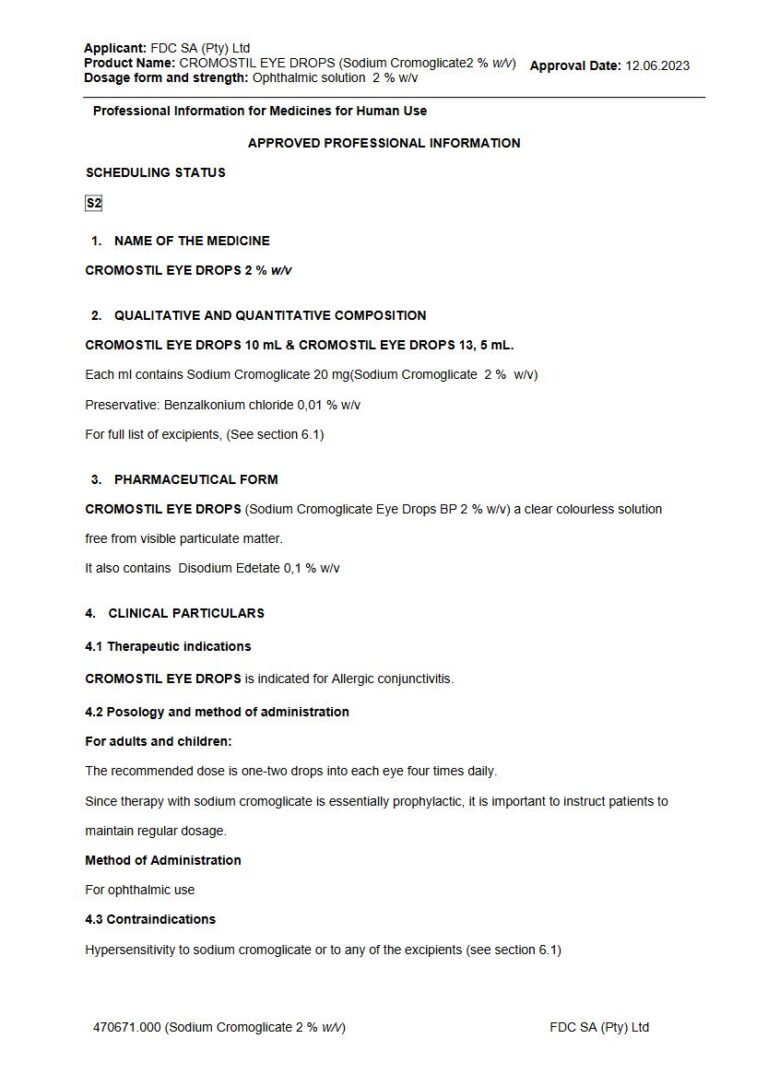
Indicated for allergic conjunctivitis.
Dosage (summary)
1-2 drops in each eye, four times daily.
Pregnancy & Breastfeeding
Caution in pregnancy, unlikely to affect breastfeeding.
Contraindications
- Hypersensitivity to sodium cromoglicate or excipients
Common side effects
- Transient stinging
- Burning
- Local irritation
Counselling Points
- Remove contact lenses before use
- May cause transient blurring of vision
Serious warnings
- Discard after 28 days of opening
- Do not wear soft contact lenses during treatment
Important Disclaimer
The Cromostil Eye Drops 2 % w/v Ophthalmic solution, professional information leaflet below is the property of Fdc Sa and is provided on Medinsert exactly as issued, with no.. alterations or editorial changes. We make every effort to keep content current by updating documents as soon as new versions become available. Medinsert serves as a trusted access point for healthcare professionals, but does not replace official sources or clinical judgement. For more details, please read our full disclaimer. read more>>
 Healthcare Professionals Only
This content is for registered healthcare professionals
Sign in or create a free account to read the full package insert.
Free for HPCSA-registered professionals. Powered by Medinsert.
Clinical Particulars
Section 4 of the official insert — extracted exactly as issued, no alterations
4.1 Therapeutic indications
CROMOSTIL EYE DROPS is indicated for Allergic conjunctivitis.
4.2 Posology and method of administration
For adults and children: The recommended dose is one -two drops into each eye four times daily. Since therapy with sodium cromoglicate is essentially prophylactic, it is important to instruct patients to maintain regular dosage.
Method of Administration
For ophthalmic use
4.3 Contraindications
Hypersensitivity to sodium cromoglicate or to any of the excipients (see section 6.1)
4.4 Special warnings and precautions for use
- Discard any remaining contents four weeks after opening the bottle.
- Soft contact lenses should not be worn during treatment period. CROMOSTIL EYE DROPS contains benzalkonium chloride. Benzalkonium chloride is a preservative which may be absorbed by soft contact lenses and may change the colour of the contact lenses. You should remove contact lenses before using this medicine and put them back 15 minutes afterwards. Benzalkonium chloride may also cause eye irritation, especially if you have dry eyes or disorders of the cornea (the clear layer at the front of the eye). If you feel abnormal eye sensation, stinging or pain in the eye after using this medicine, talk to your doctor.
- Sodium cromoglicate can be used prophylactically.
- Patients should seek advice before they discontinue use of the product.
4.5 Interaction with other medicines and other forms of interaction
Interaction with other medicines not identified.
4.6 Fertility, pregnancy and lactation
Pregnancy
Caution should be exercised especially during the first trimester of pregnancy. Cumulative experience with sodium cromoglicate suggests that it has no adverse effects on foetal development.
Lactation
It is not known whether sodium cromoglicate is excreted in human breast milk but, on the basis of its physicochemical properties, this is considered unlikely. There is no information to suggest the use of sodium cromoglicate has any undesirable effects on the baby.
Fertility
It is not known whether sodium cromoglicate has any effect on fertility.
4.7 Effects on ability to drive and use machines
Instillation of these eye drops may cause a transient blurring of vision or cause local irritation that could impact driving or operating machinery. The patient is advised not to drive or operate machinery if affected.
4.8 Undesirable effects
Eye Disorders
Transient stinging and burning may occur after instillation. Other symptoms of local irritation have been reported rarely.
Reporting of suspected adverse reactions
Reporting suspected adverse reactions after authorisation of the medicinal product is important. It allows continued monitoring of the benefit/risk balance of the medicine. Healthcare professionals are asked to report any suspected adverse reactions to SAHPRA via The u20186.04 Adverse Drug Reactions Reporting Formu2019. Found under SAHPRAu2019s publications: https://www/sahpra.org.za/Publications/Index/8
4.9 Overdose
No action other than medical observation should be necessary.
