
Chloramphenicol Eye Drops Bp 10 mL. Ophthalmic solution,
PDF Leaflet Revision Date: 25 August 2023
Clinical Summary
Quick overview from the medicine insert
Indication
Local treatment of acute eye infections.
Dosage (summary)
1-2 drops in each affected eye up to 6 times daily; severe infections may require more frequent dosing.
Special Populations
- Elderly
- Newborn infants
Pregnancy & Breastfeeding
Not recommended during pregnancy or lactation due to potential systemic absorption.
Key Drug Interactions
- Other medicines that depress bone marrow function
Contraindications
- Blood dyscrasias
- Hypersensitivity to Chloramphenicol
- Porphyria
Common side effects
- Burning sensation
- Transient irritation
- Stinging
- Hypersensitivity reactions
Counselling Points
- Avoid contact lens use during treatment
- Seek medical advice if symptoms worsen
- Do not drive if vision is blurred
Serious warnings
- Risk of bone marrow suppression
- Prolonged use may lead to resistance
Important Disclaimer
The Chloramphenicol Eye Drops Bp 10 mL. Ophthalmic solution, professional information leaflet below is the property of Fdc Sa and is provided on Medinsert exactly as issued, with no.. alterations or editorial changes. We make every effort to keep content current by updating documents as soon as new versions become available. Medinsert serves as a trusted access point for healthcare professionals, but does not replace official sources or clinical judgement. For more details, please read our full disclaimer. read more>>
 Healthcare Professionals Only
This content is for registered healthcare professionals
Sign in or create a free account to read the full package insert.
Free for HPCSA-registered professionals. Powered by Medinsert.
Clinical Particulars
Section 4 of the official insert — extracted exactly as issued, no alterations
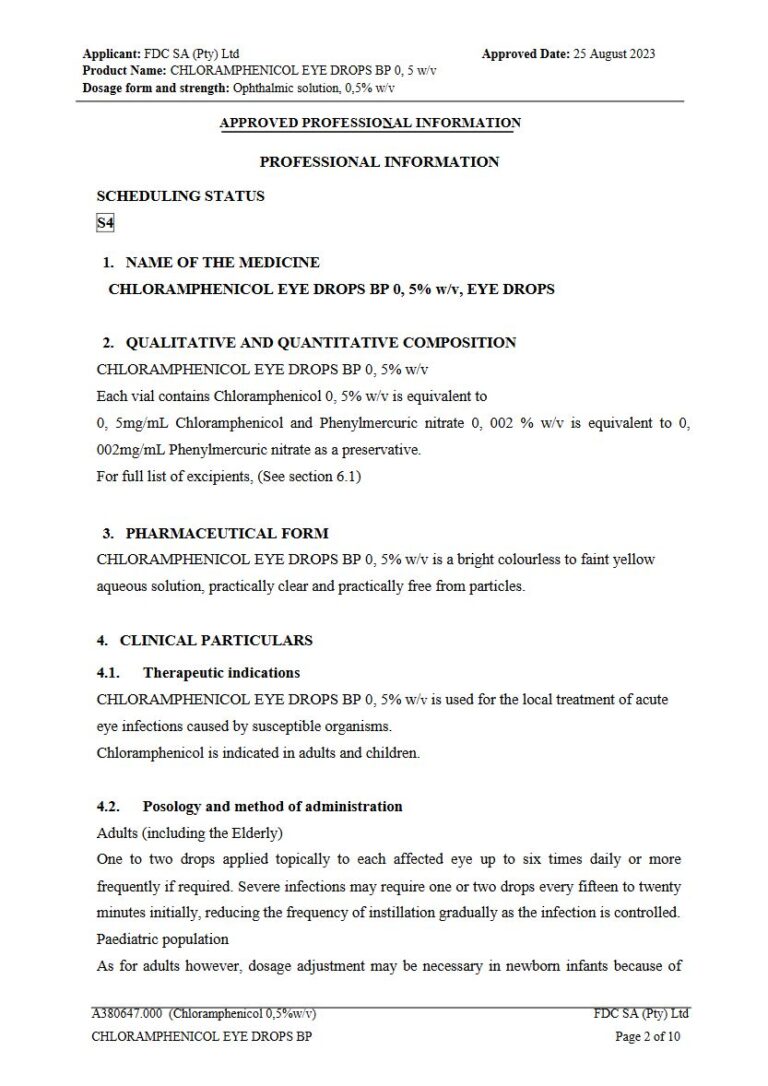
4.1. Therapeutic indications
CHLORAMPHENICOL EYE DROPS BP 0, 5% w/v is used for the local treatment of acute eye infections caused by susceptible organisms. Chloramphenicol is indicated in adults and children.
4.2. Posology and method of administration
Adults (including the Elderly)
One to two drops applied topically to each affected eye up to six times daily or more frequently if required. Severe infections may require one or two drops every fifteen to twenty minutes initially, reducing the frequency of instillation gradually as the infection is controlled.
Paediatric population
As for adults however, dosage adjustment may be necessary in newborn infants because of reduced systemic elimination due to immature metabolism and the risk of dose-related adverse effects. The maximum duration of treatment is 10 u2013 14 days.
Method of administration:
CHLORAMPHENICOL EYE DROPS BP 0, 5% w/v are ocular use only - Topical administration to the eye as directed by the ophthalmologist.
4.3. Contraindications
CHLORAMPHENICOL EYE DROPS BP 0, 5% w/v should not be administered to patients with a known personal or family history of blood dyscrasias including aplastic anaemia. A history of hypersensitivity to the Chloramphenicol or any excipients listed in section 6.1. Pregnancy and lactation (refer to section 4.6) Porphyria (refer to section 4.4)
4.4. Special warnings and precautions for use
CHLORAMPHENICOL EYE DROPS BP 0, 5% w/v is absorbed systemically from the eye and toxicity has been reported following chronic exposure. Bone marrow hypoplasia, including aplastic anaemia and death, has been reported following topical use of CHLORAMPHENICOL EYE DROPS BP 0, 5% w/v. Whilst the hazard is a rare one, it should be borne in mind when assessing the benefits expected from the use of the compound. Where CHLORAMPHENICOL EYE DROPS BP 0, 5% w/v is used on a long-term or intermittent basis, it may be advisable to perform a routine blood profile before therapy and at appropriate intervals thereafter to detect any haemopoietic abnormalities. In severe infections the topical use of chloramphenicol should be supplemented by appropriate systemic treatment. Prolonged use of chloramphenicol eye drops should be avoided as it may increase the likelihood of sensitisation and emergence of resistant organisms. If any new infection appears during treatment, the antibiotic should be discontinued and appropriate measures taken. CHLORAMPHENICOL EYE DROPS BP 0, 5% w/v should be reserved for use only in infections for which it is specifically indicated. CHLORAMPHENICOL EYE DROPS BP 0, 5% w/v does not provide adequate coverage against Pseudomonas aeruginosa and Serratia marcescens. Medical advice should be sought if there is no improvement in the condition after 2 days or if symptoms worsen at any time.
Patients should be referred to their doctor if any of the following apply:
u2022 Disturbed vision
u2022 Severe pain within the eye
u2022 Photophobia
u2022 Eye inflammation associated with a rash on the scalp or face
u2022 The eye looks cloudy
u2022 The pupil looks unusual
u2022 Suspected foreign body in the eye
CHLORAMPHENICOL EYE DROPS BP 0, 5% w/v should be used with caution in patients with a history of:
u2022 Previous conjunctivitis in the recent past
u2022 Glaucoma
u2022 Dry eye syndrome
u2022 Eye surgery or laser treatment in the last 6 months
u2022 Eye injury
u2022 Current use of other eye drops or eye ointment
u2022 Contact lens use
Soft contact lenses should not be worn during treatment with CHLORAMPHENICOL EYE DROPS BP 0, 5% w/v due to absorption of the preservative onto the lens which may cause damage to the lens. It is recommended that all types of contact lenses be avoided during ocular infections.
The packaging will convey the following information:
u2022 Seek further immediate medical advice at any time if symptoms worsen
u2022 Do not use if you are allergic to chloramphenicol or any of the ingredients
Phenylmercuric nitrate is irritating to the skin. Topical application to eyes has been associated with mercurialentis and atypical band keratopathy. Chloramphenicol has been associated with acute attacks of porphyria (disturbance in porphyrin metabolism) and is considered unsafe in patients with acute porphyria.
4.5. Interaction with other medicines and other forms of interaction
The concomitant administration of CHLORAMPHENICOL EYE DROPS BP 0, 5% w/v with other medicines liable to depress bone marrow function, aplastic anaemia should be avoided (see section 4.4).
4.6. Fertility, pregnancy and lactation
Fertility:
CHLORAMPHENICOL EYE DROPS BP 0, 5% w/v safety and efficacy on fertility has not been established.
Pregnancy:
The safety of CHLORAMPHENICOL EYE DROPS BP 0, 5% w/v safety in pregnancy has not been established.
Lactation:
CHLORAMPHENICOL EYE DROPS BP 0, 5% w/v may be absorbed systemically following the use of eye drops and may cross the placenta and appear in breast milk. Therefore this product is not recommended for use during lactation or Breast feeding.
4.7. Effects on ability to drive and use machines
CHLORAMPHENICOL EYE DROPS BP 0, 5% w/v has a minor influence on the ability to drive and use machines. Blurring of vision can occur with the drops and patients should be warned not to drive or operate machinery unless their vision is clear.
4.8 Undesirable effects
Adverse reactions reported are included in the table below. The frequencies correspond with: Frequency unknown (cannot be estimated from the available data).
Tabulated list of adverse reactions
a. Tabulated list of adverse reactions
System Organ Class Frequency
Blood & lymphatic system disorders
Blood dyscrasias Rare
Aplastic anaemia* Frequency unknown
Bone marrow suppression Frequency unknown
Idiosyncratic or related to dose and duration of treatment Frequency unknown
Immune system disorders
Anaphylactic reaction* Frequency unknown
Nervous system disorders
Burning sensation Frequency unknown
Eye disorders
Transient irritation, Burning, Stinging and sensitivity reactions such as itching, Frequency unknown
Skin and subcutaneous tissue disorders
Angioedema*, Dermatitis* (including vesicular & maculopapular dermatitis) Urticaria, Frequency unknown
General disorders and administration site conditions
Pain (stinging sensation) Pyrexia* Frequency unknown
Jarish-Herxheimer-like reactions may occur. Prolonged use may result in the overgrowth of non-susceptible organisms, including fungi. If irritation, pain, swelling, lacrimation of photophobia occurs after use, eye should be washed out for at least 15 minutes. Frequency unknown
Hypersensitivity reactions: rashes and Angioedema Less frequent
Fever, anaphylaxis Rare
*Causes for discontinuation
4.9 Overdose
Symptoms
Accidental ingestion is unlikely to cause systemic toxicity due to the low content of the antibiotic in the product. If irritation, pain, swelling, lacrimation photophobia may occur after undesired eye contact.
Management
The exposed eye(s) should be irrigated for at least 15 minutes. If symptoms persist after this, an ophthalmological examination should be considered.
