
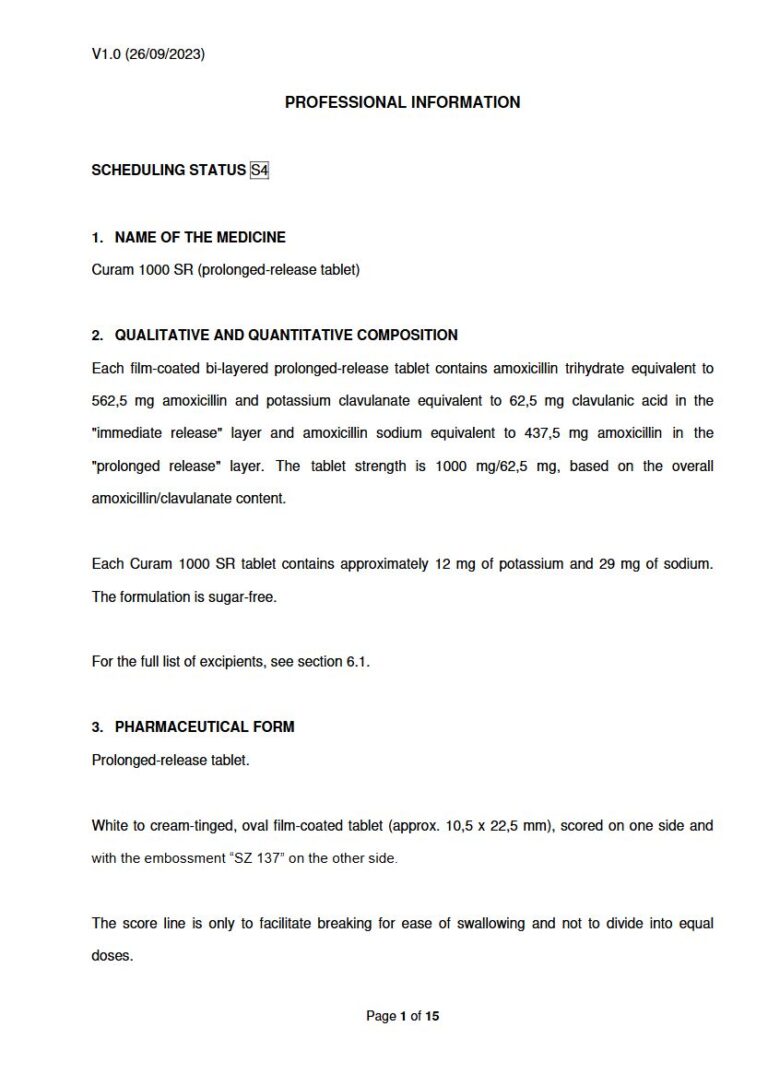
Curam 1000 Sr 437,5 mg; 562,5 mg; 62,5 mg Tablets
PDF Leaflet Revision Date: 26 September 2023
Clinical Summary
Quick overview from the medicine insert
Indication
Treatment of respiratory tract infections.
Dosage (summary)
Adults: 2 tablets 12-hourly for 7-10 days depending on infection.
Special Populations
- Renal impairment
- Hepatic impairment
Pregnancy & Breastfeeding
Safety in pregnancy not established; may cause issues in breastfeeding infants.
Key Drug Interactions
- Probenecid
- Oral anticoagulants
- Oral contraceptives
- Allopurinol
- Tetracyclines
Contraindications
- Hypersensitivity to amoxicillin or clavulanic acid
- History of jaundice/hepatic dysfunction
Common side effects
- Diarrhoea
- Nausea
- Vomiting
- Indigestion
- Headache
Counselling Points
- Take with food to minimize gastrointestinal intolerance
- Do not crush or chew tablets
- Report any allergic reactions immediately
Serious warnings
- Serious allergic reactions
- Potential for microbial overgrowth
- Clostridium difficile-associated diarrhoea
Important Disclaimer
The Curam 1000 Sr 437,5 mg; 562,5 mg; 62,5 mg Tablets professional information leaflet below is the property of Sandoz Sa and is provided on Medinsert exactly as issued, with no.. alterations or editorial changes. We make every effort to keep content current by updating documents as soon as new versions become available. Medinsert serves as a trusted access point for healthcare professionals, but does not replace official sources or clinical judgement. For more details, please read our full disclaimer. read more>>
 Healthcare Professionals Only
This content is for registered healthcare professionals
Sign in or create a free account to read the full package insert.
Free for HPCSA-registered professionals. Powered by Medinsert.
Clinical Particulars
Section 4 of the official insert — extracted exactly as issued, no alterations
4.1 Therapeutic indications
Curam 1000 SR is indicated for the treatment of respiratory tract infections, e.g. community-acquired pneumonia, acute exacerbations of chronic bronchitis and acute bacterial sinusitis, typically caused by Streptococcus pneumoniae.
4.2. Posology and method of administration
Posology: For infections caused by amoxicillin-sensitive organisms, the dosage is that approved for amoxicillin, as the clavulanic acid component does not contribute to the therapeutic effect.
Adults and adolescents u2265 16 years: The recommended dose of Curam 1000 SR is:
- Community acquired pneumonia: 2 tablets 12-hourly for 7 to 10 days.
- Acute exacerbations of chronic bronchitis: 2 tablets 12-hourly for 7 days.
- Acute bacterial sinusitis: 2 tablets 12-hourly for 10 days.
Special populations: Renal impairment: Amoxicillin and clavulanic acid are excreted by the kidneys resulting in an increase in serum half-life in patients with renal failure. The dose of Curam 1000 SR may need to be reduced or the interval extended. Dosage adjustments are based on the maximum recommended level of amoxicillin:
- No dose adjustment is required in patients with creatinine clearance u2265 30 ml/min.
- Curam 1000 SR is not recommended in patients with creatinine clearance < 30 ml/min.
- Curam 1000 SR is not recommended in haemodialysis patients.
Paediatrics and adolescents (below 16 years of age): Curam 1000 SR is not indicated for use in patients below the age of 16 years.
Method of administration: Curam 1000 SR is for oral use. Administer at the start of a meal to minimise potential gastrointestinal intolerance and optimise the absorption of the active ingredients. Curam 1000 SR is scored to allow the tablet to be broken into two halves for ease of swallowing. This is not intended to reduce the dose of medication: both halves must be taken whole at the same time. Do not crush or chew tablets.
4.3 Contraindications
- Hypersensitivity to the amoxicillin or clavulanic acid, to any of the other beta-lactam medicines (e.g. cephalosporins and penicillins) or to any of the excipients listed in section 6.1.
- History of jaundice/hepatic dysfunction due to amoxicillin/clavulanic acid (see section 4.8).
4.4 Special warnings and precautions for use
Serious Allergic Reactions, Including Anaphylaxis: Serious and occasionally fatal hypersensitivity (anaphylactic) reactions have been reported in patients on penicillin therapy. These reactions are more likely to occur in individuals with a history of penicillin hypersensitivity and/or a history of sensitivity to multiple allergens. Before initiating therapy with Curam 1000 SR, careful inquiry should be made regarding previous hypersensitivity reactions to penicillins, cephalosporins, or other allergens. If an allergic reaction occurs, Curam 1000 SR should be discontinued and appropriate therapy instituted. Serious anaphylactic reactions may require immediate emergency treatment with adrenaline. Oxygen, intravenous steroids and airway management, including intubation may also be required.
Skin Rash in Patients with Mononucleosis: Since Curam 1000 SR contains amoxicillin, an aminopenicillin, it is not the treatment of choice in patients presenting with sore throat or pharyngitis, because of the possibility that the underlying cause is infectious mononucleosis, in the presence of which there is a high incidence of morbilliform rash if amoxicillin is used. Curam 1000 SR should be avoided if infectious mononucleosis is suspected.
Potential for Microbial Overgrowth: Prolonged use of Curam 1000 SR may result in overgrowth of non-susceptible organisms. Pseudomembranous enterocolitis has been reported. The possibility of superinfections with mycotic or bacterial pathogens should be kept in mind during therapy. If superinfections occur (usually involving Pseudomonas spp. or Candida spp.), then Curam 1000 SR should be discontinued and/or appropriate therapy instituted.
Periodic Assessment of Organ System Functions: Periodic assessment of organ system functions, including renal, hepatic and haematopoietic function is advisable during prolonged therapy.
Hepatic Impairment: Curam 1000 SR should be used with caution in patients with evidence of hepatic impairment. Transient hepatitis and cholestatic jaundice have been reported. The events may be severe and occur predominantly in adult or elderly patients. Signs and symptoms usually occur during or shortly after treatment, but in some cases may not become apparent until several weeks after treatment has ceased. The hepatic events are usually reversible. However, in extremely rare circumstances, death has been reported. These have almost always been cases associated with serious underlying disease or concomitant medication.
Renal Impairment: The dose of Curam 1000 SR should be adjusted in patients with moderate renal impairment (see section 4.2). Curam 1000 SR should not be used in patients with creatinine clearance < 30 ml/minute and in haemodialysis patients (see section 4.3).
Clostridium Difficile- Associated Diarrhoea: Clostridium difficile-associated diarrhoea has been reported with nearly all antibacterial medicines including amoxicillin/clavulanic acid and may range in severity from mild to life threatening (see section 4.8). It is therefore important to consider this diagnosis in patients who present with diarrhoea during or subsequent to the administration of any antibiotics. If Clostridium difficile-associated diarrhoea is suspected or confirmed, then Curam 1000 SR should be discontinued immediately, a physician consulted, and appropriate therapy initiated.
Prolongation of Prothrombin Time: The prolongation of prothrombin time has rarely been reported in patients receiving amoxicillin/clavulanic acid. Appropriate monitoring should be undertaken when anticoagulants are prescribed concurrently (see section 4.5).
Syphilis: Caution is needed when administering amoxicillin to patients with syphilis, as the Jarisch-Herxheimer reaction may occur in these patients.
Lymphatic Leukaemia: Curam 1000 SR should be given with caution to patients with lymphatic leukaemia since they are especially susceptible to amoxicillin-induced skin rashes.
Maintenance of Adequate Fluid Intake: During the administration of high doses of amoxicillin, it is advisable to maintain adequate fluid intake and urinary output in order to reduce the possibility of amoxicillin crystalluria.
Development of Medicine-Resistant Bacteria: Prescribing Curam 1000 SR in the absence of a proven or strongly suspected bacterial infection is unlikely to provide benefit to the patient and increases the risk of the development of medicine-resistant bacteria. Sensitivity testing should, therefore, be carried out whenever possible, to demonstrate the appropriateness of therapy.
Potassium and Sodium Content: Curam 1000 SR contains approximately 12 mg of potassium and 29 mg of sodium, which is to be taken into consideration by patients on a controlled potassium and/or sodium diet.
4.5 Interaction with other medicines and other forms of interaction
Probenecid: Probenecid decreases the renal tubular secretion of amoxicillin, but does not affect clavulanic acid excretion. As concurrent use with Curam 1000 SR may result in increased and prolonged blood levels of amoxicillin, coadministration with probenecid is not recommended.
Oral anticoagulants: Abnormal prolongation of prothrombin time (increased international normalised ratio (INR)) has been reported in patients receiving amoxicillin and oral anticoagulants. Appropriate monitoring should be undertaken when anticoagulants are prescribed concurrently. Adjustments in the dose of oral anticoagulants may be necessary to maintain the desired level of anticoagulation (see section 4.4).
Oral contraceptives: Curam 1000 SR may affect intestinal flora, leading to lower oestrogen reabsorption and reduced efficacy of oral contraceptives. Patients should be warned accordingly.
Allopurinol: The concomitant administration of allopurinol and amoxicillin substantially increases the incidence of skin rashes in patients receiving both medicines as compared to patients receiving amoxicillin alone. It is not known whether this potentiation of amoxicillin rashes is due to allopurinol or the hyperuricemia present in these patients.
Tetracyclines: Tetracyclines and other bacteriostatic medicines may interfere with the bactericidal effects of amoxicillin.
Interaction with laboratory tests: High urine concentrations of amoxicillin may result in false-positive reactions when testing for the presence of glucose in urine using non-enzymatic methods. Since this effect may also occur with Curam 1000 SR, it is recommended that glucose tests based on enzymatic glucose oxidase reactions be used.
Following administration of amoxicillin to pregnant women, a transient decrease in plasma concentration of total conjugated estriol, estriol-glucuronide, conjugated estrone, and estradiol has been noted.
4.6 Fertility, pregnancy and lactation
Pregnancy: The safety of Curam 1000 SR in pregnancy has not been established. There are no adequate and well controlled studies in pregnant women. Oral ampicillin is poorly absorbed during labour. Studies in guinea pigs have shown that intravenous administration of ampicillin decreased the uterine tone, frequency of contractions, height of contractions, and duration of contractions. However, it is not known whether the use of amoxicillin/clavulanic acid in humans during labour or delivery has immediate or delayed adverse effects on the foetus, prolongs the duration of labour, or increases the likelihood that forceps delivery or other obstetrical intervention or resuscitation of the newborn will be necessary. In a single study in women with premature rupture of foetal membranes, it was reported that prophylactic treatment with amoxicillin/clavulanic acid may be associated with an increased risk of necrotising enterocolitis in neonates.
Breastfeeding: Amoxicillin is distributed into breast milk. Although significant problems in humans have not been documented, the use of Curam 1000 SR by nursing mothers may lead to sensitisation, diarrhoea, candidiasis and skin rash in the infant.
Fertility: There is no data on fertility with Curam 1000 SR.
4.7 Effects on ability to drive and use machines
No studies have been performed on the ability to drive and use machines. However, undesirable effects may occur (e.g. allergic reactions, dizziness, convulsions), which may influence the ability to drive and use machines (see section 4.8).
4.8 Undesirable effects
The most frequently reported adverse effects are diarrhoea, nausea, vomiting, indigestion, abnormal taste, headache, tiredness, hot flushes and vaginal mycosis. The incidence and severity of adverse effects, particularly nausea and diarrhoea, increased with the higher recommended dose and can be minimised by administering Curam 1000 SR at the start of a meal. In addition, as these symptoms are especially related to the potassium clavulanate component, where these gastrointestinal symptoms occur and a higher concentration of amoxicillin is required, consideration should be given to administering the additional amoxicillin separately.
Infections and infestations: Frequent: Vaginal mycosis
Blood and lymphatic system disorders: Less frequent: Thrombocytosis, prolongation of bleeding time and prothrombin time (see section 4.4). Frequency unknown: Haemolytic anaemia, reversible thrombocytopenia, thrombocytopenic purpura, eosinophilia, reversible leucopenia (including neutropenia) and agranulocytosis. These reactions are usually reversible on discontinuation of therapy and are believed to be hypersensitivity phenomena.
Immune system disorders: Frequency unknown: Serum sickness-like syndrome (urticaria or skin rash accompanied by arthritis, arthralgia, myalgia, and frequently fever), hypersensitivity vasculitis, angioneurotic oedema, anaphylaxis, (see section 4.3 and 4.4). Whenever such reactions occur, Curam 1000 SR should be discontinued. Serious and occasional fatal hypersensitivity (anaphylactic) reactions can occur with oral penicillin.
Psychiatric disorders: Less frequent: Agitation, anxiety, behavioural changes, confusion, insomnia.
Nervous system disorders: Less frequent: Reversible hyperactivity, dizziness, headache, convulsions. Convulsions may occur with impaired renal function or in those receiving high doses.
Gastrointestinal disorders: Frequent: Diarrhoea, nausea, vomiting and indigestion. Frequency unknown: Gastritis, stomatitis, glossitis, black u201chairy tongueu201d, enterocolitis, mucocutaneous candidiasis and antibiotic-associated colitis (including pseudomembranous colitis and haemorrhagic colitis), superficial tooth discolouration (brown, yellow or grey staining, which can usually be removed by brushing or dental cleaning). If gastrointestinal reactions are evident, they may be reduced by taking Curam 1000 SR with a meal. Onset of pseudomembranous colitis symptoms may occur during or after antibiotic treatment.
Hepatobiliary disorders: Frequency unknown: Moderate rise in aspartate transaminase (AST) and/or alanine transaminase (ALT) (the significance of these findings is unknown), hepatitis, cholestatic jaundice (see section 4.4). Hepatic events may be severe and occur predominantly in the elderly, in males, or in patients on prolonged treatment. Signs and symptoms usually occur during or shortly after treatment, but in some cases may not become apparent until several weeks after treatment has ceased. The hepatic events are usually reversible. However, in extremely rare circumstances, death has been reported. These have almost always been cases associated with serious underlying disease or concomitant medication.
Skin and subcutaneous tissue disorders: Less frequent: Bullous exfoliative dermatitis, acute generalised exanthemous pustulosis (AGEP), toxic epidermal necrolysis. Frequency unknown: Skin rash, urticaria, pruritus, erythema multiforme, Stevens-Johnson syndrome. When hypersensitivity skin reactions occur, treatment with Curam 1000 SR should be discontinued (see section 4.4).
Renal and urinary disorders: Less frequent: Interstitial nephritis. Frequency unknown: Haematuria, crystalluria (see section 4,4 and 4.9).
Reporting of suspected adverse reactions: Reporting suspected adverse reactions after authorisation of the medicine is important. It allows continued monitoring of the benefit/risk balance of the medicine. Healthcare providers are asked to report any suspected adverse reactions to SAHPRA via the u201c6.04 Adverse Drug Reactions Reporting Formu201d, found online under SAHPRAu2019s publications: https://www.sahpra.org.za/Publications/Index/8. Suspected side effects can also be reported directly to the Holder of the Certificate of Registration (HCR) via the link: https://pvi1j.solutions.iqvia.com or the e-mail address, [email protected].
4.9 Overdose
Overdosage with amoxicillin is usually asymptomatic. However, gastrointestinal symptoms including nausea, vomiting and diarrhoea may be evident, and symptoms of water and electrolyte imbalance should be treated symptomatically. Rash, hyperactivity, or drowsiness have also been observed in a small number of patients. Interstitial nephritis resulting in oliguric renal failure has been reported in a small number of patients after overdosage with amoxicillin. Amoxicillin crystalluria, in some cases leading to renal failure, has been observed. Adequate fluid intake and diuresis should be maintained to reduce this risk. Renal impairment appears to be reversible with cessation of medicine administration. High blood levels may occur more readily in patients with impaired renal function because of decreased renal clearance of both amoxicillin and clavulanate.
In the case of overdosage, discontinue Curam 1000 SR and treat symptomatically, instituting supportive measures as required. If the overdosage is very recent and there is no contraindication, an attempt at emesis or other means of removal of the medicine from the stomach may be performed. Both amoxicillin and clavulanic acid can be removed from the circulation by haemodialysis.
