
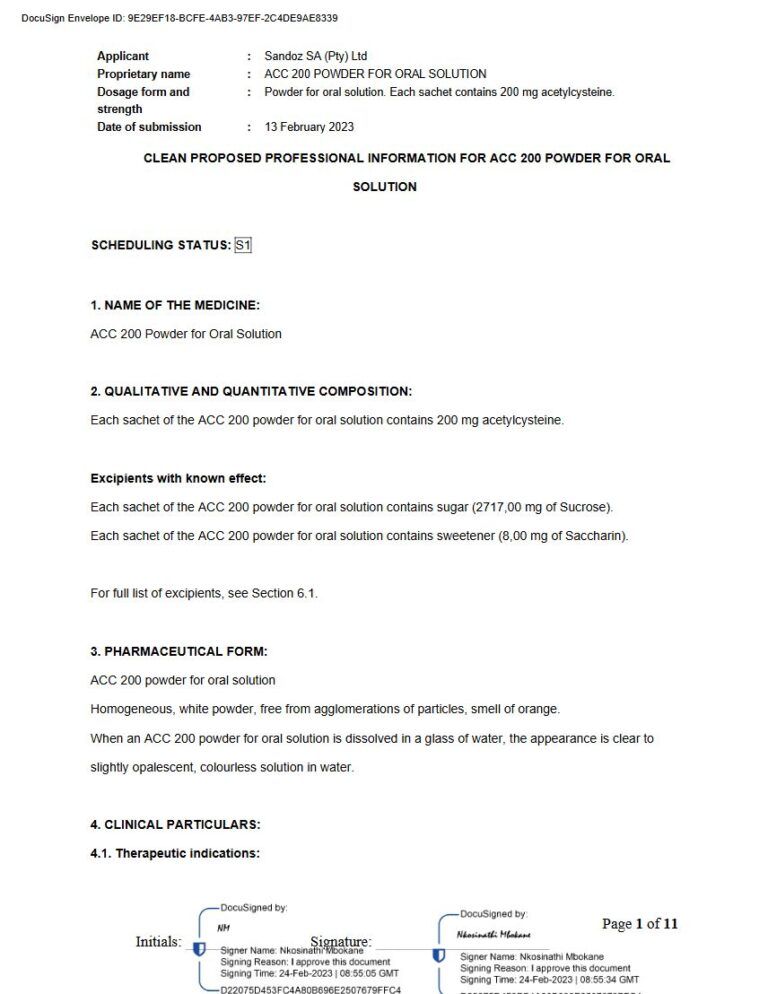
Acc 200 Powder For Oral Solution
PDF Leaflet Revision Date: 13 February 2023
Clinical Summary
Quick overview from the medicine insert
Indication
Mucolytic for acute respiratory conditions.
Dosage (summary)
Adults: 1 sachet three times daily; Children 2-6 years: 1 sachet twice daily; Children up to 2 years: 1 sachet once daily.
Special Populations
- Elderly with respiratory insufficiency
- Asthmatic patients
- Patients with peptic ulcer disease
Pregnancy & Breastfeeding
Safety in pregnancy and breastfeeding not established.
Key Drug Interactions
- Antitussive medicines
- Activated charcoal
- Oral antibiotics
- Nitroglycerin
- Carbamazepine
Contraindications
- Hypersensitivity to acetylcysteine or ingredients
Common side effects
- Headache
- Hypersensitivity
- Bronchospasm
- Vomiting
- Diarrhoea
Counselling Points
- Dissolve in water before use
- Monitor for bronchospasm
- Avoid mixing with other medicines
Serious warnings
- Serious skin reactions
- Caution in elderly and asthmatic patients
Important Disclaimer
The Acc 200 Powder For Oral Solution professional information leaflet below is the property of Sandoz Sa and is provided on Medinsert exactly as issued, with no.. alterations or editorial changes. We make every effort to keep content current by updating documents as soon as new versions become available. Medinsert serves as a trusted access point for healthcare professionals, but does not replace official sources or clinical judgement. For more details, please read our full disclaimer. read more>>
 Healthcare Professionals Only
This content is for registered healthcare professionals
Sign in or create a free account to read the full package insert.
Free for HPCSA-registered professionals. Powered by Medinsert.
Clinical Particulars
Section 4 of the official insert — extracted exactly as issued, no alterations
4.1. Therapeutic indications
ACC 200 powder for oral solution is indicated as a mucolytic in acute respiratory conditions to reduce the viscosity of non-infective secretions for a maximum treatment period of 14 days.
4.2 Posology and method of administration
Posology: The following dosages are recommended for the treatment of respiratory disorders:
- Children up to 2 years: one sachet once daily
- Children 2 to 6 years: one sachet twice daily
- Adults: one sachet three times daily
Method of administration: For oral use. The powder should be dissolved in a glass of water before administration.
4.3. Contraindications
Hypersensitivity to acetylcysteine or any of the ingredients of ACC 200 powder for oral solution listed in section 6.1. Safety in pregnancy has not been established. ACC 200 powder for oral solution should not be used during pregnancy (see section 4.6).
4.4. Special warnings and precautions for use
Use with caution in elderly patients with respiratory insufficiency or in asthmatic patients. If bronchospasm occurs, treatment with ACC 200 powder for oral solution should be discontinued immediately.
ACC 200 powder for oral solution should be used with caution in patients with recent gastroduodenal ulceration or in patients with a history of peptic ulcer disease as mucolytics may disrupt the gastric mucosal barrier.
Administration of ACC 200 powder for oral solution, especially at the beginning of treatment, may liquefy bronchial secretions and, at the same time, increase their volume. If the patient is unable to expectorate efficiently, to avoid retention of secretions postural drainage and tracheal suction should be used.
Acetylcysteine can cause interference with the colorimetric assay method for the determination of salicylates. Acetylcysteine can interfere with tests for ketones in urine.
Upon opening the sachet, the powder may smell of sulphur (rotten egg smell). This is a normal characteristic of the active substance. Upon addition of water, the solution will have a citrus odour.
Excipients ACC 200 powder for oral solution contains sucrose. Patients with the rare hereditary conditions such as fructose intolerance, glucose-galactose mal-absorption or sucrase-isomaltase insufficiency should not take ACC 200 powder for oral solution.
ACC 200 powder for oral solution contains saccharin which may have an effect on the glycaemic control of patients with diabetes mellitus.
4.5. Interaction with other medicines and other forms of interaction
Antitussive medicines and ACC 200 powder for oral solution should not be administered concomitantly because reducing the cough reflex may lead to a build-up of bronchial secretions.
Activated charcoal may reduce the effect of acetylcysteine. It is advisable not to mix ACC 200 powder for oral solution with other medicines.
It is precautionary to advise the administration of oral antibiotics at least two hours before or after ACC 200 POWDER FOR ORAL SOLUTION.
Concurrent administration of nitroglycerin and ACC 200 POWDER FOR ORAL SOLUTION causes significant hypotension and leads to temporal artery dilation with possible onset of headache. If concurrent administration of nitroglycerin and ACC 200 POWDER FOR ORAL SOLUTION is required, patients should be monitored and warned for hypotension that can be severe and accompanied by a headache.
Concurrent use of ACC 200 powder for oral solution and carbamazepine may result in sub-therapeutic carbamazepine levels.
4.6 Fertility, pregnancy and lactation
Pregnancy The safety of ACC 200 powder for oral solution in pregnancy have not been established (see section 4.3).
Breastfeeding The safety of ACC 200 powder for oral solution in breastfeeding have not been established.
4.7. Effects on ability to drive and use machines
ACC 200 powder for oral solution should be used with caution whilst driving and using machines as ACC 200 powder for oral solution may cause headaches.
4.8. Undesirable effects
Blood and the lymphatic system disorders: Frequency unknown: Haemoptysis
Immune system disorders: Less frequent: Hypersensitivity, anaphylactic shock, anaphylactic/anaphylactoid reaction.
Nervous system disorders: Less frequent: Headache.
Ear and labyrinth disorders: Less frequent: Tinnitus.
Cardiac disorders: Less frequent: Tachycardia.
Vascular disorders: Less frequent: Hypotension, haemorrhage.
Respiratory, thoracic and mediastinal disorders: Less frequent: Bronchospasm, dyspnoea. Frequency unknown: Rhinorrhoea.
Gastrointestinal disorders: Less frequent: Vomiting, diarrhoea, stomatitis, abdominal pain, nausea, dyspepsia.
Skin and subcutaneous tissue disorders: Less frequent: Urticaria, rash, angioedema, pruritus.
General disorders and administration site conditions: Less frequent: Fever. Frequency unknown: Oedema of the face, chills.
The occurrence of serious skin reactions such as Steven-Johnson syndrome and toxic epidermal necrolysis have been reported in temporal association with the use of acetylcysteine. In most of these cases reported at least one other medicine was administered at the same time, which may have possibly enhanced the described mucocutaneous effects.
In case of recurrence skin and mucosal lesions, medical advice should be sought at once and use of acetylcysteine terminated immediately.
A decreased blood platelet aggregation in the presence of acetylcysteine has been confirmed by various studies. The clinical relevance has not yet been clarified to date.
Reporting of suspected adverse reactions: Reporting suspected adverse reactions after authorisation of the medicines is important. It allows continued monitoring of the benefit/risk balance of the medicines. Healthcare providers are asked to report any suspected adverse reactions to SAHPRA via the u201c6.04 Adverse Drug Reactions Reporting Formu201d, found online under SAHPRAu2019s publications: https://www.sahpra.org.za/Publications/Index/8. Suspected adverse reactions can also be reported directly to the HCR via [email protected]
4.9. Overdose
An acute overdose of ACC 200 POWDER FOR ORAL SOLUTION can cause gastrointestinal symptoms such as nausea, vomiting and diarrhoea.
Treatment of overdose: Treatment of overdose is to be symptomatic and supportive treatment as indicated by the patientu2019s clinical condition.
