
Desrem 100,0 mg Lyophilized powder for Injection
PDF Leaflet Revision Date: 03 October 2023
Clinical Summary
Quick overview from the medicine insert
Indication
Treatment of COVID-19 in adults with pneumonia requiring supplemental oxygen.
Dosage (summary)
Day 1: 200 mg IV loading dose; Day 2+: 100 mg IV daily for 5-10 days.
Special Populations
- Elderly
- Renal impairment
- Hepatic impairment
Pregnancy & Breastfeeding
Not recommended in pregnancy; avoid breastfeeding during treatment.
Key Drug Interactions
- Chloroquine
- Hydroxychloroquine
Contraindications
- Hypersensitivity to remdesivir or excipients
Common side effects
- Nausea
- Increased transaminases
- Rash
Counselling Points
- Monitor for hypersensitivity
- Do not breast-feed
- Use effective contraception
Serious warnings
- Hypersensitivity reactions
- Transaminase elevations
- Renal toxicity
Important Disclaimer
The Desrem 100,0 mg Lyophilized powder for Injection professional information leaflet below is the property of Mylan (Pty Ltd and is provided on Medinsert exactly as issued, with no.. alterations or editorial changes. We make every effort to keep content current by updating documents as soon as new versions become available. Medinsert serves as a trusted access point for healthcare professionals, but does not replace official sources or clinical judgement. For more details, please read our full disclaimer. read more>>
 Healthcare Professionals Only
This content is for registered healthcare professionals
Sign in or create a free account to read the full package insert.
Free for HPCSA-registered professionals. Powered by Medinsert.
Clinical Particulars
Section 4 of the official insert — extracted exactly as issued, no alterations
4.1 Therapeutic indications
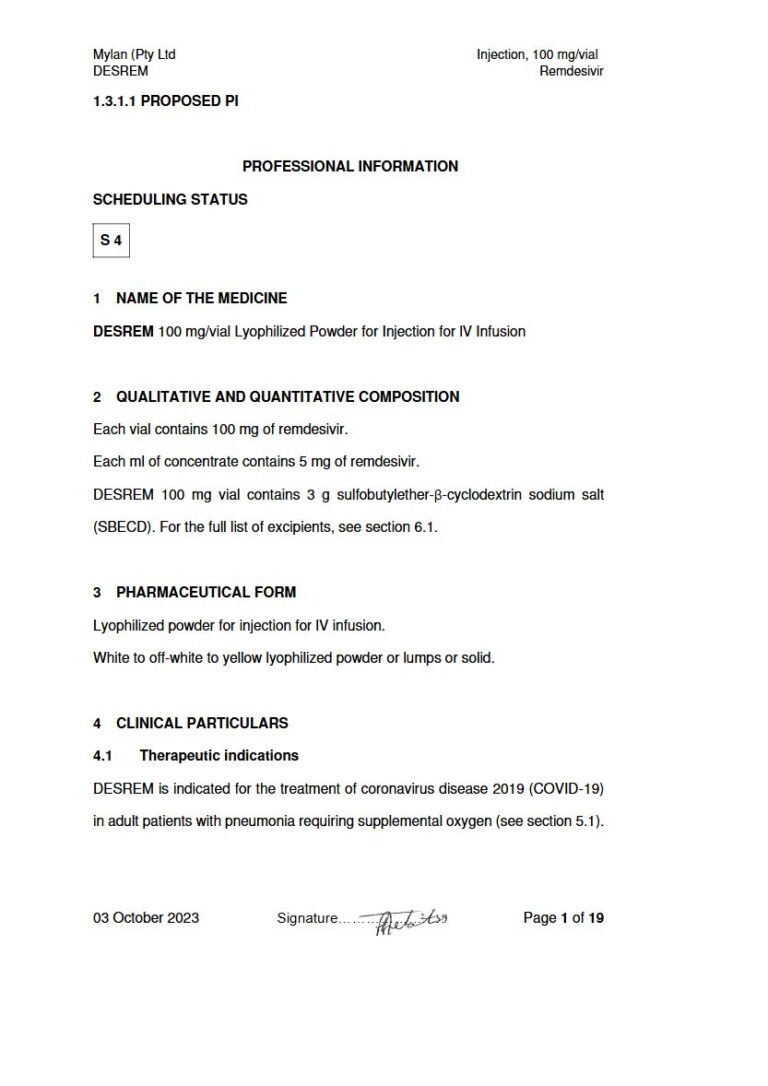
DESREM is indicated for the treatment of coronavirus disease 2019 (COVID-19) in adult patients with pneumonia requiring supplemental oxygen (see section 5.1).
4.2 Posology and method of administration
Use of DESREM is confined to healthcare facilities in which patients can be monitored closely (see section 4.4).
Posology
The recommended dosage of DESREM is:
- Day 1 u2013 single loading dose of DESREM 200 mg given by intravenous infusion.
- Day 2 onwards u2013 100 mg given once daily by intravenous infusion.
The total duration of treatment should be at least 5 days and not more than 10 days.
Special populations
Elderly
No dose adjustment of DESREM is required in patients over the age of 65 years (see sections 5.1 and 5.2).
Renal impairment
The pharmacokinetics of remdesivir have not been evaluated in patients with renal impairment. Patients with eGFR u2265 30 ml/min have received remdesivir for treatment of COVID-19 with no dose adjustment. DESREM should not be used in patients with eGFR < 30 ml/min (see sections 4.4 and 5.2).
Hepatic impairment
The pharmacokinetics of remdesivir have not been evaluated in patients with hepatic impairment. It is not known if dosage adjustment is appropriate in patients with hepatic impairment (see section 4.4 and 5.2).
Paediatric population
The safety and efficacy of DESREM in children under the age of 18 years have not yet been established. No data are available.
Method of administration
For intravenous use. DESREM is for administration by intravenous infusion after further dilution. It must not be given as an intramuscular (IM) injection.
Table 1: Recommended rate of infusion u2013 for diluted remdesivir concentrate for solution for infusion
| Infusion Bag Volume | Infusion Time | Rate of Infusion |
|---|---|---|
| 250 ml | 30 min | 8,33 ml/min |
| 60 min | 4,17 ml/min | |
| 120 min | 2,08 ml/min | |
| 100 mL | 30 min | 3,33 mL/min |
| 60 min | 1,67 mL/min | |
| 120 min | 0,83 mL/min |
4.3 Contraindications
- Hypersensitivity to remdesivir or to any of the excipients of DESREM (see section 6.1).
4.4 Special warnings and precautions for use
Hypersensitivity including infusion-related and anaphylactic reactions
Hypersensitivity reactions including infusion-related and anaphylactic reactions have been observed during and following administration of DESREM. Signs and symptoms may include hypotension, hypertension, tachycardia, bradycardia, hypoxia, fever, dyspnea, wheezing, angioedema, rash, nausea, vomiting, diaphoresis, and shivering. Slower infusion rates, with a maximum infusion time of up to 120 minutes, can be considered to potentially prevent these signs and symptoms.
If signs and symptoms of a clinically significant hypersensitivity reaction occur, immediately discontinue administration of DESREM and initiate appropriate treatment.
Transaminase elevations
Transaminase elevations have been observed in the remdesivir clinical trials, including in healthy volunteers and patients with COVID-19. Liver function should be determined in all patients prior to starting DESREM and should be monitored while receiving it as clinically appropriate. No clinical studies with remdesivir have been conducted in patients with hepatic impairment.
DESREM should not be initiated in patients with Alanine Aminotransferase (ALT) u2265 5 times the upper limit of normal at baseline
- DESREM should be discontinued in patients who develop:
- ALT u2265 5 times the upper limit of normal during treatment with remdesivir. It may be restarted when ALT is <5 times the upper limit of normal.
- OR ALT elevation accompanied by signs or symptoms of liver inflammation or increasing conjugated bilirubin, alkaline phosphatase, or international normalised ratio (INR) (see sections 4.8 and 5.2).
Renal impairment
In animal studies on rats and monkeys, severe renal toxicity was observed. The mechanism of this renal toxicity is not fully understood. A relevance for humans cannot be excluded.
All patients should have eGFR determined prior to starting DESREM and while receiving it as clinically appropriate. Remdesivir should not be used in patients with eGFR < 30 ml/min.
Risk of reduced antiviral activity when co-administered with chloroquine or hydroxychloroquine
Co-administration of DESREM and chloroquine phosphate or hydroxychloroquine sulphate is not recommended based on in vitro data demonstrating an antagonistic effect of chloroquine on the intracellular metabolic activation and antiviral activity of remdesivir (see section 4.5, 5.1).
Excipients
DESREM contains sulfobutylether-u03b2-cyclodextrin sodium salt (SBECD), which is renally cleared and accumulates in patients with decreased renal function, which may potentially adversely affect renal function. Therefore, DESREM should not be used in patients with eGFR < 30 ml/min (see sections 4.2 and 5.2).
4.5 Interaction with other medicines and other forms of interaction
No clinical interaction studies have been performed with remdesivir. The overall potential for interactions is currently unknown; patients should remain under close observation during the days of remdesivir administration. Due to antagonism observed in vitro, concomitant use of remdesivir with chloroquine phosphate or hydroxychloroquine sulphate is not recommended.
Effects of other medicines on DESREM
In vitro, DESREM is a substrate for esterases in plasma and tissue, metabolizing enzymes CYP2C8, CYP2D6, and CYP3A4, and is a substrate for Organic Anion Transporting Polypeptides 1B1 (OATP1B1) and P-glycoprotein (P-gp) transporters. The potential of interaction of DESREM with inhibitors/inducers of the hydrolytic pathway (esterase) or CYP2C8, 2D6 or 3A4 has not been studied. The risk of clinically relevant interaction is unknown.
Strong inhibitors may result in increased DESREM exposure. The use of strong inducers (e.g. rifampicin) may decrease plasma concentrations of remdesivir and is not recommended. Dexamethasone is reported to be a moderate inducer of CYP3A and P-gp. Induction is dose-dependent and occurs after multiple doses. Dexamethasone is unlikely to have a clinically significant effect on DESREM as DESREM has a moderate-high hepatic extraction ratio, and is used for a short duration in the treatment of COVID-19.
Effects of DESREM on other medicines
In vitro, DESREM is an inhibitor of CYP3A4, OATP1B1 and OATP1B3. The clinical relevance of these in vitro interactions has not been established. DESREM may transiently increase plasma concentrations of medicines that are substrates of CYP3A or OATP 1B1/1B3. No data is available, however it can be suggested that medicines that are substrates of CYP3A4 or substrates of OATP 1B1/1B3 should be administered at least 2 hours after DESREM. DESREM induced CYP1A2 and potentially CYP3A in vitro. Co-administration of DESREM with CYP1A2 or CYP3A4 substrates with narrow therapeutic index may lead to loss of their efficacy. Dexamethasone is a substrate of CYP3A4 and although DESREM inhibits CYP3A4, due to remdesivir's rapid clearance after I.V administration, DESREM is unlikely to have a significant effect on dexamethasone exposure.
4.6 Fertility, pregnancy and lactation
Women of child-bearing potential/Contraception in males and females
Women of child-bearing potential have to use effective contraception during treatment.
Pregnancy
There are no or limited amount of data from the use of DESREM in pregnant women. Animal studies are insufficient with respect to reproductive toxicity. DESREM should not be used during pregnancy.
Breast-feeding
It is unknown whether DESREM is excreted in human milk or the effects on the breast-fed infant, or the effects on milk production. In animal studies, the nucleoside analog metabolite GS-441524 has been detected in the blood of nursing rat pups of mothers given remdesivir. Therefore, excretion of remdesivir and/or metabolites into the milk of lactating animals can be assumed.
Because of the potential for viral transmission to SARS-CoV-2-negative infants and adverse reactions from the medicine in breast-feeding infants, mothers receiving DESREM should not breast-feed their infants.
Fertility
No human data on the effect of remdesivir on fertility are available. In male rats, there was no effect on mating or fertility with remdesivir treatment. In female rats, however, an impairment of fertility was observed. The relevance for humans is unknown.
4.7 Effects on ability to drive and use machines
Patients receiving DESREM must not drive or use machines until all side effects of the medicine and the symptoms of SARS-CoV-2 infection, have resolved.
4.8 Undesirable effects
a. Summary of the safety profile
The most common adverse reaction in healthy volunteers is increased transaminases (14 %). The most common adverse reaction in patients with COVID-19 is nausea (4 %).
b. Tabulated summary of adverse reactions
The adverse reactions in the table are listed below by system organ class and frequency.
System organ class
Frequency
Adverse reactions
Immune system disorders
Less frequent
Frequency not known
Hypersensitivity
Anaphylactic reaction
Nervous system disorders
Frequent
Headache
Cardiac disorders
Frequency not known
Sinus bradycardia
Gastrointestinal disorders
Frequent
Nausea
Hepatobiliary disorders
Frequent
Transaminases increased
Skin and subcutaneous tissue disorders
Frequent
Rash
Injury, poisoning and procedural complications
Less frequent
Infusion-related reaction
Investigations
Frequent
Prothrombin time prolonged
Reporting of suspected adverse reactions
Reporting suspected adverse reactions after authorisation of the medicine is important. It allows continued monitoring of the benefit/risk balance of the medicine. Health care providers are asked to report any suspected adverse reactions to SAHPRA via the u201c6.04 Adverse Drug Reactions & Quality Problem Reporting Formu201d, found online under SAHPRAu2019s publications: https://sahpra.org.za/wp-content/uploads/2020/01/6.04_ARF1_v5.1_27Jan2020.pdf
4.9 Overdose
Treatment of overdose with DESREM should consist of general supportive measures including monitoring of vital signs and observation of the clinical status of the patient. There is no specific antidote for overdose with DESREM.
