
Veklury Lyophilised 100 Mg/20 ml/5 mg Injection
PDF Leaflet Revision Date: 17 September 2025
Clinical Summary
Quick overview from the medicine insert
Indication
Treatment of COVID-19 in adults with pneumonia requiring supplemental oxygen.
Dosage (summary)
Day 1: 200 mg IV loading dose; Day 2-10: 100 mg IV daily.
Special Populations
- Elderly
- Renal impairment
- Hepatic impairment
Pregnancy & Breastfeeding
Limited data; avoid in first trimester; consider in second/third trimester. Do not breastfeed.
Key Drug Interactions
- Coadministration with chloroquine or hydroxychloroquine not recommended.
Contraindications
- Hypersensitivity to remdesivir or excipients.
Common side effects
- Nausea
- Increased transaminases
- Rash
Counselling Points
- Monitor for hypersensitivity during infusion.
- Do not drive or operate machinery until effects are known.
Serious warnings
- Hypersensitivity reactions including anaphylaxis.
- Monitor renal function.
Important Disclaimer
The Veklury Lyophilised 100 Mg/20 ml/5 mg Injection professional information leaflet below is the property of Gilead Sciences South Africa and is provided on Medinsert exactly as issued, with no.. alterations or editorial changes. We make every effort to keep content current by updating documents as soon as new versions become available. Medinsert serves as a trusted access point for healthcare professionals, but does not replace official sources or clinical judgement. For more details, please read our full disclaimer. read more>>
 Healthcare Professionals Only
This content is for registered healthcare professionals
Sign in or create a free account to read the full package insert.
Free for HPCSA-registered professionals. Powered by Medinsert.
Clinical Particulars
Section 4 of the official insert — extracted exactly as issued, no alterations
4.1 Therapeutic indications
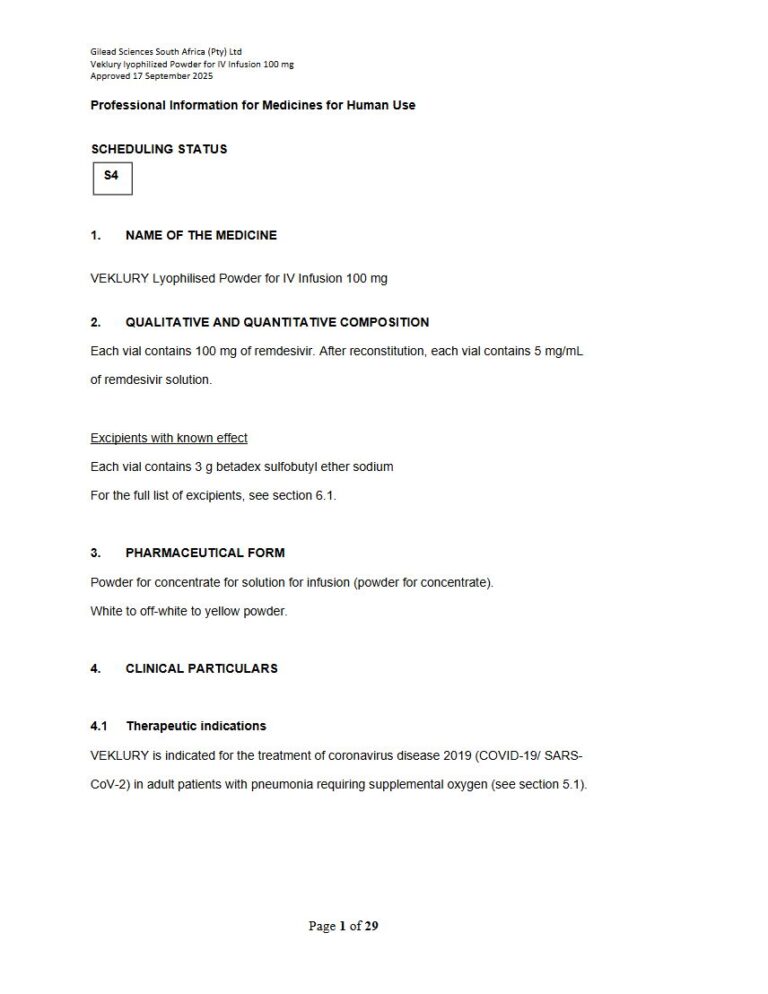
VEKLURY is indicated for the treatment of coronavirus disease 2019 (COVID-19/ SARS- CoV-2) in adult patients with pneumonia requiring supplemental oxygen (see section 5.1).
4.2 Posology and method of administration
Use of VEKLURY is confined to healthcare facilities in which patients can be monitored closely (see section 4.4).
Posology
The recommended dosage of VEKLURY is:
- Day 1 u2013 single loading dose of remdesivir 200 mg given by intravenous infusion
- Day 2 onwards u2013 100 mg given once daily by intravenous infusion.
The total duration of treatment should be at least 5 days and not more than 10 days.
Special populations
Elderly
No dose adjustment of VEKLURY is required in patients over the age of 65 years (see sections 5.1 and 5.2).
Renal impairment
No dose adjustment of remdesivir is required in patients with renal impairment, including those on dialysis. However, safety data in patients with severe renal impairment and end stage renal disease (ESRD) are limited (see section 4.4) and based on a 5-day treatment duration. The timing of administration of remdesivir is without regard to dialysis (see section 5.2).
Hepatic impairment
No dose adjustment of VEKLURY is required in patients with mild, moderate and severe hepatic impairment (Child-Pugh Class A, B, C) (see section 5.2). However, safety data in patients with severe hepatic impairment are limited and only based on a single 100 mg dose administration.
Paediatric population
The safety and efficacy of VEKLURY in children under the age of 18 years have not yet been established. No data are available.
Method of administration
For intravenous use. VEKLURY is for administration by intravenous infusion after reconstitution and further dilution. It must not be given as an intramuscular (IM) injection. For instructions on reconstitution and dilution of the medicinal product before administration, see section 6.6.
Table 1: Recommended rate of infusion u2013 for reconstituted and diluted remdesivir powder for concentrate for solution for infusion
| Infusion Bag Volume | Infusion Time | Rate of Infusion |
|---|---|---|
| 250 mL | 30 min | 8.33 mL/min |
| 60 min | 4.17 mL/min | |
| 120 min | 2.08 mL/min | |
| 100 mL | 30 min | 3.33 mL/min |
| 60 min | 1.67 mL/min | |
| 120 min | 0.83 mL/min |
4.3 Contraindications
Hypersensitivity to remdesivir or to any of the excipients listed in section 6.1.
4.4 Special warnings and precautions for use
Hypersensitivity including infusion-related and anaphylactic reactions
Hypersensitivity reactions including infusion-related and anaphylactic reactions have been observed during and following administration of VEKLURY. Signs and symptoms may include hypotension, hypertension, tachycardia, bradycardia, hypoxia, fever, dyspnoea, wheezing, angioedema, rash, nausea, vomiting, diaphoresis, and shivering. Slower infusion rates, with a maximum infusion time of up to 120 minutes, can be considered to potentially prevent these signs and symptoms. Monitor patients for hypersensitivity reactions during and following administration of VEKLURY. If signs and symptoms of a clinically significant hypersensitivity reaction occur, immediately discontinue administration of VEKLURY and initiate appropriate treatment.
Renal impairment
As clinically appropriate, patients should have eGFR determined prior to starting remdesivir and while receiving it. Safety data from patients with severe renal impairment and ESRD reported during Study GS-US-540-5912 were comparable to the known safety profile of VEKLURY. However, there are limited safety data in this patient population. Therefore, taking the significant higher exposure of the metabolite GS-441524 into account, patients with severe renal impairment and ESRD should be closely monitored for adverse events during treatment with VEKLURY (see section 5.2).
Excipients
This medicinal product contains 212 mg sodium per 100 mg dose equivalent to 10.6 % of the WHO recommended maximum daily intake of 2 g sodium for an adult.
Risk of reduced antiviral activity when coadministered with chloroquine or hydroxychloroquine
Coadministration of VEKLURY and chloroquine phosphate or hydroxychloroquine sulphate is not recommended based on in vitro data demonstrating an antagonistic effect of chloroquine on the intracellular metabolic activation and antiviral activity of VEKLURY (see sections 4.5 and 5.1) Concomitant use of remdesivir and dexamethasone, interferon and other medicines have not been investigated.
4.5 Interaction with other medicinal products and other forms of interaction
Due to antagonism observed in vitro, concomitant use of remdesivir with chloroquine phosphate or hydroxychloroquine sulphate is not recommended.
Effects of other medicinal products on VEKLURY
In vitro, remdesivir is a substrate for esterases in plasma and tissue, drug metabolizing enzyme CYP3A4 and is a substrate for Organic Anion Transporting Polypeptides 1B1 (OATP1B1) and P-glycoprotein (P-gp) transporters. GS-704277 (a metabolite of remdesivir) is a substrate for OATP1B1 and OATP1B3.
A drug-drug interaction study was conducted with remdesivir. Table 2 summarises the pharmacokinetic effects of studied drugs on remdesivir and metabolites GS-704277 and GS-441524.
Table 2: Effect of other drugs on remdesivir and metabolites GS-704277 and GS-441524
NOTE: Interaction study conducted in healthy volunteers.
Effects of VEKLURY on other medicinal products
In vitro, VEKLURY is an inhibitor of CYP3A4, UGT1A1, MATE1, OAT3, OCT1, OATP1B1 and OATP1B3. Until respective clinical data become available, the coadministration of sensitive substrates of these enzymes and/or transporters should be considered with caution. VEKLURY induced CYP1A2 and potentially CYP3A in vitro. Co-administration of VEKLURY with CYP1A2 or CYP3A4 substrates with narrow therapeutic index may lead to loss of their efficacy. Dexamethasone is a substrate of CYP3A4 and although VEKLURY inhibits CYP3A4, due to VEKLURY's rapid clearance after IV administration, remdesivir is unlikely to have a significant effect on dexamethasone exposure.
4.6 Fertility, pregnancy and lactation
Pregnancy
There is a limited amount of data from the use of VEKLURY in pregnant women (less than 300- pregnancy outcomes). Most of the exposures occurred in the second, third or an unknown trimester and available data do not indicate any risk.
Animal studies do not indicate direct or indirect harmful effects with respect to reproductive toxicity at exposures of the major metabolite of remdesivir that were around human therapeutic exposures (see section 5.3). Due to very limited experience, remdesivir should not be used during first trimester in pregnancy. Use in the second and third trimester of pregnancy may be considered. Use of effective contraception during treatment should be considered in women of child-bearing potential.
Breast-feeding
Remdesivir and its major metabolite are excreted into breast milk in very small amounts after intravenous administration. Because of the potential for viral transmission to SARS-CoV-2-negative infants and the limited clinical experience, mothers receiving VEKLURY should not breastfeed their infants.
Fertility
No human data on the effect of remdesivir on fertility are available. In male rats, there was no effect on mating or fertility with VEKLURY treatment. In female rats, however, an impairment of fertility was observed (see section 5.3). The relevance for humans is unknown.
4.7 Effects on ability to drive and use machines
Patients receiving VEKURY must not drive or use machines until all side effects of the medicine and the symptoms of SARS-CoV-2 infection, have resolved.
4.8 Undesirable effects
Summary of the safety profile
The most common adverse reaction in healthy volunteers is increased transaminases (14 %). The most common adverse reaction in patients with COVID-19 is nausea (4 %).
Tabulated summary of adverse reactions
The adverse reactions in Table 3 are listed below by system organ class and frequency. Frequencies are defined as follows: Very common (u22651/10); common (u22651/100 to <1/10); uncommon (u22651/1,000 to <1/100); rare (u22651/10,000 to <1/1,000). Not known (cannot be estimated from the available data)
Table 3: Tabulated list of adverse reactions
| Frequency | Adverse reaction |
|---|---|
| Immune system disorders | Rare hypersensitivity |
| Not known Anaphylactic reaction, anaphylactic shock | |
| Nervous system disorders | Common headache |
| Cardiac disorders | Not known Sinus bradycardia* |
| Gastrointestinal disorders | Common nausea |
| Hepatobiliary disorders | Very common transaminases increased |
| Skin and subcutaneous tissue disorders | Common rash |
| Investigations | Very common Prothrombin time prolonged |
| Injury, poisoning and procedural complications | Rare infusion-related reaction |
*Reported in post-marketing, usually normalised within 4 days following last VEKLURY administration without additional intervention
Description of selected adverse reactions
Transaminases increased
In healthy volunteer studies, increases in alanine transaminase (ALT), aspartate aminotransferase (AST) or both in subjects who received VEKLURY were 1,25 to 2,5 times the upper limit of normal (ULN) (10 %) or 2,5 to 5 times ULN (4 %). In clinical studies of patients with COVID-19, the incidence of increased transaminases was similar in patients treated with VEKLURY compared to placebo or standard of care.
Prothrombin time prolonged
In a clinical study (NIAID ACTT-1) of patients with COVID-19, the incidence of prolonged prothrombin time or INR (predominantly less than 2 times ULN) was higher in subjects who received remdesivir compared to placebo, with no difference observed in the incidence of bleeding events between the two groups. In Study GS-US-540-9012, the incidence of increased prothrombin time or INR was similar in patients treated with remdesivir compared to placebo.
Patients with renal impairment
In Study GS-US-540-5912, 163 hospitalised patients with confirmed COVID-19 and acute kidney injury, chronic kidney disease or ESRD on haemodialysis received remdesivir for up to 5 days (see sections 4.4 and 5.2). Safety data from these patients were comparable to the known safety profile of remdesivir. In this same study, the incidence of increased prothrombin time or INR was higher in patients treated with remdesivir compared to placebo, with no difference observed in the incidence of bleeding events between the two groups (see section 5.1).
Reporting of suspected adverse reactions
Reporting suspected adverse reactions after authorisation of the medicine is important. It allows continued monitoring of the benefit/risk balance of the medicine. Health care providers are requested to report any suspected adverse reactions to SAHPRA via the Med Safety APP (Medsafety X SAHPRA) and eReporting platform (who-ucm.org) found on SAHPRA website.
4.9 Overdose
Treatment of overdose with VEKLURY should consist of general supportive measures including monitoring of vital signs and observation of the clinical status of the patient. There is no specific antidote for overdose with VEKLURY.
