
Digestif Rennie Orange Tablets 80MG / 680MG TABLET
PDF Leaflet Revision Date: 09 October 2009
Clinical Summary
Quick overview from the medicine insert
Indication
Relief of heartburn.
Dosage (summary)
1-2 tablets after meals and before bed; max 11 tablets/day.
Onset of Action / Duration
Onset: 30 mins, Duration: 2 hours
Special Populations
- Renal impairment
- Children under 12
Pregnancy & Breastfeeding
No risk in pregnancy or breastfeeding at recommended doses.
Key Drug Interactions
- Iron
- Tetracyclines
- Vitamins
- Digitalis glycosides
Contraindications
- Hypermagnesaemia
- Hypercalcaemia
- Alkalosis
- Hypersensitivity
Common side effects
- Constipation
- Flatulence
- Eructations
Counselling Points
- Take after meals and before bed.
- Do not exceed recommended dose.
- Consult if symptoms persist.
Serious warnings
- Do not use for longer than 2 weeks without medical advice.
- Caution in renal impairment.
Important Disclaimer
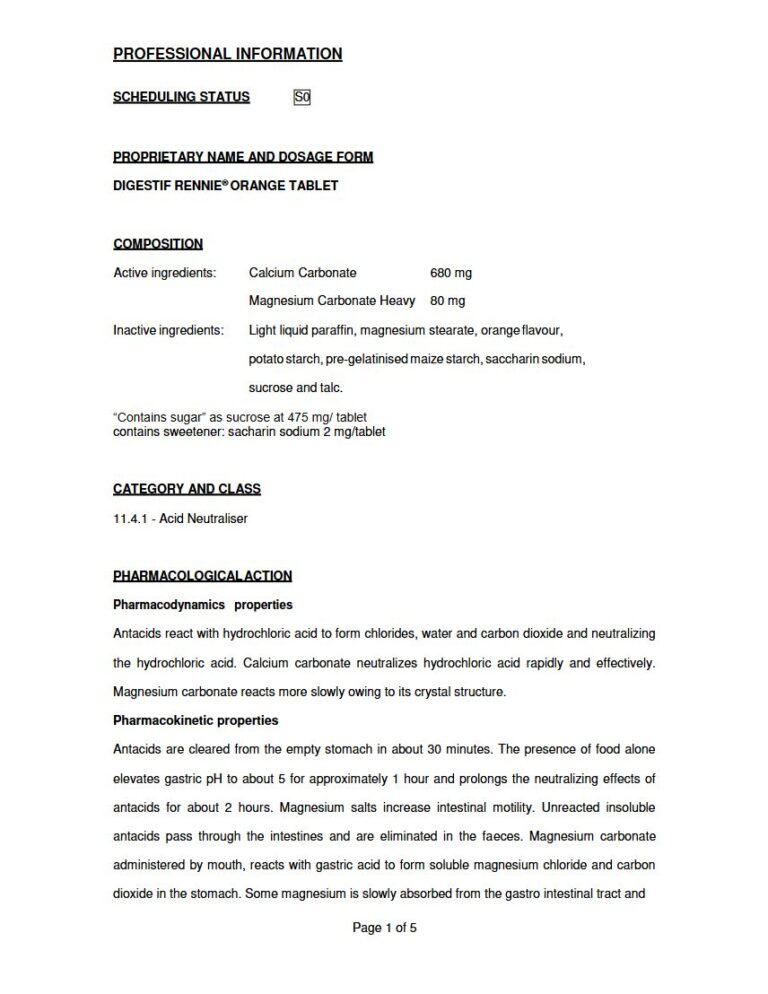
The Digestif Rennie Orange Tablets 80MG / 680MG TABLET professional information leaflet below is the property of Bayer and is provided on Medinsert exactly as issued, with no.. alterations or editorial changes. We make every effort to keep content current by updating documents as soon as new versions become available. Medinsert serves as a trusted access point for healthcare professionals, but does not replace official sources or clinical judgement. For more details, please read our full disclaimer. read more>>
 Healthcare Professionals Only
This content is for registered healthcare professionals
Sign in or create a free account to read the full package insert.
Free for HPCSA-registered professionals. Powered by Medinsert.
Clinical Particulars
Section 4 of the official insert — extracted exactly as issued, no alterations
4.1 Therapeutic indications
When an antacid is indicated, such as heartburn and heartburn in pregnancy.
4.2 Posology and method of administration
Adults and children u2265 12 years: 1-2 chewable tablets as a single dose, preferably to be taken one hour after meals and before going to bed but also between meals in case of heartburn or epigastric pain. A maximum daily dose of 8 g calcium carbonate (corresponding to 11 Digestif Rennie u00ae tablets) must not be exceeded. If symptoms persist in spite of therapy, diagnostic measures are strongly recommended in order to rule out a more serious disease. Not recommended for children under 12 years of age.
4.3 Contraindications
Hypermagnesaemia, hypercalcaemia or alkalosis. Hypersensitivity to any of the ingredients.
4.4 Special warnings and precautions for use
Do not continue usage for longer than 2 weeks except on the advice of a doctor. Do not give to children under five years, except on the advice of a doctor. May interfere with the absorption of other medicines given concomitantly (See u201cINTERACTIONSu201d). In cases of renal impairment the product should only be used on medical advice.
Renal: DIGESTIF RENNIE u00ae ORANGE TABLET should be used with caution when a state of debility, renal insufficiency or a pre-disposition to kidney stones exists. Enough calcium may be absorbed to cause systemic and renal effects in certain cases. Some of the magnesium may be absorbed and it is usually excreted rapidly in the urine. If renal function is impaired, hypermagnesaemia may result.
4.5 Interactions with other medicines
DIGESTIF RENNIE u00ae ORANGE TABLET may interfere with the absorption of other medicines, e.g. iron, tetracyclines and vitamins, if taken concomitantly. Calcium salts may enhance the cardiac effects of digitalis glycosides.
4.6 Fertility, pregnancy and lactation
Clinical experience with DIGESTIF RENNIE u00ae ORANGE TABLET has revealed no cases of associated foetal malformations. At the recommended dosage, the use of DIGESTIF RENNIE u00ae ORANGE TABLET poses no risk in pregnant or lactating (breast feeding) women.
4.7 Effects on ability to drive and use machines
No specific information available.
4.8 Undesirable effects
Gastro-intestinal: Very rare (<1/10,000) Calcium carbonate may cause constipation. However, the magnesium carbonate may counteract the latter tendency since magnesium salts are known to be mildly laxative in action. Flatulence from released carbon dioxide is usually not serious. Eructations may occur in some patients.
Metabolic: Very rare (<1/10,000) Alkalosis, hypercalcaemia, acid rebound and milk-alkali syndrome has occurred usually in patients taking doses higher than the recommended dosage or in patients with renal impairment.
4.9 Overdose
Hypercalcaemia and alkalosis which may occur with excessive doses of calcium carbonate respond to withdrawal of tablets. If renal function is impaired, hypermagnesaemia may result which is rapidly reversed by calcium salts given intravenously. IN THE EVENT OF OVERDOSAGE CONTACT A MEDICAL DOCTOR OR THE NEAREST HOSPITAL.
