
Bayer Aspirin Cardio 100 Tablets
PDF Leaflet Revision Date: 30 June 2022
Clinical Summary
Quick overview from the medicine insert
Indication
Cardiovascular risk reduction in adults.
Dosage (summary)
100 mg daily, preferably before meals.
Special Populations
- Elderly
- Hepatic impairment
- Renal impairment
Pregnancy & Breastfeeding
Contraindicated in third trimester; not recommended in first and second trimesters; avoid breastfeeding during use.
Key Drug Interactions
- Methotrexate
- NSAIDs
- Anticoagulants
- SSRIs
- Digoxin
Contraindications
- Hypersensitivity to acetylsalicylic acid
- Severe renal impairment
- Severe hepatic impairment
- Gastrointestinal ulcers
- Asthma induced by salicylates
Common side effects
- Dizziness
- Tinnitus
- Gastrointestinal bleeding
- Iron deficiency anaemia
Counselling Points
- Take with plenty of water
- Do not crush or chew tablets
- Report any signs of bleeding or hypersensitivity
Serious warnings
- Increased risk of gastrointestinal bleeding
- Caution in patients with asthma
- Risk of Reye's syndrome in children
Important Disclaimer
The Bayer Aspirin Cardio 100 Tablets professional information leaflet below is the property of Bayer and is provided on Medinsert exactly as issued, with no.. alterations or editorial changes. We make every effort to keep content current by updating documents as soon as new versions become available. Medinsert serves as a trusted access point for healthcare professionals, but does not replace official sources or clinical judgement. For more details, please read our full disclaimer. read more>>
 Healthcare Professionals Only
This content is for registered healthcare professionals
Sign in or create a free account to read the full package insert.
Free for HPCSA-registered professionals. Powered by Medinsert.
Clinical Particulars
Section 4 of the official insert — extracted exactly as issued, no alterations
4.1 Therapeutic Indication
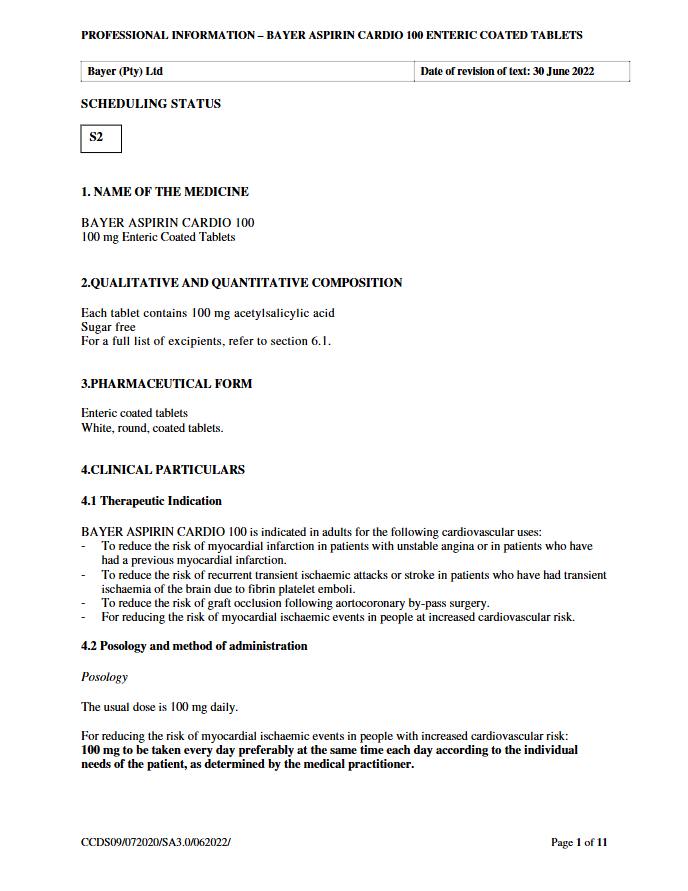
BAYER ASPIRIN CARDIO 100 is indicated in adults for the following cardiovascular uses:
- To reduce the risk of myocardial infarction in patients with unstable angina or in patients who have had a previous myocardial infarction.
- To reduce the risk of recurrent transient ischaemic attacks or stroke in patients who have had transient ischaemia of the brain due to fibrin platelet emboli.
- To reduce the risk of graft occlusion following aortocoronary by-pass surgery.
- For reducing the risk of myocardial ischaemic events in people at increased cardiovascular risk.
4.2 Posology and method of administration
Posology
The usual dose is 100 mg daily. For reducing the risk of myocardial ischaemic events in people with increased cardiovascular risk: 100 mg to be taken every day preferably at the same time each day according to the individual needs of the patient, as determined by the medical practitioner.
Method of administration
For oral use. The tablets should preferably be taken at least 30 minutes before meals, with plenty of water. They should not be crushed, broken, or chewed to ensure a release in the alkaline milieu of the intestine and to not destroy the protective effect of the enteric coating.
Special populations
Paediatric patients
The safety and efficacy of BAYER ASPIRIN CARDIO 100 in children below 18 years of age has not been established. No data are available. Therefore, BAYER ASPIRIN CARDIO 100 is not recommended for use in paediatric patients, below 18 years.
Patients with hepatic impairment
BAYER ASPIRIN CARDIO 100 is contraindicated in patients with severe hepatic failure (see section 4.3). BAYER ASPIRIN CARDIO 100 should be used with particular caution in patients with impaired hepatic function (see section 4.4).
Patients with renal impairment
BAYER ASPIRIN CARDIO 100 is contraindicated in patients with severe renal failure (see section 4.3). BAYER ASPIRIN CARDIO 100 should be used with particular caution in patients with impaired renal function since acetylsalicylic acid may further increase the risk of renal impairment and acute renal failure (see section 4.4).
4.3 Contraindications
- Hypersensitivity to acetylsalicylic acid, to other salicylates, or to any other components of BAYER ASPIRIN CARDIO 100 (see section 6.1)
- A history of asthma induced by the administration of salicylates or substances with a similar action, notably non-steroidal anti-inflammatory medicines.
- History of gastrointestinal perforation, ulceration or bleeding (peptic ulcer bleedings-PUBs) related to previous NSAIDs including BAYER ASPIRIN CARDIO 100
- Acute gastrointestinal ulcers
- Haemorrhagic diathesis
- Severe renal impairment (eGFR < 30 mL/minute)
- Severe hepatic impairment (Child-Pugh C)
- Severe cardiac failure (NYHA grade III or IV)
- Combination with methotrexate at doses of 15 mg/week or more (see section 4.5)
- Last trimester of pregnancy (see section 4.6)
4.4 Special warnings and precautions for use
BAYER ASPIRIN CARDIO 100 should be used with particular caution in the following cases:
- hypersensitivity to analgesics/ anti-inflammatory agents/ antirheumatic medicinal products and in the presence of other allergies.
- history of gastro-intestinal ulcers including chronic or recurrent ulcer disease or history of gastro-intestinal bleedings
- The elderly have an increased frequency of adverse reactions to NSAIDs, especially gastrointestinal bleeding and perforation (PUBs) which may be fatal (see section 4.8)
- The risk of gastrointestinal bleeding or perforation (PUBs) is higher with increasing doses of BAYER ASPIRIN CARDIO 100, in patients with a history of ulcers and the elderly.
- When gastrointestinal bleeding or ulceration occurs in patients receiving BAYER ASPIRIN CARDIO 100, treatment with BAYER ASPIRIN CARDIO 100 should be stopped.
- BAYER ASPIRIN CARDIO 100 should be given with caution to patients with a history of gastrointestinal disease (e.g. ulcerative colitis, Crohn's disease, hiatus hernia, gastro-oesophageal reflux disease, angiodysplasia) as the condition may be exacerbated.
- with concomitant treatment with anticoagulants (see section 4.5)
- impaired renal function; or patients with impaired cardiovascular circulation (e.g. renal vascular disease, congestive heart failure, volume depletion, major surgery, sepsis or major haemorrhagic events), since acetylsalicylic acid may further increase the risk of renal impairment and acute renal failure,
- Caution is required in patients with a history of hypertension and/or heart failure as fluid retention and oedema have been reported in association with BAYER ASPIRIN CARDIO 100 therapy
- in patients suffering from severe glucose-6-phosphate dehydrogenase (G6PD) deficiency, BAYER ASPIRIN CARDIO 100 may induce haemolysis or haemolytic anaemia. Factors that may increase the risk of haemolysis are e.g. high dosage, fever or acute infections
- impaired hepatic function;
- Metamizole and some NSAIDs, such as ibuprofen and naproxen may attenuate acetylsalicylic acidu2019s inhibitory effect on platelet aggregation. Patients should be advised to talk to their doctor if they are on a BAYER ASPIRIN CARDIO 100 regimen and plan to take metamizole or NSAIDs for pain (see section 4.5).
- Serious skin reactions, some of them fatal, including exfoliative dermatitis, Stevens-Johnson syndrome, and toxic epidermal necrolysis have been reported. BAYER ASPIRIN CARDIO 100 should be discontinued at the first appearance of skin rash, mucosal lesions, or any other sign of hypersensitivity.
- BAYER ASPIRIN CARDIO 100 may precipitate bronchospasm and induce asthma attacks and other hypersensitivity reactions. Risk factors are pre-existing asthma, hay fever, nasal polyps, or chronic respiratory disease. This also applies to patients exhibiting allergic reactions (e.g. cutaneous reactions, itching, urticaria) to other substances.
- Due to its inhibitory effect on platelet aggregation which persists for several days after administration, BAYER ASPIRIN CARDIO 100 may lead to an increased bleeding tendency during and after surgical operations (including minor surgeries, e.g. dental extractions).
- At low doses, acetylsalicylic acid reduces the excretion of uric acid. This can possibly trigger gout attacks in predisposed patients.
- Acetylsalicylic acid containing products should not be used in children and adolescents for viral infections with or without fever without consulting a medical practitioner. In certain viral illnesses, especially influenzae A, influenzae B and varicella, there is a risk of Reyeu2019s syndrome, a very rare but possibly life-threatening illness requiring immediate medical action. The risk may be increased when BAYER ASPIRIN CARDIO 100 is given concomitantly. Should persistent vomiting occur with such diseases, this may be a sign of Reyeu2019s syndrome.
4.5 Interaction with other medicines and other forms of interactions.
Contraindicated Interactions
- Methotrexate used at doses of 15 mg/week or more
Increased haematological toxicity of methotrexate (decreased renal clearance of methotrexate by anti-inflammatory agents in general and displacement of methotrexate from its plasma protein binding by salicylates) (see section 4.3).
Combinations requiring precautions for use
- Methotrexate, used at doses of less than 15 mg/week
- Increased haematological toxicity of methotrexate (decreased renal clearance of methotrexate by anti-inflammatory agents in general and displacement of methotrexate from its plasma protein binding by salicylates).
- Metamizole and NSAIDs
- The concurrent (same day) administration of metamizole and some NSAIDs, such as ibuprofen and naproxen, attenuate the irreversible platelet inhibition induced by acetylsalicylic acid. The clinical relevance of these interactions is not known. Treatment with metamizole and some NSAIDs, such as ibuprofen and naproxen, in patients with increased cardiovascular risk may limit the cardiovascular protection of BAYER ASPIRIN CARDIO 100 (see section 4.4).
- Anticoagulants, thrombolytics/other inhibitors of platelet aggregation/hemostasis
- Increased risk of bleeding.
- Non-steroidal anti-inflammatory medicines with salicylates
- Increased risk of ulcers and gastrointestinal bleeding due to synergistic effect.
- Selective Serotonin Reuptake Inhibitors (SSRIs)
- Increased risk of upper gastrointestinal bleeding due to possibly synergistic effect.
- Digoxin
- Plasma concentrations of digoxin are increased due to a decrease in renal excretion
- Antidiabetics, e.g. insulin, sulphonylureas in combination with acetylsalicylic acid at higher doses
- Increased hypoglycaemic effect at higher doses of acetylsalicylic acid via hypoglycaemic action of acetylsalicylic acid and displacement of sulfonylurea from its plasma protein binding.
- Diuretics in combination with acetylsalicylic acid at higher doses
- Decreased glomerular filtration via decreased renal prostaglandin synthesis.
Systemic glucocorticoids, except hydrocortisone used as replacement therapy in Addison's disease
Decreased blood salicylate levels during corticosteroid treatment and risk of salicylate overdose after this treatment is stopped via increased elimination of salicylates by corticosteroids. Concurrent use may increase the incidence of gastrointestinal bleeding and ulceration.
Angiotensin converting enzyme inhibitors (ACE) in combination with acetylsalicylic acid at higher doses
Decreased glomerular filtration via inhibition of vasodilator prostaglandins. Furthermore, decreased antihypertensive effect.
Valproic acid
Increased toxicity of valproic acid due to displacement from protein binding sites.
Alcohol
Increased damage to gastro-intestinal mucosa and prolonged bleeding time due to additive effects of acetylsalicylic acid and alcohol.
Uricosurics such as benzbromarone, probenecid
Decreased uricosuric effect (competition of renal tubular uric acid elimination).
4.6 Fertility, pregnancy and lactation
Pregnancy
Inhibition of prostaglandin synthesis may adversely affect the pregnancy and/or the embryo/fu0153tal development. During the first and second trimester of pregnancy, medicines containing acetylsalicylic acid are therefore not recommended.
During the third trimester of pregnancy, all prostaglandin synthesis inhibitors may expose the foetus to:
- cardiopulmonary toxicity (with premature closure of the ductus arteriosus and pulmonary hypertension);
- renal dysfunction, which may progress to renal failure with oligo-hydroamniosis; and the mother and the child, at the end of pregnancy, to:
- possible prolongation of bleeding time, an anti-aggregating effect which may occur even after very low doses
- inhibition of uterine contractions resulting in delayed or prolonged labour
Consequently, BAYER ASPIRIN CARDIO 100 is contraindicated during the third trimester of pregnancy (see section 4.3).
Fertility
Based on the limited published data available, the studies in humans showed no consistent effect of acetylsalicylic acid on impairment of fertility and there is no conclusive evidence from animal studies.
Breastfeeding
Salicylates and its metabolites pass into breastmilk in small quantities. Safety is unproven. When regular use of BAYER ASPIRIN CARDIO 100 is indicated, mothers on BAYER ASPIRIN CARDIO 100 should not breastfeed.
4.7 Effects on ability to drive and use machines
BAYER ASPIRIN CARDIO 100 has no or negligible influence on the ability to drive and use machines. However due to side effect such as dizziness, patients should check how they react to BAYER ASPIRIN CARDIO 100 before driving a vehicle or operating machinery.
4.8 Undesirable effects
a) Summary of the safety profile
The listed adverse reactions are based on postmarketing reports with all Aspirin formulations, and clinical trials (CTS) with aspirin as a study medicine. Frequency calculation is based on data from the aspirin arm of the ARRIVE study only.
b) Tabulated summary of adverse reactions
The frequencies of ARs reported with aspirin are summarized in the table below. Frequency groupings are defined according to the following convention: common (u2265 1/100 to < 1/10), uncommon (u2265 1/1,000 to < 1/100), rare (u2265 1/10,000 to < 1/1,000) The ARs identified only during post-marketing surveillance, and for which a frequency could not be estimated, are listed under u201cnot knownu201d.
Table 1: Adverse drug reactions (ADRs) reported in ARRIVE* or during post-marketing surveillance in patients treated with BAYER ASPIRIN CARDIO
System organ class
Common
Uncommon
Rare
Not known
Blood and the lymphatic system disorders
Iron deficiency anaemia
Haemorrhagic anaemia
Haemolysis
Haemolytic anaemia
Immune system disorders
Hypersensitivity
Medicine hypersensitivity
Allergic oedema and angioedema
Anaphylactic reaction
Anaphylactic shock
Nervous system disorders
Dizziness
Cerebral and intracranial haemorrhage
Ear and labyrinth disorders
Tinnitus
Cardiac disorders
Cardio-respiratory distress
4.9 Overdose
System organ class
Common
Uncommon
Rare
Not known
Vascular disorders
Haematoma
Haemorrhage
Muscle haemorrhage
Procedural haemorrhage
Respiratory, thoracic and mediastinal disorders
Epistaxis
Rhinitis
Nasal congestion
Aspirin-exacerbated respiratory disease
Gastrointestinal disorders
Dyspepsia
Gastrointestinal and abdominal pains
Gastrointestinal inflammation
Gastrointestinal tract haemorrhage
Gingival bleeding
Gastrointestinal erosion and ulcer
Gastrointestinal ulcer perforation
Intestinal diaphragm disease
Hepatobiliary disorders
Hepatic impairment
Transaminases increased
Skin and subcutaneous tissue disorders
Rash
Pruritus
Urticaria
Renal and urinary disorders
Urogenital tract haemorrhage
Renal impairment
Renal failure acute
Injury, poisoning and procedural complications
See overdose section
*ARRIVE is a Bayer sponsored clinical trial with 6270 subjects in aspirin 100 mg arm and 6276 subjects in placebo arm. The median duration of aspirin exposure was 5.0 years with a range of 0 to 7 years.
a In the context of bleeding
b In the context of severe forms of glucose-6-phosphate dehydrogenase (G6PD) deficiency
c LT/Fatal cases were reported in ASA and placebo with the same frequency, <0.1%
d In the context of severe allergic reactions
e In patients with pre-existing impaired renal function or impaired cardiovascular circulation
Salicylate toxicity (> 100 mg/kg/day over 2 days may produce toxicity) may result from chronic, therapeutically acquired, intoxication, and from, potentially life-threatening, acute intoxications (overdose), ranging from accidental ingestions in children to incidental intoxications. Chronic salicylate poisoning can be insidious as signs and symptoms are non-specific. Mild chronic salicylate intoxication, or salicylism, usually occurs only after repeated use of large doses. Symptoms include dizziness, vertigo, tinnitus, deafness, sweating, nausea and vomiting, headache, and confusion, and may be controlled by reducing the dosage. Tinnitus can occur at plasma concentrations of 150 to 300 micrograms/mL. More serious adverse events occur at concentrations above 300 micrograms/mL.
The principal feature of acute intoxication is severe disturbance of the acid-base balance, which may vary with age and severity of intoxication. The most common presentation for a child is metabolic acidosis. The severity of poisoning cannot be estimated from plasma concentration alone. Absorption of acetylsalicylic acid can be delayed due to reduced gastric emptying, formation of concretions in the stomach, or as a result of ingestion of enteric-coated preparations. Management of acetylsalicylic acid intoxication is determined by its extent, stage and clinical symptoms and according standard poisoning management techniques. Predominant measures should be the accelerated excretion of the drug as well as the restoration of the electrolyte and acid-base metabolism.
Due to the complex pathophysiologic effects of salicylate poisoning, signs and symptoms/investigational findings may include:
Signs and Symptoms
Investigational findings
Therapeutic measures
Mild to moderate intoxication
Repeated administration of activated charcoal, forced alkaline diuresis
Tachypnoea, hyperventilation, respiratory alkalosis
Alkalaemia, alkaluria
Fluid and electrolyte management
Diaphoresis
Nausea, vomiting
Moderate to-severe intoxication
Repeated administration of activated charcoal, forced alkaline diuresis, hemodialysis in severe cases
Respiratory alkalosis with compensatory metabolic acidosis, Acidaemia, aciduria
Fluid and electrolyte management
Hyperpyrexia
Fluid and electrolyte management
Respiratory: ranging from hyperventilation, non-cardiogenic pulmonary edema to respiratory arrest, asphyxiation
Cardiovascular: ranging from dysrhythmias, hypotension to cardiovascular arrest e.g., Blood pressure, ECG alteration
Fluid and electrolyte loss: dehydration, oliguria to renal failure e.g., Hypokalaemia, hypernatraemia, hyponatraemia, altered renal function
Fluid and electrolyte management
Signs and Symptoms
Investigational findings
Therapeutic measures
Impaired glucose metabolism, ketosis
Hyperglycaemia, hypoglycaemia (especially in children)
Increased ketone levels
Tinnitus, deafness
Gastrointestinal: GI bleeding
Haematologic: ranging from platelet inhibition to coagulopathy e.g., PT prolongation, hypoprothrombinaemia
Neurologic: Toxic encephalopathy and CNS depression with manifestations ranging from lethargy, confusion to coma and seizures
Emergency management
Immediate transfer to hospital specialist unit, administration of activated charcoal, check of acid-base balance, alkaline diuresis so as to obtain a urine pH between 7.5 and 8, forced alkaline diuresis should be considered when the plasma salicylate concentration is greater than: 500 mg/litre (3.6 mmol/litre) in adults or 300 mg/litre (2.2 mmol/litre) in children, possibility of haemodialysis in severe poisoning, fluid losses should be replaced, symptomatic treatment.
