
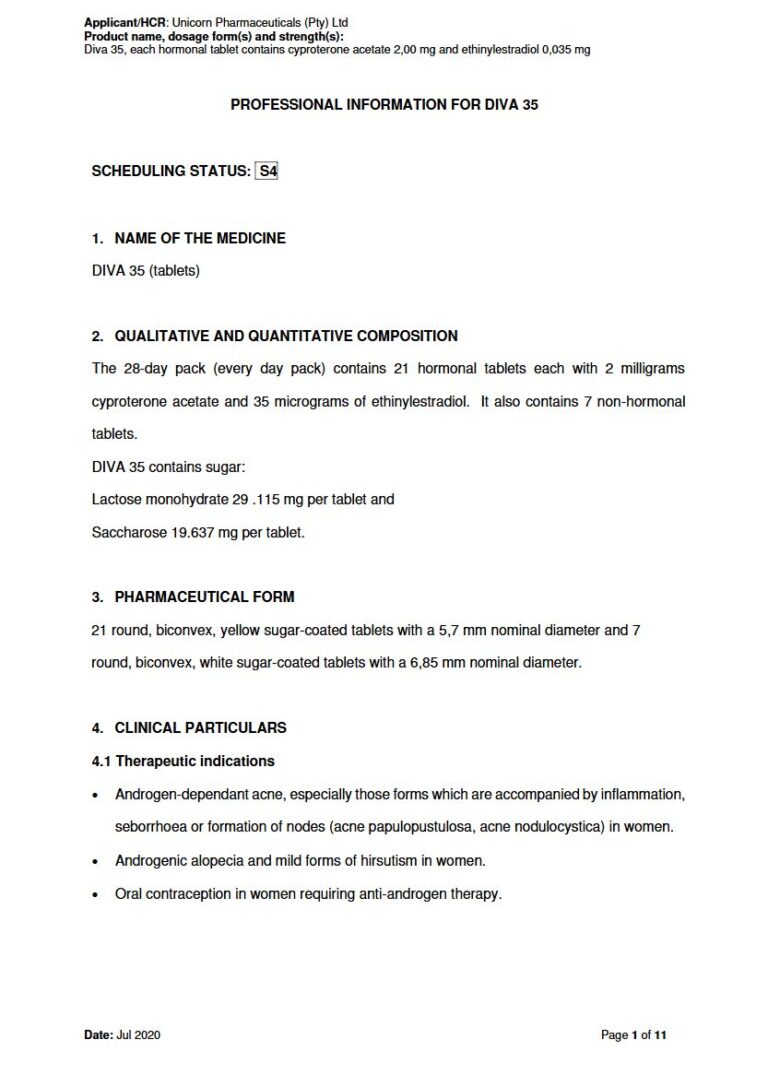
Diva 35 2,00 mg and 0,035 mg Tablets
PDF Leaflet Revision Date: 23 August 2020
Clinical Summary
Quick overview from the medicine insert
Indication
Androgen-dependent acne, androgenic alopecia, hirsutism, and oral contraception.
Dosage (summary)
Take 1 tablet daily starting on the first day of the menstrual cycle.
Special Populations
- Moderately impaired liver function
- History of depression
- Thrombo-embolic disorders
Pregnancy & Breastfeeding
Contraindicated in pregnancy and lactation.
Key Drug Interactions
- Antibiotics (e.g., ampicillin, tetracycline)
- Enzyme inducers (e.g., rifampicin)
- Anticoagulants
Contraindications
- Hypersensitivity
- Severe depression
- Liver disease
- Thrombo-embolic disorders
- Pregnancy
Common side effects
- Mood changes
- Depression
- Breast tenderness
- Nausea
- Fluid retention
Counselling Points
- Take at the same time daily
- Use additional contraception for first 14 days
- Report mood changes or severe headaches
Serious warnings
- Increased risk of thrombo-embolism
- Monitor blood pressure
- Risk of liver tumors
Important Disclaimer
The Diva 35 2,00 mg and 0,035 mg Tablets professional information leaflet below is the property of Unicorn Pharmaceuticals and is provided on Medinsert exactly as issued, with no.. alterations or editorial changes. We make every effort to keep content current by updating documents as soon as new versions become available. Medinsert serves as a trusted access point for healthcare professionals, but does not replace official sources or clinical judgement. For more details, please read our full disclaimer. read more>>
 Healthcare Professionals Only
This content is for registered healthcare professionals
Sign in or create a free account to read the full package insert.
Free for HPCSA-registered professionals. Powered by Medinsert.
Clinical Particulars
Section 4 of the official insert — extracted exactly as issued, no alterations
4.1 Therapeutic indications
u2022 Androgen-dependant acne, especially those forms which are accompanied by inflammation, seborrhoea or formation of nodes (acne papulopustulosa, acne nodulocystica) in women.
u2022 Androgenic alopecia and mild forms of hirsutism in women.
u2022 Oral contraception in women requiring anti-androgen therapy.
4.2 Posology and method of administration
Before DIVA 35 treatment is started, a thorough medical (including gynaecological) examination should be carried out and the patientu2019s medical history should be carefully evaluated. Pregnancy should be excluded before initiating therapy. Disturbances of the clotting system must be ruled out if any members of the family have suffered from thrombo-embolic disease (e.g. deep vein thrombosis, stroke, myocardial infarction) already at a young age. If the hirsutism has only recently appeared or has lately intensified to a considerable extent, an androgen-producing tumour or an adrenal enzyme defect must be excluded in the differential diagnosis. An additional, non-hormonal contraception (with exception of the rhythm and temperature methods) should be employed during the first 14 days of the first treated cycle.
First Cycle
The first course of DIVA 35 is started on the first day of the cycle (the first day of the menstrual bleeding is counted as day 1 of the cycle). The first tablet should be taken from the starter section of the calendar pack by selecting the appropriate tablet for that day of the week (e.g. u201cMonu201d for Monday). The tablet is swallowed whole with a little liquid. A tablet is then taken every day in the direction shown by the arrows until the pack is empty. Withdrawal bleeding should occur within 2 to 4 days after taking the last active tablet. Take the tablet at the same time each day if possible.
Subsequent Courses
After the last tablet has been taken from the first pack, tablet-taking is continued from a new pack on the very next day. The first tablet must again be taken from the starter section marked with the appropriate day of the week.
Length of Use
The severity of the condition treated will determine the length of use. In general treatment should be carried out over several months. It is recommended that treatment be continued for at least another 3 to 4 cycles after the signs have subsided. Should there be a recurrence weeks or months after discontinuation of DIVA 35 treatment should be resumed.
Missed Doses
If an active tablet is either delayed or missed take it as soon as possible within the next 12 hours at the latest, but not when it is nearly time for the next dose. Do not double doses. Continue to take the next tablet at the usual time in order to avoid premature withdrawal bleeding.
4.3 Contraindications
Hypersensitivity to the active substance or to any of the excipients listed in section 6.1. DIVA 35 is contraindicated in pregnancy and lactation (see PREGNANCY AND LACTATION ). DIVA 35 is contraindicated in:
- Depression not well controlled with treatment.
- A history of depression with the use of hormonal contraceptives.
- Moderately impaired liver function or cholestasis, the Dubin-Johnson or Rotor-syndromes, hepatic adenomas, estrogen-dependent neoplasms such as breast or endometrial cancer, cardiovascular disease including previous or current thrombo-embolic disorders, or high risk of them, and arterial disease or multiple risk factors for it.
- Disorders of lipid metabolism, undiagnosed vaginal bleeding, cholestatic jaundice, chorea, herpes, pemphigoid gestationis or deteriorating otosclerosis.
- Severe or focal migraine, cerebrovascular conditions, advanced diabetes mellitus with vascular changes, sickle-cell disease and porphyria.
- DIVA 35 is not for use in men and should not be used in children.
4.4 Special warnings and precautions for use
Contains lactose. Patients with the rare hereditary conditions of galactose intolerance e.g. galactosaemia, Lapp lactase deficiency, glucose-galactose malabsorption or fructose intolerance should not take DIVA 35.
DIVA 35 should be used with caution in patients with a history of clinical depression, gallbladder disease, conditions influenced by fluid retention, high blood pressure, varicose veins, a history of phlebitis, otosclerosis, multiple sclerosis, epilepsy, tetanus, chorea minor, and asthma. Mood changes and depression are side effects reported with the use of hormonal contraceptives including Diva 35. There is some evidence that hormonal contraceptive use may be associated with severe depression and a higher risk of suicidal thoughts/behaviour (e.g. talking about suicide, withdrawing from social contact, having mood swings, being preoccupied with death or violence, feeling hopeless about a situation, increasing use of alcohol/drugs, doing self-destructive things, personality changes) and suicide. P rescribers should inform their patients to contact their doctor for advice if they experience mood changes and depression whilst on treatment with Diva 35.
Regular examinations are recommended at about 6-monthly intervals during the use of DIVA 35 . Regular blood pressure checks, including a pre-treatment level, are advisable. Prolonged amenorrhoea following the use of DIVA 35 may occur. Caution is advised where oligomenorrhoea or amenorrhoea have occurred in the past. Irregular tablet-taking, vomiting or intestinal disorders with diarrhoea may decrease the efficacy of DIVA 35 . Additional methods of contraception should be used at the time of such disorders in order to prevent a possible pregnancy which would be a compelling reason for the discontinuation of DIVA 35 treatment.
Surgery is more likely to be associated with an increased incidence of thrombotic side effects. Adequate precaution should be taken. Under no circumstances should DIVA 35 be stopped without having adopted a satisfactory alternative method for contraception. If an active tablet is either delayed or missed it should be taken as soon as possible. Contraceptive protection is maintained if the delayed tablet is taken within 12 hours of the usual administration time. If more than 12 hours elapse from the time the tablets are normally taken and also in the case of vomiting or diarrhoea, the patient must continue to take the other tablets in the pack at the usual time in order to avoid premature withdrawal bleeding during this cycle. At this same time, however, an additional non-hormonal method of contraception (with exception of the rhythm and temperature methods) must be employed in order to prevent a pregnancy. If an inter-menstrual bleeding occurs during the 3 weeks in which the active tablets are being taken their use should not be interrupted. A slight bleeding (spotting) will usually stop spontaneously. However, if the bleeding is heavy, similar to menstrual bleeding, then a thorough examination is indicated to exclude organic factors. If bleeding fails to occur while the tablets from the starter section are being taken, tablet-taking must provisionally be stopped and the doctor must be consulted.
The incidence of disease of the circulatory system in women using DIVA 35 is significantly greater than those of controls and the mortality is slightly increased. Increased mortality from myocardial infarction is much greater in women aged 35 years or over, particularly if they used the contraceptive for longer than 5 years and if they smoke. Other risk factors include a family history of arterial disease, hypercholesterolaemia, familial hyperlipoproteinaemia, diabetes mellitus, hypertension, obesity and migraine. Specific risk factors for venous thrombo- embolism include a family history of venous thrombo-embolism, varicose veins and again, obesity. However, the risk of mortality due to DIVA 35 in women under 35 who are in the high- risk group is in general far less than the risk of mortality due to pregnancy.
Benign and malignant liver tumours leading in isolated cases to life-threatening intra- abdominal haemorrhage have been observed after the use of hormonal substances such as those contained in DIVA 35 . If severe upper abdominal complaints, liver enlargement or signs of intra-abdominal haemorrhage occur, a liver tumour should be included in the differential- diagnostic considerations.
DIVA 35 should be stopped immediately if any of the following occur:
- Sudden severe chest pain, sudden breathlessness or severe pain/swelling in calf of one leg (possibly indicative of thrombo-embolic complications). The medication should be discontinued at least 4 to 6 weeks before surgery of the type associated with an increased risk of thrombo-embolism or during periods of prolonged immobilization.
- Unusual, severe, prolonged headache, sudden disturbances of vision or hearing or other perceptual disorders, collapse, marked numbness or weakness affecting one side of the body, or other signs and symptoms suggestive of cerebrovascular disease.
- Hepatitis, jaundice, generalised itching, liver enlargement, severe upper abdominal pain.
- Onset of severe depression.
- Significant rise in blood pressure.
- Clear exacerbation of other conditions known to be capable of deteriorating during oral contraception or pregnancy.
- Increase in epileptic seizures.
Women using oral contraceptives are strongly advised not to smoke. Smoking increases the risk of myocardial infarction. Women smoking more than 15 cigarettes per day have at least a 20 % increased risk of serious cardiovascular side effects. This risk increases with age. An increase in the risk of venous thrombo-embolism has been reported with oral contraceptives containing cyproterone acetate.
4.5 Interaction with other medicines and other forms of interaction
Reduced DIVA 35 plasma levels have been obtained with concomitant use of certain antibiotics (e.g. ampicillin, tetracycline) and oral contraceptive failure may occur. Spotting and breakthrough bleeding are possible signs of diminished effectiveness. For maximal protection additional non-hormonal contraception should be recommended for the duration of antibiotic therapy and for seven days afterwards. Those on long-term antibiotic therapy need only take extra precautions for the first two weeks of antibiotic therapy.
Enzyme inducers such as the anti-epileptic agents, griseofulvin, barbiturates, phenylbutazone and rifampicin impair the action of DIVA 35 . This effect has also been suggested for modafinil and some antiviral agents, such as nelvinavir, ritonavir and nevirapine.
The effectiveness of anticoagulants, antidepressants, antidiabetics, antihypertensives, beta blockers and diuretics may be reduced if administered with DIVA 35 . The plasma concentrations of cyclosporine and theophylline may be increased with concomitant use. Large supplements of vitamin C have been reported to increase serum ethinylestradiol concentrations. Withdrawal of high doses of vitamin C may lead to breakthrough bleeding. Mild laxatives do not impair the action of DIVA 35 .
Effects on laboratory tests: DIVA 35 may interfere with some laboratory tests, in particular hormones, glucose tolerance, thyroid function, blood coagulation, serum triglycerides, urinary pregnanediol levels, urinary 17-keto and 17-ketogenic steroids and liver function tests.
4.6 Fertility, pregnancy and lactation
The use of DIVA 35 is contra-indicated during pregnancy and lactation (see CONTRAINDICATIONS ). Administration of DIVA 35 during the hormone-sensitive differentiation phase of the genital organs (after approximately day 45 of gravidity) could lead to signs of feminisation in male foetuses.
4.7 Undesirable effects
Side effects: Cyproterone acetate
Neoplasms benign and malignant
Less frequent: Hepatic carcinoma
Blood and lymphatic system disorders
Less frequent: Thrombosis
Endocrine disorders
Less frequent: Weight gain
Psychiatric disorders
More frequent: Changes in libido
Less frequent: Depression
Gastrointestinal disorders
Less frequent: Nausea, vomiting
Hepato-biliary disorders
Less frequent: Altered liver function, hepatitis, jaundice, hepatomegaly, hepatic failure, hepatic carcinoma, gall bladder disease
Skin and subcutaneous tissue disorders
Less frequent: Alopecia, photosensitivity, allergic rash
Reproductive system and breast disorders
More frequent: Breast tenderness
Side Effects: Ethinylestradiol
Infections and infestations
More frequent: Vaginal candidiasis
Blood and lymphatic system disorders
Less frequent: Thromboembolic disorders, thrombosis
Metabolic and nutritional disorders
Incidence unknown: Reduced glucose tolerance, changes in lipid metabolism
Psychiatric disorders
More frequent: Changes in appetite, depression
Less frequent: Mood or mental changes, changes in libido
Nervous system disorders
More frequent: Dizziness (mild), headache, migraine
Eye disorders
Less frequent: Intolerance to contact lenses
Vascular disorders
More frequent: Fluid retention or oedema
Less frequent: Hypertension
Gastrointestinal disorders
More frequent: Gastrointestinal irritation, abdominal cramps, nausea
Less frequent: Vomiting
Hepato-biliary disorders
Less frequent: Impaired liver function, gall bladder disease, hepatitis, cholestatic jaundice
Skin and subcutaneous tissue disorders
More frequent: Pruritus, skin rash
Incidence unknown: Chloasma, melasma, haemorrhagic eruption
Reproductive system and breast disorders
Incidence unknown: Change in cervical secretions
Side Effects: Ethinylestradiol/cyproterone (cyclical)
Neoplasms benign and malignant
Incidence unknown: Increased risk of cervical or breast cancer
Reproductive system and breast disorders
More frequent: Menstrual irregularities, spotting, breakthrough bleeding, amenorrhoea
Incidence unknown: Anovulation post-treatment
Post marketing reported side effects
The following side effects have been reported with the post marketing use of hormonal contraceptives: Severe depression with a higher risk of suicidal thoughts/behaviour and suicide
4.8 Overdose
Management of overdose
Treatment is symptomatic and supportive.
