
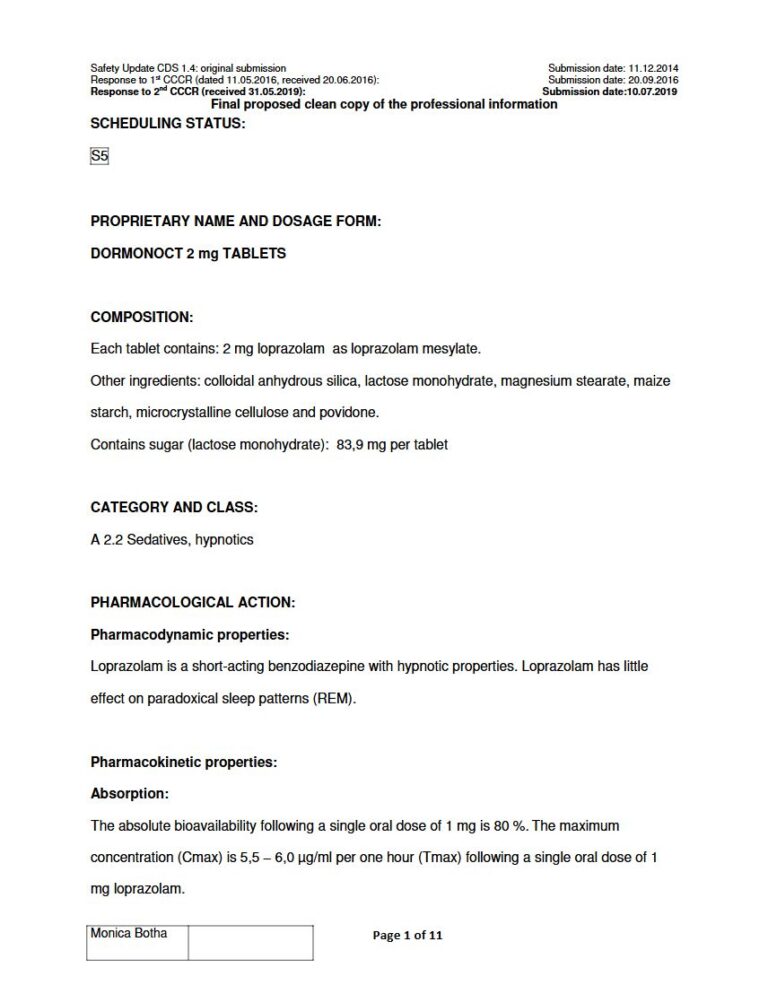
Dormonoct 2mg Tablet
PDF Leaflet Revision Date: 10 July 2019
Clinical Summary
Quick overview from the medicine insert
Indication
Short-term treatment of insomnia and sleep disturbances.
Dosage (summary)
Adults: 1-2 mg at bedtime; Elderly: 0.5-1 mg.
Onset of Action / Duration
Onset: 30 mins, Duration: 6-8 hours
Special Populations
- Elderly
- Renal impairment
- Hepatic impairment
Pregnancy & Breastfeeding
Not recommended in pregnancy; contraindicated in breastfeeding.
Key Drug Interactions
- Alcohol
- CNS depressants
- Barbiturates
Contraindications
- Hypersensitivity to loprazolam
- Severe respiratory insufficiency
- Myasthenia gravis
- Sleep apnoea syndrome
- Severe hepatic insufficiency
Common side effects
- Drowsiness
- Over-sedation
- Confusion
- Ataxia
Counselling Points
- Take 30 mins before bedtime
- Avoid alcohol
- Do not drive after taking
Serious warnings
- Risk of dependence
- Withdrawal symptoms
- Caution in pulmonary disease
Important Disclaimer
The Dormonoct 2mg Tablet professional information leaflet below is the property of Sanofi-Aventis South Africa and is provided on Medinsert exactly as issued, with no.. alterations or editorial changes. We make every effort to keep content current by updating documents as soon as new versions become available. Medinsert serves as a trusted access point for healthcare professionals, but does not replace official sources or clinical judgement. For more details, please read our full disclaimer. read more>>
 Healthcare Professionals Only
This content is for registered healthcare professionals
Sign in or create a free account to read the full package insert.
Free for HPCSA-registered professionals. Powered by Medinsert.
Clinical Particulars
Section 4 of the official insert — extracted exactly as issued, no alterations
4.1 Therapeutic indications
1) Short-term treatment of insomnia.
2) Sleep disturbances in the geriatric patient.
3) Pre-operative sleep disturbances. DORMONOCT is only indicated when the disorder is severe, disabling or when the individual is subject to extreme stress.
4.2 Posology and method of administration
The usual adult dose is 1 u2013 2 mg at bedtime, the higher dose being recommended for patients who have previously been treated with benzodiazepines for severe persistent insomnia. An initial dose of 0,5 mg u2013 1,0 mg is recommended in elderly and debilitated patients. The 2 mg tablet may not be suitable for use as initiation, in elderly patients and patients with renal, hepatic or moderate respiratory insufficiency.
Treatment should be started with the lowest recommended dose. The maximum dose should not be exceeded. Treatment should be as short as possible. Generally, the duration of treatment varies from a few days to two weeks, with a maximum of four weeks including the tapering-off process. In certain cases, extension beyond the maximum treatment period may be necessary. If so, it should not take place without re-evaluation of the patientu2019s status.
It is strongly recommended that after prolonged treatment DORMONOCT is not withdrawn suddenly but rather that the dose is reduced gradually under medical supervision; otherwise withdrawal symptoms may occur (see WARNINGS AND SPECIAL PRECAUTIONS).
DORMONOCT should be taken half an hour before bedtime. Tablets are to be swallowed without chewing, with sufficient amount of liquids.
4.3 Contraindications
- Hypersensitivity to loprazolam or to any of the other ingredients in DORMONOCT
- Severe respiratory insufficiency
- Myasthenia gravis
- Sleep apnoea syndrome
- Severe hepatic insufficiency
- Safety and efficacy in children have not been established.
4.4 Special warnings and precautions for use
Caution should be exercised in the following patients: In patients with pulmonary disease and limited pulmonary reserve. Particular caution should be exercised with the elderly and debilitated who are at particular risk of over-sedation, respiratory depression and ataxia. (The initial oral dosage should be reduced in these patients).
Care should be taken to avoid aggravation of respiratory insufficiency and the dosage should be reduced (see DOSAGE AND DIRECTIONS FOR USE).
Caution should be exercised in the following patients:
- patients suffering from impairment of renal or hepatic function
- patients suffering from anxiety accompanied by an underlying depressive disorder
- patients receiving barbiturates or other central nervous system depressants. There is an additive risk of central nervous system depression when these medicines are taken together
- patients should be cautioned regarding the additive effect of alcohol.
DORMONOCT is not recommended for the primary treatment of psychotic illness. DORMONOCT should not be used alone to treat depression, or anxiety with depression, as suicide may be precipitated in such patients. DORMONOCT should be used with extreme caution in patients with a history of alcohol or drug abuse.
4.5 Interactions with other medicines
Concomitant use not recommended:
Concomitant intake with alcohol: the sedative effect may be enhanced when DORMONOCT is used in combination with alcohol. This affects the ability to drive or use machines (see WARNINGS AND SPECIAL PRECAUTIONS).
Combinations to be taken into account:
Combination with central nervous system depressants: enhancement of the central depressive effect of DORMONOCT may occur in cases of concomitant use with antipsychotics (neuroleptics), hypnotics, anxiolytics/sedatives, antidepressant medicines, narcotic analgesics, anti-epileptic medicines, anaesthetics and sedative antihistamines (see WARNINGS AND SPECIAL PRECAUTIONS).
In the case of narcotic analgesics, enhancement of the euphoria may also occur, leading to an increase in psychic dependence.
Additive synergy has been observed with neuromuscular depressants (curare-like medicines and muscle relaxants). The risk of a withdrawal syndrome occurring is increased when DORMONOCT is combined with other benzodiazepines prescribed as anxiolytics or hypnotics.
4.6 Fertility, pregnancy and lactation
Safety in pregnancy has not been established. During labour it crosses the placenta and may cause the u201cfloppy - infantu201d syndrome characterised by central respiratory depression, hypothermia and poor sucking.
Lactation: It should not be administered to mothers breastfeeding their babies. Infants born to mothers who took benzodiazepines chronically during the later stages of pregnancy may develop physical dependence and may be at risk for developing withdrawal symptoms in the postnatal period.
4.7 Effects on ability to drive and use machines
Patients should be advised, particularly at the initiation of therapy, not to drive a motor vehicle or perform potentially hazardous tasks where impaired decision making could lead to accidents.
4.8 Undesirable effects
The following CIOMS frequency rating is used, when applicable: Very common: (u2265 1/ 10); common: (u2265 1/100, < 1/10 ; uncommon: (u2265 1/1000, < 1/100 ); rare: (u2265 1/10 000, < 1/1000); very rare: (< 1/10000), including isolated reports.
Nervous system disorders:
- Very common: drowsiness, over-sedation. Drowsiness is most common in elderly and debilitated patients, and those receiving high doses.
- Uncommon: depression of mood and affect, disorientation or confusion, lethargy, ataxia
- Frequency unknown: anterograde amnesia may occur using therapeutic dosages, with the risk increasing at higher dosages.
Psychiatric disorders:
- Uncommon: changes in libido
- Frequency unknown: paradoxical reactions such as acute hyper-excitability with rage. If these occur, DORMONOCT should be discontinued. Pre-existing depression may be unmasked by benzodiazepine use. There is a potential for abuse. Withdrawal symptoms (including convulsions) have occurred following abrupt cessation, especially in patients who have received large doses for prolonged periods.
Gastrointestinal disorders:
- Uncommon: constipation, nausea, diarrhoea
Immune system disorders:
- Frequency unknown: hypersensitivity reactions such as rash and pruritus
4.9 Overdose
Manifestations of overdosage include somnolence, confusion, coma, respiratory and cardiovascular depression and hypotension. Intravenous fluids should be administered and an adequate airway maintained. Treatment is supportive and symptomatic and gastric lavage may be of use if performed within 12 hours of ingestion.
