
Dumiva Dispersible 120mg/60 mg TABLETS
PDF Leaflet Revision Date: 17 October 2024
Clinical Summary
Quick overview from the medicine insert
Indication
Treatment of HIV infection in children from 3 months to 12 years.
Dosage (summary)
Children 3-12 years: 1-3 tablets daily based on weight.
Special Populations
- Renal impairment
- Hepatic impairment
Pregnancy & Breastfeeding
Not recommended during pregnancy; avoid breastfeeding.
Key Drug Interactions
- Ethanol may increase abacavir AUC by 41%
- Trimethoprim increases lamivudine exposure by 40%
Contraindications
- Hypersensitivity to abacavir or lamivudine
- Severe hepatic impairment
- Severe renal impairment
- Pregnancy and breastfeeding
Common side effects
- Hypersensitivity reactions
- Nausea
- Vomiting
- Diarrhoea
- Rash
- Fever
Counselling Points
- Inform about hypersensitivity risks.
- Do not restart if hypersensitivity occurs.
- Regular monitoring during the first two months.
Serious warnings
- Risk of lactic acidosis
- Severe hypersensitivity reactions
- Potential for mitochondrial dysfunction
Important Disclaimer
The Dumiva Dispersible 120mg/60 mg TABLETS professional information leaflet below is the property of Viatris Healthcare and is provided on Medinsert exactly as issued, with no.. alterations or editorial changes. We make every effort to keep content current by updating documents as soon as new versions become available. Medinsert serves as a trusted access point for healthcare professionals, but does not replace official sources or clinical judgement. For more details, please read our full disclaimer. read more>>
 Healthcare Professionals Only
This content is for registered healthcare professionals
Sign in or create a free account to read the full package insert.
Free for HPCSA-registered professionals. Powered by Medinsert.
Clinical Particulars
Section 4 of the official insert — extracted exactly as issued, no alterations
4.1 Therapeutic indications
DUMIVA DISPERSIBLE TABLETS is a fixed-dose combination of two nucleoside analogues (abacavir and lamivudine). DUMIVA DISPERSIBLE TABLETS are indicated in antiretroviral combination therapy for the treatment of Human Immunodeficiency Virus (HIV) infection in children from three months to 12 years.
4.2 Posology and method of administration
Posology
- Patients should be stabilised on individual medicines before being switched over to DUMIVA DISPERSIBLE TABLETS.
- Therapy should be initiated by a medical practitioner experienced in the management of HIV infection.
- DUMIVA DISPERSIBLE TABLETS can be taken with or without food (see section 5.2).
- DUMIVA DISPERSIBLE TABLETS may be crushed and mixed with a small amount of water or food and ingested immediately.
Children 3 months to 12 years: The recommended dose of DUMIVA DISPERSIBLE TABLETS based on body weight is as follows:
- Childu2019s weight
- 3 u2013 5.9 kg: 1 tablet daily
- 6 u2013 9.9 kg: 1.5 tablets daily
- 10 u2013 13.9 kg: 2 tablets daily
- 14 u2013 19.9 kg: 2.5 tablets daily
- 20 u2013 24.9 kg: 3 tablets daily
Children weighing 25 kg or more, adolescents and adults: For these patient groups other fixed dose formulations with higher amounts of the active substances are available.
Special Populations: DUMIVA DISPERSIBLE TABLETS is a fixed-dose tablet and should not be prescribed for patients requiring dosage adjustments, such as those with creatinine clearance less than 50 ml/min or with mild hepatic impairment. Separate preparations of abacavir or lamivudine should be administered in cases where discontinuation or dose adjustment is indicated. In these cases, the medical practitioner should refer to the individual product information for these medicines.
Elderly: The pharmacokinetics of abacavir and lamivudine have not been studied in patients over 65 years of age and consideration must be given to the greater frequency of decreased hepatic, renal and cardiac function; concomitant medicines or disease.
Renal impairment: Whilst no dosage adjustment of abacavir is necessary in patients with renal dysfunction, a dose reduction of lamivudine is required due to decreased clearance. DUMIVA DISPERSIBLE TABLETS is not recommended for use in patients with a creatinine clearance less than 50 ml/min.
Hepatic impairment: A dose reduction of abacavir is likely to be required for patients with mild hepatic impairment. As dose reduction is not possible with DUMIVA DISPERSIBLE TABLETS the separate preparations should be used when judged necessary. DUMIVA DISPERSIBLE TABLETS must not be used in patients with moderate and severe hepatic impairment.
Method of administration: For oral use.
4.3 Contraindications
DUMIVA DISPERSIBLE TABLETS is contraindicated in patients:
- with known hypersensitivity to abacavir, lamivudine, or to any of the excipients (for abacavir hypersensitivity, (see section 6.1).
- with abnormally low neutrophil counts (< 0,75 x 10⁹/l) (see section 4.4).
- with abnormally low haemoglobin levels (< 7,5 g/dl or 4,65 mmol/l) (see section 4.4).
- with severe hepatic impairment.
- with severe renal impairment.
- who are receiving treatment with emtricitabine.
- who are pregnant and breastfeeding (see section 4.6).
4.4 Special warnings and precautions for use
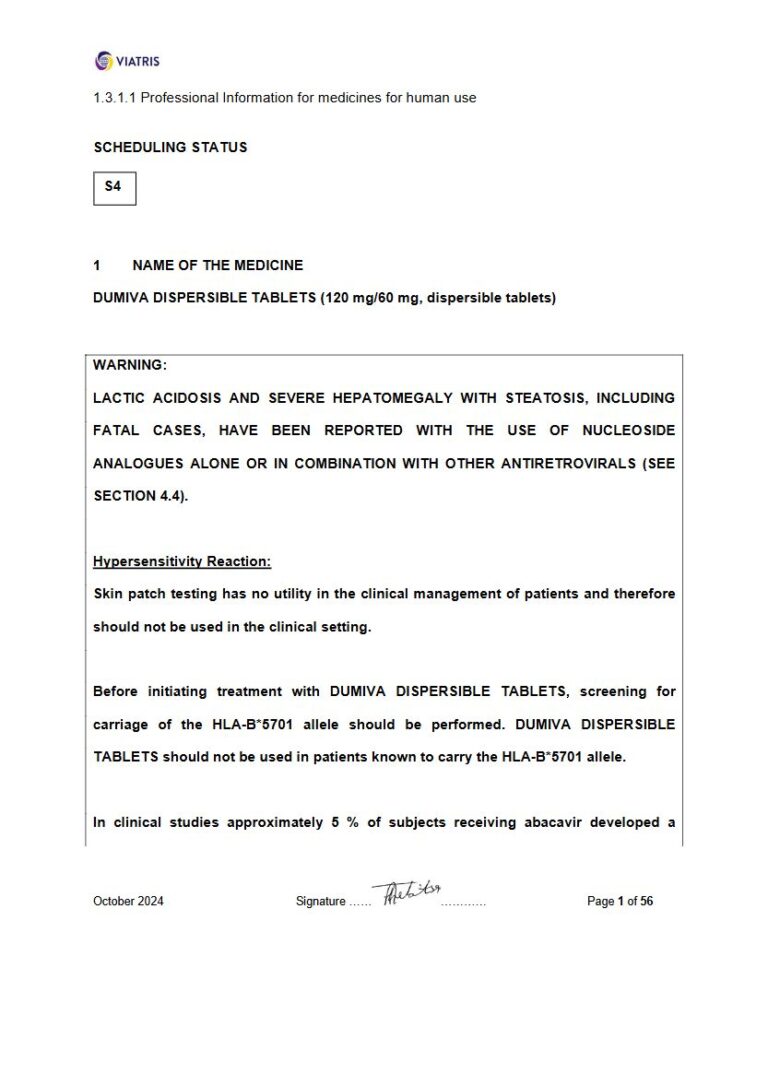
Before initiating treatment with DUMIVA DISPERSIBLE TABLETS, screening for carriage of the HLA-B*5701 allele is advisable in any HIV-infected patient, irrespective of racial origin. Screening is also recommended prior to re-initiation of DUMIVA DISPERSIBLE TABLETS in patients of unknown HLA-B*5701 status who have previously tolerated abacavir (see u201cManagement after an interruption of DUMIVA DISPERSIBLE TABLETS therapyu201d). DUMIVA DISPERSIBLE TABLETS should not be used in patients known to carry the HLA-B*5701 allele, unless no other therapeutic option is available in these patients, based on the treatment history and resistance testing. Patients who develop a hypersensitivity reaction must discontinue DUMIVA DISPERSIBLE TABLETS and MUST not be re-challenged with DUMIVA DISPERSIBLE TABLETS.
Hypersensitivity reaction:
- The warnings and special precautions relevant to both abacavir and lamivudine are included in this section.
- There are no additional SPECIAL WARNINGS AND PRECAUTIONS relevant to DUMIVA DISPERSIBLE TABLETS.
Hypersensitivity to abacavir (see section 4.8): In clinical studies, approximately 5 % of subjects receiving abacavir developed a hypersensitive reaction, which in rare cases has proved fatal. Hypersensitivity is characterised by the appearance of symptoms indicating multi-organ/body-system involvement. Patients who develop a hypersensitivity reaction must discontinue DUMIVA DISPERSIBLE TABLETS and MUST NOT be rechallenged with DUMIVA DISPERSIBLE TABLETS or any other product containing abacavir (see section 4.8).
Lactic acidosis / hyperlactataemia: Long-term use of DUMIVA DISPERSIBLE TABLETS can result in potentially fatal lactic acidosis. Symptomatic hyperlactataemia and lactic acidosis are uncommon. Suspicious biochemical features include raised transaminases, raised lactate dehydrogenase (LDH) and/or creatine kinase. Use of DUMIVA DISPERSIBLE TABLETS can result in potentially fatal lactic acidosis as a consequence of mitochondrial dysfunction. Clinical features are non-specific, and include nausea, vomiting, abdominal pain, dyspnoea, fatigue and weight loss. Lactic acidosis and severe hepatomegaly with steatosis, including fatal cases, have been reported with the use of lamivudine alone or in combination, in the treatment of HIV infection.
In patients with suspicious symptoms or biochemistry, measure the venous lactate level (normal < 2 mmol/u2113) and the serum bicarbonate and respond as follows:
- Lactate 2-5 mmol/u2113 with minimum symptoms: switch to agents that are less likely to cause lactic acidosis.
- Lactate 5-10 mmol/u2113 with symptoms and/or with reduced standard bicarbonate: Stop NRTIs and change treatment option. Once lactate has settled, use medicines that are less likely to cause lactic acidosis. Exclude other causes, e.g. sepsis, uraemia, diabetic ketoacidosis, thyrotoxicosis and hyperthyroidism.
- Lactate > 10 mmol/u2113: STOP all therapy (80 % mortality).
The above lactate values may not be applicable to paediatric patients. Caution should be exercised when administering DUMIVA DISPERSIBLE TABLETS to patients with known risk factors for liver disease and hepatic steatosis (including certain medicines and alcohol). Treatment with DUMIVA DISPERSIBLE TABLETS should be suspended in any patient who develops clinical or laboratory findings suggestive of lactic acidosis or hepatotoxicity. Diagnosis of lactic acidosis is confirmed by demonstrating metabolic acidosis with an increased anion gap and raised lactate level. Therapy should be stopped in any patient with a raised lactate level.
Blood for lactate assay should be heparinised and stored on ice. After recovery, NRTIs should be avoided. Seek expert advice on medicine selection. Lactic acidosis and severe hepatomegaly with steatosis, including fatal cases, have been reported with the use of DUMIVA DISPERSIBLE TABLETS alone or in combination. Caution should be exercised when administering DUMIVA DISPERSIBLE TABLETS to any patient with hepatomegaly, hepatitis or other known risk factors of liver disease and hepatic steatosis (including certain medicines and alcohol). Patients co-infected with hepatitis C and treated with alpha interferon and ribavirin may constitute a special risk. Patients at increased risk should be followed closely.
Mitochondrial dysfunction: Nucleoside and nucleotide analogues have been demonstrated in vitro and in vivo to cause a variable degree of mitochondrial damage. There have been reports of mitochondrial dysfunction in HIV negative infants exposed in utero and/or post-natally to nucleoside analogues. Apart from lactic acidosis/hyperlactataemia (see above) other manifestations of mitochondrial dysfunction include haematological disorders (anaemia, neutropenia), and peripheral neuropathy. Some late-onset neurological disorders have been reported (hypertonia, convulsion, abnormal behaviour). It is not known whether the neurological disorders are transient or permanent. Any foetus exposed in utero to nucleoside and nucleotide analogues, even HIV negative infants/children, should have clinical and laboratory follow-up and should be fully investigated for possible mitochondrial dysfunction in case of relevant sign and symptoms.
Cardiovascular events: Although the available data from clinical and observational studies with abacavir show inconsistent results, several studies suggest an increased risk of cardiovascular events (notably myocardial infarction) in patients treated with abacavir. Therefore, when prescribing DUMIVA DISPERSIBLE TABLETS, action should be taken to minimise all modifiable risk factors (e.g. smoking, hypertension, and hyperlipidaemia). In addition, alternative treatment options to the abacavir containing regimen should be considered when treating patients with a high cardiovascular risk.
...
4.5 Interactions with other medicines
DUMIVA DISPERSIBLE TABLETS contain abacavir and lamivudine therefore any interactions identified for these individually are relevant to DUMIVA DISPERSIBLE TABLETS. Clinical studies have shown that there are no clinically significant interactions between abacavir and lamivudine. Abacavir and lamivudine are not significantly metabolised by cytochrome P450 enzymes (such as CYP 3A4, CYP 2C9 or CYP 2D6) nor do they inhibit or induce this enzyme system. Therefore, there is little potential for interactions with antiretroviral protease inhibitors, non-nucleosides and other medicines metabolised by major P450 enzymes.
The interactions listed below should not be considered exhaustive but are representative of the classes of medicines where caution should be exercised.
Interactions relevant to abacavir: Potent enzymatic inducers such as rifampicin, phenobarbital and phenytoin may via their action on UDP-glucuronyl transferases slightly decrease the plasma concentrations of abacavir. Ethanol: The metabolism of abacavir is altered by concomitant consumption of ethanol resulting in an increase in AUC of abacavir of about 41 %. These findings are not considered clinically significant. Abacavir has no effect on the metabolism of ethanol.
...
4.6 Fertility, pregnancy and lactation
Pregnancy: DUMIVA DISPERSIBLE TABLETS is not recommended during pregnancy (see section 4.3). The safety of abacavir and lamivudine in human pregnancy has not been established.
Fertility: Studies with abacavir and lamivudine in animals have shown reproductive toxicity.
Breastfeeding: It is recommended that HIV-infected women do not breastfeed their infants under any circumstances in order to avoid transmission of HIV. Lamivudine is excreted in human milk at similar concentrations to those found in serum. It is expected that abacavir will also be secreted into human milk, although this has not been confirmed. It is therefore recommended that mothers do not breastfeed their babies while receiving treatment with DUMIVA DISPERSIBLE TABLETS.
4.7 Effects on ability to drive and use machines
No studies on the effects on ability to drive and use machines have been performed. Nevertheless, the clinical status of the patient and the adverse reaction profile of should be borne in mind when considering the patientu2019s ability to drive or operate machinery.
4.8 Undesirable effects
Some patients with hypersensitivity reactions were initially thought to have gastroenteritis, respiratory disease (pneumonia, bronchitis, pharyngitis) or a flu-like illness. This delay in diagnosis of hypersensitivity has resulted in abacavir being continued or re-introduced, leading to more severe hypersensitivity reactions or death. Therefore, the diagnosis of hypersensitivity reaction should be carefully considered for patients presenting with symptoms of these diseases. Symptoms usually appeared within the first six weeks (median time to onset 11 days) of initiation of treatment with abacavir, as contained in DUMIVA DISPERSIBLE TABLETS, although these reactions may occur at any time during therapy. Close medical supervision is necessary during the first two months, with consultations every two weeks. It is likely that intermittent therapy may increase the risk of developing sensitisation and therefore occurrence of clinically significant hypersensitivity reactions. Consequently, patients should be advised of the importance of taking DUMIVA DISPERSIBLE TABLETS regularly. Regardless of their HLA-B*5701 status, patients who develop this hypersensitivity reaction must discontinue DUMIVA DISPERSIBLE TABLETS and must never be rechallenged with DUMIVA DISPERSIBLE TABLETS, or any other medicine containing abacavir. To avoid a delay in diagnosis and minimise the risk of a life-threatening hypersensitivity reaction, abacavir, as in DUMIVA DISPERSIBLE TABLETS, must be permanently discontinued if hypersensitivity cannot be ruled out, even when other diagnoses are possible (respiratory diseases, flu-like illness, gastroenteritis or reactions to other medicines).
4.9 Overdose
Symptoms and signs: In overdose, side effects can be precipitated and/or be of increased severity (see section 4.8). No specific symptoms or signs have been identified following acute overdose with abacavir or lamivudine, apart from those listed as side-effects. Treatment: Treatment should be symptomatic and supportive. If overdose occurs the patient should be monitored for evidence of toxicity, and standard supportive treatment applied as necessary. Since lamivudine is dialysable, continuous haemodialysis could be used in the treatment of overdose, although this has not been studied. It is not known whether abacavir can be removed by peritoneal dialysis or haemodialysis.
