
Kavmyl 600 mg. 50 mg. 300 mg Film-coated tablets
PDF Leaflet Revision Date: 03 July 2025
Clinical Summary
Quick overview from the medicine insert
Indication
Treatment of HIV infection in adults and adolescents.
Dosage (summary)
One tablet once daily for adults and adolescents >40 kg.
Special Populations
- Elderly
- Renal impairment
- Hepatic impairment
Pregnancy & Breastfeeding
Contraindicated in pregnancy and breastfeeding; potential risk of neural tube defects.
Key Drug Interactions
- Metformin (contraindicated)
- Dofetilide (contraindicated)
- Carbamazepine (not recommended)
Contraindications
- Hypersensitivity to abacavir, dolutegravir, or lamivudine
- Moderate to severe hepatic impairment
- Creatinine clearance <50 mL/min
Common side effects
- Hypersensitivity reactions
- Nausea
- Fatigue
- Insomnia
- Headache
Counselling Points
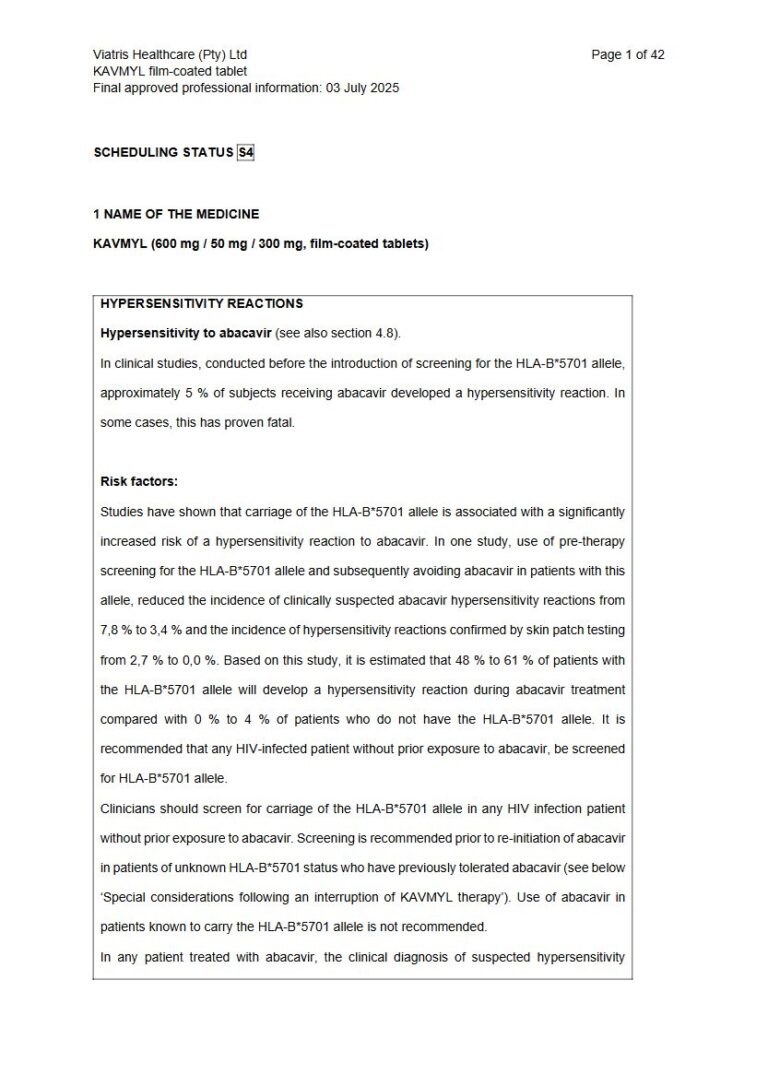
- Screen for HLA-B*5701 allele before starting therapy.
- Report any signs of hypersensitivity immediately.
- Do not restart KAVMYL after hypersensitivity reaction.
Serious warnings
- Risk of life-threatening hypersensitivity reactions
- Lactic acidosis
- Immune reconstitution inflammatory syndrome
Important Disclaimer
The Kavmyl 600 mg. 50 mg. 300 mg Film-coated tablets professional information leaflet below is the property of Viatris Healthcare and is provided on Medinsert exactly as issued, with no.. alterations or editorial changes. We make every effort to keep content current by updating documents as soon as new versions become available. Medinsert serves as a trusted access point for healthcare professionals, but does not replace official sources or clinical judgement. For more details, please read our full disclaimer. read more>>
 Healthcare Professionals Only
This content is for registered healthcare professionals
Sign in or create a free account to read the full package insert.
Free for HPCSA-registered professionals. Powered by Medinsert.
Clinical Particulars
Section 4 of the official insert — extracted exactly as issued, no alterations
4.1 Therapeutic indications
KAVMYL is indicated for the treatment of human immunodeficiency virus (HIV) infection in adults and adolescents from 18 years of age, who are antiretroviral treatment-nau00efve or are infected with HIV without documented or clinically suspected resistance to any of the three antiretroviral medicines in KAVMYL.
4.2 Posology and method of administration
Posology
KAVMYL therapy should be initiated by a medical practitioner experienced in the management of HIV infection.
Adults and adolescents
The recommended dose of KAVMYL in adults and adolescents weighing more than 40 kg is one tablet once daily. KAVMYL should not be administered to patients younger than 18 years. KAVMYL is a fixed-dose tablet and should not be prescribed for patients requiring dosage adjustments, such as those with creatinine clearance less than 50 mL/min. Separate preparations of dolutegravir, abacavir or lamivudine should be administered in cases where discontinuation or dose adjustment is indicated. In these cases, the medical practitioner should refer to the individual product information for these medicines. Since the recommended dose of dolutegravir is 50 mg twice daily for patients with resistance to integrase inhibitors, the use of KAVMYL is not recommended for patients with integrase inhibitor resistance.
Special Populations:
Elderly
There are limited data available on the use of dolutegravir, abacavir and lamivudine in patients aged 65 years and over. However, there is no evidence that elderly patients require a different dose than younger adult patients (see section 5.2). When treating elderly patients, consideration needs to be given to the greater frequency of decreased hepatic, renal and cardiac function, concomitant medicines or disease.
Renal impairment
Whilst no dosage adjustment of dolutegravir or abacavir is necessary in patients with renal impairment, a dose reduction of lamivudine is required due to decreased clearance. Therefore, KAVMYL should not be used in patients with a creatinine clearance less than 50 mL/min (see sections 5.2 and 4.3).
Hepatic impairment
A dose reduction of abacavir may be required for patients with mild hepatic impairment (Child-Pugh grade A). As dose reduction is not possible with KAVMYL, the separate preparations of dolutegravir, abacavir or lamivudine should be used when this is deemed necessary. KAVMYL is not recommended in patients with moderate and severe hepatic impairment (Child-Pugh grade B or C) (see sections 5.2 and 4.3).
Paediatric population
KAVMYL should not be used in children under the age of 18 years.
Method of administration
Oral use. KAVMYL can be taken with or without food (see section 5.2).
4.3 Contraindications
- KAVMYL is contraindicated in patients with known hypersensitivity to dolutegravir, abacavir or lamivudine or to any of the excipients of KAVMYL.
- KAVMYL is contraindicated in combination with dofetilide and pilsicainide.
- KAVMYL is contraindicated in moderate and severe hepatic impairment due to the abacavir component (see section 5.1).
- KAVMYL is contraindicated during pregnancy or in mothers who are breastfeeding their infants (see section 4.6).
- KAVMYL is contraindicated in patients with renal impairment with a creatinine clearance of <50 mL/min due to the lamivudine component (see section 5.1).
- Metformin is contraindicated in patients taking KAVMYL.
4.4 Special warnings and precautions for use
Warnings relevant to dolutegravir, abacavir and lamivudine are included in this section. There are no additional warnings relevant to KAVMYL.
Hypersensitivity to abacavir u2013 Refer to boxed warning
Hypersensitivity to dolutegravir
Hypersensitivity reactions have been reported with dolutegravir and were characterised by rash, constitutional findings and sometimes, organ dysfunction, including liver injury. Discontinue KAVMYL immediately if signs or symptoms of hypersensitivity reaction develop (including, but not limited to, severe rash or rash accompanied by fever, general malaise, fatigue, muscle or joint aches, blisters, oral lesions, conjunctivitis, facial oedema, hepatitis, eosinophilia, angioedema). Clinical status including liver aminotransferases should be monitored and appropriate therapy initiated. Delay in stopping treatment with KAVMYL after the onset of hypersensitivity may result in a life-threatening reaction.
Lipodystrophy and metabolic abnormalities
Combination antiretroviral therapy has been associated with the redistribution/accumulation of body fat, including central obesity, dorso-cervical fat enlargement (buffalo hump), peripheral wasting, facial wasting, breast enlargement and elevated serum lipid and glucose levels in HIV patients (see section 4.8). Clinical examination should include evaluation for physical signs of fat redistribution. Consideration should be given to the measurement of serum lipids and blood glucose. Lipid disorders should be managed as clinically appropriate. Patients with evidence of lipodystrophy should have a thorough cardiovascular risk assessment.
Liver disease
Use of KAVMYL can result in hepatomegaly due to non-alcoholic fatty liver disease (hepatic steatosis). The safety and efficacy of KAVMYL has not been established in patients with significant underlying liver disorders/diseases. KAVMYL is contraindicated in patients with moderate to severe hepatic impairment (see sections 4.3 and 5.2). In case of concomitant antiviral therapy for hepatitis B or C, please also consult the relevant professional information leaflets for these medicines. Patients with pre-existing liver dysfunction including chronic active hepatitis have an increased frequency of liver function abnormalities during combination antiretroviral therapy and should be monitored. If there is evidence of worsening liver disease in such patients, temporary or permanent discontinuation of treatment must be considered.
Patients with HIV and hepatitis B or C virus co-infection
Patients with chronic hepatitis B or C and treated with antiretroviral therapy are at an increased risk for severe and potentially fatal hepatic adverse reactions. Medical practitioners should refer to current HIV treatment guidelines for the optimal management of HIV infection in patients co-infected with hepatitis B virus (HBV). In case of concomitant antiviral therapy for hepatitis B or C, please refer also to the relevant package inserts for these medicines. Patients co-infected with HIV and HBV who discontinue KAVMYL should be closely monitored with both clinical and laboratory follow-up after stopping treatment. In patients with advanced liver disease or cirrhosis, treatment discontinuation is not recommended since post-treatment exacerbation of hepatitis may lead to hepatic decompensation. Discontinuation of KAVMYL therapy in patients co-infected with HIV and HBV may be associated with severe, acute exacerbations of hepatitis.
Immune Reconstitution Inflammatory Syndrome
Immune reconstitution inflammatory syndrome (IRIS) is an immunopathological response resulting from the rapid restoration of pathogen-specific immune responses to pre-existing antigens combined with immune dysregulation, which occurs shortly after starting combination Anti-Retroviral Therapy (cART). Typically, such reaction presents by paradoxical deterioration of opportunistic infections being treated or with unmasking of an asymptomatic opportunistic disease, often with an atypical inflammatory presentation. IRIS usually develops within the first three months of initiation of ART and occurs more commonly in patients with low CD4 counts. Common examples of IRIS reactions to opportunistic diseases are tuberculosis, cytomegalovirus retinitis, and cryptococcal meningitis. Appropriate treatment of the opportunistic disease should be instituted or continued and ART continued. Inflammatory manifestations generally subside after a few weeks. Severe cases may respond to glucocorticoids, but there is only limited evidence for this in patients with tuberculosis IRIS. Autoimmune disorders (such as Graves' disease) have also been reported as IRIS reactions; however, the reported time to onset is more variable and these events can occur many months after initiation of treatment.
Lactic acidosis / hyperlactataemia
Use of KAVMYL can result in potentially fatal lactic acidosis as a consequence of mitochondrial dysfunction. Clinical features are non-specific and include nausea, vomiting, abdominal pain, generalised weakness, anorexia and sudden unexplained weight loss, and respiratory symptoms (dyspnoea and tachypnoea). In patients with suspicious symptoms of biochemistry, measure the venous lactate level (normal < 2 mmol/L) and the serum bicarbonate and respond as follows:
u2022 Lactate 2-5 mmol/L with minimum symptoms: switch to medicines that are less likely to cause lactic acidosis.
u2022 Lactate 5-10 mmol/L with symptoms and/or with reduced standard bicarbonate: Stop NRTIs and change treatment option. Once lactate has settled, use medicines that are less likely to cause lactic acidosis. Exclude other causes, e.g. sepsis, uraemia, diabetic ketoacidosis, thyrotoxicosis and hyperthyroidism.
u2022 Lactate > 10 mmol/L: STOP all therapy (80 % mortality). The above lactate values may not be applicable to paediatric patients. Caution should be exercised when administering KAVMYL to patients with known risk factors for liver disease. Treatment with KAVMYL should be suspended in any patient who develops clinical or laboratory findings suggestive of lactic acidosis or hepatotoxicity.
Mitochondrial dysfunction
Nucleoside and nucleotide analogues have been demonstrated in vitro and in vivo to cause a variable degree of mitochondrial damage. There have been reports of mitochondrial dysfunction in HIV-negative infants exposed in utero and/or post-natal to nucleoside analogues. Apart from lactic acidosis/hyperlactataemia (see above) other manifestations of mitochondrial dysfunction include haematological disorders (anaemia, neutropenia) and peripheral neuropathy. Some late-onset neurological disorders have been reported (hypertonia, convulsion, abnormal behaviour). Whether the neurological disorders are transient or permanent is currently unknown. Any foetus exposed in utero to nucleoside and nucleotide analogues, such as lamivudine and abacavir in KAVMYL, even HIV-negative infants/children, should have clinical and laboratory follow-up and should be fully investigated for possible mitochondrial dysfunction in case of relevant signs or symptoms.
Patients with moderate to severe renal impairment
In patients with moderate to severe renal impairment, the terminal half-life of KAVMYL is increased due to decreased clearance. The dose of KAVMYL should therefore be adjusted.
Cardiovascular events
Although the available data from clinical and observational studies with abacavir show inconsistent results, several studies suggest an increased risk of cardiovascular events (notably myocardial infarction) in patients treated with abacavir. Therefore, when prescribing KAVMYL, action should be taken to minimise all modifiable risk factors (e.g. smoking, hypertension, and hyperlipidaemia). In addition, alternative treatment options to the abacavir containing regimen should be considered when treating patients with a high cardiovascular risk.
Osteonecrosis
Although the aetiology is considered to be multifactorial (including corticosteroid use, alcohol consumption, severe immunosuppression, higher body mass index), cases of osteonecrosis have been reported particularly in patients with advanced HIV-disease and/or long-term exposure to combination antiretroviral therapy (cART). Patients should be advised to seek medical advice if they experience joint aches and pain, joint stiffness or difficulty in movement.
Opportunistic infections
Patients receiving KAVMYL should be advised that they may continue to develop opportunistic infections and other complications of HIV infection, and therefore they should remain under close observation by healthcare professionals experienced in the treatment of patients with associated HIV disease. Regular monitoring of viral load and CD4 counts needs to be done.
The risk of HIV transmission to others
Patients should be advised that antiretroviral therapy, including KAVMYL, has not been proven to prevent the risk of transmission of HIV to others through sexual contact or blood contamination. Appropriate precautions should continue to be taken.
Pancreatitis
Pancreatitis has been observed in some patients receiving KAVMYL. Pancreatitis must be considered whenever a patient develops abdominal pain, nausea, vomiting or elevated biochemical markers. Discontinue use of KAVMYL until diagnosis of pancreatitis is excluded.
4.5 Interactions with other medicines
Caution should be given to co-administering medications (prescription and non-prescription) that may change the exposure of dolutegravir, abacavir, lamivudine or medications that may have their exposure changed by KAVMYL (see sections 4.3 and 4.5). The co-administration of dolutegravir with etravirine (ETR) is not recommended unless the patient is also receiving concomitant atazanavir + ritonavir (ATV + RTV), lopinavir + ritonavir (LPV + RTV) or darunavir + ritonavir (DRV +RTV) (see section 4.5). Dolutegravir should not be co-administered with polyvalent cation-containing antacids. KAVMYL is recommended to be administered 2 hours before or 6 hours after these medicines (see section 4.5). KAVMYL is recommended to be administered 2 hours before or 6 hours after taking calcium or iron supplements, or alternatively, administered with food (see section 4.5). Dolutegravir increase metformin concentrations. This combination may increase the risk for lactic acidosis in patients with moderate renal impairment (stage 3a creatinine clearance [CrCl] 45u201359 mL/min). Metformin is contraindicated in patients taking KAVMYL (see section 4.3). Since the recommended dose of dolutegravir is 50 mg twice daily when co-administered with etravirine (without boosted protease inhibitors), the use of KAVMYL is not recommended for patients taking these medicines (see section 4.5).
4.6 Fertility, pregnancy and lactation
Women of childbearing potential: Women of childbearing potential should be counselled about the potential risk of neural tube defects with dolutegravir (see below), including consideration of using effective contraceptive measures. Perform pregnancy testing before initiation of KAVMYL in women of childbearing potential to exclude inadvertent (unintentional) use of KAVMYL during the first trimester of pregnancy. If a woman plans pregnancy, the benefits and the risks of starting or continuing treatment with dolutegravir versus using another antiretroviral regimen should be discussed with her.
Pregnancy: KAVMYL should not be used during pregnancy and lactation as teratogenicity has been observed in animal studies. The safe use of KAVMYL in human pregnancy has not been established. Dolutegravir, lamivudine and abacavir were shown to cross the placenta in reproductive toxicity studies in animals. Use of dolutegravir during pregnancy was associated with a small increase in the prevalence of neural tube defects (0,19 %) compared to non-dolutegravir regimens (0,11 %). Most neural tube defects occur within the first 4 weeks of embryonic development after conception (approximately 6 weeks after the last menstrual period). If a pregnancy is confirmed in the first trimester while on dolutegravir, the benefits and risks of continuing dolutegravir versus switching to another antiretroviral regimen should be discussed with the patient, taking the gestational age and the critical time period of neural tube defect development into account. Dolutegravir may be used during the second and third trimester of pregnancy when the expected benefit outweighs the potential risk to the foetus. Dolutegravir was shown to cross the placenta in humans, leading to significant exposure to the foetus, but the implications of such exposure are not yet known. For patients co-infected with hepatitis B who are being treated with a lamivudine containing medicine such as KAVMYL and subsequently become pregnant, consideration should be given to the possibility of a recurrence of hepatitis on discontinuation of lamivudine. Elevations in serum lactate levels: There have been reports of elevations in serum lactate levels, which may be due to mitochondrial dysfunction, in neonates and infants exposed in utero or peri-partum to nucleoside reverse transcriptase inhibitors (NRTIs) such as abacavir and lamivudine (see section 4.4). The clinical relevance of transient elevations in serum lactate is unknown. There have also been reports of developmental delay, seizures and other neurological disease.
Breastfeeding: HIV infected women should not breastfeed their infants in order to avoid transmission of HIV or follow appropriate guidelines. Dolutegravir is excreted in human breast milk, and there is significant exposure to the neonate/infants due to slow elimination; the half-life of dolutegravir in the newborn was 33 hr compared to 14 hr in the adults. There is insufficient information on the effects of dolutegravir in neonates/infants. Lamivudine is excreted in human milk at < 4 % of maternal serum concentrations. Therefore, mothers breastfeeding their infants should not take KAVMYL.
Fertility: There are no data on the effects of dolutegravir, abacavir or lamivudine on human male or female fertility. Animal studies indicate no effects of dolutegravir, abacavir or lamivudine on male or female fertility (see section 5.3).
4.7 Effects on ability to drive and use machines
Adverse effects such as fatigue and insomnia have been observed during treatment with KAVMYL and should be borne in mind when considering the patientu2019s ability to drive or operate machinery.
4.8 Undesirable effects
KAVMYL contains dolutegravir, abacavir and lamivudine, therefore the adverse events associated with these may be expected. The side effects listed below have been identified during post-approval use of abacavir, lamivudine and dolutegravir.
Side effects based on post-marketing experience:
System organ class
Abacavir
Lamivudine
Dolutegravir
Blood and lymphatic systems disorders
Pure red cell aplasia
Immune system disorders
Hypersensitivity, immune reconstitution syndrome
Metabolism and nutrition disorders
Hyperlactataemia, lactic acidosis
Hyperlactataemia, lactic acidosis
Psychiatric disorders
Insomnia, depression, suicidal ideation or suicide attempt
Nervous system disorders
Paraesthesia, peripheral neuropathy has been reported although a causal relationship to treatment is uncertain
Headache, dizziness, abnormal dreams
Gastrointestinal disorders
Pancreatitis, but a causal relationship to abacavir is uncertain
Rises in serum amylase, pancreatitis, although a causal relationship to lamivudine is uncertain
Nausea, diarrhoea, vomiting, flatulence, upper abdominal pain, abdominal pain, abdominal discomfort
Hepatobiliary disorders
Hepatitis
Skin and subcutaneous tissue disorders
Rash (without systemic symptoms), erythema multiforme, stevens-johnson syndrome and toxic epidermal necrolysis
Alopecia
Rash, pruritus
Musculoskeletal and connective tissue disorders
Arthralgia, muscle disorders, rhabdomyolysis
General disorders and administration site conditions
Fatigue
Investigations
Increased AST, ALT, CPK, bilirubin
a. Summary of the safety profile
The most frequently reported adverse reactions considered possibly or probably related to dolutegravir and abacavir/lamivudine were nausea, insomnia, dizziness and headache. Adverse reactions listed in the table below occur frequently (nausea, vomiting, diarrhoea, fever, lethargy, rash) in patients with abacavir hypersensitivity. Therefore, patients with any of these symptoms should be carefully evaluated for the presence of this hypersensitivity (see section 4.4). Less frequent cases of erythema multiforme, Stevens-Johnson syndrome or toxic epidermal necrolysis have been reported where abacavir hypersensitivity could not be ruled out. In such cases medicines containing abacavir should be permanently discontinued. The most severe adverse event related to the treatment with dolutegravir and abacavir/lamivudine, seen in individual patients, was a hypersensitivity reaction that included rash and severe liver effects (see section Boxed warning, section 4.4 and Description of selected adverse reactions in this section).
4.9 Overdose
Symptoms and signs
In overdose, side effects can be precipitated and/or be of increased severity.
Treatment
The patient should be treated symptomatically and supportively with appropriate monitoring as necessary. Since lamivudine is dialysable, continuous haemodialysis could be used in the treatment of overdose, although this has not been studied. It is not known whether abacavir can be removed by peritoneal dialysis or haemodialysis. There is currently limited experience with overdosage in dolutegravir. However, as dolutegravir is highly bound by plasma proteins, it is unlikely that it will be significantly removed by dialysis.
