
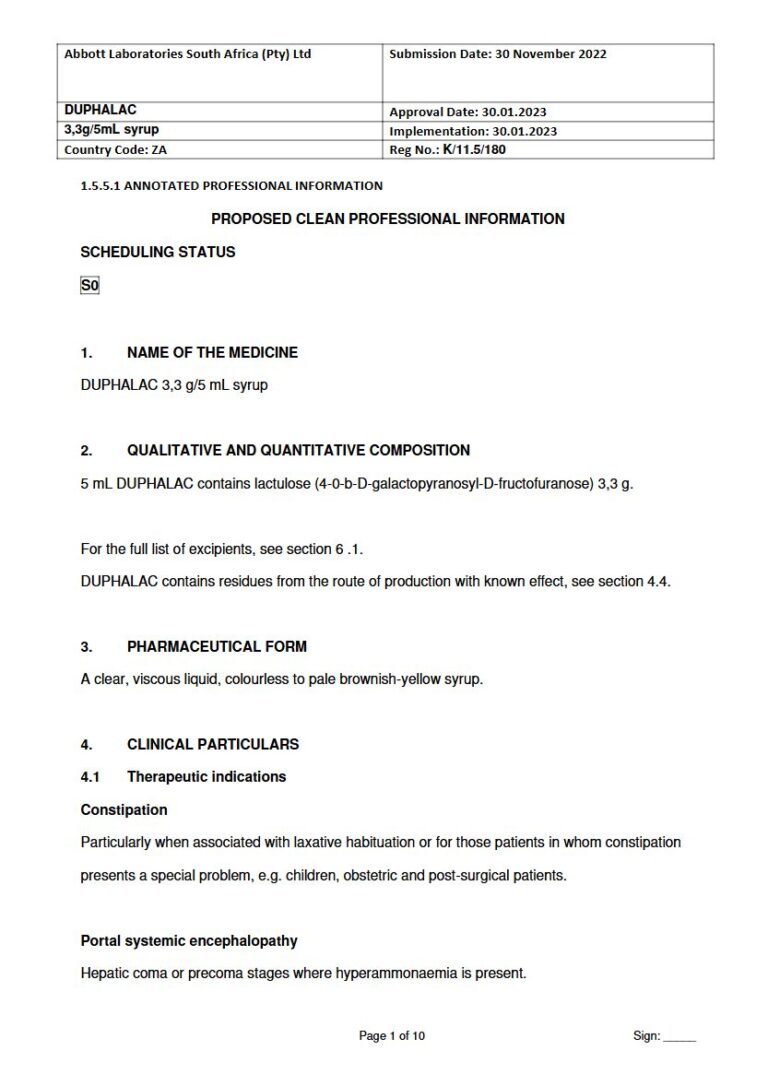
Duphalac 3,3 G/5 Ml Syrup
PDF Leaflet Revision Date: 30 January 2023
Clinical Summary
Quick overview from the medicine insert
Indication
Constipation and portal systemic encephalopathy.
Dosage (summary)
Adults: 30 mL initial, 15-30 mL maintenance; Children: 15 mL (6-14 years), 10 mL (1-5 years), 5 mL (infants).
Special Populations
- Diabetics
- Paediatric patients
Pregnancy & Breastfeeding
Negligible systemic exposure; safe during pregnancy and lactation.
Key Drug Interactions
- Increases potassium loss with thiazides, corticosteroids, amphotericin B
- May enhance cardiac glycoside effects
Contraindications
- Hypersensitivity to lactulose
- Galactosaemia
- Gastrointestinal obstruction
Common side effects
- Diarrhoea
- Flatulence
- Abdominal pain
- Nausea
Counselling Points
- Take after breakfast
- Monitor for abdominal pain or diarrhoea
- Use caution in children
Serious warnings
- Consult doctor for unknown abdominal pain
- Risk of electrolyte imbalance with chronic use
Important Disclaimer
The Duphalac 3,3 G/5 Ml Syrup professional information leaflet below is the property of Abbott Laboratories South Africa and is provided on Medinsert exactly as issued, with no.. alterations or editorial changes. We make every effort to keep content current by updating documents as soon as new versions become available. Medinsert serves as a trusted access point for healthcare professionals, but does not replace official sources or clinical judgement. For more details, please read our full disclaimer. read more>>
 Healthcare Professionals Only
This content is for registered healthcare professionals
Sign in or create a free account to read the full package insert.
Free for HPCSA-registered professionals. Powered by Medinsert.
Clinical Particulars
Section 4 of the official insert — extracted exactly as issued, no alterations
4.1 Therapeutic indications
Constipation
Particularly when associated with laxative habituation or for those patients in whom constipation presents a special problem, e.g. children, obstetric and post-surgical patients.
Portal systemic encephalopathy
Hepatic coma or precoma stages where hyperammonaemia is present.
4.2 Posology and method of administration
Posology
Constipation
Dosage can vary widely with the severity of the condition. A relatively large initial dose should be followed by a smaller maintenance dose after the first three days of treatment. Only one dose daily needs to be taken, preferably after breakfast.
Recommended dosages are as follows:
Usual starting dose
Adults: 30 mL (6 x 5 mL spoonfuls).
Children (6-14 years): 15 mL (3 x 5 mL spoonfuls).
Children (1-5 years): 10 mL (2 x 5 mL spoonfuls).
Infants: 5 mL (1 x 5 mL spoonful).
Maintenance dose
Adults: 15 u2013 30 mL (3 u2013 6 x 5 mL spoonfuls).
Children (6-14 years): 10 u2013 15 mL (2 u2013 3 x 5 mL spoonfuls).
Children (1-5 years): 5 u2013 10 mL (1 u2013 2 x 5 mL spoonfuls).
Infants: 2,5 u2013 5 mL (u00bd u2013 1 x 5 mL spoonful).
Portal systemic encephalopathy
Initial dose of 30 u2013 50 mL 3 times daily. Subsequently adjust the dose to produce two or three soft stools daily.
4.3 Contraindications
Hypersensitivity to lactulose (see section 2).
Galactosaemia.
Gastrointestinal obstruction, perforation in the digestive organs or risk of this (for example, acute inflammatory diseases of the intestine, such as colitis ulcerosa, Crohnu2019s disease).
4.4 Special warnings and precautions for use
It is advised that a doctor should be consulted in the case of:
u2022 painful abdominal symptoms of unknown origin before the treatment is started;
u2022 insufficient therapeutic effect after a few days.
DUPHALAC should be given with caution to patients with a lactose intolerance. The usual dosage in constipation does normally not pose a problem for diabetics. The dosage used in the treatment of portal systemic encephalopathy is usually much higher and may need to be taken into consideration with diabetics. Note should, however, be taken that DUPHALAC contains small amounts of lactose, galactose and fructose from the manufacturing process.
Patients with rare hereditary galactose or fructose intolerance, total lactase deficiency or glucose-galactose malabsorption should not take DUPHALAC.
DUPHALAC contains residues of sulphite from the manufacturing process.
Patients with a gastro-cardiac syndrome (Roemheld syndrome) should use lactulose only after consulting a doctor. If symptoms such as meteorism or distension occur in these patients after taking DUPHALAC, the dosage should be reduced, or treatment should be discontinued.
Chronic use of unregulated doses and abuse may lead to diarrhoea and disturbance of the electrolyte balance.
Paediatric population
Laxatives should only be used in children in exceptional cases and under medical supervision. Caution should be exercised when giving DUPHALAC to babies and small children who have a rare autosomal recessive fructose intolerance. It should be taken into account that the reflex that causes defecation may be disturbed during the treatment.
4.5 Interaction with other medicines and other forms of interaction
No interaction studies have been carried out. DUPHALAC may increase the potassium loss induced by other medicines (for example thiazides, corticosteroids and amphotericin B). Concomitant use of cardiac glycosides may increase the effect of the glycosides due to potassium deficiency.
4.6 Fertility, pregnancy and lactation
Pregnancy
No effects are anticipated during pregnancy since the systemic exposure to lactulose is negligible.
Lactation
No harmful effects on the health of the child during breastfeeding are anticipated, since the systemic exposure to lactulose is negligible.
Fertility
No effects are anticipated because the systemic exposure to lactulose is negligible.
4.7 Effects on ability to drive and use machines
DUPHALAC has no or a negligible effect on the ability to drive or use machines.
4.8 Undesirable effects
Although occasionally nausea and meteorism or flatulence have been reported on the high initial dosages used, these effects normally disappear when the maintenance dosage has been reached. If the dosage given is higher than prescribed, abdominal pain and diarrhoea may occur. The dosage should then be reduced. If high doses (normally only for portal systemic encephalopathy, PSE) are used for an extended period, the patientu2019s electrolyte balance may be disturbed as a result of diarrhoea.
Immune system disorders
Not known : hypersensitivity
Gastrointestinal disorders
frequent : diarrhoea, flatulence, abdominal pain, nausea, vomiting
Common: flatulence, abdominal pain, nausea, vomiting
Skin and subcutaneous tissue disorders
Frequency unknown : rash, pruritus, urticaria, erythema
Investigations
Less frequent : disturbed electrolyte balance as a result of diarrhoea
Paediatric patients
The safety profile is expected to be the same in children as in adults.
Reporting of suspected adverse reactions
Reporting suspected adverse reactions after authorisation of DUPHALAC is important. It allows continued monitoring of the benefit/risk balance of DUPHALAC. Healthcare providers are asked to report any suspected adverse reactions to SAHPRA via the u201c 6.04 Adverse Drug Reactions Reporting Form u201d, found online under SAHPRAu2019s publications: https://www.sahpra.org.za/Publications/Index/8
4.9 Overdose
See section 4.8.
Symptoms: Diarrhoea and abdominal pain.
Treatment: Stop treatment with DUPHALAC or reduce the dose. Extreme fluid loss due to diarrhoea or vomiting may require correction of the disturbed electrolyte balance.
