
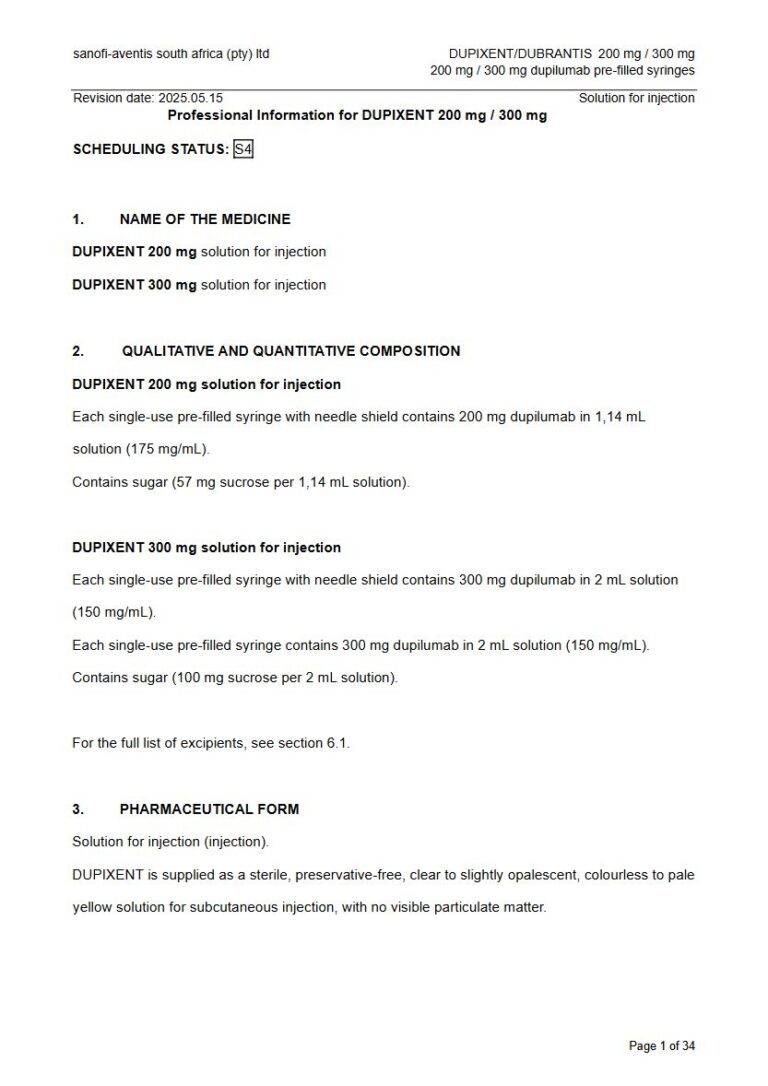
Dupixent/Dubrantis 200 mg / 300 mg Solution for injection.
PDF Leaflet Revision Date: 15 May 2025
Clinical Summary
Quick overview from the medicine insert
Indication
Treatment of moderate-to-severe atopic dermatitis, asthma, chronic rhinosinusitis with nasal polyposis, and prurigo nodularis.
Dosage (summary)
Adults: Initial 600 mg, then 300 mg every 2 weeks for atopic dermatitis; 400 mg initial, then 200 mg every 2 weeks for asthma.
Special Populations
- Elderly
- Hepatic impairment
- Renal impairment
Pregnancy & Breastfeeding
Not recommended during pregnancy; unknown if excreted in breast milk.
Key Drug Interactions
- Live vaccines
- CYP450 substrates
Contraindications
- Hypersensitivity to dupilumab or excipients
Common side effects
- Conjunctivitis
- Injection site reactions
- Eosinophilia
Counselling Points
- Administer subcutaneously
- Rotate injection sites
- Report eye symptoms
Serious warnings
- Hypersensitivity reactions
- Conjunctivitis and keratitis
- Eosinophilic conditions
Important Disclaimer
The Dupixent/Dubrantis 200 mg / 300 mg Solution for injection. professional information leaflet below is the property of Sanofi-Aventis South Africa and is provided on Medinsert exactly as issued, with no.. alterations or editorial changes. We make every effort to keep content current by updating documents as soon as new versions become available. Medinsert serves as a trusted access point for healthcare professionals, but does not replace official sources or clinical judgement. For more details, please read our full disclaimer. read more>>
 Healthcare Professionals Only
This content is for registered healthcare professionals
Sign in or create a free account to read the full package insert.
Free for HPCSA-registered professionals. Powered by Medinsert.
Clinical Particulars
Section 4 of the official insert — extracted exactly as issued, no alterations
4.1 Therapeutic indications
DUPIXENT is indicated for the following type 2 inflammatory diseases:
ATOPIC DERMATITIS
DUPIXENT is indicated for the treatment of patients aged 6 months and older with moderate-to-severe atopic dermatitis (AD) whose disease is not adequately controlled with topical corticosteroid therapies or when those therapies are not advisable. DUPIXENT can be used with or without additional topical corticosteroids therapy.
ASTHMA
DUPIXENT is indicated in patients 6 years and older as an add-on maintenance treatment for moderate-to-severe asthma with type 2 inflammation characterised by elevated blood eosinophils and/or elevated fractional exhaled nitric oxide (FeNO). DUPIXENT is indicated as maintenance therapy to improve lung function. DUPIXENT is indicated as maintenance therapy for oral corticosteroid-dependent asthma irrespective of baseline levels of type 2 inflammatory biomarkers.
CHRONIC RHINOSINUSITIS WITH NASAL POLYPOSIS
DUPIXENT is indicated as an add-on maintenance treatment in adult patients with inadequately controlled severe chronic rhinosinusitis with nasal polyposis (CRSwNP). DUPIXENT is indicated to reduce the need for surgery and systemic corticosteroid use in adult patients with inadequately controlled severe CRSwNP. DUPIXENT is indicated as an add-on maintenance treatment of co-morbid asthma in adult patients with inadequately controlled severe CRSwNP.
PRURIGO NODULARIS
DUPIXENT is indicated for the treatment of adult patients with prurigo nodularis (PN) whose disease is not adequately controlled with topical prescription therapies or when those therapies are not advisable. DUPIXENT can be used with or without topical corticosteroids.
4.2 Posology and method of administration
Posology
DUPIXENT is administered by subcutaneous injection.
ATOPIC DERMATITIS
Adults
The recommended dose of DUPIXENT for adult patients is an initial dose of 600 mg (two 300 mg injections), followed by 300 mg given every other week. Based on individual therapeutic response, the dosage may be increased to 300 mg given weekly.
Paediatric and adolescent patients (6 to 17 years of age)
The recommended dose of DUPIXENT for paediatric and adolescent patients 6 to 17 years of age is specified in Table 1.
Table 1: Dose of DUPIXENT for subcutaneous administration in paediatric and adolescent patients 6 to 17 years of age with atopic dermatitis
- Body weight
- Initial dose
- Subsequent doses
- 15 to less than 30 kg
- 600 mg (two 300 mg injections)
- 300 mg every 4 weeks (Q4W)
- 30 to less than 60 kg
- 400 mg (two 200 mg injections)
- 200 mg every other week (Q2W)
- 60 kg or more
- 600 mg (two 300 mg injections)
- 300 mg every other week (Q2W)
Paediatric patients (6 months to 5 years of age)
The recommended dose of DUPIXENT for children 6 months to 5 years of age is specified in Table 2.
Table 2: Dose of DUPIXENT for subcutaneous administration in paediatric patients 6 months to 5 years of age with atopic dermatitis
- Body weight
- Initial dose
- Subsequent doses
- 5 to less than 15 kg
- 200 mg (one 200 mg injection)
- 200 mg every 4 weeks (Q4W)
- 15 to less than 30 kg
- 300 mg (one 300 mg injection)
- 300 mg every 4 weeks (Q4W)
DUPIXENT can be used with or without topical therapy.
ASTHMA
Adults and adolescents (12 years of age and older)
The recommended dose of DUPIXENT for adults and adolescents (12 years of age and older) is:
- An initial dose of 400 mg (two 200 mg injections) followed by 200 mg given every other week. The dose may be increased to 300 mg every other week based on the prescriberu2019s assessment.
- An initial dose of 600 mg (two 300 mg injections) followed by 300 mg given every other week for patients with oral corticosteroid-dependent asthma or with co-morbid moderate-to-severe atopic dermatitis or adults with co-morbid severe chronic rhinosinusitis with nasal polyposis for which DUPIXENT is indicated.
Paediatric patients (6 to 11 years of age)
The recommended dose of DUPIXENT for paediatric patients 6 to 11 years of age is specified in Table 3.
Table 3: Dose of DUPIXENT for subcutaneous administration in paediatric patients 6 to 11 years of age with asthma
- Body weight
- Initial and subsequent doses
- 15 to less than 30 kg
- 300 mg every 4 weeks (Q4W)
- 30 to less than 60 kg
- 200 mg every other week (Q2W) or 300 mg every 4 weeks (Q4W)
- 60 kg or more
- 200 mg every other week (Q2W)
For paediatric patients (6 u2013 11 years old) with asthma and co-morbid moderate-to-severe atopic dermatitis, the recommended dose in Table 1 should be followed.
CHRONIC RHINOSINUSITIS WITH NASAL POLYPOSIS
The recommended dose of DUPIXENT for adult patients is an initial dose of 300 mg followed by 300 mg given every other week.
PRURIGO NODULARIS
The recommended dose of DUPIXENT for adult patients is an initial dose of 600 mg (two 300 mg injections), followed by 300 mg given every other week.
Missed dose
If a weekly dose is missed, administer the dose as soon as possible. Thereafter, resume dosing at the regular scheduled time. If an every other week dose is missed, administer the injection within 7 days from the missed dose and then resume the patient's original schedule. If the missed dose is not administered within 7 days, wait until the next dose on the original schedule. If an every 4 week dose is missed, administer the injection within 7 days from the missed dose and then resume the patient's original schedule. If the missed dose is not administered within 7 days, administer the dose, starting a new schedule based on this date.
Special populations
Elderly patients
No dose adjustment is recommended for elderly patients (see section 5.2).
Hepatic impairment
No data are available in patients with hepatic impairment (see section 5.2).
Renal impairment
No dosage adjustment is needed in patients with mild or moderate renal impairment. No data are available in patients with severe renal impairment (see section 5.2).
Body weight
No dose adjustment for body weight is recommended in patients with asthma 12 years of age and older and in adults with atopic dermatitis, CRSwNP or PN. For patients 6 to 17 years of age with atopic dermatitis, the recommended doses are 300 mg Q4W (15 kg to < 30 kg), 200 mg Q2W (30 kg to < 60 kg) and 300 mg Q2W (u2265 60 kg). For patients 6 months to 5 years of age with atopic dermatitis, the recommended dose is 200 mg Q4W (5 kg to < 15 kg) and 300 mg Q4W (15 kg to < 30 kg). For patients 6 to 11 years of age with asthma, the recommended doses are 300 mg Q4W (u2265 15 kg to < 30 kg), 200 mg Q2W or 300 mg Q4W (u2265 30 kg to < 60 kg) and 200 mg Q2W (u2265 60 kg).
4.3 Contraindications
DUPIXENT is contraindicated in patients who have known hypersensitivity to dupilumab or any of its excipients (see sections 4.4 and 6.1).
4.4 Special warnings and precautions for use
DUPIXENT is for subcutaneous administration only.
Hypersensitivity
If a systemic hypersensitivity reaction occurs, administration of DUPIXENT should be discontinued immediately and appropriate therapy initiated. Hypersensitivity reactions, including anaphylaxis, serum sickness or serum sickness-like reactions and angioedema, have been reported in clinical trials following the administration of DUPIXENT (see section 4.8).
Conjunctivitis- and keratitis-related events
Conjunctivitis- and keratitis-related events have been reported with DUPIXENT, predominantly in atopic dermatitis patients. Some patients reported visual disturbances (e.g. blurred vision) associated with conjunctivitis or keratitis (see section 4.8). Patients should report new onset or worsening eye symptoms to their health care professional. Patients treated with DUPIXENT who develop conjunctivitis that does not resolve following standard treatment or signs and symptoms suggestive of keratitis should undergo ophthalmological examination, as appropriate (see section 4.8).
Eosinophilic conditions
Patients being treated for asthma may present with serious systemic eosinophilia, sometimes presenting with clinical features of eosinophilic pneumonia or vasculitis consistent with eosinophilic granulomatosis with polyangiitis, conditions which are often treated with systemic corticosteroid therapy. These events usually, but not always, may be associated with the reduction of oral corticosteroid therapy. Medical practitioners should be alert to vasculitic rash, worsening pulmonary symptoms, cardiac complications and/or neuropathy presenting in their patients with eosinophilia. Cases of eosinophilic pneumonia were reported in adult patients who participated in the asthma development programme and cases of vasculitis consistent with eosinophilic granulomatosis with polyangiitis (EGPA) have been reported with DUPIXENT in adult patients who participated in the asthma development programme as well as in adult patients with co-morbid asthma in the CRSwNP development programme. A causal association between DUPIXENT and these conditions has not been established.
Acute asthma symptoms or deteriorating disease
DUPIXENT should not be used to treat acute symptoms or acute exacerbations of asthma. Do not use DUPIXENT to treat acute bronchospasm or status asthmaticus.
Reduction of corticosteroid dosage
Do not discontinue systemic, topical, or inhaled corticosteroids abruptly upon initiation of therapy with DUPIXENT. Reductions in corticosteroid dose, if appropriate, should be gradual and performed under the direct supervision of a medical practitioner. Reduction in corticosteroid dose may be associated with systemic withdrawal symptoms and/or unmask conditions previously suppressed by systemic corticosteroid therapy.
Helminth infection
Patients with known helminth infections were excluded from participation in clinical studies. It is unknown if DUPIXENT will influence the immune response against helminth infections. Treat patients with pre-existing helminth infections before initiating DUPIXENT. If patients become infected while receiving treatment with DUPIXENT and do not respond to antihelminth treatment, discontinue treatment with DUPIXENT until infection resolves. Enterobiasis was reported as adverse reaction in children 6 to 11 years old who participated in the paediatric asthma development programme.
Concomitant atopic conditions
Patients with co-morbid asthma should be advised not to adjust their treatment without consultation with their health care professional. When discontinuing DUPIXENT consider the potential effects on other atopic conditions.
Sodium content
Both DUPIXENT 200 mg and DUPIXENT 300 mg contain less than 1 mmol sodium (23 mg) per dose, that is to say essentially sodium free.
4.5 Interaction with other medicines and other forms of interaction
Live vaccines
DUPIXENT has not been studied with live attenuated vaccines.
Non-live vaccines
Immune responses to vaccination were assessed in a study in which patients with atopic dermatitis were treated once weekly for 16 weeks with 300 mg dupilumab. After 12 weeks of dupilumab administration, patients were vaccinated with a Tdap vaccine (T cell-dependent) and a meningococcal polysaccharide vaccine (T cell-dependent), and immune responses were assessed 4 weeks later. Antibody responses to both tetanus vaccine and meningococcal polysaccharide vaccine were similar in dupilumab-treated and placebo-treated patients. No adverse interactions between either of the non-live vaccines and dupilumab were noted in the study.
CYP450 substrates
In a clinical trial of AD patients, the effects of dupilumab on the pharmacokinetics (PK) of CYP substrates was evaluated. The data gathered from this study did not indicate a clinically relevant effect of dupilumab on CYP1A2, CYP3A, CYP2C19, CYP2D6 or CYP2C9 activity.
Use with other medicines for treatment of asthma
An effect of dupilumab on the PK of co-administered medicines is not expected. Based on the population analysis, commonly co-administered medicines had no effect on dupilumab pharmacokinetics in patients with moderate to severe asthma.
4.6 Fertility, pregnancy and lactation
Pregnancy
Safety in pregnancy has not been established. Animal studies do not indicate direct or indirect harmful effects with respect to reproductive toxicity. Due to the lack of data, the use of DUPIXENT is not recommended during pregnancy.
Lactation
It is unknown whether dupilumab is excreted in human milk. Because many antibodies are excreted in human milk, mothers receiving DUPIXENT are advised not to breastfeed their infants.
Fertility
No data are available.
4.7 Effects on ability to drive and use machines
DUPIXENT has no or negligible influence on the ability to drive or operate machinery.
4.8 Undesirable effects
ATOPIC DERMATITIS
Adults
In the overall exposure pool, a total of 2 526 patients with atopic dermatitis were treated with DUPIXENT in controlled and uncontrolled clinical trials. Of these, 739 patients were exposed for at least 1 year. The safety of DUPIXENT monotherapy was evaluated through Week 16 based on data from three randomised, double-blind, placebo-controlled multicentre studies (SOLO 1, SOLO 2 and a phase 2, dose-ranging study) that included 1 564 adult patients with moderate-to-severe atopic dermatitis (AD).
The safety of DUPIXENT with concomitant topical corticosteroids (TCS) was evaluated based on data from one randomised, double-blind, placebo-controlled, multicentre study (CHRONOS). A total of 740 patients were treated up to 52 weeks.
Table 4 summarises the adverse reactions that occurred in u2265 1 % of patients treated with DUPIXENT during the first 16 weeks of treatment in placebo-controlled trials. The adverse reactions are listed by system organ class and frequency using the following convention: Very common (u2265 10 %); common (u2265 1 % and < 10 %); uncommon (u2265 0,1 % and < 1 %); rare (u2265 0,01 % and < 0,1 %); very rare (< 0,01 %); not known (cannot be estimated from available data).
Table 4: Adverse reactions occurring in u2265 1 % of patients with atopic dermatitis treated with DUPIXENT through Week 16 in placebo-controlled trials
| MedDRA system organ class | Frequency | Adverse reaction |
|---|---|---|
| Infections and infestations | Common | Conjunctivitis |
| Oral herpes | ||
| Bacterial conjunctivitis | ||
| Herpes simplex | ||
| Blood and lymphatic system disorders | Common | Eosinophilia |
| Eye disorders | Common | Allergic conjunctivitis |
| Eye pruritus | ||
| Blepharitis | ||
| Dry eye | ||
| General disorders and administration site conditions | Very common | Injection site reactions |
The safety profile of DUPIXENT + TCS in adult atopic dermatitis patients through Week 52 is consistent with the safety profile observed at Week 16.
In a phase 3, multicentre, open label extension (OLE) study (AD-1225), the long-term safety of repeat doses of DUPIXENT was assessed in adults with moderate-to-severe AD who had previously participated in controlled studies of DUPIXENT or had been screened for a phase 3 study (SOLO1 or SOLO2). The safety data in AD-1225 reflect the exposure to DUPIXENT in 2 677 adult atopic dermatitis patients, including 2 254 who completed at least 52 weeks, 1 224 who completed at least 100 weeks, 561 who completed at least 148 weeks and 179 who completed at least 260 weeks of the study. The majority of the patients in Trial 5 (99,7 %) were exposed to DUPIXENT 300 mg weekly dosing (QW). The long-term safety profile observed in this study up to 5 years was generally consistent with the safety profile of DUPIXENT observed in controlled studies.
Adolescents (12 to 17 years of age)
The safety of DUPIXENT was assessed in a study of 250 patients 12 to 17 years of age with moderate-to-severe atopic dermatitis (AD-1526). The safety profile of DUPIXENT in these patients followed through Week 16 was similar to the safety profile from studies in adults with atopic dermatitis.
The long-term safety of DUPIXENT was assessed in an open-label extension study in patients 12 to 17 years of age with moderate-to-severe atopic dermatitis (AD-1434). The safety profile of DUPIXENT in patients followed through Week 52 was similar to the safety profile observed at Week 16 in AD-1526 study. The long-term safety profile of DUPIXENT observed in adolescents was consistent with that seen in adults with atopic dermatitis.
Paediatric patients (6 to 11 years of age)
The safety of DUPIXENT was assessed in a trial of 367 patients 6 to 11 years of age with severe atopic dermatitis (AD-1652). The safety profile of DUPIXENT + TCS in these patients through Week 16 was similar to the safety profile from studies in adults and adolescents with atopic dermatitis.
The long-term safety of DUPIXENT + TCS was assessed in an open-label extension study of 368 patients 6 to 11 years of age with atopic dermatitis (AD-1434). Among patients who entered this study, 110 (29,9 %) had moderate and 72 (19,6 %) had severe atopic dermatitis at the time of enrolment in study AD-1434. The safety profile of DUPIXENT + TCS in patients followed through Week 52 was similar to the safety profile observed at Week 16 in AD-1652. The long-term safety profile of DUPIXENT + TCS observed in paediatric patients was consistent with that seen in adults and adolescents with atopic dermatitis.
Paediatric patients (6 months to 5 years of age)
The safety of DUPIXENT + TCS was assessed in a study of 161 patients 6 months to 5 years of age with moderate-to-severe atopic dermatitis (AD-1539). The safety profile of DUPIXENT + TCS in these patients through Week 16 was similar to the safety profile from studies in adults and paediatric patients 6 to 17 years of age with atopic dermatitis. The long-term safety profile of DUPIXENT + TCS observed in paediatric subjects 6 months to 5 years of age was consistent with that seen in adults and paediatric patients 6 to 17 years old with atopic dermatitis.
ASTHMA
A total of 2 888 adult and adolescent patients with moderate-to-severe asthma were evaluated in 3 randomised, placebo-controlled, multicentre trials of 24 to 52 weeks duration (DRI12544, QUEST and VENTURE). Of these, 2 678 had a history of 1 or more severe exacerbations in the year prior to enrolment despite regular use of medium- to high-dose inhaled corticosteroids plus an additional controller(s) (DRI12544 and QUEST). A total of 210 patients with oral corticosteroid-dependent asthma receiving high-dose inhaled corticosteroids plus up to two additional controllers were enrolled (VENTURE). DUPIXENT 200 mg or 300 mg was administered subcutaneously every other week, following an initial dose of 400 mg or 600 mg, respectively.
In DRI12544 and QUEST studies, the proportion of patients who discontinued treatment due to adverse events was 3,2 % of the DUPIXENT 200 mg Q2W group and 6,1 % of the DUPIXENT 300 mg Q2W group.
Table 5 summarises the adverse reactions that occurred at a rate of at least 3 % of patients treated with DUPIXENT and at higher rate than in their respective comparator groups in DRI12544 and QUEST studies. The adverse reactions are listed by system organ class and frequency using the following convention: Very common (u2265 10 %); common (u2265 1 % and < 10 %); uncommon (u2265 0,1 % and < 1 %); rare (u2265 0,01 % and < 0,1 %); very rare (< 0,01 %); not known (cannot be estimated from available data).
Table 5: Adverse reactions occurring in u2265 3 % of the DUPIXENT groups in the DRI12544 and QUEST
| MedDRA system organ class | Frequency | Adverse reaction |
|---|---|---|
| General disorders and administration site conditions | Very common | Injection site erythema |
| Common | Injection site oedema | |
| Common | Injection site pruritus |
Adults and adolescents (12 years and older)
The long-term safety of DUPIXENT was assessed in an open-label extension study in 2 282 patients 12 years and older with moderate-to-severe asthma (TRAVERSE). In this study, patients were followed for up to 96 weeks, resulting in 3 169 patient-years cumulative exposure to DUPIXENT. The safety profile of DUPIXENT in TRAVERSE was consistent with the safety profile observed in pivotal asthma studies for up to 52 weeks of treatment.
Paediatric patients (6 to 11 years of age)
The safety of DUPIXENT was assessed in 405 patients 6 to 11 years of age with moderate-to-severe asthma (VOYAGE). The safety profile of DUPIXENT in these patients through Week 52 was similar to the safety profile from studies in adults and adolescents with moderate-to-severe asthma, with the additional adverse reactions of enterobiasis and eosinophilia. Enterobiasis was reported in 1,8 % (5 patients) in the DUPIXENT groups and none in the placebo group. All enterobiasis cases were mild to moderate and patients recovered with antihelminth treatment without DUPIXENT treatment discontinuation. Eosinophilia (blood eosinophils u2265 3 000 cells/u03bcL or deemed by the investigator to be an adverse event) was reported in 6,6 % of the DUPIXENT groups and 0,7 % in the placebo group.
The long-term safety of DUPIXENT was assessed in an open-label extension study (EXCURSION) in children 6 to 11 years of age with moderate-to-severe asthma who previously participated in VOYAGE. Among 365 patients who entered EXCURSION, 350 completed 52 weeks of treatment and 228 patients completed a cumulative treatment duration of 104 weeks (VOYAGE and EXCURSION). The safety profile of DUPIXENT in children with asthma 6 to 11 years of age who participated in the 52 weeks long-term safety study (EXCURSION) was consistent with the safety profile observed in the pivotal asthma study (VOYAGE) for 52 weeks of treatment.
CHRONIC RHINOSINUSITIS WITH NASAL POLYPOSIS
A total of 722 adult patients with chronic rhinosinusitis with nasal polyposis (CRSwNP) were evaluated in 2 randomised, placebo-controlled, multicentre trials of 24 to 52 weeks duration (SINUS-24 and SINUS-52). The safety pool consisted of data from the first 24 weeks of treatment. Table 6 summarises the adverse reactions that occurred at a rate of at least 1 % in patients treated with DUPIXENT and at a higher rate than in their respective comparator group in SINUS-24 and SINUS-52. The adverse reactions are listed by system organ class and frequency using the following convention: Very common (u2265 10 %); common (u2265 1 % and < 10 %); uncommon (u2265 0,1 % and < 1 %); rare (u2265 0,01 % and < 0,1 %); very rare (< 0,01 %); not known (cannot be estimated from available data).
Table 6: Adverse reactions occurring in u2265 1 % of the DUPIXENT group in SINUS-24 and SINUS-52 and greater than placebo (24-week safety pool)
| MedDRA system organ class | Frequency | Adverse reaction |
|---|---|---|
| Infections and infestations | Common | Conjunctivitis |
| General disorders and administration site conditions | Common | Injection site reactions |
The safety profile of DUPIXENT through Week 52 was generally consistent with the safety profile observed at Week 24.
PRURIGO NODULARIS
A total of 309 adult patients with prurigo nodularis (PN) were evaluated in two 24-week randomised, double-blind, placebo-controlled, multicentre trials (PRIME and PRIME2). The safety pool included data from the 24-week treatment and 12-week follow-up periods from both studies. Table 7 summarises the adverse reactions that occurred at a rate of at least 1 % in patients treated with DUPIXENT and at a higher rate than in their respective comparator group in PRIME and PRIME2. The adverse reactions are listed by system organ class and frequency using the following convention: Very common (u2265 10 %); common (u2265 1 % and < 10 %); uncommon (u2265 0,1 % and < 1 %); rare (u2265 0,01 % and < 0,1 %); very rare (< 0,01 %); not known (cannot be estimated from available data).
Table 7: Adverse reactions occurring in u2265 1 % of the DUPIXENT group in PRIME and PRIME2 and greater than placebo (safety pool)
| MedDRA system organ class | Frequency | Adverse reaction |
|---|---|---|
| Infections and infestations | Common | Conjunctivitis |
Description of selected adverse reactions
Hypersensitivity
Hypersensitivity reactions, including anaphylaxis, angioedema and serum sickness or serum sickness-like reactions have been reported following the administration of DUPIXENT (section 4.4).
Conjunctivitis- and keratitis-related events
Conjunctivitis- and keratitis-related events occurred more frequently in atopic dermatitis patients who received DUPIXENT in the placebo-controlled atopic dermatitis studies. Most patients with conjunctivitis or keratitis recovered or were recovering during the treatment period. The respective rates of conjunctivitis and keratitis remained similar at 5 years in the long-term OLE study (AD-1225). Among asthma patients the frequency of conjunctivitis and keratitis was low and similar between DUPIXENT and placebo. In patients with CRSwNP and PN, the frequency of conjunctivitis was low, although the frequency in the DUPIXENT group was higher than in the placebo group. There were no cases of keratitis in the CRSwNP and PN development programmes.
Eosinophils
DUPIXENT-treated patients had a greater mean initial increase from baseline in eosinophil count compared to patients treated with placebo in the atopic dermatitis, asthma and CRSwNP indications. Eosinophil counts declined to near baseline levels during study treatment. Eosinophil counts continued to decline below baseline during the open-label extension study in asthma patients. Compared to placebo, no increase in mean blood eosinophil counts was observed in PN (PRIME and PRIME2). Across atopic dermatitis, asthma and CRSwNP indications, the incidence of treatment-emergent eosinophilia (u2265 500 cells/u03bcL) was similar in DUPIXENT and placebo groups. Treatment-emergent eosinophilia (u2265 5 000 cells/u03bcL) was reported in < 2 % of DUPIXENT treated patients and < 0,5 % in placebo-treated patients. In PN the incidence of treatment-emergent eosinophilia (u2265 500 cells/u03bcL) was lower in DUPIXENT than in the placebo group.
Treatment-emergent eosinophilia (u2265 5 000 cells/u03bcL) was reported in 8,4 % of DUPIXENT treated patients and 0 % in placebo-treated patients in study AD-1539, with median eosinophil counts declining below baseline at end of treatment period.
Infections
In atopic dermatitis, asthma, CRSwNP and PN, the rate of serious infections was similar between DUPIXENT and placebo-treated patients. No increase was observed in the overall incidence of infections or serious infections with DUPIXENT compared to placebo in the primary safety pool for atopic dermatitis clinical studies. In the 16-week monotherapy clinical studies primary safety pool, serious infections were reported in 0,5 % of patients treated with DUPIXENT and 1,0 % of patients treated with placebo. In the 52-week CHRONOS study, serious infections were reported in 0,2 % of patients treated with DUPIXENT and 0,6 % of patients treated with placebo. The rates of serious infections remained stable at 5 years in the long-term OLE study (AD-1225).
No increase was observed in the overall incidence of infections with DUPIXENT compared to placebo in the safety pool for asthma clinical studies. In the 24-week safety pool, serious infections were reported in 1,0 % of patients treated with DUPIXENT and 1,1 % of patients treated with placebo. In the 52-week QUEST study, serious infections were reported in 1,3 % of patients treated with DUPIXENT and 1,4 % of patients treated with placebo. No increase was observed in the overall incidence of infections with DUPIXENT compared to placebo in the safety pool for CRSwNP clinical studies. In the 24-week safety pool, serious infections were reported in 0,7 % of patients treated with DUPIXENT and 1,1 % of patients treated with placebo. In the 52-week SINUS-52 study, serious infections were reported in 1,3 % of patients treated with DUPIXENT and 1,3 % of patients treated with placebo. No increase was observed in the overall incidence of infections with DUPIXENT compared to placebo in the safety pool for PN clinical studies. In the safety pool, serious infections were reported in 1,3 % of patients treated with DUPIXENT and 1,3 % of patients treated with placebo.
Patients with existing active severe infections such as tuberculosis, sepsis, cytomegalovirus, listeriosis, HIV and opportunistic infections such as progressive multifocal leukoencephalopathy (PML) were not studied in dupilumab clinical trials.
Immunogenicity
There is a potential for immunogenicity with dupilumab. Approximately 5 % of patients with atopic dermatitis, asthma or CRSwNP who received DUPIXENT 300 mg Q2W for 52 weeks developed antidrug antibodies (ADA) to dupilumab; approximately 2 % exhibited persistent ADA responses and approximately 2 % had neutralising antibodies. Similar results were observed in adult patients with PN who received DUPIXENT 300 mg Q2W for 24 weeks, paediatric patients (6 months to 11 years of age) with atopic dermatitis who received either DUPIXENT 200 mg Q2W, 200 mg Q4W or 300 mg Q4W and patients 6 to 11 years of age with asthma who received either DUPIXENT 100 mg Q2W or 200 mg Q2W up to 52 weeks. Approximately 16 % of adolescent patients with atopic dermatitis who received DUPIXENT 300 mg or 200 mg Q2W for 16 weeks developed antibodies to dupilumab; approximately 3 % exhibited persistent ADA responses, and approximately 5 % had neutralising antibodies. Approximately 9 % of patients with asthma who received DUPIXENT 200 mg Q2W for 52 weeks developed antibodies to dupilumab; approximately 4 % exhibited persistent ADA responses and approximately 4 % had neutralising antibodies.
Regardless of age or population, up to 4 % of patients in the placebo groups were positive for antibodies to DUPIXENT; up to 2 % exhibited persistent ADA responses and approximately 1 % had neutralising antibodies. ADA responses were not generally associated with impact on DUPIXENT exposure, safety or efficacy. Less than 1 % of patients who received DUPIXENT at approved dosing regimens exhibited high titre ADA responses associated with reduced exposure and efficacy. In addition, there was one patient with serum sickness and one with serum sickness-like reaction (< 0,1 %), associated with high ADA titres (see section 4.4).
Post-marketing experience
The following additional adverse reactions have been reported during post-approval use of DUPIXENT. The adverse reactions are derived from spontaneous reports and therefore, the frequency is u201cnot knownu201d (cannot be estimated from the available data).
Immune system disorders: angioedema.
Skin and subcutaneous tissue disorders: facial rash.
Musculoskeletal and connective tissue disorders: arthralgia.
Eye disorders: keratitis, ulcerative keratitis.
Reporting of suspected adverse reactions
Reporting suspected adverse reactions after authorisation of DUPIXENT is important. It allows continued monitoring of the benefit/risk balance of DUPIXENT. Health care providers are asked to report any suspected adverse reactions to:
u2022 The Pharmacovigilance Unit at Sanofi: [email protected] (email), https://ae.reporting.sanofi/ (web portal) or +27 11 256 3700 (tel), or
u2022 SAHPRA via the u201c6.04 Adverse Drug Reaction Reporting Formu201d, found online under SAHPRAu2019s publications: https://www.sahpra.org.za/Publications/Index/8
4.9 Overdose
Signs and symptoms
In clinical studies, no safety issues were identified with single intravenous doses up to 12 mg/kg.
Management
There is no specific treatment for DUPIXENT overdose. In the event of overdosage, monitor the patient for any signs or symptoms of adverse reactions and institute appropriate symptomatic treatment immediately. Treatment is symptomatic and supportive.
