
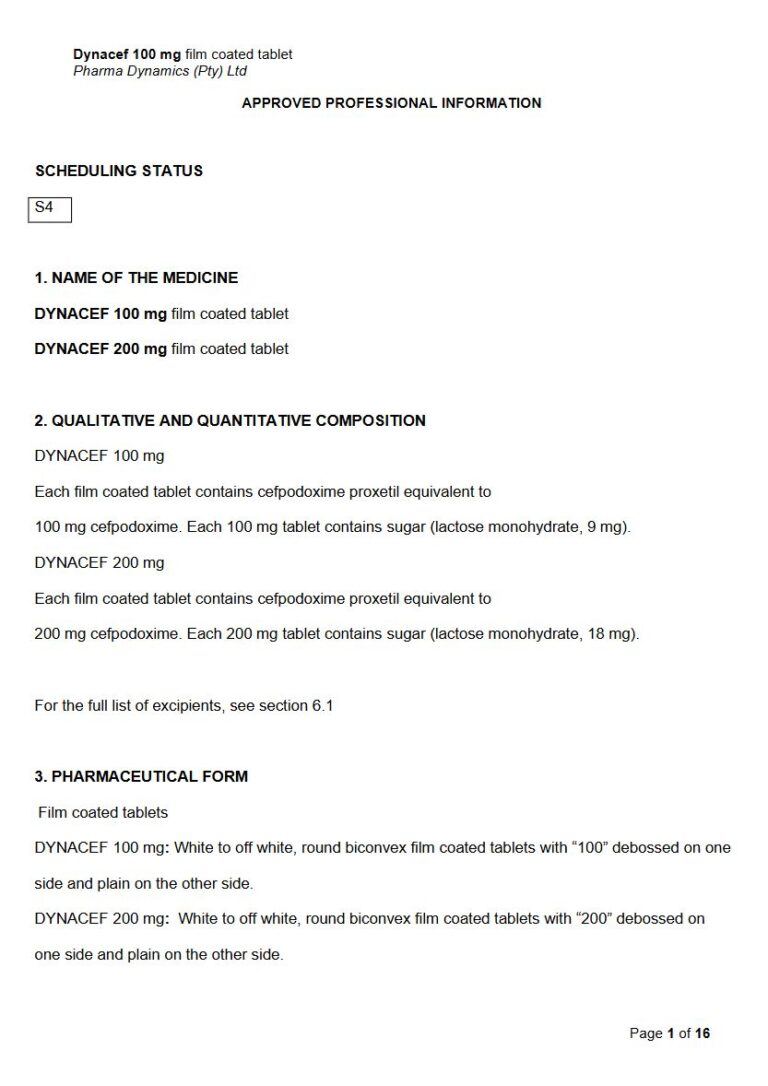
Dynacef 100 mg/200 mg Film-Coated Tablets
PDF Leaflet Revision Date: 14 August 2025
Clinical Summary
Quick overview from the medicine insert
Indication
Short-term treatment of upper and lower respiratory tract infections.
Dosage (summary)
100 mg every 12 hours for tonsillitis/bronchitis; 200 mg every 12 hours for sinusitis/pneumonia.
Special Populations
- Elderly
- Renal impairment
- Hepatic impairment
Pregnancy & Breastfeeding
Safety in pregnancy not established; excreted in breast milk.
Key Drug Interactions
- Antacids reduce absorption
- Warfarin increases anticoagulant effect
- Oestrogens contraceptive effect reduced
Contraindications
- Hypersensitivity to cefpodoxime or cephalosporins
- Pregnancy and lactation safety not established
Common side effects
- Diarrhoea
- Nausea
- Vomiting
- Headache
- Dizziness
Counselling Points
- Take with meals
- Monitor for allergic reactions
- Report severe diarrhoea
Serious warnings
- Serious allergic reactions
- Clostridium difficile-associated disease
- Neutropenia risk
Important Disclaimer
The Dynacef 100 mg/200 mg Film-Coated Tablets professional information leaflet below is the property of Pharma Dynamics and is provided on Medinsert exactly as issued, with no.. alterations or editorial changes. We make every effort to keep content current by updating documents as soon as new versions become available. Medinsert serves as a trusted access point for healthcare professionals, but does not replace official sources or clinical judgement. For more details, please read our full disclaimer. read more>>
 Healthcare Professionals Only
This content is for registered healthcare professionals
Sign in or create a free account to read the full package insert.
Free for HPCSA-registered professionals. Powered by Medinsert.
Clinical Particulars
Section 4 of the official insert — extracted exactly as issued, no alterations
4.1 Therapeutic indications
In Adults DYNACEF 100 mg and 200 mg tablets are indicated for use in the short-term treatment of upper and lower respiratory tract infections when caused by susceptible organisms (sensitivity tests must be performed):
- acute bronchitis due to Haemophilus influenzae, Streptococcus pneumoniae, Moraxella catarrhalis
- pharyngitis and tonsillitis due to Streptococcus pyogenes
- acute exacerbations of chronic bronchitis due to: Haemophilus influenzae, Streptococcus pneumoniae, Moraxella catarrhalis
- bacterial pneumonia and community acquired bronchopneumonia due to Haemophilus influenzae, Streptococcus pneumoniae, Moraxella catarrhalis
- acute sinusitis due to Haemophilus influenzae (non-typeable), Streptococcus pneumoniae, Methicillin-sensitive Staphylococcus aureus, Moraxella catarrhalis
4.2 Posology and method of administration
Posology Adults Each film coated tablet of DYNACEF contains either 100 mg or 200 mg cefpodoxime. The dosage is dependent on the condition being treated.
Tonsillitis, pharyngitis and acute bronchitis One DYNACEF 100 mg tablet every 12 hours with meals (200 mg/day). As is the case with all beta lactam antibiotics in the treatment of beta-haemolytic streptococcal infections, therapeutic doses should be administered for at least ten days.
Acute sinusitis, acute exacerbations of chronic bronchitis, pneumonia One DYNACEF 200 mg tablets every 12 hours (400 mg/day), to be taken with meals.
Special populations Elderly patients No dose adjustments are necessary with normal renal function. Renal insufficiency in adults When the creatinine clearance is above 40 mL/min, it is not necessary to adjust the dose. For values below 40 mL/min, the daily dosage regimen should be reduced by half. For values 10 u2013 39 mL/min DYNACEF tablets should be administered as a single daily dose and every second day for values below 10 mL/min. DYNACEF tablets should be administered after each dialysis session for haemodialysis patients. Hepatic insufficiency in adults No dose adjustments are necessary.
Method of administration DYNACEF tablets are for oral use and must be swallowed whole with half a glass of water and should be taken with meals.
4.3 Contraindications
- hypersensitivity to cefpodoxime proxetil, the cephalosporin group of antibiotics, penicillinu2019s or to any of the ingredients of DYNACEF.
- Safety in pregnancy and lactation has not been established.
4.4 Special warnings and precautions for use
Prescribers must adhere to the principles of antibiotic stewardship. Before initiating therapy with DYNACEF, careful enquiry should be made concerning previous hypersensitivity reactions to penicillin and other u03b2-lactam antibiotics. The use of DYNACEF is strictly contraindicated in subjects with a previous history of immediate type hypersensitivity to cephalosporins (see section 4.3). There have been reports of serious and occasionally fatal allergic hypersensitivity reactions which progressed to Kounis syndrome (acute coronary arterio-spasm that can result in myocardial infarction) (see section 4.8). If an allergic reaction occurs, treatment should be stopped immediately.
Clostridium difficile-associated disease: Diarrhoea, particularly if severe and/or persistent, occurring during treatment or in the initial weeks following treatment with DYNACEF may be symptomatic of Clostridium difficile-associated disease, (CDAD) the most severe form of which is pseudomembranous colitis. The diagnosis of this possibly fatal condition is confirmed by endoscopy and/or histology. Screening of faeces for this pathogen, and its cytotoxin is the best way to diagnose Clostridium difficile associated disease. It is important to consider its diagnosis in patients who develop diarrhoea in association with the use of DYNACEF. Such colitis may range in severity from mild to life threatening. Treatment should be discontinued if symptoms suggestive of pseudomembranous colitis arise. When the colitis does not improve after the medicine has been discontinued, or when it is severe, appropriate specific therapy should be started without delay. Clostridium difficile-associated disease can be favoured by faecal stasis.
Renal impairment: DYNACEF should be given with caution to patients with renal impairment, dosage reduction may be necessary. Renal and haematological status should be monitored, especially during prolonged and high-dose therapy. Changes in renal function have been observed with antibiotics of the same class as DYNACEF and particularly when given concurrently with potentially nephrotoxic medicines such as aminoglycosides and/or potent diuretics. In such cases renal function should be monitored. As with all beta-lactam antibiotics, neutropenia and less frequently agranulocytosis may develop particularly during extended treatments. For cases of treatment lasting longer than 10 days, blood count should therefore be monitored, and treatment discontinued if neutropenia is found.
Superinfection: Overgrowth of non-susceptible organisms may result during DYNACEF treatment, especially if prolonged. Repeated evaluation of the patient's condition is essential. If superinfection occurs during therapy, appropriate measures should be taken (see section 4.8).
Interference with laboratory testing: Positive results to the antiglobulin direct Coombsu2019 test and haemolytic anaemia have been found during treatment with cefpodoxime, such as in DYNACEF, and these can interfere with blood-cross-matching. Cross-reactivity may occur with penicillin for this reaction. The urine of patients being treated with DYNACEF may give false-positive reactions for glucose using copper-reduction reactions. DYNACEF may interfere with Jaffu00cb method of measuring creatinine concentrations and may produce falsely high values.
Encephalopathy: Beta-lactams, including cefpodoxime, predispose the patient to encephalopathy risk (which may include convulsions, confusion, impairment of consciousness, movement disorders), particularly in case of overdose or renal impairment.
Lactose: DYNACEF 100 mg and 200 mg tablets contain lactose. Patients with rare hereditary problems of galactose intolerance, total lactase deficiency or glucose-galactose malabsorption should not take this medicine.
Paediatric population Safety and efficacy of DYNACEF have not been established in children under one year of age.
4.5 Interaction with other medicines and other forms of interaction
The bioavailability of cefpodoxime is increased if DYNACEF is administered during meals (acid pH). Absorption of cefpodoxime is decreased by concurrent ingestion of antacids and histamine H2-receptor antagonists such as ranitidine. Therefore, mineral antacids and histamine blocking H2 blockers, which cause an increase in gastric pH, should be taken 2 or 3 hours after DYNACEF administration. In contrast, a decrease in gastric pH (pentagastrin) will increase bioavailability.
Probenecid slows tubular excretion of DYNACEF and increases serum levels thereof. Changes in renal function have been observed with antibiotics of the same class, particularly when given concurrently with potentially nephrotoxic medicines such as aminoglycosides (e.g. gentamicin) and/or potent diuretics. Enhanced nephrotoxicity with a loop diuretic (e.g. furosemide) may occur. In such cases, renal function should be monitored (see section 4.4).
As with other cephalosporins, isolated cases showing development of a positive Coombs test have been reported (see section 4.4). In patients treated with DYNACEF, a false positive reaction for glucose in the urine may occur with Benedictu2019s or Fehlingu2019s solutions or with copper sulphate test tablets, but not with tests based on enzymatic glucose oxidase reactions.
Concurrent use with warfarin may increase resulting in an enhanced anticoagulant effect. DYNACEF may reduce the contraceptive effect of oestrogens.
4.6 Fertility, pregnancy and lactation
Pregnancy Safety and efficacy in pregnancy have not been established (see section 4.3)
Breastfeeding Cefpodoxime is excreted into breast milk. It is recommended that either breastfeeding should be ceased, or treatment of the mother should be discontinued.
Fertility There is no data on fertility with DYNACEF.
4.7 Effects on ability to drive and use machines
DYNACEF tablets can lead to dizziness and patients should be aware how they react to DYNACEF tablets and exercise caution before driving, operating hazardous machinery or performing hazardous tasks.
4.8 Undesirable effects
Summary of the safety profile The most frequent reported adverse effects of DYNACEF are gastrointestinal disturbances, especially diarrhoea.
Tabulated list of adverse effects
System Organ Class Frequency Side effects Infections and infestations Frequent Less frequent Oral and vaginal candidiasis, superinfections, overgrowth of non-susceptible organisms. Clostridium difficile Blood and lymphatic system disorders Less frequent Thrombocytopenia, leucopoenia, neutropenia, hypoprothrombinaemia, haemolytic anaemia, reduction of haemoglobin, thrombocytosis, agranulocytosis, aplastic anaemia, pancytopenia, eosinophilia, lymphocytosis, anaemia, leucocytosis Immune system disorders Less frequent Hypersensitivity reactions, anaphylactic reactions, angioedema, bronchospasm, malaise, shock Metabolism and nutrition disorders Frequent Appetite loss Nervous system disorders Less frequent Frequency unknown Headache, dizziness, paraesthesia Asthenia, convulsions and signs of CNS toxicity especially in patients with severe renal impairment Ear and labyrinth disorders Less frequent Tinnitus, hearing loss Cardiac disorders Frequency unknown Kounis syndrome Gastrointestinal disorders Frequent Less frequent Diarrhoea, nausea, vomiting, abdominal pain Dyspepsia, flatulence, enterocolitis, pseudomembranous colitis, blood in stools, acute pancreatitis Hepatobiliary disorders Less frequent Frequency unknown Bilirubinaemia, liver injury, acute hepatitis, cholestatic jaundice Hepatic dysfunction including cholestasis Skin and subcutaneous tissue disorders Less frequent Pruritus and urticaria, bullous eruptions (erythema multiforme, rash, Stevens-Johnson syndrome, toxic epidermal necrolysis), cutaneous eruptions, purpura, Linear IgA bullous dermatosis (LABD) Renal and urinary disorders Less frequent Renal dysfunction, toxic nephropathy, acute renal insufficiency, increase in blood urea and creatinine General disorders and administrative site conditions Less frequent Asthenia, fatigue, malaise Investigations Less frequent Positive response to the Coombs test, elevations of AST, ALT and alkaline phosphatase, increase of blood urea and creatinine
a. Description of selected adverse reactions Increased liver enzymes (AST, ALT and alkaline phosphatase) and/or bilirubin are less frequently observed; however, these laboratory abnormalities exceed twice the upper limit of the normal range and elicit a pattern of drug-induced hepatitis, usually cholestatic. Changes in renal function have been observed with antibiotics from the same group as DYNACEF, particularly when co-prescribed with aminoglycosides and/or potent diuretics (see section 4.4). Diarrhoea may sometimes be a symptom of enterocolitis, which may, in some cases, be accompanied by blood in stools. A particular form of enterocolitis than can occur with antibiotics is pseudomembranous colitis (in most cases due to Clostridium difficile) (see section 4.4).
Reporting of suspected adverse reactions Reporting suspected adverse reactions after authorisation of the medicine is important. It allows continued monitoring of the benefit/risk balance of the medicine. Healthcare professionals are asked to report any suspected adverse reactions to SAHPRA via the Med Safety APP (Medsafety X SAHPRA) and eReporting platform (who-umc.org) found on SAHPRA website. An email can be sent directly to the company, [email protected], to ensure safety of the product.
4.9 Overdose
Signs and symptoms: Overdosage with DYNACEF may manifest in any of the symptoms described under undesirable side effects (see section 4.8). Convulsions and other signs of CNS toxicity and encephalopathy have been associated with high doses, especially in patients with severe renal impairment.
Management of overdose: There is no specific antidote for DYNACEF. Treatment should be symptomatic and supportive.
