
Edurant 25 mg FC TABLETS
PDF Leaflet Revision Date: 19 June 2023
Clinical Summary
Quick overview from the medicine insert
Indication
Treatment of HIV-1 infection in treatment-nau00efve adults and adolescents (12-17 years).
Dosage (summary)
25 mg once daily with a meal; increase to 50 mg with rifabutin.
Special Populations
- Elderly
- Hepatic impairment
- Renal impairment
Pregnancy & Breastfeeding
Monitor viral load closely during pregnancy; not recommended for breastfeeding.
Key Drug Interactions
- CYP3A inducers (e.g., rifampicin)
- Proton pump inhibitors
- NNRTIs
Contraindications
- Hypersensitivity to rilpivirine
- Co-administration with certain anticonvulsants
Common side effects
- Depression
- Insomnia
- Headache
- Rash
- Nausea
- Dizziness
Counselling Points
- Take with food
- Do not skip doses
- Use additional precautions to prevent HIV transmission
Serious warnings
- Risk of virologic failure with high baseline viral load
- Immune reconstitution inflammatory syndrome
Important Disclaimer
The Edurant 25 mg FC TABLETS professional information leaflet below is the property of Janssen Pharmaceutica and is provided on Medinsert exactly as issued, with no.. alterations or editorial changes. We make every effort to keep content current by updating documents as soon as new versions become available. Medinsert serves as a trusted access point for healthcare professionals, but does not replace official sources or clinical judgement. For more details, please read our full disclaimer. read more>>
 Healthcare Professionals Only
This content is for registered healthcare professionals
Sign in or create a free account to read the full package insert.
Free for HPCSA-registered professionals. Powered by Medinsert.
Clinical Particulars
Section 4 of the official insert — extracted exactly as issued, no alterations
4.1 Therapeutic indications
Adult Patients
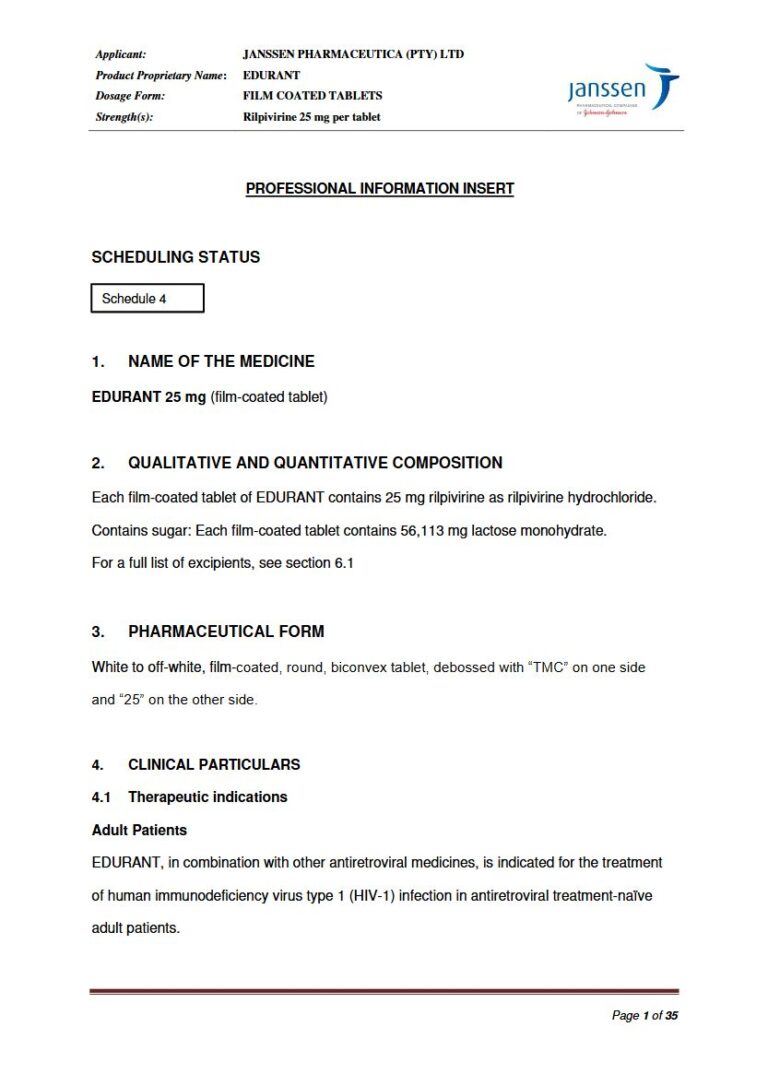
EDURANT, in combination with other antiretroviral medicines, is indicated for the treatment of human immunodeficiency virus type 1 (HIV-1) infection in antiretroviral treatment-nau00efve adult patients.
Paediatric Patients (12 to less than 18 years of age)
EDURANT, in combination with other antiretroviral medicinal products, is indicated for the treatment of human immunodeficiency virus type 1 (HIV-1) infection in antiretroviral treatment-nau00efve paediatric patients 12 to less than 18 years of age with a viral load of u2264 100000 HIV-1 RNA copies/mL.
4.2 Posology and method of administration
EDURANT must always be given in combination with other antiretroviral medicinal products.
Adults and paediatric patients (12 to less than 18 years of age)
The recommended dose of EDURANT is 25 mg once-daily taken orally with a meal.
Dose adjustment with rifabutin coadministration
For patients concomitantly receiving rifabutin, the EDURANT dose should be increased to 50 mg (two tablets of 25 mg each) once daily, taken with a meal. When rifabutin co administration is stopped, the EDURANT dose should be decreased to 25 mg once daily, taken with a meal.
Pregnancy and Postpartum
The recommended dose of EDURANT in pregnant patients is one 25 mg tablet once daily taken orally with a meal. Lower exposure of rilpivirine was observed during pregnancy, therefore viral load should be monitored closely.
Missed dose(s)
If the patient misses a dose of EDURANT within 12 hours of the time it is usually taken, the patient should take EDURANT with a meal as soon as possible and then take the next dose of EDURANT at the regularly scheduled time. If a patient misses a dose of EDURANT by more than 12 hours, the patient should not take the missed dose, but resume the usual dosing schedule.
Special populations
Paediatrics (less than 12 years of age)
The safety and efficacy of EDURANT in children less than 12 years of age have not been proven. Treatment with EDURANT is not recommended for use in children less than 12 years of age.
Elderly (65 years of age and older)
No dose adjustment of EDURANT is required in elderly patients.
Hepatic impairment
No dose-adjustment of EDURANT is required in patients with mild or moderate hepatic impairment (Child-Pugh score A or B). EDURANT has not been studied in patients with severe hepatic impairment (Child-Pugh score C).
Renal impairment
No dose adjustment of EDURANT is required in patients with renal impairment.
4.3 Contraindications
Hypersensitivity to rilpivirine or to any of the excipients of EDURANT.
It is not recommended that EDURANT be co-administered with other Non-Nucleoside Reverse Transcriptase Inhibitors (NNRTIs) e.g. delavirdine, efavirenz, etravirine, nevirapine (see section 4.5 INTERACTIONS).
EDURANT should not be used in combination with carbamazepine, oxcarbazepine, phenobarbital, phenytoin and dexamethasone (except as a single-dose treatment) as co-administration may cause significant decreases in rilpivirine plasma concentrations due to the induction of CYP3A enzymes. This may result in loss of therapeutic effect of EDURANT.
Rifabutin, rifampicin and rifapentine are potent inducers of CYP3A enzymes. EDURANT should not be used in combination with these medicines as co-administration may cause significant decreases in rilpivirine plasma concentrations. This may result in loss of therapeutic effect of EDURANT.
EDURANT should not be used concomitantly with products containing St. Johnu2019s Wort (Hypericum perforatum) because co-administration may cause significant decreases in rilpivirine plasma concentrations. This may result in loss of therapeutic effect of EDURANT.
The proton-pump inhibitors (PPIs) lanzoprazole, omeprazole, rabeprazole, pantoprazole and esomeprazole should not be administered concomitantly with EDURANT as this may result in significant decreases in rilpivirine plasma concentration due to gastric pH increase. This may result in loss of therapeutic effect of EDURANT.
4.4 Special warnings and precautions for use
Transmission of HIV
Patients should be advised that current antiretroviral therapy does not cure HIV and has not been proven to prevent the transmission of HIV to others through blood, other bodily secretion, or sexual contact. Appropriate precautions to prevent the transmission of HIV should continue to be employed.
Virologic failure and development of resistance
In the pooled analysis from the phase III trials through 96 weeks, patients treated with EDURANT with a baseline viral load > 100 000 HIV-1 RNA copies/mL had a greater risk of virologic failure compared to patients with a baseline viral load u2264 100 000 HIV-1 RNA copies mL. The greater risk of virologic failure for patients in regimens containing EDURANT was observed in the first 48 weeks of these trials while a low rate of virologic failure was observed from week 48 to week 96. Patients with a baseline viral load > 100 000 HIV-1 RNA copies/mL who experienced virologic failure exhibited a higher rate of treatment-emergent resistance to the NNRTI class. Patients who failed virologically on EDURANT developed lamivudine/emtricitabine-associated resistance. This information should be taken into consideration when initiating therapy with EDURANT.
No new information was identified in paediatric patients 12 to less than 18 years.
Interaction with other medicines
Caution should be given to prescribing EDURANT with other medicines that may reduce the exposure of rilpivirine (see section 4.5 INTERACTIONS).
Fat redistribution
Redistribution/accumulation of body fat, including central obesity, dorsocervical fat enlargement (buffalo hump), peripheral wasting, facial wasting, breast enlargement, and u201cCushingoid appearanceu201d have been observed in patients receiving antiretroviral therapy. The mechanism and long-term consequences of these events are currently unknown. A causal relationship has not been established.
Immune reconstitution inflammatory syndrome
Immune reconstitution inflammatory syndrome has been reported in patients treated with combination antiretroviral therapy, including EDURANT. During the initial phase of combination antiretroviral treatment, patients whose immune systems respond may develop an inflammatory response to indolent or residual opportunistic infections (such as Mycobacterium avium complex, cytomegalovirus, Pneumocystis jiroveci pneumonia, and tuberculosis) which may necessitate further evaluation and treatment. Autoimmune disorders such as Gravesu2019 disease and autoimmune hepatitis have also been reported to occur in the setting of immune reconstitution inflammatory syndrome; however, the time to onset is more variable, and these events can occur many months after initiation of treatment (see section 4.8 UNDESIRABLE EFFECTS).
Excipients
EDURANT contains lactose which may have an effect on the glycaemic control of patients with diabetes mellitus. Patients with the rare hereditary conditions of galactose intolerance e.g. galactosaemia, Lapp lactase deficiency, glucose-galactose malabsorption or fructose intolerance should not take EDURANT.
4.5 Interaction with other medicines and other forms of interaction
Medicines that affect rilpivirine exposure:
Rilpivirine is primarily metabolised by cytochrome P450 (CYP3A), and medicines that induce or inhibit CYP3A may thus affect the clearance of rilpivirine. Co-administration of EDURANT and medicines that induce CYP3A may result in decreased plasma concentrations of rilpivirine (exposure) which could potentially reduce the therapeutic effect of EDURANT. Co-administration of EDURANT and medicines that inhibit CYP3A may result in increased plasma concentrations of rilpivirine.
Co-administration of EDURANT with medicines that increase gastric pH such as PPIu2019s, may result in decreased plasma concentrations of rilpivirine which could potentially reduce the therapeutic effect of EDURANT.
Medicines that are affected by the use of rilpivirine
EDURANT at a dose of 25 mg q.d. (once daily) is not likely to have a clinically relevant effect on the exposure of medicines metabolised by CYP enzymes. Established and theoretical interactions with selected antiretrovirals and non-antiretroviral medicines are listed in Table 1 and Table 2, respectively.
Interaction table
Interactions between rilpivirine and co-administered medicines are listed in Table 1 and Table 2 below (increase is indicated as u201cu2191u201d, decrease as u201cu2193u201d, no change as u201cu2194u201d, not applicable as u201cNAu201d).
4.6 Fertility, pregnancy, and lactation
Safety in lactation has not been established.
Women of childbearing potential
Adequate contraception is recommended for women of childbearing potential when taking EDURANT.
Contraception in females
A trial to investigate the effect of EDURANT when co-administered with oral contraceptives demonstrated that EDURANT is unlikely to decrease the effectiveness of oral contraceptives. EDURANT and oestrogen and/or progesterone based contraceptives can be used without dose adjustments.
Pregnancy
There are no well controlled clinical or pharmacokinetic studies with EDURANT in pregnant women. Rilpivirine in combination with a background regimen was evaluated in a clinical trial of 19 pregnant women during the second and third trimesters, and postpartum. The pharmacokinetic data demonstrate that total exposure (AUC) to rilpivirine as a part of an antiretroviral regimen was approximately 30 % lower during pregnancy compared with postpartum (6 - 12 weeks). Virologic response was preserved throughout the trial period. No mother to child transmission occurred in all 10 infants born to the mothers who completed the trial and for whom the HIV status was available. Rilpivirine was well tolerated during pregnancy and postpartum. There were no new safety findings compared with the known safety profile of rilpivirine in HIV 1 infected adults.
Breastfeeding
It is not known whether rilpivirine is secreted in human milk. Because of both the potential for HIV transmission and the potential for adverse events in nursing infants, mothers should be instructed not to breastfeed if they are receiving EDURANT.
Fertility
No human data on the effect of rilpivirine on fertility are available. In a study conducted in rats, there were no effects on mating or fertility with rilpivirine up to 400 mg/kg/day, a dose of rilpivirine that showed maternal toxicity. This dose is associated with an exposure that is approximately 40 times higher than the exposure in humans at the recommended dose of 25 mg once daily.
4.7 Effects on ability to drive and use machines
EDURANT may influence the ability to drive and use machines. Dizziness and somnolence have been reported with the use of EDURANT.
4.8 Undesirable effects
The safety assessment is based on the week 96 pooled data from 1 368 patients in the phase III controlled trials TMC278 C209 (ECHO) and TMC278 C215 (THRIVE) in antiretroviral treatment-nau00efve HIV-1 infected adult patients, 686 of whom received EDURANT (25 mg daily). The median duration of exposure for patients was 104.3 and 104.1 weeks, respectively. Most adverse reactions (ARs) occurred in the first 48 weeks of treatment.
In the phase III controlled trials, the most frequently reported adverse reactions (ARs) (u2265 2 %) that were at least grade 2 in severity, were depression, insomnia, headache, rash, abnormal dreams, nausea and dizziness (see Table 3 for the complete list of ARs). The majority of the ARs reported during treatment with EDURANT 25 mg once daily were grade 1 to 2 in severity. The most commonly reported grade 3 or 4 ARs were transaminases increased, depression, abdominal pain, dizziness and rash. All ARs leading to discontinuation had an incidence < 0,5 %.
Clinical ARs of at least moderate intensity (u2265 grade 2) reported in adult patients treated with EDURANT are summarised in Table 3. The ARs are listed by system organ class (SOC) and frequency. Selected treatment emergent laboratory abnormalities, considered as ARs, are included in Table 4. Adverse reactions are listed by system organ class and frequency. The following terms and frequencies are applied: very common (u2265 1/10); common (u2265 1/100 to < 1/10); uncommon (u2265 1/1,000 to < 1/100); rare (u2265 1/10,000 to < 1/1,000); very rare (< 1/10,000); and not known (cannot be estimated from the available data).
4.9 Overdose
Symptoms
There is no specific antidote for overdose with EDURANT. Human experience of overdose with EDURANT is limited.
Treatment
Treatment of overdose with EDURANT consists of general supportive measures including monitoring of vital signs and ECG (QT interval) as well as observation of the clinical status of the patient. It is advisable to contact a poison control center to obtain the latest recommendations for the management of an overdose. Since rilpivirine is highly bound to plasma protein, dialysis is unlikely to result in significant removal of the active substance.
