
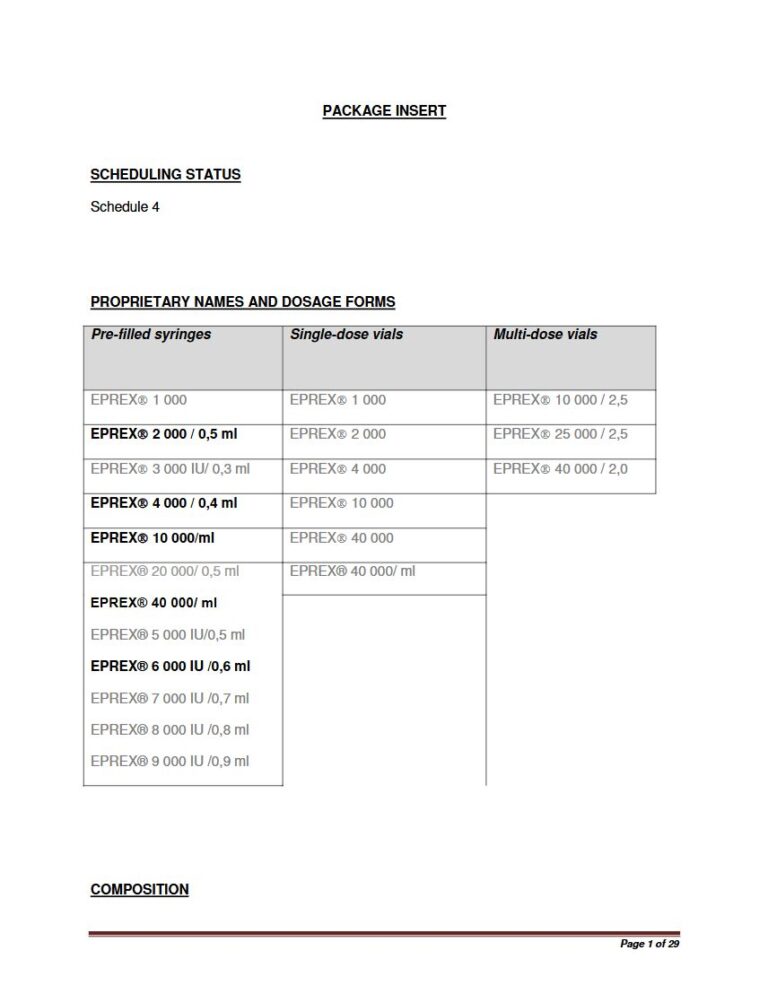
Eprex 0.4ml Vials
PDF Leaflet Revision Date: 27 July 2012
Clinical Summary
Quick overview from the medicine insert
Indication
Treatment of anaemia in chronic renal failure and cancer patients receiving chemotherapy.
Dosage (summary)
IV: 50 IU/kg 3x/week; SC: 150 IU/kg 3x/week or 40,000 IU weekly for cancer patients.
Onset of Action / Duration
Onset: 2 weeks, Duration: variable
Special Populations
- Renal impairment
- Hepatic impairment
Pregnancy & Breastfeeding
Use with caution; not recommended in pregnant/lactating women.
Key Drug Interactions
- Cyclosporin
- Ferrous sulphate
Contraindications
- Uncontrolled hypertension
- Hypersensitivity to mammalian products
- Myeloid malignancies
Common side effects
- Hypertension
- Nausea
- Headache
- Diarrhoea
Counselling Points
- Monitor haemoglobin levels
- Ensure adequate iron supplementation
- Report unusual headaches
Serious warnings
- Monitor blood pressure closely
- Risk of thromboembolic events
- Caution in patients with seizures
Important Disclaimer
The Eprex 0.4ml Vials professional information leaflet below is the property of Janssen Pharmaceutica and is provided on Medinsert exactly as issued, with no.. alterations or editorial changes. We make every effort to keep content current by updating documents as soon as new versions become available. Medinsert serves as a trusted access point for healthcare professionals, but does not replace official sources or clinical judgement. For more details, please read our full disclaimer. read more>>
 Healthcare Professionals Only
This content is for registered healthcare professionals
Sign in or create a free account to read the full package insert.
Free for HPCSA-registered professionals. Powered by Medinsert.
Clinical Particulars
Section 4 of the official insert — extracted exactly as issued, no alterations
4.1 Therapeutic indications
EPREX is indicated for the following:
- EPREX can be used for the treatment of anaemia with chronic renal failure in patients on haemodialysis and peritoneal dialysis.
- The treatment of anaemia and reduction of transfusion requirements in adult cancer patients with non-myeloid malignancies receiving chemotherapy. EPREX is not indicated for the treatment of anaemia in cancer patients due to other factors such as iron folate deficiencies, haemolysis or gastrointestinal bleeding, which should be managed appropriately.
- To increase the yield of autologous blood from patients in a predonation programme initiated to reduce the risk of exposure to homologous blood transfusions. Treatment is indicated in patients with moderate anaemia (PCV approximately 33 to 39 %, and no iron deficiency) if blood conserving procedures are not available or insufficient either: a) When the scheduled major elective surgery requires a large volume of blood (4 or more units blood for females or 5 or more units for males) or b) When the period necessary to obtain the required volume of autologous blood is too short.
- To increase red cell production and hasten erythroid recovery in adult patients with a haemoglobin (Hb) > 10 g/dL to u2264 13 g/dL scheduled for elective surgery and not participating in an autologous pre-donation programme.
4.2 Posology and method of administration
Method of administration
EPREX may be administered by intravenous or subcutaneous injection. When changing from one route of administration to the other, the same dose should be used, and the haemoglobin should be monitored carefully (e.g. weekly) so that appropriate changes in EPREX dose can be made to keep the haemoglobin within target range.
The injection solution should be inspected for particles and discolouration prior to administration. Do not shake, shaking may denature the glycoprotein, rendering it inactive. EPREX in single use vials and syringes contains no preservatives. Do not re-enter vial or re-use syringe. Discard unused portion. Incompatibilities u2013 Do not dilute or transfer to any container. Do not administer by intravenous infusions or in conjunction with other medicine solutions.
Epoetinum alfa in multidose vials contains preservatives. Store at 2u00b0 to 8u00b0 C after initial entry and between doses. Discard unused portion 30 days after initial entry.
- Intravenous injection EPREX should be administered over at least one to five minutes, depending on the total dose. A slower injection may be preferable in patients who react to the treatment with flu-like symptoms. In haemodialysis patients, a bolus injection may be given during the dialysis session through a suitable venous port in the dialysis line. Alternatively, the injection can be given via the fistula needle tubing, at the completion of a haemodialysis session, followed by 10 ml of isotonic saline to rinse the tubing and ensure satisfactory injection of the product into the circulation. EPREX should not be administered by intravenous infusion or mixed with other medicines.
- Subcutaneous injection The maximum volume per injection site should be 1 ml. In case of larger volumes, more than one injection site should be used. The injections should be given in the limbs or the anterior abdominal wall.
4.3 Contraindications
Patients who develop antibody-mediated pure red cell aplasia (PRCA) following treatment with any erythropoietin should not receive EPREX or any other erythropoietin (See SIDE EFFECTS AND SPECIAL PRECAUTIONS u2013 Pure Red Cell Aplasia). EPREX is contra-indicated in patients with:
- uncontrolled hypertension.
- known hypersensitivity to mammalian-cell derived products.
- known hypersensitivity to the active substance or to any of the excipients.
- myeloid malignancies.
- surgery patients who for any reason cannot receive adequate anti-thrombotic prophylaxis. The use of EPREX in patients scheduled for elective surgery and not participating in an autologous blood pre-donation program is contra-indicated in patients with severe coronary, peripheral arterial, carotid, or cerebral vascular disease, including patients with recent myocardial infarction or cerebral vascular accident.
4.4 Special warnings and precautions for use
Blood pressure should be adequately controlled prior to initiation of EPREX therapy. In all patients receiving EPREX, blood pressure should be closely monitored and controlled as necessary. EPREX should be used with caution in the presence of untreated, inadequately treated or poorly controlled hypertension. Particular attention should be paid to the development of unusual headaches or an increase in headaches as a possible warning signal. It may be necessary to initiate or increase anti-hypertensive treatment during EPREX therapy. If blood pressure cannot be controlled, EPREX treatment should be discontinued.
EPREX should be used with caution in patients with a history of seizures. EPREX should also be used with caution in patients with epilepsy and chronic liver failure. In all patients, haemoglobin levels should be closely monitored due to a potential increased risk of thromboembolic events and fatal outcomes when patients are treated at haemoglobin levels above the target for the indication of use. The safety and efficacy of EPREX therapy have not been established in patients with underlying haematologic diseases (e.g. haemolytic anaemia, sickle cell anaemia, thalassemia, porphyria). The safety of EPREX has not been established in patients with hepatic dysfunction. Due to decreased metabolism, patients with hepatic dysfunction may have increased erythropoiesis with EPREX. There may be a moderate dose-dependent rise in the platelet count, within the normal range, during treatment with EPREX. This usually regresses during the course of continued therapy. In addition, thrombocythaemia above the normal range has been reported. It is recommended that the platelet count should be regularly monitored during EPREX therapy. Erythropoiesis-stimulating agents (ESAs) are not necessarily equivalent nor interchangeable.
4.5 Interactions with other medicines
There are no known clinically significant interactions, but the effect of EPREX may be potentiated by the simultaneous therapeutic administration of a haematinic agent such as ferrous sulphate when a deficiency state exists.
No evidence exists that indicates that treatment with EPREX alters the metabolism of other medicines. However, since cyclosporin is bound by red blood cells there is potential for a medicine interaction. If EPREX is given concomitantly with cyclosporin blood levels of cyclosporin should be monitored and the dose of cyclosporin adjusted as the haematocrit rises. Subcutaneous co-administration of 40,000 IU/mL EPREX with trastuzumab (6 mg/kg) had no effect on the pharmacokinetics of trastuzumab in subjects with metastatic breast cancer.
4.6 Fertility, pregnancy and lactation
There are no adequate and well-controlled studies in pregnant women. Erythropoietin is present in human milk. However, it is not known whether EPREX is distributed into human milk. EPREX should be used with caution in breastfeeding women. In pregnant or lactating surgical patients participating in an autologous blood predonation programme, the use of EPREX is not recommended.
4.7 Effects on ability to drive and use machines
EPREX has no or negligible influence on the ability to drive and use machines.
4.8 Undesirable effects
Clinical Trial Data The most frequent adverse drug reaction during treatment with EPREX is a dose-dependent increase in blood pressure or aggravation of existing hypertension. Monitoring of the blood pressure should be performed, particularly at the start of the therapy. Other common adverse drug reactions observed in clinical trials of EPREX are diarrhoea, nausea, headache, influenza-like illness, pyrexia, rash, and vomiting. Influenza-like illness including headaches, joint pains, myalgia, and pyrexia may occur especially at the start of treatment. Serious adverse drug reactions include venous and arterial thromboses and embolism (including some with fatal outcomes), such as deep venous thrombosis, pulmonary emboli, arterial thrombosis, retinal thrombosis, and shunt thrombosis (including dialysis equipment). In a cumulative analysis of 10 double-blind, randomised, placebo-controlled trials in subjects with cancer receiving chemotherapy, deep venous thrombosis was reported in 2,1 % and pulmonary embolism in 1,2 % of the 1 564 subjects exposed to EPREX, compared to 1,2 % and 1,2 %, respectively, of the 1 207 subjects exposed to placebo. Additionally, cerebrovascular accidents (including cerebral infarction and cerebral haemorrhage) and transient ischaemic attacks have been reported in clinical trials of EPREX. Hypersensitivity reactions, including cases of rash, urticaria, anaphylactic reaction, and angioneurotic oedema have been reported.
4.9 Overdose
Response to EPREX is dose related and individualised. Therapeutic response to excessive doses may lead to hypertension. Phlebotomy may be performed if excessively high haemoglobin levels occur. Treatment is symptomatic and supportive.
