
Angeliq 1.0 mg/2.0 mg FC tablets
Clinical Summary
Quick overview from the medicine insert
Indication
Hormone replacement therapy in postmenopausal women to relieve menopausal symptoms and to prevent osteoporosis.
Dosage (summary)
One tablet daily, taken orally at the same time each day.
Onset of Action / Duration
Symptomatic relief may be observed within a few weeks, with maximum effect typically seen after several months of therapy.
Special Populations
- Elderly patients
- Patients with liver impairment
- Patients with a history of thromboembolic disorders
Pregnancy & Breastfeeding
Not recommended during pregnancy. Use with caution during lactation as it may affect milk production.
Key Drug Interactions
- Anticonvulsants may reduce the effectiveness of progesterones.
- Certain antibiotics (e.g., rifampicin) may decrease the effectiveness of hormonal contraceptives.
- St. John's Wort may reduce plasma concentrations of progesterones.
Contraindications
- Known or suspected pregnancy
- Active or history of thromboembolic disorders
- Severe liver disease
- Hormone-sensitive cancers
Common side effects
- Nausea
- Headache
- Breast tenderness
- Mood changes
- Weight gain
Counselling Points
- Advise patients to take the medication at the same time each day.
- Inform patients about potential side effects and when to seek medical advice.
- Discuss the importance of regular follow-up appointments to monitor therapy.
Serious warnings
- Monitor for signs of thromboembolic events.
- Use with caution in patients with a history of depression.
- Discontinue use if unexplained vaginal bleeding occurs.
Important Disclaimer
The Angeliq 1.0 mg/2.0 mg FC tablets professional information leaflet below is the property of Bayer and is provided on Medinsert exactly as issued, with no.. alterations or editorial changes. We make every effort to keep content current by updating documents as soon as new versions become available. Medinsert serves as a trusted access point for healthcare professionals, but does not replace official sources or clinical judgement. For more details, please read our full disclaimer. read more>>
 Healthcare Professionals Only
This content is for registered healthcare professionals
Sign in or create a free account to read the full package insert.
Free for HPCSA-registered professionals. Powered by Medinsert.
Clinical Particulars
Section 4 of the official insert — extracted exactly as issued, no alterations
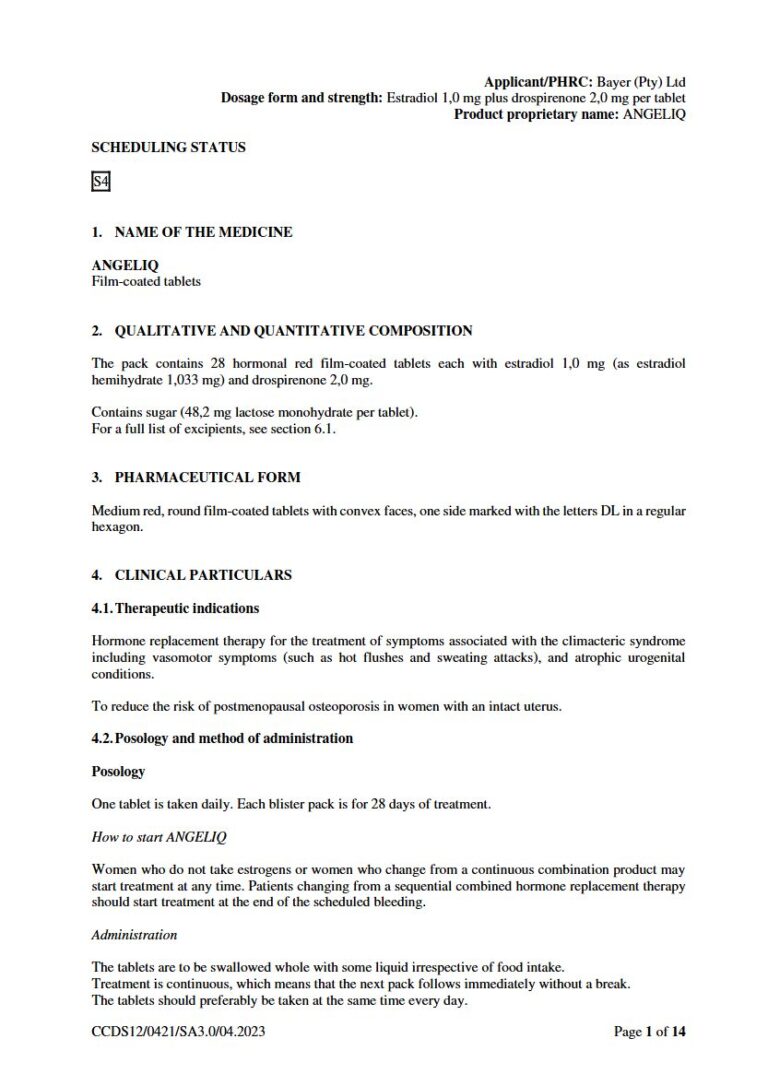
4.1. Therapeutic indications
Hormone replacement therapy for the treatment of symptoms associated with the climacteric syndrome including vasomotor symptoms (such as hot flushes and sweating attacks), and atrophic urogenital conditions. To reduce the risk of postmenopausal osteoporosis in women with an intact uterus.
4.2. Posology and method of administration
Posology
One tablet is taken daily. Each blister pack is for 28 days of treatment.
How to start ANGELIQ
Women who do not take estrogens or women who change from a continuous combination product may start treatment at any time. Patients changing from a sequential combined hormone replacement therapy should start treatment at the end of the scheduled bleeding.
Administration
The tablets are to be swallowed whole with some liquid irrespective of food intake. Treatment is continuous, which means that the next pack follows immediately without a break. The tablets should preferably be taken at the same time every day.
Missed tablets
If a tablet is forgotten it should be taken as soon as possible. If more than 24 hours have elapsed, no extra tablet needs to be taken. If several tablets are forgotten, bleeding may occur.
Special populations
Paediatric patients
ANGELIQ is not indicated for use in children and adolescents.
Geriatric patients
There is no data suggesting a need for dosage adjustment in elderly patients. In women aged 65 years and older see section 4.4.
Patients with hepatic impairment
In women with mild or moderate hepatic impairment, drospirenone is well tolerated (see section 5.2). ANGELIQ is contraindicated in women with presence or history of liver tumours and with severe hepatic disease (see section 4.3). For women with impaired liver function, close supervision is needed and in case of deterioration of markers of liver function, use of HRT should be stopped (see section 4.4).
Patients with renal impairment
In women with mild to moderate renal impairment, a slight increase of drospirenone exposure was observed but is not expected to be of clinical relevance (see section 5.2). ANGELIQ is contraindicated in women with severe renal disease (see section 4.3).
4.3. Contraindications
Hormone replacement therapy should not be started in the presence of any of the conditions listed below. Should any of the conditions appear during hormone replacement therapy use, the product should be stopped immediately.
u2022 Known hypersensitivity to the active substances or to any of the excipients (see section 6.1)
u2022 Abnormal vaginal bleeding of unknown causes
u2022 Known or suspected cancer of the breast
u2022 Personal and family history of breast cancer
u2022 Known or suspected estrogen-dependent neoplasia
u2022 Presence or history of liver tumours (benign or malignant)
u2022 Existing or previous serious hepatic diseases, if liver functions have not returned to normal
u2022 Presence or history of severe renal disease, as long as renal function values have not returned to normal
u2022 Acute arterial thromboembolism (e.g. myocardial infarction, stroke)
u2022 Evident active venous thrombosis (deep vein thrombosis, pulmonary embolism) or a history of these conditions
u2022 A previous history of repeated venous thromboembolism or known thrombophilia for which no anticoagulant treatment has yet been given
u2022 A high risk of venous or arterial thrombosis
u2022 Severe hypertriglyceridaemia
u2022 Known or suspected pregnancy (see section 4.6)
u2022 Lactation (see section 4.6)
u2022 Inherited thrombophilia.
u2022 Patients known with inherited genetic mutations: BRCA1 and BRCA 2 genes.
u2022 Early menstrual periods (before the age of 12 years).
u2022 History of non-cancerous breast diseases (atypical hyperplasia or lobular carcinoma in situ).
u2022 Previous treatment using radiation therapy to the chest or breast.
u2022 Previous exposure to diethylstilbestrol (DES).
4.4. Special warnings and precautions for use
ANGELIQ cannot be used as a contraceptive.
If any of the conditions/risk factors mentioned below is present or deteriorates, an individual risk-benefit analysis should be done before hormone replacement therapy is started or continued. During ANGELIQ use, therapy should be discontinued immediately in case a contraindication is discovered, as well as in the following situations:
u2022 Migrainous or frequent and unusually severe headaches that occur for the first time or other symptoms that are possible prodroma of cerebrovascular occlusion.
u2022 Recurrence of cholestatic jaundice or cholestatic pruritus which occurred first during pregnancy or previous use of sex steroids.
u2022 Symptoms of a thrombotic event or suspicion thereof.
The potential for an increased synergistic risk of thrombosis should be considered in women who possess a combination of risk factors or exhibit a greater severity of an individual risk factor. This increased risk may be greater than a simple cumulative risk of the factors. ANGELIQ should not be prescribed in case of a negative risk benefit assessment.
Venous thromboembolism
Epidemiological studies have suggested that hormone replacement therapy is associated with a higher relative risk of developing venous thromboembolism, i.e. deep vein thrombosis or pulmonary embolism. The studies found a two to threefold higher risk for users compared with non-users, which for healthy women amounts to one to two additional cases of venous thromboembolism in 10 000 patient-years of treatment with hormone replacement therapy. The occurrence of such an event is more likely in the first year of hormone replacement therapy than later. Generally recognised risk factors for venous thromboembolism include a personal history or family history, severe obesity (Body Mass Index > 30 kg/m2) and systemic lupus erythematosus. There is no consensus about the role of varicose veins in venous thromboembolism.
Use of hormone replacement therapy in patients with a history of recurrent venous thromboembolism or known thrombophilic states already on anticoagulant treatment requires careful consideration of the benefit-risk of use of hormone replacement therapy (see section 4.3). Personal or strong family history of recurrent thromboembolism or recurrent spontaneous abortion should be investigated in order to exclude a thrombophilic predisposition. Until a definite diagnosis has been made or anticoagulant treatment initiated, use of hormone replacement therapy in such patients should be viewed as contraindicated. There are no clinical data regarding the use of ANGELIQ in patients on anticoagulant treatment.
The risk of venous thromboembolism may be temporarily increased with prolonged immobilisation, major trauma or major surgery. As in all post-operative patients, scrupulous attention should be given to prophylactic measures to prevent venous thromboembolism following surgery. Where prolonged immobilisation is liable to follow elective surgery, particularly abdominal or orthopaedic surgery to the lower limbs, consideration should be given to temporarily stopping hormone replacement therapy four to six weeks earlier, if possible. If venous thromboembolism develops or is suspected after initiating therapy, the medicine should be discontinued. Patients should be told to contact their doctors immediately if they become aware of a potential thromboembolic symptom (e.g. painful swelling of a leg, sudden pain in the chest, dyspnoea).
Arterial thromboembolism
Two large clinical trials with continuous combined conjugated equine estrogens and medroxyprogesterone acetate showed a possible increased risk of coronary heart disease in the first year of use and no benefit thereafter. One large clinical trial with conjugated equine estrogens alone showed a potential reduction of coronary heart disease rates in women aged 50-59 and no overall benefit in the total study population. As a secondary outcome, in two large clinical trials with conjugated equine estrogens alone or combined with medroxyprogesterone acetate a 30-40 % increased risk of stroke was found. It is uncertain whether these findings also extends to other hormone replacement therapy products, such as ANGELIQ or non-oral routes of administration.
Tumours
Breast cancer
ANGELIQ contains (estrogen and progestogen or estrogen only) which, on prolonged use, may increase the risk of developing breast cancer. A meta-analysis of prospective epidemiological studies from 1992 to 2018 reported a significant increase in the risk of developing breast cancer in 55 575 women 40-59 years of age who used menopausal hormone therapy (MHT). The risk increased steadily with duration of use and was slightly greater for estrogen-progestogen than estrogen only preparations, and the risk persisted for more than 10 years after stopping the treatment. The relative risk (RR) to develop breast cancer for estrogen-progestogen preparations was 1,60 at 1-4 years and RR=2,08 at 5-14 years, while that for estrogen only preparations were 1,17 at 1-4 years and 1,33 at 5-14 years. There was no risk to develop breast cancer in women who started MHT at 60 years of age.
All women on ANGELIQ should receive yearly breast examinations by a healthcare provider and perform monthly breast self-examinations. Mammography evaluations should be done based on patient age, risk factors, and prior mammogram results.
Ovarian cancer
Ovarian cancer is much rarer than breast cancer. Epidemiological evidence from a large meta-analysis suggests a slightly increased risk in women taking estrogen-only or combined estrogen-progestogen HRT, which becomes apparent within 5 years of use and diminishes over time after stopping. Some other studies, including the WHI trial, suggest that the use of combined HRTs may be associated with a similar, or slightly smaller risk (see Section 4.8).
Endometrial cancer
Prolonged exposure to unopposed estrogens increases the risk of the development of endometrial hyperplasia or carcinoma. The addition of drospirenone opposes the development of endometrial hyperplasia caused by estrogens. Nevertheless, clinical surveillance of menopausal women receiving hormone replacement therapy is essential. Persistent breakthrough bleeding during treatment may be an indication for endometrial assessment, which may include biopsy.
Liver tumours
In rare cases benign and, even more rarely, malignant liver tumours have been observed after the use of hormonal substances such as those contained in hormone replacement therapy products. In isolated cases, these tumours led to life-threatening intra-abdominal haemorrhage. A hepatic tumour should be considered in the differential diagnosis if upper abdominal pain, enlarged liver, or signs of intra-abdominal haemorrhage occur.
Gallbladder disease
Estrogens are known to increase the lithogenicity of the bile. Some women are predisposed to gallbladder disease during estrogen therapy.
Dementia
There is limited evidence from clinical studies with conjugated equine estrogens-containing preparations that hormonal treatment may increase the risk of probable dementia if initiated in women aged 65 or older. The risk may be decreased if treatment is initiated in the early menopause, as observed in other studies. It is unknown whether these findings also extend to other hormone replacement therapy products such as ANGELIQ.
Other conditions
Treatment should be stopped at once if migrainous or frequent and unusually severe headaches occur for the first time, or if there are other symptoms that are possible premonitory signs of cerebrovascular occlusion. A general association between hormone replacement therapy use and the development of clinical hypertension has not been established. Small increases in blood pressure have been reported in women taking hormone replacement therapy; clinically relevant increases are rare. However, if in individual cases a sustained clinically significant hypertension develops during the use of hormone replacement therapy, then withdrawing the hormone replacement therapy may be considered. ANGELIQ has the potential to lower blood pressure in women with elevated blood pressure. In normotensive women, relevant changes in blood pressure are not expected. Potassium excretion capacity may be limited in patients with renal insufficiency. In a clinical study, drospirenone intake did not show an effect on the serum potassium concentration in patients with mild or moderate renal impairment. A theoretical risk for hyperkalaemia can be assumed only for patients whose pretreatment serum potassium is in the upper reference range, and who are additionally using potassium-sparing medicines. Non-severe disturbances of liver function, including hyperbilirubinemias such as Dubin-Johnson syndrome or Rotor syndrome, need close supervision and liver function should be checked periodically. In case of deterioration of markers of liver function, use of hormone replacement therapy should be stopped.
Recurrence of cholestatic jaundice or cholestatic pruritus which occurred first during pregnancy or during previous use of sex steroids, necessitates the immediate discontinuation of hormone replacement therapy. Women with moderately elevated levels of triglycerides need special surveillance. Hormone replacement therapy in these women may be associated with a further increase in triglyceride levels, bearing the risk of acute pancreatitis. Although hormone replacement therapy may have an effect on peripheral insulin resistance and glucose tolerance, there is generally no need to alter the therapeutic regimen in diabetics using hormone replacement therapy. However, diabetic women should be carefully monitored while taking hormone replacement therapy. Certain patients may develop undesirable manifestations of estrogenic stimulation under hormone replacement therapy, such as abnormal uterine bleeding. Frequent or persistent abnormal uterine bleeding during treatment is an indication for endometrial assessment. Uterine fibroids may increase in size under the influence of estrogens. If this is observed, treatment should be discontinued. Should endometriosis be reactivated under treatment, discontinuation of therapy is recommended. Should there be a suspicion of a prolactinoma, this should be ruled out before starting treatment. Chloasma may occasionally occur, especially in women with a history of chloasma gravidarum. Women with a tendency to chloasma should avoid exposure to the sun or ultraviolet radiation whilst taking hormone replacement therapy. The following conditions have been reported to occur or deteriorate with hormone replacement therapy use. Although the evidence of an association with hormone replacement therapy use is inconclusive, women with these conditions and treated with hormone replacement therapy should be carefully monitored.
u2022 epilepsy
u2022 benign breast disease
u2022 asthma
u2022 migraine
u2022 porphyria
u2022 otosclerosis
u2022 systemic lupus erythematosus
u2022 chorea minor
In women with hereditary angioedema exogenous estrogens may induce or exacerbate symptoms of angioedema. Depressed mood and depression are well-known undesirable effects of hormonal containing products (see section 4.8). Depression can be serious and is a well-known risk factor for suicidal behaviour and suicide. Women should be advised to contact their medical practitioner in case of mood changes and depressive symptoms, including shortly after initiating the treatment. Each tablet contains 48,2 mg lactose monohydrate. Patients with rare hereditary problems of galactose intolerance, the Lapp lactase deficiency or glucose-galactose malabsorption who are on a lactose-free diet should take this amount into consideration.
4.5. Interactions with other medicines and other forms of interaction.
Effects of other medicines on ANGELIQ
Interactions can occur with medicines that induce microsomal enzymes which can result in increased clearance of sex hormones and which may lead to changes in the uterine bleeding profile and/or reduction of the therapeutic effect. Enzyme induction can already be observed after a few days of treatment. Maximal enzyme induction is generally seen within a few weeks. After the cessation of therapy enzyme induction may be sustained for about 4 weeks.
Substances increasing the clearance of sex hormones (diminished efficacy by enzyme-induction), e.g.: Phenytoin, barbiturates, primidone, carbamazepine, rifampicin, and possibly also oxcarbazepine, topiramate, felbamate, griseofulvin and products containing St. Johnu2019s wort.
Substances with variable effects on the clearance of sex hormones: When co-administered with sex hormones, many HIV/HCV protease inhibitors and non-nucleoside reverse transcriptase inhibitors can increase or decrease plasma concentrations of estrogen or progestin or both. These changes may be clinically relevant in some cases.
Substances decreasing the clearance of sex hormones (enzyme inhibitors)
Strong and moderate CYP3A4 inhibitors such as azole antifungals (e.g. fluconazole, itraconazole, ketoconazole, voriconazole), verapamil, macrolides (e.g. clarithromycin, erythromycin), diltiazem and grapefruit juice can increase plasma concentrations of the progestin or the estrogen or both. In a multiple dose study with a drospirenone (3 mg/day) / estradiol (1,5 mg/day) combination, coadministration of the strong CYP3A4 inhibitor ketoconazole for 10 days increased the AUC(0-24h) of drospirenone 2,30-fold (90 %CI: 2,08, 2,54). No change was observed for estradiol, although the AUC(0-24h) of its less potent metabolite estrone increased 1,39-fold (90 %CI: 1,27, 1,52).
Interaction with alcohol
Acute alcohol ingestion during use of ANGELIQ may lead to elevations of circulating estradiol levels.
Interaction of ANGELIQ with other medicines
In vitro, drospirenone is capable to inhibit weakly to moderately the cytochrome P450 enzymes CYP1A1, CYP2C9, CYP2C19 and CYP3A4. Based on in vivo interaction studies in female volunteers using omeprazole, simvastatin, or midazolam as marker substrates, a clinically relevant interaction of drospirenone at doses of 3 mg with the cytochrome P450 enzyme mediated metabolism of other medicines in unlikely.
Pharmacodynamic interaction with antihypertensive medicines and non-steroidal anti-inflammatory drugs (NSAIDs)
Hypertensive women treated with ANGELIQ and anti-hypertensive medicines, e.g. ACE inhibitors, angiotensin-II-receptor antagonists, and hydrochlorthiazide may experience an additional decrease in blood pressure. Estrogen and estrogen/progestin therapy has been associated with an increased risk of cardiovascular events such as myocardial infarction and stroke. Should any of these occur or be suspected, estrogens should be discontinued immediately. Combined use of ANGELIQ and NSAIDs or antihypertensive medicines is unlikely to increase serum potassium. Concomitant use of these three types of medicines together may cause a small increase in serum potassium, more pronounced in diabetic women.
Other forms of interactions
Laboratory tests
The use of sex steroids may influence the results of certain laboratory tests, including biochemical parameters of liver, thyroid, adrenal and renal function, plasma levels of (carrier) proteins, e.g. sex hormone binding globulin and lipid/lipoprotein fractions, and parameters of coagulation and fibrinolysis. Changes generally remain within the reference range. Glucose tolerance was not compromised by the use of ANGELIQ.
4.6. Pregnancy and lactation
ANGELIQ should not be used during pregnancy and lactation.
Pregnancy
If pregnancy occurs during medication with ANGELIQ, treatment should be discontinued promptly. No clinical data on exposed pregnancies are available for ANGELIQ. Animal studies have shown adverse effects during pregnancy and lactation. The potential risk for humans is unknown. The results of epidemiological studies to date have not indicated a teratogenic effect when pregnant women were inadvertently exposed to estrogen/progestogen combinations.
Lactation
Small amounts of drospirenone are excreted with the milk.
4.7. Effects on ability to drive and use machines
No studies on the ability to drive and use machines have been performed. No effects on the ability to drive and use machines have been observed in users of ANGELIQ.
4.8. Undesirable effects
Summary of safety profile
Serious undesirable effects associated with the use of hormone replacement therapy are also mentioned in section 4.4. The most commonly reported adverse drug reaction (ADR) with ANGELIQ are breast pain, female genital tract bleeding and gastrointestinal and abdominal pains. They occur in u2265 6 % of users.
During the first few months of treatment, bleeding and spotting can occur. These are usually temporary and normally disappear after continued treatment (see section 5.1). The frequency of bleeding decreases with the duration of treatment.
Tabulated summary of adverse reactions
The table below attributes frequencies to the undesirable effects of ANGELIQ. These frequencies are based on the frequencies of adverse events which were recorded in 13 phase II and phase III clinical studies (n = 2 842 women at risk) and considered at least possibly related to treatment with 1 mg estradiol in combination with 1, 2, or 3 mg drospirenone. Within each frequency grouping, ADRs are presented in order of decreasing seriousness. Frequencies are defined as very common (u2265 1/10), common (u2265 1/100 to < 1/10), uncommon (u2265 1/1 000 to < 1/100) and rare (u2265 1/10 000 to < 1/1 000).
Organ system Very Common Common Uncommon Rare
Psychiatric disorders - Emotional lability - -
Nervous system disorders - Migraine - -
Vascular disorders - - Venous and arterial thromboembolic events * -
Gastrointestinal disorders - Gastrointestinal and abdominal pains - -
Reproductive system and breast disorders Breast pain *** Female genital tract bleeding Cervical polyp Breast cancer ** -
Adverse events in clinical studies were coded using the MedDRA dictionary (version 13.0). Different MedDRA terms representing the same medicinal phenomenon have been grouped together as single adverse reactions to avoid diluting or obscuring the true effect. * Evidence for relatedness and estimated frequency derived from epidemiological studies with ANGELIQ (EURAS HRT). u2018Venous and arterial thromboembolic eventsu2019 summarises the following Medical Labelling Groupings: Peripheral deep venous occlusion, thrombosis and embolism/pulmonary vascular occlusion, thrombosis, embolism and infarction/myocardial infarction/cerebral infarction and stroke not specified as haemorrhagic ** Evidence for relatedness derived from post-marketing experience; frequency estimation derived from clinical studies with ANGELIQ. *** Including breast discomfort
For venous and arterial thromboembolic events, breast cancer and migraine see also sections 4.3 and 4.4.
Description of selected adverse reactions
Adverse reactions with very low frequency or with delayed onset of symptoms which are considered to be related to the group of continuous combined products for hormone replacement therapy are listed below (see also section 4.4):
Tumours u2022 Liver tumours (benign and malignant) u2022 Sex-steroid influenced malignancies and pre-malignant conditions (if such a condition is known, this constitutes a contraindication for the use of ANGELIQ) u2022 Ovarian cancer: Use of estrogen-only or combined estrogen-progestogen HRT has been associated with a slightly increased risk of having ovarian cancer diagnosed (see Section 4.4). A meta-analysis from 52 epidemiological studies reported an increased risk of ovarian cancer in women currently using HRT compared to women who have never used HRT (RR 1.43, 95% CI 1.31- 1.56). For women aged 50 to 54 years taking 5 years of HRT, this results in about 1 extra case per 2000 users. In women aged 50 to 54 who are not taking HRT, about 2 women in 2000 will be diagnosed with ovarian cancer over a 5-year period.
Other conditions u2022 Gallbladder disease (estrogens are known to increase the lithogenicity of the bile) u2022 Dementia (there is limited evidence from clinical studies with conjugated equine estradiol-containing preparations that hormonal treatment may increase the risk of probable dementia if initiated in women aged 65 years or older. The risk may be decreased if treatment is initiated in the early menopause, as observed in other studies. It is unknown whether these findings also extend to other hormone replacement therapy products.) u2022 Endometrial cancer (studies have suggested that the appropriate addition of progestogens eliminates the increase in risk resulting from the use of unopposed estrogen) u2022 Hypertension (ANGELIQ has the potential to lower blood pressure in women with elevated blood pressure) u2022 Disturbances of liver function u2022 Hypertriglyceridaemia (increased risk of pancreatitis when using hormone replacement therapy) u2022 Changes in glucose tolerance or effect on peripheral insulin resistance u2022 Increase in size of uterine fibroids u2022 Reactivation of endometriosis u2022 Prolactinoma (risk of aggravation of hyperprolactinaemia or induction of tumour growth) u2022 Chloasma u2022 Jaundice and/or pruritus related to cholestasis u2022 Occurrence or deterioration of conditions for which association with hormone replacement therapy is not conclusive: epilepsy; benign breast disease; asthma; porphyria; systemic lupus erythematosus; otosclerosis; chorea minor u2022 In women with hereditary angioedema exogenous estrogens may induce or exacerbate symptoms of angioedema u2022 Hypersensitivity (incl. symptoms such as rash and urticaria) u2022 In exceptional cases erythema nodosum, erythema multiforme, chloasma and haemorrhagic dermatitis have been reported in women receiving hormone replacement therapy.
Reporting of suspected adverse reactions
Reporting suspected adverse reactions after authorisation of the medicine is important. It allows continued monitoring of the benefit/risk balance of the medicine. Healthcare professionals are asked to report any suspected adverse reactions to SAHPRA via the u201c6.04 Adverse Drug Reaction Reporting Formu201d, found online under SAHPRAu2019s publications : http://www.sahpra.org.za/Publications/index/8
4.9. Overdose
Acute toxicity studies did not indicate a risk of acute adverse effects in case of inadvertent intake of a multiple of the daily therapeutic dose. In clinical studies up to 100 mg of drospirenone and estrogen/progestogen preparations containing 4 mg of estradiol were well tolerated. Overdosage may cause nausea and vomiting and withdrawal bleeding may occur in some women. There is no specific antidote and treatment should be symptomatic.
