
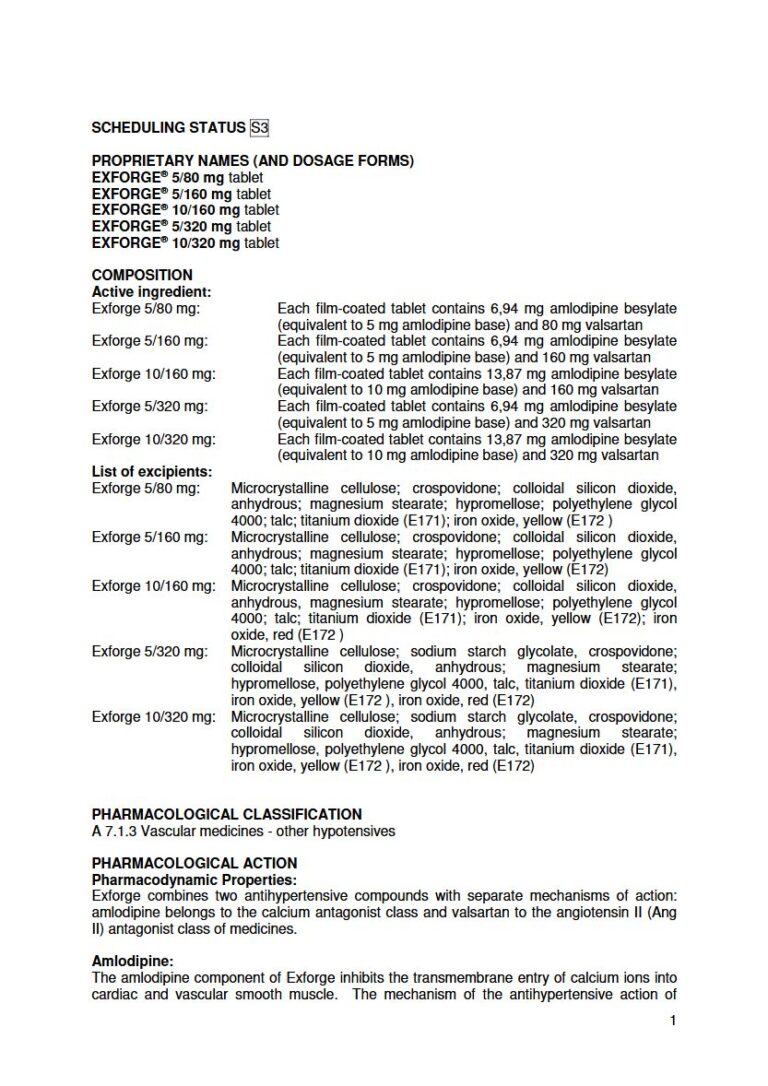
Exforge 80 mg/160 mg/320 mg Tablets
PDF Leaflet Revision Date: 26 October 2012
Clinical Summary
Quick overview from the medicine insert
Indication
Treatment of mild to moderate essential hypertension.
Dosage (summary)
One tablet daily; normal regimens for elderly.
Onset of Action / Duration
Onset: 2 hours, Duration: 24 hours
Special Populations
- Elderly
- Renal impairment
- Hepatic impairment
Pregnancy & Breastfeeding
Contraindicated in pregnancy and lactation.
Key Drug Interactions
- Lithium
- Potassium-sparing diuretics
- ACE inhibitors
Contraindications
- Angioedema history
- Severe renal impairment
- Aortic stenosis
Common side effects
- Headache
- Dizziness
- Oedema
- Fatigue
Counselling Points
- Take with water
- Monitor potassium levels
- Avoid abrupt discontinuation
Serious warnings
- Risk of hypotension in volume-depleted patients
- Caution in hepatic impairment
Important Disclaimer
The Exforge 80 mg/160 mg/320 mg Tablets professional information leaflet below is the property of Novartis South Africa and is provided on Medinsert exactly as issued, with no.. alterations or editorial changes. We make every effort to keep content current by updating documents as soon as new versions become available. Medinsert serves as a trusted access point for healthcare professionals, but does not replace official sources or clinical judgement. For more details, please read our full disclaimer. read more>>
 Healthcare Professionals Only
This content is for registered healthcare professionals
Sign in or create a free account to read the full package insert.
Free for HPCSA-registered professionals. Powered by Medinsert.
Clinical Particulars
Section 4 of the official insert — extracted exactly as issued, no alterations
4.1 Indications
Treatment of mild to moderate essential hypertension in patients whose blood pressure is normalized with the individual components in the same doses as the proposed fixed dose combination of Exforge.
4.2 Contraindications
- Sensitivity to any of the components of Exforge.
- A history of angioedema related to previous therapy with ACE inhibitors or angiotensin receptor blockers (ARBs): These patients must never again be given these medicines.
- Hereditary or idiopathic angioedema
- Hypertrophic obstructive cardiomyopathy (HOCM)
- Aortic stenosis
- Severe renal function impairment (creatinine clearance less than 30 ml/min)
- Bilateral renal artery stenosis.
- Renal artery stenosis in patients with a single kidney
- Concomitant therapy with potassium sparing diuretics such as spironolactone, triamterene, amiloride.
- Porphyria.
- Lithium therapy: Concomitant administration with Exforge may lead to toxic blood concentrations of lithium.
- Pregnancy and lactation (see Pregnancy and lactation).
4.3 Warnings
Renal Impairment: Amlodipine is extensively metabolised to inactive metabolites with 10 % excreted unchanged in the urine. Changes in amlodipine plasma concentrations are not correlated with mild renal impairment. Exforge may be used in such patients at normal doses. In patients with severe renal impairment, Exforge containing reduced amlodipine dosages (5 mg) may need to be administered in these patients. Amlodipine is not dialysable.
Hepatic Impairment: Amlodipine half-life is prolonged in patients with impaired liver function. Exforge containing lower amlodipine dosages (5 mg) should therefore be administered in these patients.
Children: Safety and effectiveness of Exforge in children has not been established.
4.4 Interactions
Amlodipine: In monotherapy, amlodipine has been safely administered with thiazide diuretics, beta-blockers, angiotensin-converting enzyme inhibitors, long-acting nitrates, sublingual nitroglycerin, digoxin, warfarin, atorvastatin, sildenafil, Maalox u00ae (Aluminium hydroxide gel, Magnesium hydroxide and Simeticone), cimetidine, non-steroidal anti-inflammatory drugs, antibiotics, and oral hypoglycaemic medicines. Studies have indicated that the co-administration of monotherapy amlodipine with digoxin did not change serum digoxin levels or digoxin renal clearance in renal clearance in normal volunteers, and that co-administration of cimetidine did not alter the pharmacokinetics of amlodipine.
Valsartan: In monotherapy with valsartan, no interactions of clinical significance have been found with the following medicines: cimetidine, warfarin, furosemide, digoxin, atenolol, indomethacin, hydrochlorothiazide, amlodipine, glibenclamide. Concomitant use with potassium supplements, potassium-sparing diuretics, salt substitutes containing potassium, or other medicines that may increase potassium levels (heparin, etc.) requires caution and frequent monitoring of potassium levels (see Contra-indications).
4.5 Pregnancy and lactation
Pregnancy: Safety of ARBu2019s in pregnancy has not been established. ACE-inhibitors pass through the placenta and can be presumed to cause disturbance in foetal blood pressure regulatory mechanisms. Oligohydramnios as well as hypotension, oliguria and anuria in newborns, have been reported after administration of ACE-inhibitors in the second and third trimester. Safety in pregnancy and lactation has not been established Exforge acts directly on the renin-angiotensin system therefore a risk to the foetus cannot be excluded. When pregnancy is detected during therapy, Exforge must be discontinued as soon as possible. Exforge must not be used during pregnancy as teratogenicity has been shown with valsartan in experimental animals (see Contra-indications). There have been reports of spontaneous abortion, oligohydramnios and newborn renal dysfunction when pregnant women have inadvertently taken valsartan.
Lactation: It is not known whether valsartan and/or amlodipine are excreted in human milk. Valsartan was excreted in the milk of lactating rats. Exforge is contra-indicated for women who are breast-feeding (see Contra-indications).
4.6 Effects on ability to drive and use machines
No studies on the effects on the ability to drive and use machines have been performed. When driving vehicles or using machines it should be taken into account that occasionally dizziness or weariness may occur.
4.7 Undesirable effects
The safety of Exforge has been evaluated in five controlled clinical studies with 5 175 patients, 2 613 of whom received valsartan in combination with amlodipine at variable dosage combinations. Adverse reactions (Table 1) are ranked under heading of frequency, the most frequent first, using the following convention: very common (u2265 1/10); common (u2265 1/100, < 1/10); uncommon (u2265 1/1 000, < 1/100); rare (u2265 1/10 000, < 1/1 000) very rare (< 1/10 000), including isolated reports.
Table 1 Infections and infestations Common: Nasopharyngitis, influenza Immune system disorders Rare: Hypersensitivity Eye disorders Rare Visual disturbance Psychiatric disorders Rare: Anxiety Nervous system disorders Common: Headache Uncommon: Dizziness, somnolence, dizziness postural, paraesthesia Ear and labyrinth disorders Uncommon: Vertigo Rare: Tinnitus Cardiac disorders Uncommon: Tachycardia, palpitations Rare: Syncope Vascular disorders Uncommon: Orthostatic hypotension Rare: Hypotension Respiratory, thoracic and mediastinal disorders Uncommon: Cough, pharyngolaryngeal pain Gastrointestinal disorders Uncommon: Diarrhoea, nausea, vomiting, abdominal pain, constipation, dry mouth Skin and subcutaneous tissue disorders Uncommon: Rash, erythema Rare: Hyperhidrosis, exanthema, pruritus Musculoskeletal and connective tissue disorders Uncommon: Joint swelling, back pain, arthralgia Rare: Muscle spasm, sensation of heaviness Renal and urinary disorders Rare: Pollakiuria, polyuria Reproductive system and breast disorders Rare: Erectile dysfunction General disorders and administration site conditions Common: Oedema, pitting oedema, facial oedema, oedema peripheral, fatigue, flushing, asthenia, hot flushes
4.8 Overdose
There is no experience of overdose with Exforge yet. The major symptom of overdose with valsartan is possibly pronounced hypotension with dizziness. Overdose with amlodipine may result in excessive peripheral vasodilatation and possibly reflex tachycardia. Marked and potentially prolonged systemic hypotension up to and including shock with fatal outcome have been reported. If the ingestion is recent, induction of vomiting or gastric lavage may be considered. Administration of activated charcoal to healthy volunteers immediately or up to two hours after ingestion of amlodipine has been shown to significantly decrease amlodipine absorption. Clinically significant hypotension due to Exforge overdose calls for active cardiovascular support including frequent monitoring of cardiac and respiratory function, elevation of extremities, and attention to circulating fluid volume and urine output. A vasoconstrictor may be helpful in restoring vascular tone and blood pressure, provided that there is no contraindication to its use. Intravenous calcium gluconate may be beneficial in reversing the effects of calcium channel blockade. Both valsartan and amlodipine are unlikely to be removed by haemodialysis.
