
Flagyl Suspension 200 mg/5 mL SUSPENSION
PDF Leaflet Revision Date: 03 December 2025
Clinical Summary
Quick overview from the medicine insert
Indication
Treatment of various infections including trichomoniasis, amoebiasis, and anaerobic infections.
Dosage (summary)
Adults: 200-800 mg 3 times daily depending on indication. Adjust for children based on weight.
Special Populations
- Hepatic impairment
- Renal impairment
Pregnancy & Breastfeeding
Not established; crosses placenta and excreted in breast milk.
Key Drug Interactions
- Disulfiram
- Alcohol
- Warfarin
- Lithium
- Ciclosporin
Contraindications
- Hypersensitivity to metronidazole
- Co-administration with busulfan
- Co-administration with disulfiram
Common side effects
- Nausea
- Dizziness
- Headache
- Peripheral neuropathy
Counselling Points
- Avoid alcohol during and 1-3 days after treatment
- Monitor for psychiatric symptoms
- Report any signs of liver injury
Serious warnings
- QT prolongation
- Disulfiram-like reaction with alcohol
- Severe hepatotoxicity
Important Disclaimer
The Flagyl Suspension 200 mg/5 mL SUSPENSION professional information leaflet below is the property of Sanofi-Aventis South Africa and is provided on Medinsert exactly as issued, with no.. alterations or editorial changes. We make every effort to keep content current by updating documents as soon as new versions become available. Medinsert serves as a trusted access point for healthcare professionals, but does not replace official sources or clinical judgement. For more details, please read our full disclaimer. read more>>
 Healthcare Professionals Only
This content is for registered healthcare professionals
Sign in or create a free account to read the full package insert.
Free for HPCSA-registered professionals. Powered by Medinsert.
Clinical Particulars
Section 4 of the official insert — extracted exactly as issued, no alterations
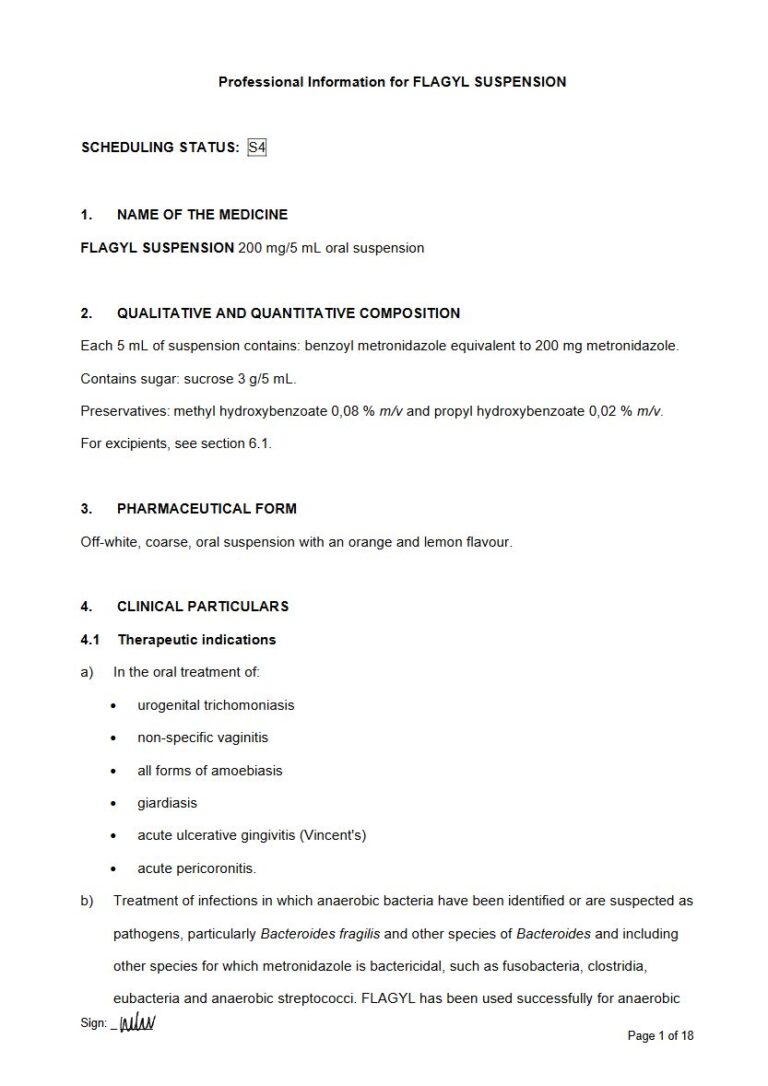
4.1 Therapeutic indications
a) In the oral treatment of:
- urogenital trichomoniasis
- non-specific vaginitis
- all forms of amoebiasis
- giardiasis
- acute ulcerative gingivitis (Vincent's)
- acute pericoronitis.
b) Treatment of infections in which anaerobic bacteria have been identified or are suspected as pathogens, particularly Bacteroides fragilis and other species of Bacteroides and including other species for which metronidazole is bactericidal, such as fusobacteria, clostridia, eubacteria and anaerobic streptococci. FLAGYL has been used successfully for anaerobic infections in the following conditions: pelvic inflammatory disease and post-operative wound infections. Combined therapy is often indicated as there are usually mixed infections.
c) Prevention of post-operative infections due to anaerobic bacteria:
- i) given before and after gynaecological surgery
- ii) given before and after appendectomy
- iii) given before and after colonic surgery.
d) Treatment of Helicobacter pylori-associated gastritis and duodenal ulcer. FLAGYL is used in combination with bismuth subsalicylate or colloidal bismuth subcitrate and appropriate antibiotic therapy.
4.2 Posology and method of administration
Posology
FLAGYL is administered orally. It is recommended that it be taken at least 1 hour before food. Immature children and babies weighing less than 10 kg should receive proportionally smaller doses, as advised by the medical practitioner. Children over 10 years may be given a suitable proportion of the adult dosage according to body mass.
INDICATION DURATION OF DOSAGE IN DAYS
ADULTS CHILDREN
7 TO 10 YEARS 3 TO 7 YEARS 1 TO 3 YEARS
UROGENITAL TRICHOMONIASIS Where re-infection is likely, in adults the consort should receive a similar course of treatment concurrently
1 2 g as a single dose -- -- --
7 200 mg three times daily or 400 mg twice 100 mg three times daily 100 mg twice daily 50 mg three times daily
daily 2 800 mg in the morning and 1,2 g in the evening -- -- --
NON-SPECIFIC VAGINITIS 7 400 mg twice daily -- -- -- OR 1 2 g as a single dose -- -- --
AMOEBIASIS a) Invasive intestinal disease in susceptible subjects. 5 800 mg three times daily 400 mg three times daily 200 mg four times daily 200 mg three times daily
AMOEBIASIS b) Intestinal disease in less susceptible subjects and u201cchronic amoebic hepatitisu201d. 5 to 10 400 mg three times daily 200 mg three times daily 100 mg four times daily 100 mg three times daily
AMOEBIASIS c) Amoebic liver abscess, also other forms of extra- intestinal amoebiasis. 5 400 mg three times daily 200 mg three times daily 100 mg four times daily 100 mg three times daily
AMOEBIASIS (d) Symptomless cyst passers. 5 to 10 400 to 800 mg three times daily 200 to 400 mg three times daily 100 to 200 mg four times daily 100 to 200 mg three times daily
GIARDIASIS A second course of 2 g once daily 1 g once daily 600 to 800 mg 500 mg once daily treatment may be necessary for some patients two weeks after the end of the first course.
3 once daily ACUTE ULCERATIVE GINGIVITIS 3 200 mg three times daily 100 mg three times daily 100 mg twice daily 50 mg three times daily
ACUTE PERICORONITIS 3 to 7 200 mg three times daily -- -- --
Anaerobic infections
a) Treatment: FLAGYL may be given alone or concurrently with other bacteriologically-appropriate antibacterial agents. They should be given for 7 days or longer depending on clinical and bacteriological assessments of the patient's condition. Adults: Initially, 800 mg followed by 400 mg by mouth every 8 hours. Children: 7,5 mg/kg body mass by mouth every 8 hours.
b) Prevention: Adults: Administered in doses similar to those used for the treatment of established infection. 400 mg may be given every 8 hours in the 24 hours before surgery followed post-operatively by intravenous or rectal administration until oral therapy is possible. Children: As for treatment (a).
Treatment of Helicobacter pylori-associated gastritis and duodenal ulcer The following regimens have been used: a) FLAGYL 200 u2013 250 mg: 4 u2013 5 times a day for 14 days in combination with other medicines. To obtain a dosage of 250 mg FLAGYL (metronidazole), 6,25 mL of the FLAGYL should be administered.
Special populations
Patients with hepatic impairment: Metronidazole, as in FLAGYL, is mainly metabolised by hepatic oxidation. Substantial impairment of metronidazole clearance may occur in the presence of advanced hepatic insufficiency. Significant accumulation may occur in patients with hepatic encephalopathy and the resulting high plasma concentrations of metronidazole may contribute to the symptoms of the encephalopathy. Therefore, FLAGYL should be administered with caution to patients with hepatic encephalopathy. The daily dosage should be reduced to one third and may be administered once daily.
Patients with renal impairment: The elimination half-life of metronidazole remains unchanged in the presence of renal failure. Therefore, the dosage of metronidazole, as in FLAGYL, needs no reduction. However, such patients retain the metabolites of metronidazole. The clinical significance of this is not known at present. In patients undergoing haemodialysis metronidazole and metabolites are efficiently removed during an eight-hour period of dialysis. Therefore, FLAGYL should be re-administered immediately after haemodialysis. No routine adjustment in the dosage of FLAGYL need be made in patients with renal failure undergoing intermittent peritoneal dialysis (IDP) or continuous ambulatory peritoneal dialysis (CAPD).
Method of administration
Oral administration.
4.3 Contraindications
- Hypersensitivity to metronidazole, other imidazoles and any of the excipients of FLAGYL listed in section 6.1.
- Co-administration with busulfan (see sections 4.4 and 4.5).
- Co-administration with disulfiram (see sections 4.4 and 4.5).
4.4 Special warnings and precautions for use
QT prolongation has been reported, particularly when metronidazole, as in FLAGYL, was administered with medicines with the potential for prolonging the QT interval (see section 4.5). Avoid the use of FLAGYL in patients who have a history of congenital long QT syndrome, torsades de pointes, cardiac dysrhythmias including ventricular tachycardia or family history of sudden death. Patients should be advised not to take alcohol during FLAGYL therapy and for at least one to three days afterwards because of the possibility of a disulfiram-like reaction (see section 4.5). Psychotic reactions have been reported in patients who were using metronidazole, as in FLAGYL and disulfiram concurrently (see sections 4.3 and 4.5). Co-administration with busulfan: As plasma levels of busulfan may be increased significantly, it may lead to severe busulfan toxicity and death. Pseudomembranous colitis has been reported with the use of FLAGYL. Studies have shown FLAGYL to be mutagenic in bacteria and carcinogenic in some animals. FLAGYL should be administered with caution to patients with hepatic encephalopathy. Cases of severe hepatotoxicity/acute hepatic failure, including cases with a fatal outcome with very rapid onset after treatment initiation, in patients with Cockayne syndrome have been reported with medicines containing metronidazole (the active ingredient of FLAGYL) for systemic use. In this population, FLAGYL should therefore be used after careful benefit-risk assessment and only if no alternative treatment is available. Liver functions tests must be performed just prior to the start of therapy, throughout and after end of treatment until liver function is within normal ranges, or until the baseline values are reached (see section 4.5). If the liver function tests become markedly elevated during treatment, FLAGYL should be discontinued. Patients with Cockayne syndrome should be advised to immediately report any symptoms of potential liver injury to their doctor and stop taking FLAGYL. Cases of severe bullous skin reactions such as Stevens-Johnson syndrome (SJS), toxic epidermal necrolysis (TEN) or acute generalised exanthematous pustulosis (AGEP) have been reported with metronidazole (see section 4.8). If symptoms or signs of SJS, TEN or AGEP are present, FLAGYL treatment must be immediately discontinued. Cases of suicidal ideation with or without depression have been reported during treatment with FLAGYL. Patients should be advised to discontinue treatment and contact their healthcare provider immediately if they experience psychiatric symptoms during treatment (see section 4.8). FLAGYL should be used with great care in patients with blood dyscrasias or with active or chronic disease of the central and peripheral nervous system. All patients receiving FLAGYL for more than 10 days should be monitored and treatment discontinued if signs of peripheral neuropathy or central nervous system toxicity develop. Doses should be reduced in patients with severe liver disease. FLAGYL has anti-treponemal activity and may mask the immunological response seen in untreated early syphilis; contacts of syphilis receiving FLAGYL should probably be screened for an additional 4 to 8 weeks. Patients should be warned that FLAGYL may darken urine (due to metronidazole metabolite). For information on renal and hepatic insufficiency, please see section 4.2. Monitoring for metronidazole associated adverse events is recommended (see section 4.8).
Information on excipients:
- Sucrose : FLAGYL contains sucrose which may have an effect on the glycaemic control of patients with diabetes mellitus. Patients with rare hereditary conditions such as fructose intolerance, glucose-galactose mal-absorption or sucrase-isomaltase insufficiency should not take FLAGYL (see section 2).
- Preservatives: M ethyl hydroxybenzoate (E218) and propyl hydroxybenzoate (E216) can cause an allergic reaction in some people (possibly delayed).
- Alcohol: FLAGYL contains 0,44 % alcohol (ethanol) by volume.
4.5 Interaction with other medicines and other forms of interaction
Disulfiram: Acute psychoses or confusion have been associated with the concomitant use of FLAGYL and disulfiram (see sections 4.3 and 4.4). Alcohol: When given in conjunction with alcohol, FLAGYL may provoke a disulfiram-like reaction in some individuals (effects include intense vasodilation and flushing of the face and neck, restlessness, anxiety, tachycardia, tachypnoea, headache, nausea, vomiting, hyperpnoea, chest pains, sweating, pallor and hypotension); reactions have occurred after the administration of pharmaceutical preparations formulated with alcohol, including injections, as well as after drinking alcohol. Alcoholic beverages and medicine containing alcohol should not be consumed during therapy and for at least 1 to 3 days afterwards (see section 4.4). Oral anticoagulant therapy (warfarin type): Potentiation of the anticoagulant effect and increased haemorrhagic risk. In case of co- administration with warfarin, prothrombin time/INR should be more frequently monitored and warfarin therapy/dose adjusted during treatment with FLAGYL. Lithium: Plasma levels of lithium may be increased by FLAGYL. Plasma concentrations of lithium, creatinine and electrolytes should be monitored in patients under treatment with lithium while they receive FLAGYL. Ciclosporin: Risk of elevation of ciclosporin serum levels. Serum ciclosporin and serum creatinine should be closely monitored when co-administration is necessary. Phenytoin or phenobarbital: There is evidence that phenytoin might accelerate the metabolism of FLAGYL. Plasma concentrations of FLAGYL are decreased by the concomitant administration of phenobarbital, with a consequent reduction in the effectiveness of FLAGYL. 5-Fluorouracil: Reduced clearance of 5-fluorouracil resulting in increased toxicity of 5-fluorouracil may occur. Busulfan: Plasma levels of busulfan may be increased by FLAGYL, which may lead to severe busulfan toxicity and death (see sections 4.3 and 4.4). Medicines that prolong QT interval: QT prolongation has been reported, particularly when FLAGYL was administered with medicines with the potential for prolonging the QT interval. Cimetidine: Hepatic metabolism may be decreased when FLAGYL and cimetidine are used concurrently, possibly resulting in delayed elimination and increased serum metronidazole concentrations with an increased risk of neurological side effects. Interferences with laboratory and diagnostic test: Metronidazole, as in FLAGYL, may interfere with certain types of blood test determinations in blood (aminotransferase [ALT], aspartate aminotransferase [AST], lactate dehydrogenase [LDH], triglycerides, glucose), which may lead to false negative or an abnormally low result. These analytical determinations are based on a decrease in ultraviolet absorbance, a fact that occurs when nicotinamide adenine dinucleotide hydrogen (NADH) is oxidised to nicotinamide adenine dinucleotide (NAD). The interference is due to the similarity in the absorption peaks of NADH (340 nm) and metronidazole (322 nm) at pH 7.
4.6 Fertility, pregnancy and lactation
Pregnancy
Safety in pregnancy and lactation has not been established. FLAGYL crosses the placental barrier.
Breastfeeding
FLAGYL is excreted in breast milk. Women using FLAGYL should not breastfeed their infants.
Fertility
No data available.
4.7 Effects on ability to drive and use machines
Patients should be warned about the potential for confusion, dizziness, vertigo, hallucinations, convulsions or eye disorders (see section 4.8), and advised not to drive or operate machinery if these symptoms occur.
4.8 Undesirable effects
a. Summary of the safety profile
Serious adverse reactions occur rarely with standard recommended regimens. Medical practitioners who contemplate continuous therapy for the relief of chronic conditions, for periods longer than those recommended, are advised to consider the possible therapeutic benefit against the risk of peripheral neuropathy. The frequency of adverse events listed below is defined using the following convention: Very common (u2265 1/10); common (u2265 1/100 to < 1/10); uncommon (u2265 1/1 000 to < 1/100); rare (u2265 1/10 000 to < 1/1 000); very rare (< 1/10 000); not known (cannot be estimated from the available data). The adverse effects of FLAGYL are generally dose related. The following side effects have been reported:
System organ class Common (u2265 1/100 to < 1/10) Rare (u2265 1/10 000 to < 1/1 000) Very rare (< 1/10 000) Not known
Blood and lymphatic system disorders agranulocytosis, neutropenia, thrombocytopenia leucopenia
Immune system disorders anaphylaxis angioedema, urticaria
Metabolism and nutrition disorders anorexia
Psychiatric disorders psychotic disorders including confusion, irritability and hallucinations, changes in mood or mental state such as depression
Nervous system disorders weakness, dizziness, drowsiness, insomnia, cases of encephalopathy (e.g. confusion) and subacute cerebellar syndrome (e.g. ataxia, dysarthria, gait impairment, nystagmus and tremor), which may resolve with discontinuation of FLAGYL peripheral neuropathy, usually presenting as numbness or tingling in the extremities, and epileptiform seizures are serious adverse effects on the nervous system that have been associated especially with high doses of FLAGYL or prolonged treatment
Eye disorders transient vision disorders such as diplopia and myopia
Respiratory, thoracic and nasal congestion mediastinal disorders
Gastro- intestinal disorders gastro- intestinal disturbances, nausea (accompanied by headache) taste disorders, vomiting, diarrhoea, dry mouth, furred tongue, oral mucositis, stomatitis pseudo- membranous colitis
Hepatobiliary disorders increase in liver enzymes (AST, ALT, alkaline phosphatase) and cholestatic hepatitis sometimes with jaundice pancreatitis and raised liver enzyme values
Skin and subcutaneous tissue disorders pustular eruptions, mild erythematous eruptions with fleeting joint pains resembling serum sickness skin rashes, flushing and pruritus
Musculo- skeletal, connective tissue and myalgia and arthralgia bone disorders
Renal and urinary disorders urethral discomfort and darkening of the urine
General disorders and administration site conditions fever
Post-marketing experience
The adverse effects listed below are based on data from post-marketing experience:
Nervous system disorders: headache, aseptic meningitis, vertigo
Eye disorders: transient vision disorders such as blurred vision, decreased visual acuity, changes in colour vision, optic neuropathy/neuritis
Ear and labyrinth disorders: hearing impaired/hearing loss (including sensorineural), tinnitus
Cardiac disorders: QT prolongation has been reported, particularly when FLAGYL was administered with medicines with the potential for prolonging the QT interval. Ventricular tachycardia (including torsades de pointes) has also been reported.
Gastrointestinal disorders: epigastric pain
Hepato-biliary disorders: mixed hepatitis and hepatocellular liver injury, cases of liver failure requiring liver transplant have been reported in patients treated with FLAGYL in combination with other antibiotic medicine
Skin and subcutaneous tissue disorders: acute generalised exanthematous pustulosis, fixed drug eruption, Stevens-Johnson syndrome, toxic epidermal necrolysis (see section 4.4).
Reporting of suspected adverse reactions
Reporting suspected adverse reactions after authorisation of FLAGYL is important. It allows continued monitoring of the benefit/risk balance of FLAGYL. Health care providers are asked to report any suspected adverse reactions to:
- The Pharmacovigilance Unit at Sanofi: [email protected] (email) ), https://ae.reporting.sanofi/ (web portal) or +27 11 256 3700 (tel), or
- SAHPRA via the Med Safety APP (Medsafety X SAHPRA) and eReporting platform (who- umc.org) found on the SAHPRA website.
4.9 Overdose
In overdose, side effects can be precipitated and/or be of increased severity. See section 4.8 above. Treatment is symptomatic and supportive.
