
Forteo 250 µg/ml Solution for injection
PDF Leaflet Revision Date: 17 March 2022
Clinical Summary
Quick overview from the medicine insert
Indication
Treatment of osteoporosis in postmenopausal women and men.
Dosage (summary)
20 u03bcg once daily by subcutaneous injection.
Special Populations
- Renal impairment
- Hepatic impairment
- Elderly patients
Pregnancy & Breastfeeding
Not established; contraindicated in pregnancy and lactation.
Key Drug Interactions
- Digitalis
- Hydrochlorothiazide
- Furosemide
Contraindications
- Hypersensitivity to teriparatide
- Hypercalcaemia
- Metabolic bone diseases other than primary osteoporosis
- Skeletal malignancies
- Prior radiation therapy involving the skeleton
Common side effects
- Nausea
- Dizziness
- Headache
- Pain in limb
Counselling Points
- Educate on proper injection techniques
- Concomitant calcium and vitamin D supplementation required
- Avoid driving if experiencing dizziness
Serious warnings
- Risk of osteosarcoma with prolonged use
- Monitor serum calcium levels
Important Disclaimer
The Forteo 250 µg/ml Solution for injection professional information leaflet below is the property of Eli Lilly (SA) and is provided on Medinsert exactly as issued, with no.. alterations or editorial changes. We make every effort to keep content current by updating documents as soon as new versions become available. Medinsert serves as a trusted access point for healthcare professionals, but does not replace official sources or clinical judgement. For more details, please read our full disclaimer. read more>>
 Healthcare Professionals Only
This content is for registered healthcare professionals
Sign in or create a free account to read the full package insert.
Free for HPCSA-registered professionals. Powered by Medinsert.
Clinical Particulars
Section 4 of the official insert — extracted exactly as issued, no alterations
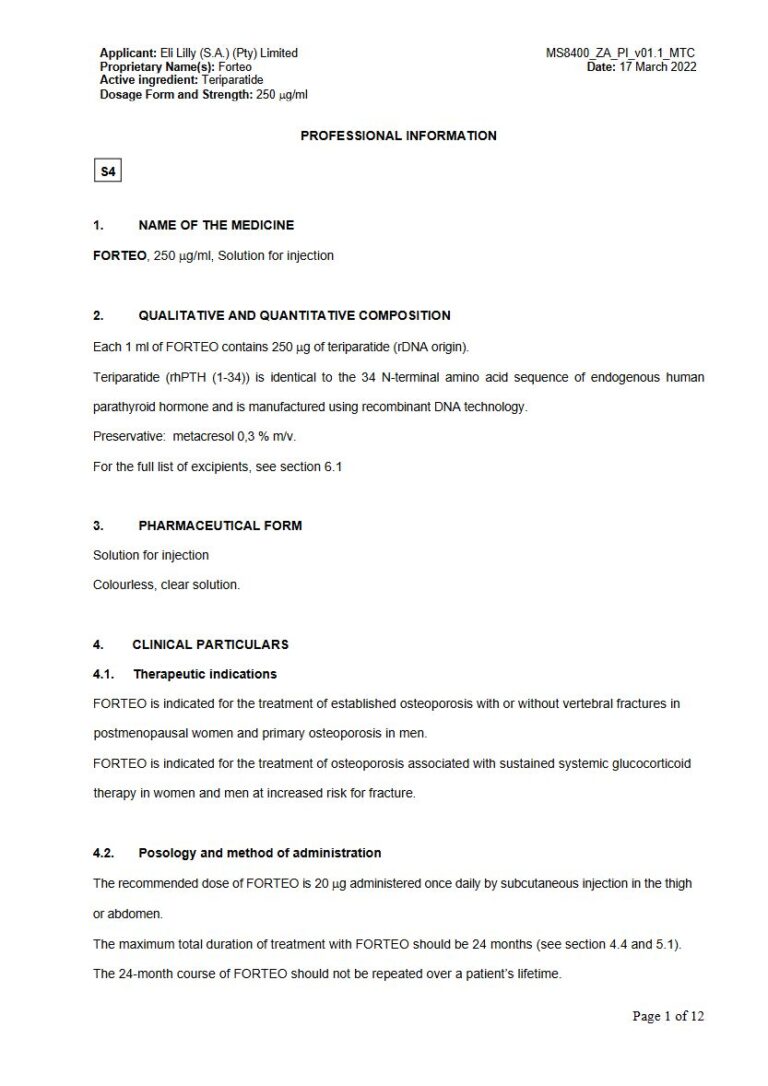
4.1. Therapeutic indications
FORTEO is indicated for the treatment of established osteoporosis with or without vertebral fractures in postmenopausal women and primary osteoporosis in men. FORTEO is indicated for the treatment of osteoporosis associated with sustained systemic glucocorticoid therapy in women and men at increased risk for fracture.
4.2. Posology and method of administration
The recommended dose of FORTEO is 20 u03bcg administered once daily by subcutaneous injection in the thigh or abdomen. The maximum total duration of treatment with FORTEO should be 24 months (see section 4.4 and 5.1). The 24-month course of FORTEO should not be repeated over a patientu2019s lifetime.
FORTEO is supplied in a 2,4 ml cartridge contained in a prefilled delivery device (pen) that delivers 20 u03bcg per dose. Patients must be educated to use the proper injection techniques. Please refer to the enclosed User Manual for instructions on the pen injector. Calcium (1 000 mg per day) and Vitamin D (400 - 1 200 IU per day) must be administered concomitantly with FORTEO.
Special populations
Patients with renal impairment
FORTEO must not be used in patients with severe renal impairment (see section 4.3.). In patients with moderate renal impairment, FORTEO should be used with caution. No special caution is required for patients with mild renal impairment.
Patients with hepatic impairment
No data are available in patients with impaired hepatic function (see section 5.3). Therefore, FORTEO should be used with caution.
Paediatric population and young adults with open epiphyses
The safety and efficacy of FORTEO in children and adolescents less than 18 years has not been established. FORTEO should not be used in paediatric patients (less than 18 years), or young adults with open epiphyses.
Elderly patients
Dosage adjustment based on age is not required (see section 5.2).
4.3 Contraindications
- FORTEO should not be used in patients with hypersensitivity to teriparatide or to any of its excipients listed in section 6.1.
- Hypercalcaemia (see section 4.4).
- Unexplained elevations of alkaline phosphatase.
- Metabolic bone diseases other than primary osteoporosis (see section 4.4).
- Skeletal malignancies or bone metastases (see section 4.4).
- Patients with prior external beam or implant radiation therapy involving the skeleton should be excluded from treatment with FORTEO.
- Pregnancy: Safety in pregnancy has not been established (see section 4.6).
- Lactation: The safety of FORTEO has not been established in breastfeeding women (see section 4.6).
4.4 Special warnings and precautions for use
Hypercalcaemia: FORTEO has not been studied in patients with pre-existing hypercalcaemia. These patients should be excluded from treatment with FORTEO because of the possibility of exacerbating hypercalcaemia. Hypercalcaemia should be excluded before treatment with FORTEO. Routine monitoring of serum calcium during therapy is required (see section 4.3).
Bone Disorders other than Osteoporosis: Patients with metabolic bone diseases other than primary osteoporosis (including hyperparathyroidism and Pagetu2019s disease of the bone) and those with otherwise unexplained elevations of alkaline phosphatase should generally be excluded from treatment with FORTEO. Patients with skeletal malignancies or bone metastases should also be excluded from treatment with FORTEO (see section 4.3).
Children: FORTEO has not been studied in paediatric populations. FORTEO should not be used in paediatric patients or young adults with open epiphyses.
Urolithiasis: FORTEO has not been studied in patients with active urolithiasis. FORTEO should be used with caution in patients with active or recent urolithiasis because of the potential to exacerbate this condition.
Hypotension: In short-term clinical studies with FORTEO, isolated episodes of transient orthostatic hypotension were observed (see section 4.7). Typically, an event began within 4 hours of dosing and spontaneously resolved within a few minutes to a few hours. When transient orthostatic hypotension occurred, it happened within the first several doses, was relieved by placing subjects in a reclining position and did not preclude continued treatment.
Carcinogenesis: Rats treated with near-lifetime daily FORTEO injections had dose-dependent exaggerated bone formation and increased incidence of osteosarcoma. Teriparatide did not increase the incidence of neoplasms in other tissues. A second rat study (of up to 2 years duration) confirmed that the occurrence of osteosarcoma was dependent upon dose and duration of treatment. A no-observed-effect level (NOEL) was identified; the NOEL is 3 times the exposure in patients given a 20 u03bcg dose based upon AUC. Until further clinical data become available, the recommended treatment duration of 24 months should not be exceeded.
Mutagenesis: FORTEO was not genotoxic in any of the following test systems: the Ames test for bacterial mutagenesis with and without metabolic activation, the mouse lymphoma assay for mammalian cell mutation, the chromosomal aberration assay in Chinese hamster ovary cells and the in vivo micronucleus test in mice. The relevance of these findings to humans is not known: Osteosarcoma has not been observed in FORTEO clinical studies. Chronic elevation of blood PTH levels as occurs clinically in primary or secondary hyperparathyroidism is not associated with an increased risk of osteosarcoma.
4.5 Interaction with other medicinal products and other forms of interaction
FORTEO has been evaluated in pharmacodynamic interaction studies with hydrochlorothiazide, furosemide, atenolol and extended release preparations of diltiazem, nifedipine, felodipine, nisoldipine. No clinically significant interactions were noted.
Co-administration of raloxifene or hormone replacement therapy with FORTEO did not alter the effects of FORTEO on serum or urine calcium or on clinical adverse events.
Serum Calcium: FORTEO can induce small, transient increases in serum calcium. If serum calcium is to be assessed, blood samples should be obtained at least 16 hours after the most recent FORTEO injection to allow waning of the effects of the administered teriparatide.
Urinary Calcium: FORTEO may cause small increases in urinary calcium excretion, but the incidence of hypercalciuria did not differ from that in the placebo-treated patients in clinical trials.
Digoxin: In a study of 15 healthy subjects administered digoxin daily to steady state, a single FORTEO dose did not alter the cardiac effect of digoxin. However, sporadic case reports have suggested that hypercalcaemia may predispose patients to digitalis toxicity. Because FORTEO transiently increases serum calcium, FORTEO should be used with caution in patients taking digitalis.
4.6 Fertility, pregnancy and lactation
Pregnancy
Animal reproduction studies have been conducted with teriparatide. No teratogenic effects were observed (see section 5.3). The effect of FORTEO treatment on human foetal development has not been studied. FORTEO should not be administered to pregnant women (see section 4.3).
Lactation
There have been no studies to determine if FORTEO is secreted into breast milk. FORTEO should not be administered to nursing women (see section 4.3).
Fertility
Studies in rabbits have shown reproductive toxicity (see section 5.3). The effect of teriparatide on human foetal development has not been studied. The potential risk for humans is unknown.
4.7 Effects on ability to drive and use machines
FORTEO may cause orthostatic hypotension or dizziness. These patients should refrain from driving or the use of machines until symptoms have subsided.
4.8 Undesirable effects
The most commonly reported adverse reactions in patients treated with FORTEO are nausea, pain in limb, headache and dizziness.
Adverse Reactions are classified according to the system organ class and frequency using the following frequency conversion: very common (u2265 1/10); common (u2265 1/100, < 1/10); uncommon (u22651/1 000, <1/100); rare (u2265 1/10 000, < 1/1 000) and very rare (<1/10 000)
System organ class Frequency Adverse reactions
Blood and lymphatic system disorders Common Anaemia
Immune System Disorder Rare Anaphylaxis
Metabolism and nutrition disorders Common Hypercholesterolaemia
Uncommon Hypercalcaemia greater than 2.76 mmol/L, hyperuricemia
Rare Hypercalcaemia greater than 3.25 mmol/L
Psychiatric disorders Common Depression
Nervous system disorders Common Dizziness, headache, sciatica, syncope
Ear and labyrinth disorders Common Vertigo
Cardiac disorders Common Palpitations
Uncommon Tachycardia
Vascular disorders Common Hypotension
Respiratory, thoracic and mediastinal disorders Common Dyspnoea
Uncommon Emphysema
Gastrointestinal disorders Common Nausea, vomiting, hiatus hernia, gastroesophageal reflux disease
Uncommon Haemorrhoids
Skin and subcutaneous tissue disorders Common Increased sweating
Musculoskeletal and connective tissue disorders Very common Pain in limb
Common Muscle cramps
Uncommon Myalgia, arthralgia, back cramp/pain*
Renal and urinary disorders Uncommon Urinary incontinence, polyuria, micturition urgency, nephrolithiasis
Rare Renal failure/impairment
General disorders and administration site conditions Common Fatigue, chest pain, asthenia, mild and transient injection site events, including pain, swelling, erythema, localised bruising, pruritis and minor bleeding at injection site.
Uncommon Injection site erythema, injection site reaction
Rare Possible allergic events soon after injection: acute dyspnoea, oro/facial oedema, generalised urticaria, chest pain, oedema (mainly peripheral).
Investigations Uncommon Weight increased, cardiac murmur, alkaline phosphatase increase
*Serious cases of back cramp or pain have been reported within minutes of the injection.
Description of selected adverse reactions
In a large clinical trial, antibodies that cross-reacted with teriparatide were detected in 2.8 % of women receiving FORTEO. Generally, antibodies were first detected following 12 months of treatment and diminished after withdrawal of therapy.
Reporting of suspected adverse reactions
Reporting suspected adverse reactions after authorisation of the medicine is important. It allows continued monitoring of the benefit/risk balance of the medicine. Healthcare professionals are asked to report any suspected adverse reactions to SAHPRA via the u201c6.04 Adverse Drug Reaction Reporting Formu201d, found online under SAHPRAu2019s publications: https://www.sahpra.org.za/Publications/Index/8 Alternately, report suspected adverse reactions to the company at [email protected].
4.9. Overdose
The effects of overdose that might be expected include a delayed hypercalcaemic effect and risk of orthostatic hypotension. Nausea, vomiting, dizziness and headache might also occur. There is no specific antidote for FORTEO. Treatment of suspected overdose should include transitory discontinuation of FORTEO, monitoring of serum calcium, and implementation of appropriate supportive measures, such as hydration.
