
Inocrave 15 & 30 15 mg, 30 mg Capsule
PDF Leaflet Revision Date: 26 September 2023
Clinical Summary
Quick overview from the medicine insert
Indication
Management of obesity as part of a comprehensive weight reduction regimen.
Dosage (summary)
One capsule daily at approximately 7 a.m. for adults and children over 12 years.
Onset of Action / Duration
Onset: 10-14 hours, Duration: up to 3 months
Special Populations
- Renal impairment
- Mild hypertension
- Established coronary artery disease
Pregnancy & Breastfeeding
Not recommended in pregnancy or lactation due to safety concerns.
Key Drug Interactions
- MAO inhibitors
- Sympathomimetics
- Thyroid hormones
- Alcohol
Contraindications
- Pulmonary artery hypertension
- Cardiac disease
- Hyperthyroidism
- Glaucoma
- History of drug/alcohol abuse
Common side effects
- Insomnia
- Dizziness
- Tachycardia
- Dry mouth
- Nausea
Counselling Points
- Avoid evening dosing to prevent insomnia
- Monitor for cardiovascular symptoms
- Do not combine with other appetite suppressants
Serious warnings
- Risk of primary pulmonary hypertension
- Valvular heart disease
- Caution in patients with hypertension
Important Disclaimer
The Inocrave 15 & 30 15 mg, 30 mg Capsule professional information leaflet below is the property of Inova Pharmaceuticals and is provided on Medinsert exactly as issued, with no.. alterations or editorial changes. We make every effort to keep content current by updating documents as soon as new versions become available. Medinsert serves as a trusted access point for healthcare professionals, but does not replace official sources or clinical judgement. For more details, please read our full disclaimer. read more>>
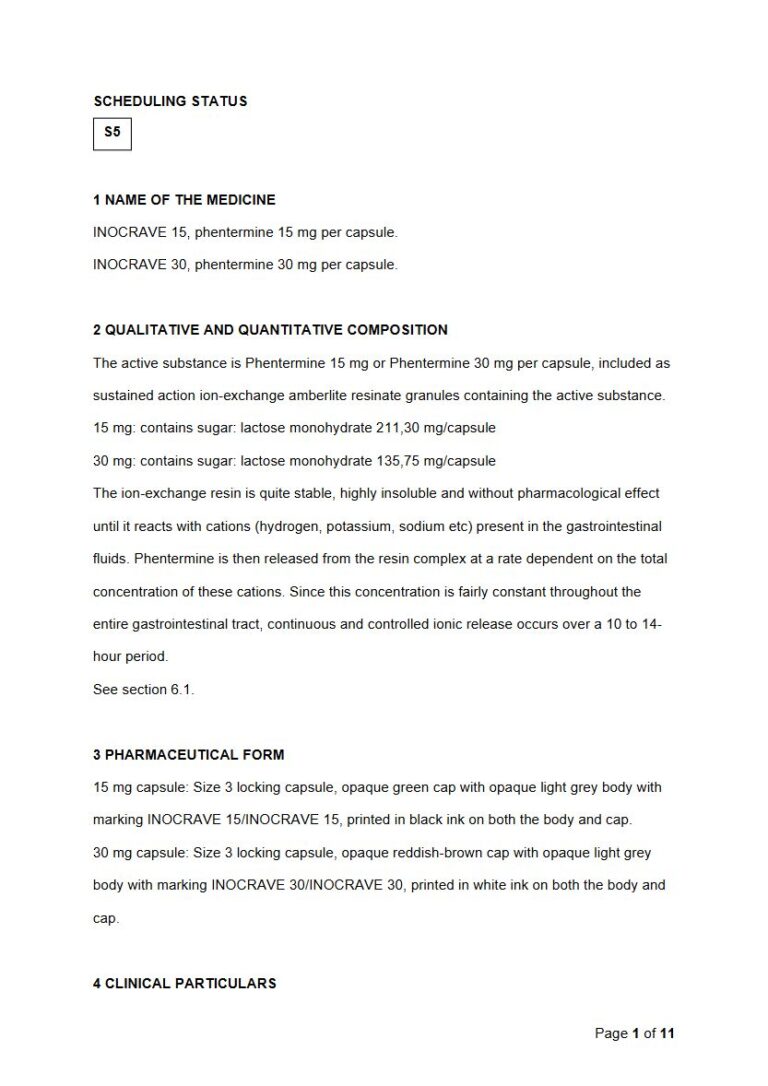 Healthcare Professionals Only
This content is for registered healthcare professionals
Sign in or create a free account to read the full package insert.
Free for HPCSA-registered professionals. Powered by Medinsert.
Clinical Particulars
Section 4 of the official insert — extracted exactly as issued, no alterations
4.1 Therapeutic indications
INOCRAVE is an anorectic agent used in the management of obesity. INOCRAVE is indicated as a short-term adjunct in a medically monitored comprehensive regimen of weight reduction based, for example, on exercise, diet (caloric/kilojoule restriction) and behaviour modification in obese patients with a body mass index (BMI) of 30 kg/m2 or higher who have not achieved an adequate clinical response to an appropriate weight-reducing regimen alone. Treatment with INOCRAVE can be initiated at a lower BMI in patients with other risk factors. Secondary organic causes of obesity should be excluded by diagnosis before prescribing this agent.
4.2 Dose and method of administration
Adults and Children over 12 years: One capsule daily at approximately 7 a.m., swallowed whole. Evening dosing should be avoided, as this agent may induce insomnia. It is recommended that treatment should be initiated under the care of physicians experienced in the treatment of obesity. The recommended dose of INOCRAVE should not be exceeded, and INOCRAVE should not be combined with other appetite suppressants, in an attempt to increase the effect. Patients require medical review after a defined course of treatment, which ideally should not exceed three months.
Children under 12 years: INOCRAVE is not recommended for use as safety and efficacy have not been established.
4.3 Contraindications
Pulmonary artery hypertension, arterial hypertension, cerebra-vascular disease, cardiac disease including arrhythmias, advanced arteriosclerosis; known hypersensitivity for phentermine and sympathomimetic drugs; hyperthyroidism; agitated states or a history of psychiatric disorders including anorexia nervosa and depression; glaucoma; history of drug/alcohol abuse or dependence; obstructive uropathy; poorly controlled epilepsy; concomitant treatment with Monoamine Oxidase (MAO) Inhibitors or within 14 days following their administration.
Pregnancy and Lactation: Studies in animals have shown evidence of an increased occurrence of fetal damage. Due to inadequate evidence of safety in human pregnancy, INOCRAVE should not be used in pregnant women. There are no data available on the safety of INOCRAVE in lactation and as such, its use in lactating women should be avoided.
4.4 Special warnings and precautions for use
INOCRAVE capsules are indicated only as short-term monotherapy for the management of exogenous obesity. The safety and efficacy of combination therapy with phentermine and any other medication for weight loss have not been established. Therefore, coadministration of drug products for weight loss is not recommended.
Valvular Heart Disease: Serious regurgitant cardiac valvular disease, primarily affecting the mitral, aortic and/or tricuspid valves, has been reported in otherwise healthy persons who had taken a combination of phentermine with fenfluramine or dexfenfluramine for weight loss. The etiology of these valvulopathies has not been accurately established and their course in individuals after the drugs are stopped is not fully known. There have been no reported cases to date of valvular heart disease occurring with the use of phentermine alone.
Primary Pulmonary Hypertension (PPH): Cases of severe, sometime fatal primary pulmonary hypertension, have been reported in patients who have received anorectics. In a case-control epidemiological study, the duration of treatment with anorectic agents, not including phentermine, beyond three months significantly increases the risk of PPH. However, patients treated with phentermine require medical review at least every 3 months (See 4.2). PPH has been reported in patients receiving fenfluramine/dexfenfluramine combined with phentermine. The possibility of an association between PPH and the use of phentermine alone cannot be ruled out; there have been very rare cases of PPH in patients who reportedly have taken phentermine alone. The initial symptom of PPH is usually dyspnoea. Other early symptoms include: angina pectoris, syncope, lower extremity oedema or the unexplained onset or aggravation of diminished exercise tolerance. Under these circumstances, treatment should be immediately discontinued and the patient referred to a specialist unit for investigation.
Use with Caution in the following circumstances: INOCRAVE should be used with caution in patients with mild hypertension and kidney impairment. In the first days of treatment, determine that there is no loss of blood pressure control. In patients receiving INOCRAVE, response to insulin and oral hypoglycaemic agents may vary due to alterations in dietary regimes. This should be kept in mind if INOCRAVE is used in diabetic patients. Inappropriate use has been reported with similar drugs and the possibility of this occurrence should be considered with INOCRAVE. Cardiovascular and cerebrovascular events have rarely been reported, mainly in association with rapid weight loss. Weight loss should be gradual and controlled in obese patients undergoing treatment with INOCRAVE.
INOCRAVE should be used with caution in patients with established coronary artery disease. A single case of exacerbation of angina pectoris in a patient with established coronary artery disease has been reported. INOCRAVE should be used with caution in patients receiving anti-hypertensive agents, since it may cause loss of blood pressure control. INOCRAVE should be used with caution in patients receiving psychotropic drugs, including sedatives and agents with sympathomimetic activity. INOCRAVE should be used with caution in epileptic patients.
Use in the elderly: INOCRAVE is not recommended for the elderly.
Paediatric use: INOCRAVE is not recommended for children.
Lactose: This medicinal product contains lactose monohydrate. Patients with rare hereditary problems of galactose intolerance, the Lapp deficiency or glucose-galactose malabsorption, should not take this medicine. Lactose monohydrate may have an effect on the glycaemic control of patients with diabetes mellitus.
4.5 Interactions with other medicines and other forms of interactions
INOCRAVE should be used with caution in patients receiving sympathomimetic agents. INOCRAVE antagonises adrenergic neurone blocking drugs such as clonidine, methyldopa and guanethidine and may decrease their hypotensive effect. The effects of INOCRAVE are potentiated by Monoamine Oxidase Inhibitors (see 4.3) and may result in a hypertensive crisis. Since the selective serotonin reuptake inhibitors (e.g., fluoxetine, sertraline, fluvoxamine, paroxetine), ergot-like drugs and clomipramine affect serotonin metabolism there is a risk that combination of these agents with phentermine may be associated with cardiac valvular disease. INOCRAVE should be used with caution in patients receiving sympathomimetic agents. The concurrent use of thyroid hormones with INOCRAVE may increase the CNS stimulation that can occur with INOCRAVE. Alcohol may increase CNS side effects such as dizziness, light-headedness and confusion, and its concurrent use should be avoided with INOCRAVE.
4.6 Fertility, pregnancy and lactation
Effects on fertility: In rats, administration of phentermine at a dose 10 times the maximum human dose on a mg/m2 basis abolished oestrous cycling. There is no information on the potential of phentermine to impair fertility in humans.
Use in pregnancy: Weight reduction using appetite suppression drugs is not recommended during pregnancy. In rats, administration of phentermine during late gestation at a dose 7 times the maximum human dose on a mg/m2 basis had no adverse effects on dams or offspring. There is no information on the teratological potential of phentermine. Because of inadequate evidence of safety in human pregnancy, INOCRAVE should not be used in pregnant women.
Use in lactation: There is no data available on the safety of INOCRAVE in lactation and as such, its use in lactating women should be avoided.
4.7 Effects on ability to drive and use machines
INOCRAVE may impair the ability to perform activities requiring mental alertness, such as driving and operating machinery, and patients therefore should be cautioned accordingly.
4.8 Adverse effects
Central Nervous System: Overstimulation, restlessness, nervousness, insomnia, tremor, dizziness and headache. Rarely euphoria may occur and this may be followed by fatigue and depression. Psychotic episodes and hallucinations are less frequent side effects.
Cardiovascular: See 4.4. The most common reported reactions are tachycardia, palpitations, hypertension elevation of blood pressure, precordial pain. Rare occurrences of cardiovascular or cerebro-vascular accidents have been described in patients treated with anorectic agents. In particular stroke, angina, myocardial infarction, cardiac failure and cardiac arrest have been reported.
Gastrointestinal: Nausea, vomiting, dry mouth, abdominal cramps, unpleasant taste, diarrhoea, constipation.
General disorders: Micturition disturbances, rash, impotence, changes in libido, facial oedema, blurred vision.
Reporting of suspected adverse reactions: Reporting suspected adverse reactions after authorisation of the medicine is important. It allows continued monitoring of the benefit/risk balance of the medicine. Health care providers are asked to report any suspected adverse reactions to SAHPRA via the u201c6.04 Adverse Drug Reactions Reporting Formu201d, found online under SAHPRAu2019s publications: https://www.sahpra.org.za/Publications/Index/8
4.9 Overdose
Symptoms: Initially irritability, rapid respiration, agitation, euphoria, restlessness, hyperreflexia, disorientation and tremor, aggressiveness, hallucinations and panic states may occur, followed by cardiac arrhythmias, convulsions, fatigue, central nervous system depression and coma. Cardiovascular effects include arrhythmias, hypertension or hypotension and circulatory collapse. Gastrointestinal symptoms include nausea, vomiting, diarrhea and abdominal cramps.
Treatment: The treatment is largely symptomatic. Activated charcoal may reduce absorption of the medicine if given within one or two hours after ingestion. In patients who are not fully conscious or have impaired gag reflex, consideration should be given to administering activated charcoal via a nasogastric tube, once the airway is protected. Diazepam, preferably by mouth (cautiously by intravenous injection) can be used to control marked excitement and convulsions. Provided renal function is adequate, elimination of phentermine has been shown to be assisted by acidification of the urine. There is insufficient experience to recommend haemodialysis or peritoneal dialysis.
