
Irocan 40 mg/100 mg/300 mg/500 mg Solution
PDF Leaflet Revision Date: 20 October 2025
Clinical Summary
Quick overview from the medicine insert
Indication
Treatment of advanced colorectal cancer.
Dosage (summary)
350 mg/mu00b2 IV every 3 weeks for monotherapy; 80 mg/mu00b2 weekly or 180 mg/mu00b2 every 2 weeks for combination therapy.
Special Populations
- Hepatic impairment
- Renal impairment
- Elderly
Pregnancy & Breastfeeding
Contraindicated in pregnancy and lactation; effective contraception required.
Key Drug Interactions
- Azole antifungals
- St John's Wort
- Live attenuated vaccines
Contraindications
- Severe hypersensitivity to irinotecan
- Chronic inflammatory bowel disease
- Bowel obstruction
- Bilirubin > 1.5 times ULN
- Severe bone marrow failure
- WHO performance status > 2
Common side effects
- Neutropenia
- Diarrhea
- Nausea
- Vomiting
- Alopecia
Counselling Points
- Avoid pregnancy during treatment
- Report diarrhea immediately
- Hydration is crucial
Serious warnings
- Risk of delayed diarrhea
- Severe neutropenia
- Monitor for infections
Important Disclaimer
The Irocan 40 mg/100 mg/300 mg/500 mg Solution professional information leaflet below is the property of Innovata Pharmaceuticals and is provided on Medinsert exactly as issued, with no.. alterations or editorial changes. We make every effort to keep content current by updating documents as soon as new versions become available. Medinsert serves as a trusted access point for healthcare professionals, but does not replace official sources or clinical judgement. For more details, please read our full disclaimer. read more>>
 Healthcare Professionals Only
This content is for registered healthcare professionals
Sign in or create a free account to read the full package insert.
Free for HPCSA-registered professionals. Powered by Medinsert.
Clinical Particulars
Section 4 of the official insert — extracted exactly as issued, no alterations
4.1 Therapeutic Indications
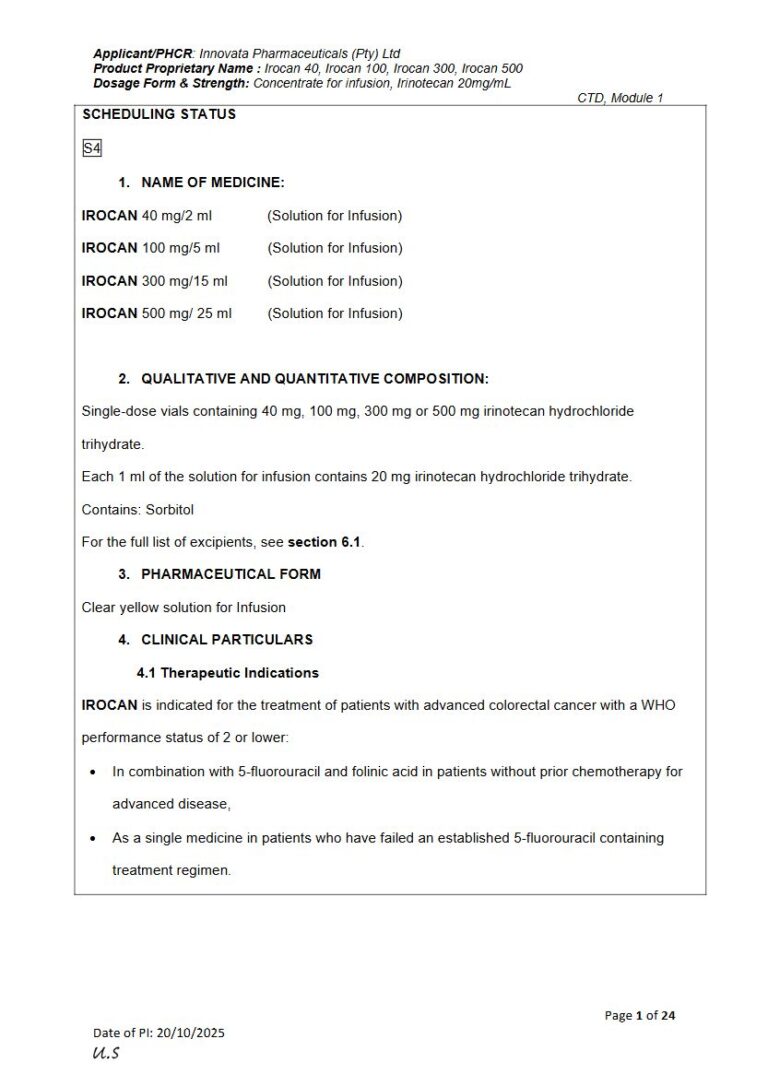
IROCAN is indicated for the treatment of patients with advanced colorectal cancer with a WHO performance status of 2 or lower:
- In combination with 5-fluorouracil and folinic acid in patients without prior chemotherapy for advanced disease,
- As a single medicine in patients who have failed an established 5-fluorouracil containing treatment regimen.
4.2 Posology and method of administration
Recommended Dosage:
In monotherapy (for a previously treated patient): The recommended dosage of IROCAN is 350 mg/mu00b2 administered as an intravenous infusion over a 30- to 90-minute period every three weeks.
In combination therapy (for a previously untreated patient): Safety and efficacy of IROCAN in combination with 5-fluorouracil (5FU) and folinic acid (FA) have been assessed with either of the following schedules:
- IROCAN plus 5FU/FA in weekly schedule: The recommended dose of IROCAN is 80 mg/mu00b2 administered as a weekly intravenous infusion over a 30- to 90-minute period, followed by infusion with folinic acid and then by 5-fluorouracil over 6 weeks. This treatment is followed by one-week rest. The full dosage regimen is as follows: IROCAN 80 mg/mu00b2 as a 30- to 90-minute infusion on Day 1 and then weekly for 6 weeks. Folinic acid 500 mg/mu00b2 I.V. as a 2-hour infusion, followed by 5-fluorouracil 2000 mg/mu00b2 I.V. as a 24-hour infusion, on Day 1 and then weekly for 6 weeks. The treatment is to be repeated every 7 weeks.
- IROCAN plus 5FU/FA in every 2 weeks schedule: The recommended dose of IROCAN is 180 mg/mu00b2 administered once every 2 weeks as an intravenous infusion over a 30- to 90-minute period, followed by infusion with folinic acid and 5-fluorouracil. The full dosage regimen is as follows: IROCAN 180 mg/mu00b2 i.v. as a 30- to 90-minute infusion on Day 1 only. Folinic acid 200 mg/mu00b2 I.V. as a 2-hour infusion, followed by 5-fluorouracil 400 mg/mu00b2 I.V. bolus, followed by 5-fluorouracil 600 mg/mu00b2 I.V. as a 22-hour infusion. The folinic acid and 5-fluorouracil are repeated for two consecutive days. The cycle must be repeated every two weeks.
Dosage Adjustments:
Delayed dosing: IROCAN should not be administered until the neutrophil count remains above 1500 cells/mmu00b3. In patients who experienced severe neutropenia or severe gastrointestinal adverse events such as diarrhoea, nausea and vomiting, dosing of IROCAN should be delayed until there has been a full recovery of these effects, especially diarrhoea. IROCAN should be administered after appropriate recovery of all adverse events to grade 0 or 1 NCI-CTC grading (National Cancer Institute Common Toxicity Criteria) and when treatment-related diarrhoea is fully resolved. This must be strictly adhered to. At the start of a subsequent infusion of therapy, the dose of IROCAN, and 5FU when applicable, should be decreased according to the worst grade of adverse events observed in the prior infusion. Treatment should be delayed by 1 to 2 weeks to allow recovery from treatment-related adverse events. With the following adverse events a dose reduction of 15 to 20 % should be applied for IROCAN and/or 5FU when applicable:
- haematological toxicity (neutropenia grade 4, febrile neutropenia ([neutropenia grade 3-4 and fever grade 2-4), thrombocytopenia and leukopenia (grade 4)),
- non-haematological toxicity (grade 3-4).
Treatment Duration: Treatment with IROCAN should be continued until there is an objective progression of the disease or an unacceptable toxicity.
Special populations:
Patients with Impaired Hepatic Function: IROCAN is contraindicated in patients with bilirubin levels > 1.5 times the upper limit of the normal range. Liver function tests should be performed at baseline and before each cycle.
Patients with renal impairment: Irocan is not recommended for use in patients with impaired renal function, as the product has not been studied in this patient group (see sections 4.4 and 5.2).
Elderly: The dose should be chosen carefully in the elderly due to their greater frequency of decreased biological function.
Paediatric population: The safety and efficacy of IROCAN in children have not been established. IROCAN is contraindicated in patients with severe bone marrow failure.
Method of administration:
Preparation for the Intravenous Infusion Administration: The required amount of IROCAN solution must be aseptically withdrawn from the vial with a calibrated syringe and injected into a 250 ml infusion bag or bottle containing either 0.9 % sodium chloride solution or 5 % dextrose solution. The infusion should be thoroughly mixed by manual rotation thereafter. IROCAN infusion solution should be infused into a peripheral or central vein. IROCAN should not be delivered as an intravenous bolus or an intravenous infusion shorter than 30 minutes or longer than 90 minutes. If any precipitate is observed in the vials before or after reconstitution, the product should be discarded according to standard procedures for cytotoxic medicines. Do not admix with other medicines. Recommendations for safe handling: Medicine handling precautions for cytostatic medicines should be followed: Only trained personnel should reconstitute the medicine in a designated area. IROCAN is an antineoplastic medicine and, as with other potentially toxic medicines, caution should be exercised when handling it and preparing IROCAN solutions. The work surface should be covered with disposable plastic-backed absorbent paper. Adequate protective gloves and clothing should be worn. If IROCAN solution or infusion solution should come into contact with the skin, wash immediately and thoroughly with soap and water. If IROCAN solution or infusion solution should come into contact with the eyes or mucous membranes, wash immediately and thoroughly with water. The cytotoxic preparation must not be handled by pregnant staff. Adequate care and precautions should be taken in the disposal of items used to reconstitute the medicine.
4.3 Contraindications
- History of severe hypersensitivity reactions to irinotecan hydrochloride trihydrate or to one of the excipients of IROCAN (see section 6.1)
- Chronic inflammatory bowel disease, and/or bowel obstruction or ileus. Patients should not be treated with IROCAN until resolution of the ileus.
- IROCAN is contraindicated in pregnancy and lactation. Women of childbearing age receiving IROCAN should be advised to avoid becoming pregnant and to inform the treating medical practitioner immediately should this occur.
- Patients with bilirubin levels > 1.5 times the upper limit of the normal range should not use IROCAN.
- The safety and efficacy of IROCAN in children have not been established.
- IROCAN is contraindicated in patients with severe bone marrow failure.
- Patients with a WHO performance status > 2 should not use IROCAN.
- Concomitant administration of azole antifungals.
- St Johnu2019s Wort
- Live attenuated vaccines (see section 4.5).
4.4 Special warnings and precautions for use
IROCAN should be used in patients with a WHO performance status of less than 2. The use of IROCAN should be confined to units specialised in the administration of cytotoxic chemotherapy and it should only be administered under the supervision of a qualified oncologist. It is strongly recommended that IROCAN be administered only in healthcare institutions with adequately equipped facilities, including an intensive care unit.
In all instances where the use of IROCAN is considered for chemotherapy, it is especially important to ensure that the patient understands the need for sufficiently prolonged antidiarrhoeal treatment and abundant fluid intake. In less frequent cases where it is predictable that the patient would comply poorly with the guidance for the management of side-effects, a strict follow-up of the patient by the treating medical practitioner or hospitalisation is recommended.
Given the nature and frequency of adverse events, the expected benefit must be balanced in case of risk factors, especially WHO Performance status u2265 2 (or Karnofsky Index < 50).
Delayed diarrhoea: Apart from the diarrhoea shortly after the infusion of IROCAN, patients should be aware of the high risk of delayed diarrhoea occurring more than 24 hours after the administration of IROCAN and at any time before the next cycle. Patients should inform their medical practitioner of the first liquid stool and start appropriate therapy immediately. Patients with an increased risk of diarrhoea are those who had a previous abdominal/pelvic radiotherapy, those with baseline hyperleukocytosis and those with performance status u2265 2. If not properly treated, diarrhoea can be life-threatening, especially if the patient is concomitantly neutropenic.
As soon as the first liquid stool occurs, the patient should start drinking large volumes of beverages containing electrolytes and an appropriate antidiarrhoeal therapy must be initiated immediately. This antidiarrhoeal treatment must be prescribed by the department where IROCAN has been administered. After discharge from the hospital, the patients should obtain the prescribed medicines so that they can treat the diarrhoea as soon as it occurs. In addition, they must inform their medical practitioner or the department administering IROCAN that diarrhoea is occurring.
The currently recommended antidiarrhoeal treatment is loperamide 4 mg for the first intake and then 2 mg every 2 hours. This therapy should continue for 12 hours after the last liquid stool and should not be modified. Loperamide should under no circumstances be administered for more than 48 consecutive hours at the above doses, because of the risk of paralytic ileus, nor for less than 12 hours.
In addition to the antidiarrhoeal treatment, a prophylactic broad-spectrum antibiotic should be given when diarrhoea is associated with severe neutropenia (neutrophil count < 500 cells/mmu00b3). In addition to the antibiotic treatment, hospitalisation is recommended for management of the diarrhoea in the following cases:
- Diarrhoea associated with fever,
- Severe diarrhoea (requiring intravenous hydration),
- Diarrhoea persisting beyond 48 hours following the initiation of high dose loperamide therapy.
Loperamide should not be given prophylactically, even in patients who experienced delayed diarrhoea at previous cycles.
In patients who experienced severe diarrhoea, a reduction in dose is recommended for subsequent cycles.
Haematology: Weekly monitoring of complete blood cell counts should be performed during IROCAN treatment. Patients should be aware of the risk of infection and the significance of a fever. Febrile neutropenic (temperature u2265 38 u00baC and neutrophil count u2264 1000 cells/mmu00b3) should be urgently treated in the hospital with broad spectrum intravenous antibiotics. IROCAN administration should be delayed until the neutrophil count is u22651500 cells/mmu00b3. In patients who experienced severe asymptomatic neutropenia (< 500 cells/mmu00b3), fever or infections associated with neutropenia the dose of IROCAN should be reduced.
In patients who experienced severe haematologic events, a dose reduction is recommended for subsequent administration. There is an increased risk of infections and haematological toxicity in patients with severe diarrhoea.
Liver Impairment: Liver function tests should be performed at baseline and before each cycle. Patients with impaired liver function (bilirubin > 1.0 and u2264 1.5 times the upper limit of the normal range [ULN] and transaminases 5 times ULN) are at greater risk of developing severe neutropenia or febrile neutropenia and should be closely monitored, including complete blood counts. IROCAN should not be used in patients with a bilirubin > 1.5 times the ULN and the patients with bilirubin > ULN should be followed with caution. In patients with a bilirubin of < 1.5 times ULN a dose of 350 mg/mu00b2 is recommended once every 3 weeks (see section 4.2).
Renal Impairment: No specific pharmacokinetic studies have been performed in patients with renal impairment.
Nausea and vomiting: Prophylactic treatment with an anti-emetic is recommended before each treatment with IROCAN. Nausea and vomiting have been frequently reported. Patients with vomiting associated with delayed diarrhoea should be hospitalised as soon as possible for treatment.
Acute cholinergic syndrome: If an acute cholinergic syndrome appears (defined as early diarrhoea and a group of symptoms such as sweating, abdominal cramping, lachrymation, myosis and salivation), atropine sulphate (0.25 mg subcutaneously) should be administered unless clinically contraindicated. These symptoms may disappear after atropine administration. Caution should be exercised in patients with asthma. In patients who experienced an acute cholinergic syndrome, the use of prophylactic atropine sulphate is recommended with subsequent doses of IROCAN.
Immunosuppressant effects/increased susceptibility to infections: Administration of live or live-attenuated vaccines in patients immunocompromised by IROCAN, may result in serious or fatal infections. Vaccination with a live vaccine should be avoided in patients receiving IROCAN. Killed or inactivated vaccines may be administered; however, the response to such vaccines may be diminished.
Respiratory disorders: Interstitial lung disease presenting as lung infiltration may occur during IROCAN therapy. Interstitial lung disease can be fatal. Risk factors possibly associated with the development of interstitial lung disease include the use of pneumotoxic medicinal products, radiation therapy and colony stimulating factors. Patients with risk factors should be closely monitored for respiratory symptoms before and during IROCAN therapy.
Extravasation: While irinotecan is not a known vesicant, care should be taken to avoid extravasation and the infusion site should be monitored for signs of inflammation. Should extravasation occur, flushing the site and application of ice is recommended.
Elderly: Due to the greater frequency of decreased hepatic, renal or cardiac function in an elderly patient, dose selection with IROCAN should be cautious in the elderly.
Chronic inflammatory bowel disease and/or bowel obstruction: Patients must not be treated with IROCAN until resolution of the bowel obstruction (see section 4.3).
Renal function: Increases in serum creatinine or blood urea have been observed. There have been cases of acute renal failure. These events have generally been attributed to complications of infection or to dehydration related to nausea, vomiting, or diarrhoea. Renal dysfunction due to tumour lysis syndrome have also been reported.
Irradiation therapy: Patients who have previously received pelvic/abdominal irradiation are at increased risk of myelosuppression following the administration of IROCAN. Medical practitioners should use caution in treating patients with extensive prior irradiation (e.g. > 25% of bone marrow irradiated and within 6 weeks prior to start of treatment with IROCAN). Dosing adjustment may apply to this population (see section 4.2).
Cardiac disorders: Myocardial ischaemic events have been observed following irinotecan therapy predominately in patients with underlying cardiac disease, other known risk factors for cardiac disease, or previous cytotoxic chemotherapy (see section 4.8). Consequently, patients with known risk factors should be closely monitored, and action should be taken to try to minimize all modifiable risk factors (e.g. smoking, hypertension, and hyperlipidaemia).
Vascular disorders: Irinotecan has been associated with thromboembolic events (pulmonary embolism, venous thrombosis, and arterial thromboembolism) in patients presenting with multiple risk factors in addition to the underlying neoplasm.
Others: Infrequent cases of renal insufficiency, hypotension or circulatory failure have been observed in patients who experienced episodes of dehydration associated with diarrhoea and/or vomiting, or sepsis. Women of childbearing potential and men have to use effective contraception during and for at least 3 months after treatment (see section 4.6).
Concomitant administration of irinotecan with a strong inhibitor (e.g. ketoconazole) or inducer (e.g. rifampicin, carbamazepine, phenobarbitone, phenytoin) of CYP3A4 may alter the metabolism of irinotecan and should be avoided (see section 4.5).
Paediatric Population: The safety and efficacy of IROCAN in children have not been established.
Sorbitol: Since IROCAN contains sorbitol, it is unsuitable for use in patients with hereditary fructose intolerance. Sorbitol can also have a laxative effect.
4.5 Interaction with other medicines and other forms of interaction
Concomitant use contraindicated (see section 4.3)
- Yellow fever vaccine: Risk of fatal generalised reaction to vaccines
- Saint John's Wort: Decrease in the active metabolite of irinotecan, SN-38, plasma levels. In a small pharmacokinetic study (n=5), in which irinotecan 350 mg/mu00b2 was co-administered with St. John's Wort (Hypericum perforatum) 900 mg, a 42% decrease in the active metabolite of irinotecan, SN-38, plasma concentrations was observed. As a result, St. John's Wort should not be administered with IROCAN.
- Live attenuated vaccines: Risk of generalised reaction to vaccines, possibly fatal. Concomitant use is contraindicated during treatment with IROCAN and for 6 months following discontinuation of chemotherapy. Killed or inactivated vaccines may be administered; however, the response to such vaccines may be diminished.
Concomitant use not recommended (see section 4.4)
Concurrent administration of IROCAN with a strong inhibitors or inducers of cytochrome P450 3A4 (CYP3A4) may alter the metabolism of irinotecan which is found in IROCAN and should be avoided (see section 4.4):
- Strong CYP3A4 and/or UGT1A1 inducing medicinal products: (e.g. rifampicin, carbamazepine, phenobarbital or phenytoin): Risk of reduced exposure to irinotecan, SN-38 and SN-38 glucuronide and reduced pharmacodynamic effects. Several studies have shown that concomitant administration of CYP3A4-inducing anticonvulsant medicines leads to reduced exposure to irinotecan, SN-38 and SN-38 glucuronide and reduced pharmacodynamic effects. The effects of such anticonvulsant medicines were reflected by a decrease in AUC of SN-38 and SN-38G by 50% or more. In addition to induction of CYP3A4 enzymes, enhanced glucuronidation and enhanced biliary excretion may play a role in reducing exposure to irinotecan and its metabolites. Additionally with phenytoin: Risk of exacerbation of convulsions resulting from the decrease of phenytoin digestive absorption by cytotoxic medicines.
- Strong CYP3A4 inhibitors: (e.g. ketoconazole, itraconazole, voriconazole, posaconazole, protease inhibitors, clarithromycine, erythromycine, telithromycine): A study has shown that the co-administration of ketoconazole resulted in a decrease in the AUC of APC of 87% and in an increase in the AUC of SN-38 of 109% in comparison to irinotecan given alone.
- UGT1A1 inhibitors: (e.g. atazanavir, ketoconazole, regorafenib) Risk to increase systemic exposure to SN-38, the active metabolite of irinotecan. Medical practitioners should take this into consideration if the combination is unavoidable.
- Other CYP3A4 inhibitors: (e.g. crizotinib, idelalisib) Risk of increase in irinotecan toxicity, due to a decrease in irinotecan metabolism by crizotinib or idelalisib.
Caution for use
Vitamin K antagonists: Increased risk of haemorrhage and thrombotic events in tumoral diseases. If vitamin K antagonists are indicated, an increased frequency in the monitoring of INR (International Normalised Ratio) is required.
Concomitant use to take into consideration
Immunosuppressant agents: (e.g. ciclosporine, tacrolimus): Excessive immunosuppression with risk of lymphoproliferation.
Neuromuscular blocking medicines: Interaction between IROCAN and neuromuscular blocking medicines cannot be ruled out. Since IROCAN has anticholinesterase activity, medicines with anticholinesterase activity may prolong the neuromuscular blocking effects of suxamethonium and the neuromuscular blockade of non-depolarising medicines may be antagonised. Excess acetylcholine may impair the muscle relaxant action of the non-depolarising medicines and may impair the return of normal muscle tone at the end of anaesthesia.
Other combinations
5-fluorouracil/folinic acid: Coadministration of 5-fluorouracil/folinic acid in the combination regimen does not change the pharmacokinetics of irinotecan found in IROCAN.
Bevacizumab: Results from a dedicated drug-drug interaction trial demonstrated no significant effect of bevacizumab on the pharmacokinetics of irinotecan and its active metabolite SN-38. However, this does not preclude any increase of toxicities due to their pharmacological properties.
Cetuximab: There is no evidence that the safety profile of irinotecan found in IROCAN is influenced by cetuximab or vice versa. Loperamide should not be given prophylactically.
4.6 Fertility, pregnancy and lactation
Women of childbearing potential/Contraception in males and females: Women of childbearing age receiving IROCAN should avoid becoming pregnant. Contraceptive measures must be taken during and for at least three months after cessation of therapy.
Pregnancy: IROCAN is contraindicated during pregnancy (see section 4.3). It may cause foetal harm when administered to a pregnant woman. There are no adequate and well-controlled studies of IROCAN in pregnant women. If IROCAN is used during pregnancy, or if the patient becomes pregnant, while receiving IROCAN, the patient should be apprised of the potential hazard to the foetus.
Breast feeding: IROCAN is contraindicated during lactation (see section 4.3). Patients receiving IROCAN should therefore not breastfeed their infants.
Fertility: There are no human data on the effect of IROCAN on fertility. In animalsu2019 adverse effects of IROCAN on the fertility of offspring has been documented (see section 5.3).
4.7 Effects on ability to drive and use machines
There is a potential for dizziness or visual disturbances when IROCAN is used. Patients must be advised not to drive or operate machinery if these symptoms occur.
4.8 Undesirable effects
SIDE-EFFECTS:
Infections and infestations:
- Frequent: Infection
- Less Frequent: Sepsis
Blood and lymphatic system disorders:
- Frequent: Neutropenia, anaemia, leukopenia, thrombocytopenia, febrile neutropenia
Endocrine disorders:
- Less frequent: diaphoresis, increased salivation
Metabolism and nutrition disorders:
- Frequent: Decreased weight, dehydration, hypovolaemia
- Less frequent: Hypokalaemia, hypomagnesaemia
Nervous system disorders:
- Less frequent: Abnormal gait, confusion, headache, dizziness, cholinergic syndrome
Eye disorders:
- Less frequent: Increased lacrimation, miosis
- Unknown frequency: conjunctivitis, visual disturbances
Cardiac disorders:
- Less frequent: Hypotension, syncope, bradycardia
- Frequency unknown: Myocardial ischaemic events have been observed following IROCAN therapy.
Vascular disorders:
- Frequent: Venous and arterial thromboembolic events which includes u2013 angina pectoris, arterial thrombosis, cerebral infarct, cerebrovascular accident, deep vein thrombophlebitis, heart arrest, myocardial infarct, myocardial ischaemia, peripheral vascular disorder, pulmonary embolus, sudden death, thrombophlebitis, thrombosis, vascular disorder
- Less frequent: Flushing
- Unknown frequency: Vasodilation
Respiratory, thoracic and mediastinal disorders:
- Frequent: Dyspnoea
- Less frequent: Rhinitis
Gastrointestinal disorders:
- Frequent: Delayed diarrhoea, nausea, vomiting, early diarrhoea, abnormal cramping/pain, anorexia, stomatitis, constipation, mucositis
- Less frequent: Rectal disorder, GI monilia
- Frequency unknown: Intestinal obstruction, ileus, megacolon, gastrointestinal haemorrhage, colitis, including typhlitis, ischaemic and ulcerative colitis, colitis complicated by ulceration, bleeding, ileus or infection, ileus without preceding colitis, intestinal perforation. Symptomatic pancreatitis or asymptomatic elevated pancreatic enzymes have been reported.
Hepatobiliary disorders:
- Frequent: Hyperbilirubinemia
Skin and subcutaneous disorders:
- Frequent: Alopecia
- Less frequent: Rash, cutaneous signs such as dry skin, pruritus, skin discolouration
- Unknown frequency: Sweating
Renal and urinary disorders:
- Less frequent: Urinary tract infection
Reproductive system and breast disorders:
- Less frequent: Breast pain
General disorders and administration site conditions:
- Frequent: Asthenia, fever, pain
- Less frequent: Chills, malaise, extravasation, tumour-lysis syndrome
Investigations:
- Frequent: Increased serum creatinine, transaminases increased (ALT and AST), blood bilirubin increased, blood alkaline phosphatase increased
- Less frequent: Increased serum alkaline phosphatase, increased GGTP (gamma-glutamyl transpeptidase), increase in amylase, increase in lipase
Reporting of suspected adverse reactions: Reporting suspected adverse reactions after authorisation of the medicine is important. It allows continued monitoring of the benefit/risk balance of the medicine. Health care providers are requested to report any suspected adverse drug reactions to SAHPRA via the Med Safety APP (Medsafety X SAHPRA) and eReporting platform (who-umc.org) found on SAHPRA website.
4.9 Overdose
There have been reports of overdosage at doses up to approximately twice the recommended therapeutic dose, which may be fatal. The most significant adverse reactions reported were severe neutropenia and diarrhoea. There is no known antidote for IROCAN. Maximum supportive care should be instituted to prevent dehydration due to diarrhoea and to treat any infectious complications.
