
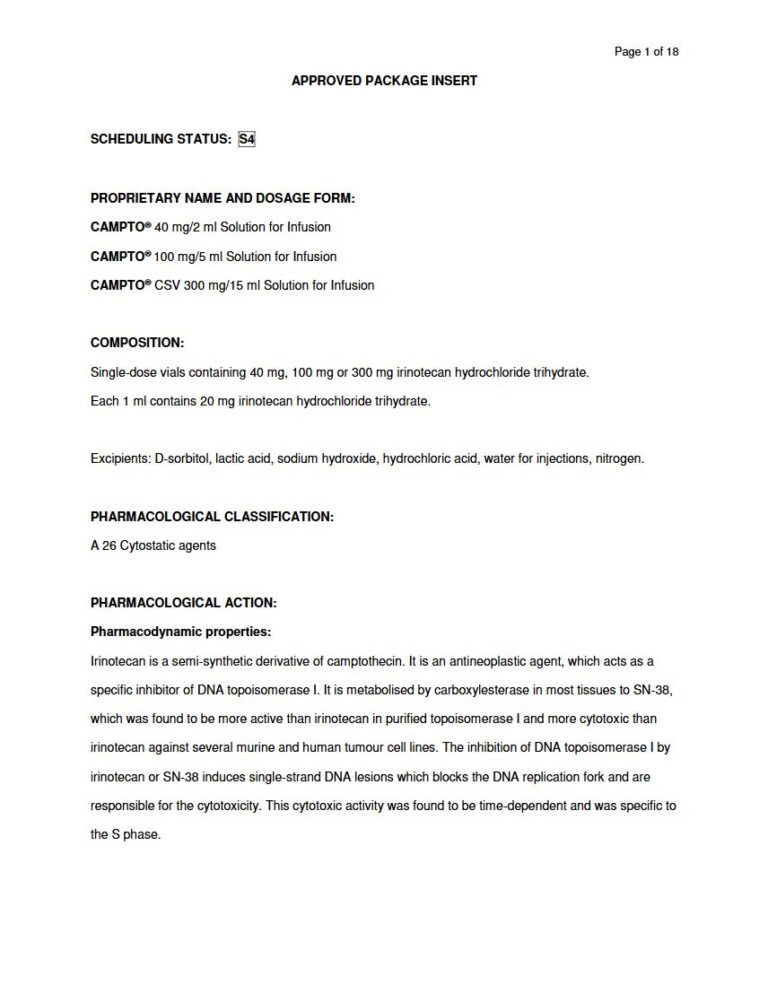
Campto Infusion
PDF Leaflet Revision Date: 09 June 2016
Clinical Summary
Quick overview from the medicine insert
Indication
Treatment of advanced colorectal cancer.
Dosage (summary)
350 mg/mu00b2 IV every 3 weeks; 80 mg/mu00b2 weekly or 180 mg/mu00b2 every 2 weeks in combination with 5-FU/FA.
Onset of Action / Duration
Onset: 5 days for delayed diarrhea.
Special Populations
- Elderly
- Renal impairment
- Hepatic impairment
Pregnancy & Breastfeeding
Contraindicated in pregnancy and lactation; may cause fetal harm.
Key Drug Interactions
- Azole antifungals
- St. John's Wort
- Antineoplastic agents
- Neuromuscular blocking agents
Contraindications
- Severe hypersensitivity
- Bilirubin > 1.5 x ULN
- Severe bone marrow failure
- Chronic inflammatory bowel disease
Common side effects
- Diarrhea
- Nausea
- Vomiting
- Neutropenia
- Anemia
Counselling Points
- Hydration and antidiarrheal therapy are crucial
- Avoid pregnancy during treatment
- Report any diarrhea immediately
Serious warnings
- Risk of severe diarrhea
- Monitor for febrile neutropenia
- Use in specialized units only
Important Disclaimer
The Campto Infusion professional information leaflet below is the property of Pfizer and is provided on Medinsert exactly as issued, with no.. alterations or editorial changes. We make every effort to keep content current by updating documents as soon as new versions become available. Medinsert serves as a trusted access point for healthcare professionals, but does not replace official sources or clinical judgement. For more details, please read our full disclaimer. read more>>
 Healthcare Professionals Only
This content is for registered healthcare professionals
Sign in or create a free account to read the full package insert.
Free for HPCSA-registered professionals. Powered by Medinsert.
Clinical Particulars
Section 4 of the official insert — extracted exactly as issued, no alterations
4.1 Therapeutic indications
CAMPTO is indicated for the treatment of patients with advanced colorectal cancer with a WHO performance status of 2 or lower:
- In combination with 5-fluorouracil and folinic acid in patients without prior chemotherapy for advanced disease,
- As a single agent in patients who have failed an established 5-fluorouracil containing treatment regimen.
4.2 Posology and method of administration
The recommended dosage of CAMPTO is 350 mg/mu00b2 administered as an intravenous infusion over a 30- to 90-minute period every three weeks.
In combination therapy (for previously untreated patient): Safety and efficacy of CAMPTO in combination with 5-fluorouracil (5FU) and folinic acid (FA) have been assessed with either of the following schedules:
- CAMPTO plus 5FU/FA in weekly schedule: The recommended dose of CAMPTO is 80 mg/mu00b2 administered as a weekly intravenous infusion over a 30- to 90-minute period, followed by infusion with folinic acid and then by 5-fluorouracil over 6 weeks. This treatment is followed by one week rest.
- CAMPTO plus 5FU/FA in every 2 weeks schedule: The recommended dose of CAMPTO is 180 mg/mu00b2 administered once every 2 weeks as an intravenous infusion over a 30- to 90-minute period, followed by infusion with folinic acid and 5-fluorouracil.
4.3 Contraindications
Chronic inflammatory bowel disease, and/or bowel obstruction or ileus. Patients should not be treated with CAMPTO until resolution of the ileus.
History of severe hypersensitivity reactions to irinotecan hydrochloride trihydrate or to one of the excipients of CAMPTO.
Pregnancy and lactation. Women of childbearing age receiving CAMPTO should be advised to avoid becoming pregnant and to inform the treating medical practitioner immediately should this occur (see PREGNANCY AND LACTATION).
Bilirubin > 1,5 times the upper limit of the normal range.
The safety and efficacy of CAMPTO in children have not been established.
Severe bone marrow failure.
WHO performance status > 2.
Concomitant administration of azole antifungals, St. Johnu2019s Wort.
4.4 Special warnings and precautions for use
CAMPTO should be used in patients with a WHO good performance status of less than 2. The use of CAMPTO should be confined to units specialised in the administration of cytotoxic chemotherapy and it should only be administered under the supervision of a qualified oncologist.
It is strongly recommended that CAMPTO be administered only in healthcare institutions with adequately equipped facilities, including an intensive care unit.
In all instances where the use of CAMPTO is considered for chemotherapy, it is especially important to ensure that the patient understands the need for sufficiently prolonged antidiarrhoeal treatment and abundant fluid intake.
In rare cases where it is predictable that the patient would comply poorly with the guidances for the management of side effects, a strict follow-up of the patient by the treating medical practitioner or hospitalisation is recommended.
4.5 Interactions with other medicines
Pharmacokinetic parameters of CAMPTO combined with 5-fluorouracil-folinic acid are comparable to those observed in monotherapy.
Interaction between CAMPTO and neuromuscular blocking agents cannot be ruled out. Medicines with anticholinesterase activity may prolong the neuromuscular blocking effects of suxamethonium and the neuromuscular blockade of non-depolarising agents may be antagonised.
The adverse effects of CAMPTO, such as myelosuppression and diarrhoea, is expected to be exacerbated by other antineoplastic agents having a similar adverse-effect profile.
Administration of live or live-attenuated vaccines in patients immunocompromised by CAMPTO, may result in serious or fatal infections. Vaccination with a live vaccine should be avoided in patients receiving CAMPTO.
4.6 Fertility, pregnancy and lactation
CAMPTO is contraindicated during pregnancy and lactation as it may cause foetal harm when administered to a pregnant woman. There are no adequate and well-controlled studies of CAMPTO in pregnant women. If CAMPTO is used during pregnancy, or if the patient becomes pregnant, while receiving CAMPTO, the patient should be apprised of the potential hazard to the foetus. Women of childbearing potential should be advised to avoid becoming pregnant while receiving treatment with CAMPTO (see CONTRAINDICATIONS).
Patients receiving CAMPTO should not breastfeed their infants.
4.7 Effects on ability to drive and use machines
Patients should be warned about the potential for dizziness or visual disturbances, and advised not to drive or operate machinery if these symptoms occur.
4.8 Undesirable effects
The intensity of the major toxicities encountered with CAMPTO (e.g. leukoneutropenia and diarrhoea) are related to the exposure (AUC) to parent substance and metabolite SN-38. Significant correlations were observed between haematological toxicity (decrease in white blood cells and neutrophils at nadir) or diarrhoea intensity and both irinotecan and metabolite SN-38 AUC values in monotherapy.
Adverse events that occurred during clinical trials are tabulated below:
- Very Common: u2265 1/10 (u2265 10 %)
- Common: u2265 1/100 and < 1/10 (u2265 1 % and < 10 %)
- Uncommon: u2265 1/1 000 and < 1/100 (u2265 0,1 % and < 1 %)
- Rare: u2265 1/10 000 and < 1/1 000 (u2265 0,01 % and < 0,1 %)
4.9 Overdose
There have been reports of overdosage at doses up to approximately twice the recommended therapeutic dose, which may be fatal. The most significant adverse reactions reported were severe neutropenia and diarrhoea. There is no known antidote for CAMPTO. Maximum supportive care should be instituted to prevent dehydration due to diarrhoea and to treat any infectious complications.
