
Ketotifen Ipharma 0,25 mg Eye drops solution
PDF Leaflet Revision Date: 10 August 2022
Clinical Summary
Quick overview from the medicine insert
Indication
Temporary prevention of itching of the eye due to seasonal allergic conjunctivitis.
Dosage (summary)
1 drop into lower conjunctival sac, 2-3 times daily for adults and children 3 years and older.
Special Populations
- Children under 3 years
- Pregnant women
Pregnancy & Breastfeeding
Caution in pregnancy; safety during lactation not established.
Key Drug Interactions
- CNS depressants
- Antihistamines
- Alcohol
Contraindications
- Hypersensitivity to ketotifen
- Pregnancy
- Contact lenses
Common side effects
- Eye irritation
- Eye pain
- Flu syndrome
- Pharyngitis
- Rhinitis
Counselling Points
- Do not touch dropper tip to avoid contamination
- Remove contact lenses before use
- Report any allergic reactions
Serious warnings
- Risk of corneal epithelium disruption
- May cause drowsiness and blurred vision
Important Disclaimer
The Ketotifen Ipharma 0,25 mg Eye drops solution professional information leaflet below is the property of Ipharma and is provided on Medinsert exactly as issued, with no.. alterations or editorial changes. We make every effort to keep content current by updating documents as soon as new versions become available. Medinsert serves as a trusted access point for healthcare professionals, but does not replace official sources or clinical judgement. For more details, please read our full disclaimer. read more>>
 Healthcare Professionals Only
This content is for registered healthcare professionals
Sign in or create a free account to read the full package insert.
Free for HPCSA-registered professionals. Powered by Medinsert.
Clinical Particulars
Section 4 of the official insert — extracted exactly as issued, no alterations
4.1 Therapeutic indications
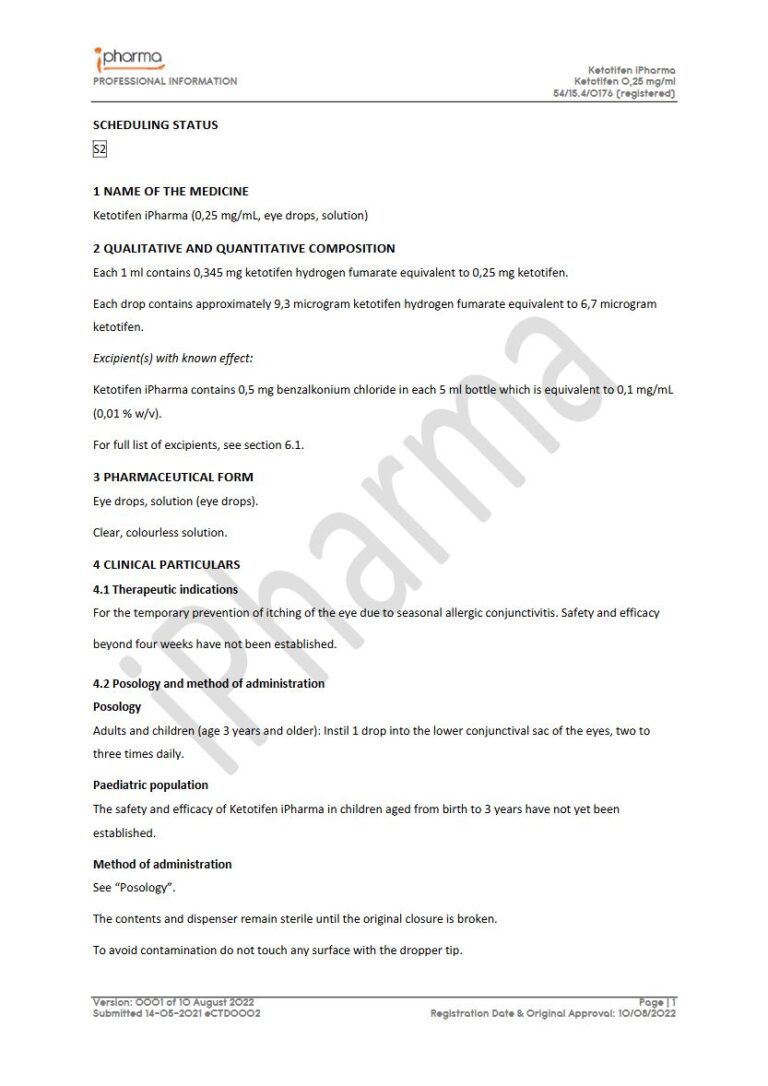
For the temporary prevention of itching of the eye due to seasonal allergic conjunctivitis. Safety and efficacy beyond four weeks have not been established.
4.2 Posology and method of administration
Posology
Adults and children (age 3 years and older): Instil 1 drop into the lower conjunctival sac of the eyes, two to three times daily.
Paediatric population
The safety and efficacy of Ketotifen iPharma in children aged from birth to 3 years have not yet been established.
Method of administration
See u201cPosologyu201d. The contents and dispenser remain sterile until the original closure is broken. To avoid contamination do not touch any surface with the dropper tip.
4.3 Contraindications
- Hypersensitivity to ketotifen or to any of the excipients in Ketotifen iPharma listed in section 6.1.
- The safety of administration in pregnancy has not yet been established.
- Contact lenses.
4.4 Special warnings and precautions for use
Use only for ocular instillation. The possibility of corneal permeability and the danger of disruption of the corneal epithelium with prolonged or repeated usage of benzalkonium chloride preserved ophthalmological preparations such as Ketotifen iPharma, cannot be excluded, therefore regular ophthalmological examinations are required. Caution should be exercised in the use of benzalkonium chloride preserved topical medication, such as Ketotifen iPharma, over an extended period in patients with extensive ocular surface disease. Ketotifen iPharma contains benzalkonium chloride as preservative, which may be absorbed by soft contact lenses and may change the colour of the contact lenses. Ketotifen iPharma should, therefore, not be administered while wearing contact lenses. The lenses should be removed prior to instillation of Ketotifen iPharma and only reinserted 15 minutes after administration. Benzalkonium chloride may also cause eye irritation, especially with dry eyes or disorders of the cornea.
4.5 Interaction with other medicines and other forms of interaction
If Ketotifen iPharma is used concomitantly with other eye medications, there must be an interval of at least 5 minutes between the two medications to avoid the washing out of the medicine. The use of ketotifen may potentiate the effect of central nervous system (CNS) depressants, antihistamines and alcohol. Although this has not been observed with Ketotifen iPharma eye drops, the possibility of such effects cannot be excluded.
4.6 Fertility, pregnancy and lactation
Pregnancy
There are no adequate data from the use of ketotifen eye drops in pregnant women (see section 4.3). Animal studies using maternally toxic oral doses showed increased pre- and postnatal mortality, but no teratogenicity. Systemic levels after ocular administration are much lower than after oral use. Caution should be exercised when prescribing Ketotifen iPharma to pregnant women.
Breast Feeding
Although animal data following oral administration show excretion into breast milk, topical administration of ketotifen hydrogen fumarate in humans are unlikely to produce detectable quantities in breast milk. The safety of Ketotifen iPharma eye drops during lactation has not been established, therefore not recommended for use during breast feeding.
Fertility
There are no data available on the effect of ketotifen hydrogen fumarate on the fertility in humans.
4.7 Effects on ability to drive and use machines
Ketotifen iPharma may cause drowsiness and blurred vision. Patients who experience blurred vision or somnolence should refrain from driving a vehicle or operating machinery.
4.8 Undesirable effects
Summary of the safety profile
Frequent side effects reported were flu syndrome, pharyngitis, rhinitis and eye disorders including eye irritation, eye pain, punctate keratitis and punctate corneal epithelial erosion.
Tabulated list of adverse reactions:
Immune system disorders
Less frequent
Hypersensitivity
Nervous system disorders
Less frequent
Headache
Eye disorders
Frequent
Eye irritation, eye pain, punctate keratitis, punctate corneal epithelial erosion
Less frequent
Vision blurred (during instillation), dry eyes, eyelid disorder, conjunctivitis, photophobia, conjunctival haemorrhage, lacrimation disorder, discharge, mydriasis, burning or stinging, itching.
Respiratory, thoracic and mediastinal disorders
Frequent
Flu syndrome, pharyngitis, rhinitis
Gastrointestinal disorders
Less frequent
Dry mouth
Skin and subcutaneous tissue disorders
Less frequent
Rash, eczema, urticarial
General disorders and administrative site conditions
Less frequent
Somnolence
Adverse reactions reported from post-marketing experience:
Immune system disorders
Frequency not known
Hypersensitivity reactions including local allergic reaction (mostly contact dermatitis, eye swelling, eyelid pruritis and oedema), systemic allergic reactions including facial swelling/oedema (in some cases associated with contact dermatitis) and exacerbation of pre-existing allergic conditions such as asthma and eczema.
Reporting of suspected adverse reactions
Reporting suspected adverse reactions after authorisation of the medicine is important. It allows continued monitoring of the benefit/risk balance of the medicine. Healthcare providers are asked to report any suspected adverse reactions to SAHPRA via the u201c6.04 Adverse Drug Reactions Reporting Formu201d, found online under SAHPRAu2019s publications: https://www.sahpra.org.za/Publications/Index/8.
4.9 Overdose
If overdosage occurs, treatment should be symptomatic and supportive.
