
Levomont 10,0 mg/5,0 mg Fim-coated tablets
PDF Leaflet Revision Date: October 2022
Clinical Summary
Quick overview from the medicine insert
Indication
Relief of symptoms associated with seasonal allergic rhinitis in adults.
Dosage (summary)
One tablet orally in the evening for adults; not recommended for patients under 18.
Special Populations
- Renal impairment
- Hepatic impairment
Pregnancy & Breastfeeding
Safety not established; montelukast may be excreted in milk.
Key Drug Interactions
- Caution with CYP3A4 inducers
- Avoid alcohol
Contraindications
- Hypersensitivity to components
- Severe renal impairment (<10 mL/min)
Common side effects
- Headache
- Dizziness
- Somnolence
- Dry mouth
Counselling Points
- Take in the evening
- Avoid alcohol
- Report any mood changes
Serious warnings
- Not for acute asthma attacks
- Risk of neuropsychiatric events
Important Disclaimer
The Levomont 10,0 mg/5,0 mg Fim-coated tablets professional information leaflet below is the property of Forrester Pharma and is provided on Medinsert exactly as issued, with no.. alterations or editorial changes. We make every effort to keep content current by updating documents as soon as new versions become available. Medinsert serves as a trusted access point for healthcare professionals, but does not replace official sources or clinical judgement. For more details, please read our full disclaimer. read more>>
 Healthcare Professionals Only
This content is for registered healthcare professionals
Sign in or create a free account to read the full package insert.
Free for HPCSA-registered professionals. Powered by Medinsert.
Clinical Particulars
Section 4 of the official insert — extracted exactly as issued, no alterations
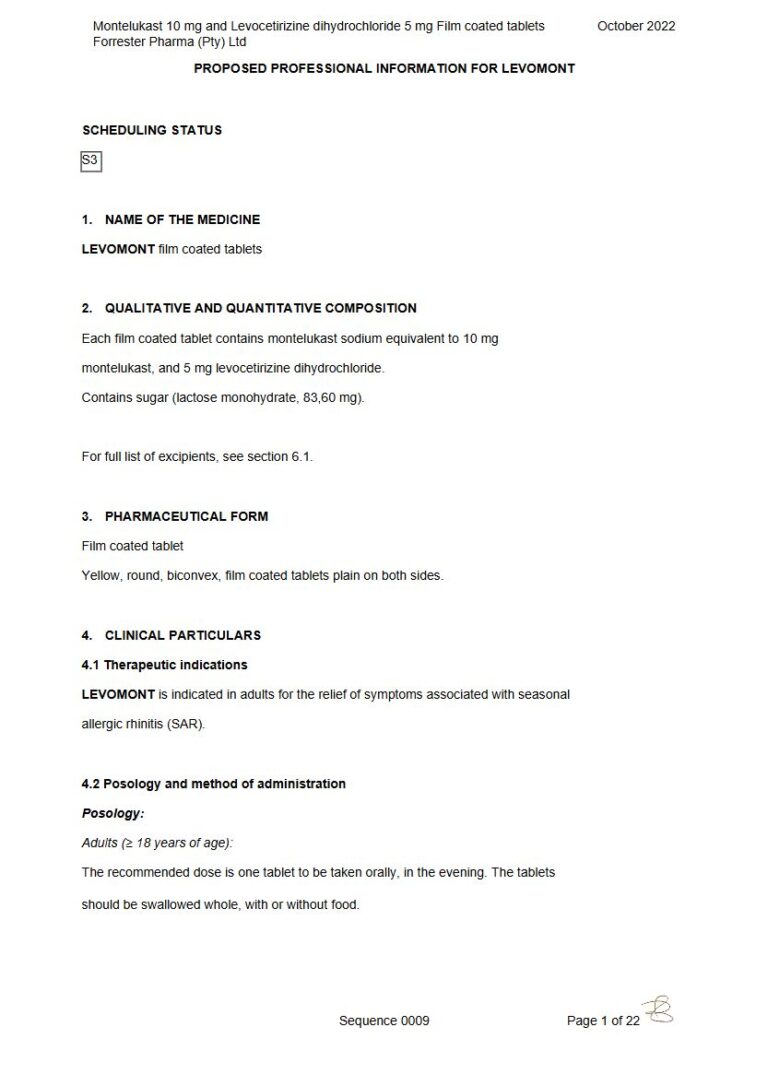
4.1 Therapeutic indications
LEVOMONT is indicated in adults for the relief of symptoms associated with seasonal allergic rhinitis (SAR).
4.2 Posology and method of administration
Posology: Adults (u2265 18 years of age): The recommended dose is one tablet to be taken orally, in the evening. The tablets should be swallowed whole, with or without food.
Paediatric and adolescent patients (u2264 18 years): LEVOMONT has not been studied in the paediatric and adolescent population and is not recommended for use in this age group.
Special population: Patients with renal impairment: No dose adjustment is needed in patients with mild renal impairment (creatinine clearance > 79 mL/min). LEVOMONT should be used with caution and under strict medical supervision in patients with moderate to severe renal impairment (creatinine clearance 10mL/min). Patients with hepatic impairment: No dose adjustment is needed in patients with hepatic impairment.
Method of administration: LEVOMONT is for oral administration.
4.3 Contraindications
LEVOMONT is contraindicated in:
- Hypersensitivity to the active substances, or to hydroxyzine, or to any other piperazine derivatives or to any of the excipients (see section 6.1).
- Patients with severe renal impairment at less than 10 mL/min creatinine clearance.
4.4 Special warnings and precautions for use
Montelukast: LEVOMONT is not indicated in the reversal of bronchospasm in acute asthma attacks, including status asthmaticus as the efficacy of LEVOMONT has not been established for the treatment of acute asthma attacks.
Eosinophilic Conditions: In some cases, patients on therapy with montelukast, as contained in LEVOMONT, may present with systemic eosinophilia, sometimes presenting with clinical features of vasculitis consistent with Churg-Strauss syndrome, a condition which is often treated with systemic corticosteroid therapy. These events usually, but not always, have been associated with the reduction of oral corticosteroid therapy. Medical practitioners should be alert to eosinophilia, vasculitic rash, worsening pulmonary symptoms, cardiac complications, and/or neuropathy presenting in their patients. Patients who develop these symptoms should be reassessed and their treatment regimens evaluated.
Neuropsychiatric events: Neuropsychiatric events have been reported in adult, adolescent and paediatric patients taking LEVOMONT. Post-marketing reports with LEVOMONT use include agitation, aggressive behaviour or hostility, anxiousness, depression, disorientation, disturbance in attention, abnormal dreams, hallucinations, insomnia, irritability, memory impairment, restlessness, somnambulism, suicidal ideation and behaviour (including suicide), tic and tremor. Patients and medical practitioners should be alert for neuropsychiatric events. Patients should be instructed to notify their medical practitioners if these changes occur. Medical practitioners should carefully evaluate the risks and benefits of continuing treatment with LEVOMONT if such events occur.
Hypersensitivity to aspirin: Patients with a known hypersensitivity to aspirin should continue avoiding aspirin and nonsteroidal anti-inflammatory drugs (NSAIDs) while taking LEVOMONT. Although LEVOMONT is effective in improving airway function in asthmatics, it has not been demonstrated to reduce the bronchoconstrictor response to aspirin or other NSAIDs in aspirin-sensitive asthmatic patients.
Hepatic impairment: The metabolism of montelukast may be decreased in patients with mild to moderate hepatic impairment and clinical evidence of cirrhosis. The half-life may be slightly prolonged; however, dosage adjustment is not necessary. No data are available for patients with severe hepatic impairment.
Levocetirizine: Alcohol: Precaution is recommended with intake of alcohol (see section 4.5). LEVOMONT lacks significant sedative effects. Patients should, however, be warned that a small number of individuals may experience sedation. This effect may be compounded by the simultaneous intake of alcohol or other central nervous system depressants (see section 4.5).
Risk of urinary retention: Caution should be taken in patients with predisposing factors of urinary retention (e.g. spinal cord lesion, prostatic hyperplasia) as levocetirizine may increase the risk of urinary retention.
Risk of seizure aggravation: Caution should be taken in patients with epilepsy and patients at risk of convulsion as levocetirizine may cause seizure aggravation.
Allergy skin tests: Response to allergy skin tests are inhibited by antihistamines and a wash-out period (of 3 days) is required before performing them.
Withdrawal syndrome: Pruritus may occur when levocetirizine is stopped even if those symptoms were not present before treatment initiation. The symptoms may resolve spontaneously. In some cases, the symptoms may be intense and may require treatment to be restarted. The symptoms should resolve when the treatment is restarted.
Excipients warnings: LEVOMONT contains lactose monohydrate. Patients with rare hereditary problems of galactose intolerance, total lactase deficiency or glucose-galactose malabsorption should not take this medicine.
4.5 Interactions with other medicines
Pharmacodynamic interactions: No specific drug-drug interaction studies have been performed with LEVOMONT. The data is complied with the available information from the individual components of the fixed dose combination (FDC). Also, since both montelukast and levocetirizine metabolise with different receptors there are no drug-drug interaction anticipated with the use of LEVOMONT.
Montelukast: Montelukast may be administered with other therapies routinely used in the prophylaxis and chronic treatment of asthma, and seasonal allergic rhinitis. In medicine-interactions studies, the recommended clinical dose of montelukast did not have clinically important effects on the pharmacokinetics of the following medicines: theophylline, prednisone, prednisolone, oral contraceptives (ethinyl oestradiol/norethindrone 35/1), terfenadine, digoxin and warfarin. The area under the plasma concentration-time curve (AUC) for montelukast was decreased approximately 40% in subjects with co-administration of phenobarbital. Since montelukast is metabolised by CYP 3A4, 2C8, and 2C9, caution should be exercised when montelukast is co-administered with inducers of CYP 3A4, 2C8, and 2C9, such as phenytoin, phenobarbital and rifampicin.
In vitro studies have shown that montelukast is a potent inhibitor of CYP 2C8. However, data from an interaction study involving montelukast and rosiglitazone (a probe substrate representative of medicines primarily metabolized by CYP2C8) demonstrated that montelukast did not significantly inhibit CYP2C8 in vivo. Therefore, montelukast is not anticipated to alter the metabolism of drugs metabolized by this enzyme (e.g. paclitaxel, rosiglitazone, and repaglinide). In vitro studies have shown that montelukast is a substrate of CYP 2C8, and to a less significant extent, of 2C9, and 3A4. In a medicine-medicine interaction study involving montelukast and gemfibrozil (an inhibitor of both CYP 2C8 and 2C9) gemfibrozil increased the systemic exposure of montelukast by 4.4-fold. No routine dosage adjustment of montelukast is required upon co-administration with gemfibrozil or other potent inhibitors of CYP 2C8, but the doctors should be aware of the potential for an increase in adverse reactions. Based on in vitro data, clinically important drug interactions with less potent inhibitors of CYP 2C8 (e.g. trimethoprim) are not anticipated. Co-administration of montelukast with itraconazole, a strong inhibitor of CYP 3A4, resulted in no significant increase in the systemic exposure of montelukast.
Levocetirizine: No interaction studies have been performed with levocetirizine (including no studies with CYP3A4 inducers). Studies with the racemate compound cetirizine demonstrated that there were no clinically relevant adverse interactions with phenazone, azithromycin, cimetidine, diazepam, erythromycin, glipizide, ketoconazole and pseudoephedrine. Theophylline: A decrease in the clearance of cetirizine (16%) was observed in a multiple dose study with theophylline (400 mg once a day); while the disposition of theophylline was not altered by concomitant cetirizine administration. Ritonavir: In a multiple dose study of ritonavir (600 mg twice daily) and cetirizine (10 mg daily), the extent of exposure to cetirizine was increased by about 40% while the disposition of ritonavir was decreased (-11%). Ritonavir increased the plasma AUC of cetirizine by about 42% accompanied by an increase in half-life (53%) and a decrease in clearance (29%) of cetirizine. The disposition of ritonavir was not altered by concomitant cetirizine administration. Food: The extent of absorption of levocetirizine, as contained in LEVOMONT, is not reduced with food, although the rate of absorption is decreased. Alcohol: In sensitive patients the simultaneous administration of levocetirizine and alcohol or other central nervous system (CNS) depressants may have effects on the central nervous system such as reductions in alertness and impairment of performance.
4.6 Fertility, pregnancy and lactation
No specific studies have been performed with LEVOMONT on pregnant and lactating women. The safety of LEVOMONT in pregnant and lactating women has not been established.
Pregnancy: Montelukast: Animal studies do not indicate harmful effects with respect to effects on pregnancy or embryonal/foetal development. Limited data from available pregnancy databases do not suggest a causal relationship between montelukast and malformations (i.e. limb defects) that have been rarely reported in worldwide post marketing experience.
Levocetirizine: There are no or limited amount of data (less than 300 pregnancy outcomes) from the use of levocetirizine in pregnant women.
Breastfeeding: Montelukast: Studies in rats have shown that montelukast is excreted in milk. It is not known if montelukast is excreted in human milk. Levocetirizine: Cetirizine, the racemate of levocetirizine, has been shown to be excreted in human. Therefore, the excretion of levocetirizine in human milk is likely. Adverse reactions associated with levocetirizine may be observed in breastfed infants.
Fertility: No clinical data are available for LEVOMONT.
4.7 Effects on ability to drive and use machines
LEVOMONT may cause dizziness, drowsiness, and fatigue. Therefore, patients intending to drive, engage in potentially hazardous activities or operate machinery should take their response to the medicine into account.
4.8 Undesirable effects
Summary of the safety profile: The most frequently reported adverse events were nervous system disorders, gastrointestinal disorders and respiratory disorders. The most common single adverse event reported was headache. Adverse events of fever, urinary tract infection and cough were also common. No serious adverse events were reported.
Tabulated list of adverse reactions:
Montelukast
| System Organ Class | Frequency | Side effects |
|---|---|---|
| Infections and infestations | Frequent | Upper respiratory infection |
| Blood and lymphatic system disorders | Less frequent | Thrombocytopenia, increased bleeding tendency |
| Immune system disorders | Less frequent | Hypersensitivity reactions including anaphylaxis, hepatic eosinophilic infiltration |
| Psychiatric disorders | Less frequent | Dream abnormalities including nightmares, insomnia, somnambulism, anxiety, agitation including aggressive behaviour or hostility, depression, psychomotor hyperactivity (including irritability, restlessness, tremor), disturbance in attention, memory impairment, tic, hallucinations, disorientation, suicidal thinking and behaviour (suicidality), obsessive-compulsive symptoms, dysphemia |
| Nervous system disorders | Frequent | Less frequent: Headache, dizziness, drowsiness, paraesthesia/hypoesthesia, seizure |
| Cardiac disorders | Less frequent | Palpitations |
| Respiratory, thoracic and mediastinal disorders | Less frequent | Epistaxis, Churg-Strauss syndrome, pulmonary eosinophilia |
| Gastrointestinal disorders | Frequent | Less frequent: Abdominal pain, diarrhoea, nausea, vomiting, dry mouth, dyspepsia |
| Hepato-biliary disorders | Frequent | Less frequent: Elevated levels of serum transaminases (ALT, AST), hepatitis (including cholestatic, hepatocellular, and mixed-pattern liver injury) |
| Skin and subcutaneous tissue disorders | Frequent | Less frequent: Rash, bruising, urticaria, pruritus, angioedema, erythema nodosum, erythema multiforme |
| Musculoskeletal and connective tissue disorders | Less frequent | Arthralgia, myalgia including muscle cramps |
| General disorders and administration site conditions | Frequent | Less frequent: Pyrexia, asthenia/fatigue, malaise, oedema |
Levocetirizine
| System Organ Class | Frequency | Side effects |
|---|---|---|
| Immune system disorders | Frequency unknown | Hypersensitivity including anaphylaxis |
| Metabolism and nutrition disorders | Frequency unknown | Increased appetite |
| Psychiatric disorders | Frequency unknown | Aggression, agitation, hallucination, depression, insomnia, suicidal ideation, nightmare |
| Nervous system disorders | Frequent | Frequency unknown: Headache, somnolence, convulsions, paraesthesia, dizziness, syncope, tremor, dysgeusia |
| Eye disorders | Frequency unknown | Visual disturbances, blurred vision |
| Ear and labyrinth disorders | Frequency unknown | Vertigo |
| Cardiac disorders | Frequency unknown | Palpitations, tachycardia |
| Respiratory, thoracic and mediastinal disorders | Frequency unknown | Dyspnoea |
| Gastrointestinal disorders | Frequent | Frequency unknown: Dry mouth, nausea, vomiting, diarrhoea |
| Hepato-biliary disorders | Frequency unknown | Hepatitis |
| Skin and subcutaneous tissue disorders | Frequency unknown | Angioedema, fixed drug eruption, pruritus, rash, urticaria |
| Musculoskeletal and connective tissue disorders | Frequency unknown | Myalgia, arthralgia |
| Renal and urinary disorders | Frequency unknown | Dysuria, urinary retention |
| General disorders and administration site conditions | Frequent | Frequency unknown: Fatigue, oedema |
| Investigations | Frequency unknown | Weight increased, abnormal liver function tests |
4.9 Overdose
No specific information is available on the treatment of overdose with LEVOMONT.
Montelukast: Symptoms: The most frequently occurring adverse experiences were consistent with the safety profile of montelukast and included abdominal pain, somnolence, thirst, headache, vomiting, and psychomotor hyperactivity. Management: Should overdose occur, symptomatic and supportive treatment is recommended.
Levocetirizine: Symptoms: Symptoms of overdose may include drowsiness in adults and initially agitation and restlessness, followed by drowsiness in children. Management: There is no known specific antidote to levocetirizine. Should overdose occur, symptomatic or supportive treatment is recommended. Levocetirizine is not effectively removed by haemodialysis.
