
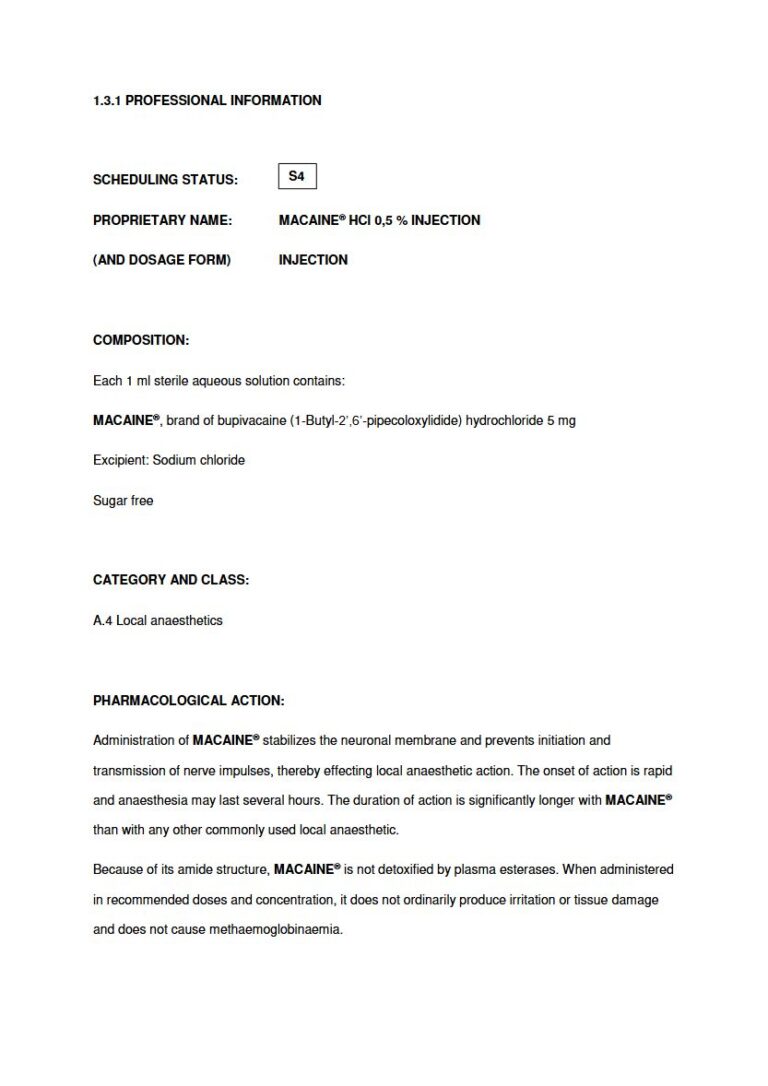
Macaine 1ml Injection
PDF Leaflet Revision Date: 17 August 2018
Clinical Summary
Quick overview from the medicine insert
Indication
Peripheral nerve block, caudal or epidural block.
Dosage (summary)
Varies by procedure; max single dose 150 mg.
Onset of Action / Duration
Onset: rapid, Duration: several hours
Special Populations
- Severe liver disease
- Children under 12
Pregnancy & Breastfeeding
Safety in pregnancy and lactation not established.
Contraindications
- Known sensitivity to ingredients
Common side effects
- CNS effects: dizziness, drowsiness
- CVS effects: hypotension, cardiac arrest
- Allergic reactions
Counselling Points
- Do not exceed max dose
- Discard unused portion after initial use
- Monitor for allergic reactions
Serious warnings
- Caution in pregnancy; foetal bradycardia risk
- Resuscitative equipment should be available
Important Disclaimer
The Macaine 1ml Injection professional information leaflet below is the property of Adcock Ingram Critical Care and is provided on Medinsert exactly as issued, with no.. alterations or editorial changes. We make every effort to keep content current by updating documents as soon as new versions become available. Medinsert serves as a trusted access point for healthcare professionals, but does not replace official sources or clinical judgement. For more details, please read our full disclaimer. read more>>
 Healthcare Professionals Only
This content is for registered healthcare professionals
Sign in or create a free account to read the full package insert.
Free for HPCSA-registered professionals. Powered by Medinsert.
Clinical Particulars
Section 4 of the official insert — extracted exactly as issued, no alterations
4.1 Therapeutic indications
Peripheral nerve block, caudal or epidural block.
4.2 Posology and method of administration
Dosage varies and depends upon the area to be anaesthetized, the vascularity of the tissues, the number of neuronal segments to be blocked, individual tolerance and technique of anaesthesia. In recommended doses, MACAINE u00ae produces complete sensory block, but the effect on motor function differs depending on volume utilized. The duration of anaesthesia is such that for most indications, a single dose is sufficient The dosages of MACAINE u00ae 0,5% INJECTION in the table below have generally proved satisfactory and are recommended as a guide for use in the average adult. Until further experience is gained, MACAINE u00ae is not recommended for children younger than 12 years.
Procedure Dose Remarks ml mg
- Trigeminal block 0,5 - 4 2,5 u2013 20
- Axillary block 15 - 30 75 - 150
- Intercostal block 3 - 5 15 - 25 The dose indicated is for every segment.
- Epidural Anaesthesia 10 - 20 50 - 100
- Continuous epidural Anaesthesia Initially 10 ml followed by 3 u2013 5 u2013 8 ml every 4 u2013 6 hours. The dose depends on the number of segments to be rendered analgesic and the patientu2019s age.
- Caudal anaesthesia 15 - 30 75 - 150
The maximum recommended dose of MACAINE u00ae in a single injection is 150 mg and should not be exceeded unless there are special considerations present. Where dosage is calculated on the patient's mass, this should not exceed 2 mg/kg body mass up to a maximum of 150 mg.
4.3 Contraindications
MACAINE u00ae is contra-indicated in patients with known sensitivity to any of its ingredients.
4.4 Special warnings and precautions for use
Safe use of MACAINE u00ae in pregnant women, other than those in labour, has not been established. Foetal bradycardia frequently follows paracervical block with some amide-type local anaesthetics and may be associated with foetal acidosis. Added risk appears to be present in prematurity, toxaemia of pregnancy and foetal distress. Until further clinical experience is gained paracervical block with MACAINE u00ae is not recommended. RESUSCITATIVE EQUIPMENT AND DRUGS SHOULD BE READILY AVAILABLE WHEN ANY LOCAL ANAESTHETIC IS USED. Caution is advised in administration of repeat doses of MACAINE u00ae 0,5 % INJECTION to patients with severe liver disease. Check for minute leaks by squeezing. Do not use if solution is brown or contains a precipitate. Discard unused portion after initial use.
4.5 Interactions with other medicines
Interaction studies have not been performed.
4.6 Fertility, pregnancy and lactation
Safety in pregnancy and lactation has not been established.
4.7 Effects on ability to drive and use machines
Not specified in the provided text.
4.8 Undesirable effects
Reactions to MACAINE u00ae are characteristic of those associated with other amide-type local anaesthetics. High plasma levels caused by excessive dosage, inadvertent intravascular injection or slow metabolic degradation cause systemic reactions involving the central nervous system and the cardiovascular system.
CNS effects: Excitation or depression. The first manifestation may be nervousness, dizziness, blurred vision or tremors, followed by drowsiness, sometimes merging into unconsciousness and respiratory arrest. Other effects may be nausea, vomiting, chills, constriction of the pupils or tinnitus.
CVS effects: Depression of the myocardium blood pressure changes (usually hypotension), and cardiac arrest.
Allergic effects are characterized by cutaneous lesions (e.g, urticaria), oedema and other manifestations of allergy. Detection of sensitivity by skin testing is of doubtful value.
4.9 Overdose
Toxic effects of local anaesthetics require symptomatic treatment; there is no specific cure. The physician should be prepared to maintain an airway and to support ventilation with oxygen. Supportive treatment of the cardiovascular system includes intravenous fluids and when appropriate, vasopressors. Convulsions may be controlled with oxygen and intravenous administration of diazepam or short-acting barbiturates.
