
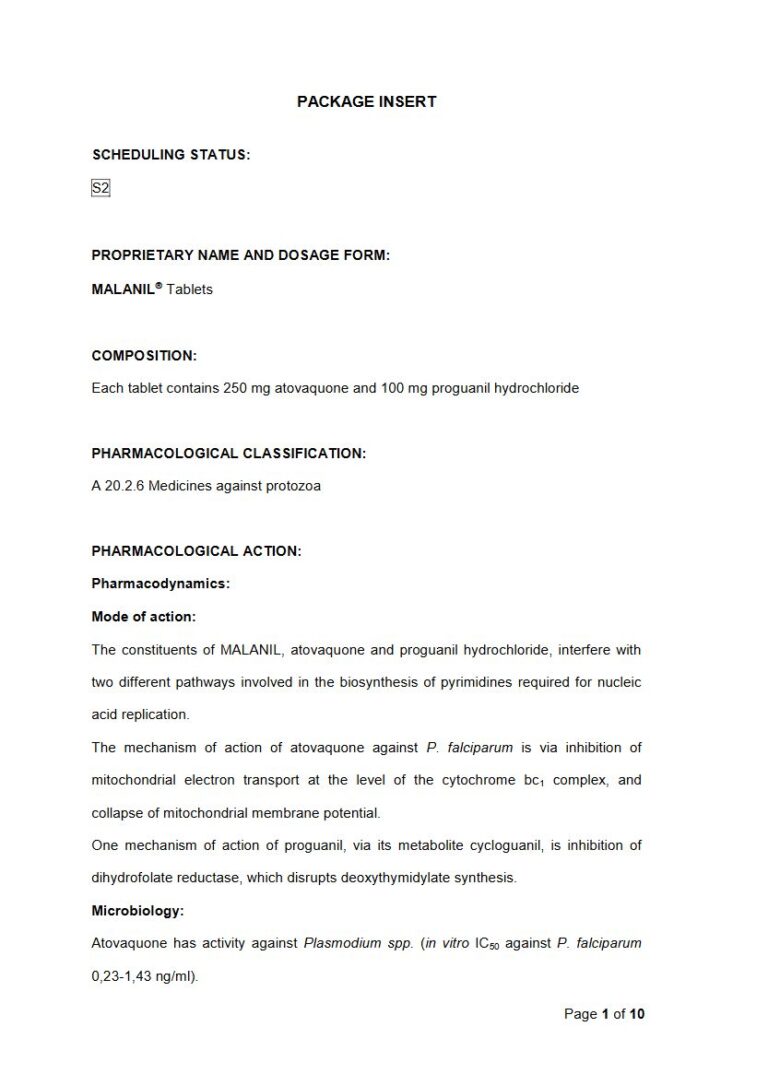
Malanil 250mg. 100mg Tablet
PDF Leaflet Revision Date: 05 March 2009
Clinical Summary
Quick overview from the medicine insert
Indication
Prophylaxis of drug-sensitive and drug-resistant Plasmodium falciparum malaria.
Dosage (summary)
One tablet daily with food; start 1-2 days before exposure.
Special Populations
- Elderly
- Hepatic impairment
- Renal impairment
Pregnancy & Breastfeeding
Safety in pregnancy and lactation not established; avoid breastfeeding.
Key Drug Interactions
- Warfarin
- Tetracycline
- Rifampicin
- Indinavir
Contraindications
- Hypersensitivity to components
- Severe renal impairment
Common side effects
- Headache
- Abdominal pain
- Nausea
- Diarrhoea
- Rash
Counselling Points
- Take with food or milk
- Repeat dose if vomiting within 1 hour
- Continue personal protection measures
Serious warnings
- Serious skin reactions
- Caution in epilepsy
- Not established for <40 kg
Important Disclaimer
The Malanil 250mg. 100mg Tablet professional information leaflet below is the property of Litha Pharma and is provided on Medinsert exactly as issued, with no.. alterations or editorial changes. We make every effort to keep content current by updating documents as soon as new versions become available. Medinsert serves as a trusted access point for healthcare professionals, but does not replace official sources or clinical judgement. For more details, please read our full disclaimer. read more>>
 Healthcare Professionals Only
This content is for registered healthcare professionals
Sign in or create a free account to read the full package insert.
Free for HPCSA-registered professionals. Powered by Medinsert.
Clinical Particulars
Section 4 of the official insert — extracted exactly as issued, no alterations
4.1 Therapeutic indications
MALANIL is indicated for the prophylaxis of drug sensitive and drug resistant Plasmodium falciparum malaria. Official guidelines and local information on the prevalence of resistance to antimalarial drugs should be taken into consideration.
4.2 Posology and method of administration
The daily dose should be taken with food or milk at the same time each day. In the event of vomiting within 1 hour of dosing, a repeat dose should be taken.
Prophylaxis: Prophylaxis should start 1 to 2 days before entering a malaria-endemic area, and be continued daily until 7 days after leaving the area.
Dosage in adults: One MALANIL tablet daily.
Dosage in the elderly: A pharmacokinetic study indicates that no dosage adjustments are needed in the elderly (see Pharmacokinetics).
Dosage in hepatic impairment: A pharmacokinetic study indicates that no dosage adjustments are needed in patients with mild to moderate hepatic impairment. No studies have been conducted in patients with severe hepatic impairment (see Pharmacokinetics in hepatic impairment).
Dosage in renal impairment: Pharmacokinetic studies indicate that no dosage adjustments are needed in patients with mild to moderate renal impairment. For prophylaxis of P. falciparum malaria in patients with severe renal impairment (see CONTRA-INDICATIONS).
4.3 Contraindications
MALANIL is contra-indicated in individuals with known hypersensitivity to atovaquone or proguanil hydrochloride or any component of the formulation. MALANIL is contra-indicated for prophylaxis of P. falciparum malaria in patients with severe renal impairment (creatinine clearance < 30 ml/min).
4.4 Special warnings and precautions for use
Safety and effectiveness of MALANIL for the prophylaxis of malaria in patients who weigh less than 40 kg has not been established. In the event of recrudescent infections due to P. falciparum or failure of chemoprophylaxis, patients should be treated with a different blood schizonticide. Persons taking MALANIL for prophylaxis of malaria should take a repeat dose if they vomit within 1 hour of dosing. In the event of diarrhoea, normal dosing should be continued. Absorption of atovaquone may be reduced in patients with diarrhoea or vomiting, but diarrhoea or vomiting was not associated with reduced efficacy in clinical trials of MALANIL for malaria prophylaxis. However, patients with diarrhoea or vomiting should be advised to continue to comply with personal protection measures (repellents, bednets). The concomitant administration of MALANIL and rifampicin or rifabutin is not recommended (see INTERACTIONS). It is not recommended that mothers receiving MALANIL breastfeed their babies. MALANIL should be used with caution in patients with a history of epilepsy (see SIDE EFFECTS). Skin rashes ranging from photosensitivity rashes and urticaria to Stevens-Johnson syndrome have been reported. MALANIL must be stopped immediately at the first sign of a serious skin rash or where there is blistering or mucosal involvement. There have been no studies to investigate the effect of MALANIL on driving performance or the ability to operate machinery, but a detrimental effect on such activities is not predicted from the pharmacology of the component drugs.
4.5 Interactions with other medicines
Proguanil may potentiate the anticoagulant effect of warfarin and other coumarin based anticoagulants. The mechanism of this potential drug interaction has not been established. Caution is advised when initiating or withdrawing malaria prophylaxis with MALANIL in patients on continuous treatment with anticoagulants. Concomitant use of tetracycline, metoclopramide, rifampicin and rifabutin have been associated with significant decreases in plasma concentrations of atovaquone (see WARNINGS AND SPECIAL PRECAUTIONS). Concomitant administration of atovaquone and indinavir results in a decrease in the C min of indinavir (23 % decrease; 90 % CI 8-35 %). Caution should be exercised in prescribing atovaquone with indinavir due to the decrease in trough levels of indinavir. Atovaquone is highly protein bound (> 99 %) but does not displace other highly protein bound drugs in vitro, indicating that significant drug interactions arising from displacement are unlikely.
4.6 Fertility, pregnancy and lactation
The safety of atovaquone and proguanil hydrochloride when administered concurrently in human pregnancy and lactation have not been established. The proguanil component of MALANIL acts by inhibiting parasitic dihydrofolate reductase. There are no clinical data indicating that folate supplementation diminishes drug efficacy. For women of childbearing age receiving folate supplements to prevent neural tube birth defects, such supplements may be continued while taking MALANIL.
4.7 Effects on ability to drive and use machines
There have been no studies to investigate the effect of MALANIL on driving performance or the ability to operate machinery, but a detrimental effect on such activities is not predicted from the pharmacology of the component drugs.
4.8 Undesirable effects
Adverse reactions are listed below by system organ class and frequency. Frequencies are defined as: very common > 1/10, common > 1/100 and 1/1 000 and 1/10 000 and < 1/1 000, very rare < 1/10 000. Very common, common and uncommon frequencies were determined from clinical trial data. Rare and very rare frequencies were generally derived from spontaneous data. The frequency classification "Not known" has been applied to those reactions where a frequency could not be estimated from the available data. MALANIL contains atovaquone and proguanil hydrochloride, therefore, the adverse events associated with each of these compounds may be expected with MALANIL. At the doses employed for prophylaxis of malaria, adverse events are generally mild and of limited duration. There is no evidence of added toxicity following concurrent administration of atovaquone and proguanil. A summary of adverse events associated with the use of MALANIL, atovaquone or proguanil hydrochloride is provided below.
Blood & Lymphatic system disorders: Common: anaemia, neutropenia. Not Known: pancytopenia in patients with severe renal impairment.
Immune system disorders: Common: rash. Uncommon: urticaria. Not Known: angioedema, anaphylaxis, vasculitis, photosensitivity reactions, Stevens-Johnson syndrome.
Metabolism and nutritional disorders: Common: hyponatraemia, anorexia. Uncommon: elevated amylase levels.
Nervous system disorders: Very common: headache. Common: insomnia, dizziness. Not Known: Cases of convulsions have been reported (see WARNINGS AND SPECIAL PRECAUTIONS).
Psychiatric disorders: Not Known: depression, anxiety, mood disorders, and psychotic reactions including paranoid reactions and hallucinations have been reported.
Gastrointestinal disorders: Very common: abdominal pain, nausea, vomiting, diarrhoea. Uncommon: stomatitis. Not Known: gastric intolerance, oral ulceration.
Hepatobiliary disorders: Common: elevated liver enzyme levels. Not Known: hepatitis, cholestasis. Clinical trial data for MALANIL indicated that abnormalities in liver function tests were reversible and not associated with untoward clinical events.
Skin and subcutaneous tissue disorders: Uncommon: hair loss.
General disorders and administration site conditions: Common: fever.
Respiratory, thoracic and mediastinal disorders: Common: cough. In clinical trials of MALANIL for prophylaxis of malaria, the most commonly reported adverse events, independent of attributability, were headache, abdominal pain and diarrhoea, and were reported in a similar proportion of subjects receiving MALANIL or placebo.
4.9 Overdose
In case of suspected overdosage, symptomatic and supportive therapy should be given as appropriate.
