
Xefoa Rapid 8 mg FC tablets
PDF Leaflet Revision Date: 01 December 2021
Clinical Summary
Quick overview from the medicine insert
Indication
Short term treatment of mild to moderate pain.
Dosage (summary)
8 mg, not exceeding 16 mg daily; elderly and impaired renal/hepatic function may require reduced frequency.
Onset of Action / Duration
Onset: 30 mins, Duration: 6-8 hours
Special Populations
- Elderly
- Renal impairment
- Hepatic impairment
Pregnancy & Breastfeeding
Contraindicated in pregnancy and lactation due to risks of renal dysfunction.
Key Drug Interactions
- Anticoagulants
- Sulphonylureas
- Diuretics
- ACE inhibitors
- Lithium
- Methotrexate
Contraindications
- Hypersensitivity to lornoxicam
- Gastrointestinal bleeding
- Severe liver impairment
- Severe renal impairment
- Pregnancy
- Under 18 years
Common side effects
- Nausea
- Dyspepsia
- Abdominal pain
- Diarrhoea
- Vomiting
Counselling Points
- Take before meals with liquid
- Monitor for gastrointestinal symptoms
- Avoid in pregnancy and breastfeeding
Serious warnings
- Risk of gastrointestinal bleeding
- Serious skin reactions
- DRESS syndrome
Important Disclaimer
The Xefoa Rapid 8 mg FC tablets professional information leaflet below is the property of Litha Pharma and is provided on Medinsert exactly as issued, with no.. alterations or editorial changes. We make every effort to keep content current by updating documents as soon as new versions become available. Medinsert serves as a trusted access point for healthcare professionals, but does not replace official sources or clinical judgement. For more details, please read our full disclaimer. read more>>
 Healthcare Professionals Only
This content is for registered healthcare professionals
Sign in or create a free account to read the full package insert.
Free for HPCSA-registered professionals. Powered by Medinsert.
Clinical Particulars
Section 4 of the official insert — extracted exactly as issued, no alterations
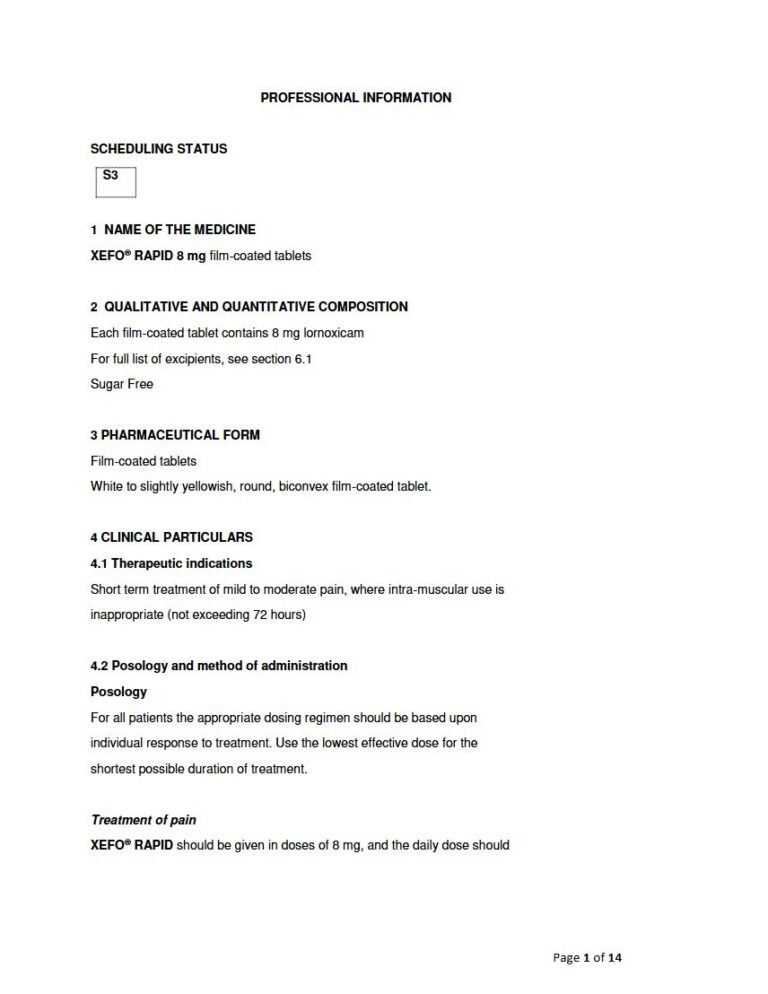
4.1 Therapeutic indications
Short term treatment of mild to moderate pain, where intra-muscular use is inappropriate (not exceeding 72 hours)
4.2 Posology and method of administration
Posology
For all patients the appropriate dosing regimen should be based upon individual response to treatment. Use the lowest effective dose for the shortest possible duration of treatment.
Treatment of pain
XEFO u00ae RAPID should be given in doses of 8 mg, and the daily dose should in general not exceed 16 mg. In some patients a further 8 mg given within the first 24 hours could be needed. Use the lowest effective dose for the shortest possible duration of treatment.
Special populations
Elderly patients
No special dosage modification is required for elderly patients ( > 65 years), unless renal or hepatic function is impaired, in which case the daily dose should be restricted (see section 4.4).
Patients with renal or hepatic impairment
For patients with renal or hepatic impairment the dose frequency of XEFO u00ae RAPID must be reduced to once daily. For details see section 4.4.
Paediatric population
XEFO u00ae RAPID is not recommended for use in children under 18 years.
Method of administration
XEFO u00ae RAPID tablets are supplied for oral administration and should be taken before meals with a sufficient quantity of liquid.
4.3 Contraindications
- Hypersensitivity to lornoxicam or to any of the excipients (see section 6.1)
- Hypersensitivity reactions (bronchospasm, rhinitis, angioedema or urticaria) to other non-steroidal anti-inflammatory medicines, including, acetylic salicylic acid
- History of gastro-intestinal bleeding or perforation related to previous NSAID use
- Hypovolaemia or dehydration
- Confirmed or suspected cerebrovascular bleeding
- Bleeding and coagulation disorders
- Active peptic ulcer or history of recurrent peptic ulceration/ haemorrhage/ perforations
- Severe liver impairment
- Severe renal impairment (serum creatinine > 700 u03bcmol/l or creatinine clearance < 30 mL/min)
- Thrombocytopenia
- Heart failure
- The elderly (> 65 years)
- Body weight less than 50 kg
- Undergoing acute surgery
- Pregnancy, due to the risk of foetal renal dysfunction, leading to oligohydramnios and, in some cases, neonatal renal impairment associated with the use of NSAIDs during pregnancy, and lactation
- Patients under 18 years of age
4.4 Special warnings and precautions for use
In patients with the following disorders, XEFO u00ae RAPID should only be administered after careful risk-benefit assessment. XEFO u00ae RAPID should be given with caution to patients with a history of gastrointestinal disease (e.g., ulcerative colitis, Crohnu2019s disease, hiatus hernia, gastro-oesophageal reflux disease, angiodysplasia) as the condition may be exacerbated. Previous cerebrovascular haemorrhage; systemic lupus erythematosus; porphyria; haematopoietic disorders; patients with reduced cardiac function. When treating patients with mild to moderate cardiac failure, attention must be paid to the risk of fluid retention and decreased renal function. Caution is required in patients with a history of hypertension and/or heart failure as fluid retention and oedema have been reported in association with XEFO u00ae RAPID therapy.
Drug Reaction with Eosinophillia and Systemic Symptoms (DRESS) has been reported in patients taking NSAIDs such as XEFO u00ae RAPID. Some of these events have been fatal or life-threatening. DRESS typically, although not exclusively, presents with fever, rash, lymphadenopathy, and/or facial swelling. Other clinical manifestations may include hepatitis, nephritis, haematological abnormalities, myocarditis, or myositis. Sometimes symptoms of DRESS may resemble an acute viral infection. Eosinophillia is often present. Because this disorder is variable in its presentation, other organ systems not noted here may be involved. It is important to note that early manifestations of hypersensitivity, such as fever or lymphadenopathy, may be present even though rash is not evident. If such signs or symptoms are present, discontinue XEFO u00ae RAPID and evaluate the patient immediately.
Serious skin reactions, some of them fatal, including exfoliative dermatitis, Stevens-Johnson syndrome, and toxic epidermal necrolysis have been reported. XEFO u00ae RAPID should be discontinued at the first appearance of skin rash, mucosal lesions, or any other sign of hypersensitivity.
Renal impairment
Caution is advised in patients with mild to moderate renal impairment. Reduction of dose of XEFO u00ae RAPID to once daily in patients with mild to moderate renal impairment.
Gastro-intestinal ulceration and bleeding in medical history
Clinical monitoring at regular intervals is recommended. Patients developing peptic ulceration and/or gastro-intestinal bleeding while taking XEFO u00ae RAPID must discontinue medicine administration with appropriate therapeutic actions being taken.
Patients with coagulation disorders
Careful clinical monitoring and laboratory assessment is recommended (e.g., PTT).
Liver diseases (e.g., liver cirrhosis)
Clinical monitoring and laboratory assessment at regular intervals are recommended (e.g., liver enzymes).
Elderly patients (65 years or above)
The elderly has an increased frequency of adverse reactions to NSAIDs, especially gastrointestinal bleeding and perforation which may be fatal. The risk of gastrointestinal bleeding or perforation is higher with increasing doses of XEFO u00ae RAPID in patients with a history of ulcers, and the elderly. When gastrointestinal bleeding or ulceration occurs in patients receiving XEFO u00ae RAPID, treatment with XEFO u00ae RAPID should be stopped. There is no clinical experience with this dosage form in this patient group. It is important to monitor renal function in patients:
u2022 who are to undergo major surgery
u2022 with compromised renal function e.g., as a result of significant blood loss or severe dehydration
u2022 with cardiac failure
u2022 receiving concomitant treatment with diuretics
u2022 receiving concomitant treatment with medicines that are nephrotoxic.
Pregnancy
The use of NSAIDs during pregnancy is associated with a risk of foetal renal dysfunction, leading to oligohydramnios and, in some cases, neonatal renal impairment.
4.5 Interaction with other medicines and other forms of interaction
- Concomitant administration of XEFO u00ae RAPID and anticoagulants or platelet aggregation inhibitors may prolong the bleeding time.
- Sulphonylureas: may increase the hypoglycaemic effect.
- Other non-steroidal anti-inflammatory medicines and aspirin: increased risk of adverse reactions.
- Diuretics: decreased efficacy of loop diuretic medicines; NSAIDs counteract the diuretic effect of furosemide.
- ACE inhibitors and ARBs: the effect of the ACE inhibitor may decrease and there is a risk of acute renal insufficiency.
- Lithium: might lead to an increase of the lithium peak concentration and thus to a possible increase in adverse events. Avoid concomitant use if frequent analysis of lithium concentration in plasma cannot be performed.
- Methotrexate: increased serum concentration of high dose methotrexate; avoid concomitant use.
- Special care must be taken if both NSAIDs and methotrexate are administered within 24 hours (see section 4.3).
- Cimetidine: higher plasma concentrations of lornoxicam. (No interaction between XEFO u00ae RAPID and ranitidine, or XEFO u00ae RAPID and antacids has been demonstrated).
- Digoxin: decreased renal clearance of digoxin.
- Ciclosporin: increased renal toxicity.
- Corticosteroids: increased risk of gastrointestinal ulceration or bleeding.
- Anti-coagulants: XEFO u00ae RAPID may enhance the effects of anti-coagulants such as Warfarin.
- Anti-platelet agents and selective serotonin reuptake inhibitors (SSRIs): increased risk of gastrointestinal bleeding.
- XEFO u00ae RAPID has interactions with known inducers and inhibitors of CYP2C9 isoenzymes such as phenytoin, amiodarone, miconazole, tranylcypromine and rifampicin (see section 5.2).
4.6 Fertility, pregnancy and lactation
Pregnancy
The use of XEFO u00ae RAPID is contraindicated during pregnancy. The use of NSAIDs around 20 weeks gestation or later in pregnancy may cause a rare but serious foetal renal dysfunction leading to oligohydramnios and, in some cases, neonatal renal impairment. Complications of prolonged oligohydramnios include limb contractures and delayed lung maturation, which may require invasive procedures such as exchange transfusion or dialysis, in some cases (see section 4.3).
Breastfeeding
The use of XEFO u00ae RAPID is contraindicated during lactation (see section 4.3).
4.7 Effects on ability to drive and use machines
Patients showing dizziness and/or somnolence under treatment with XEFO u00ae RAPID should refrain from driving or operation of machinery.
4.8 Undesirable effects
a. Summary of the safety profile
The most commonly observed adverse events of NSAIDs are gastrointestinal in nature. Peptic ulcers, perforation or GI bleeding, sometimes fatal, particularly in the elderly, may occur (see section 4.4). Nausea, vomiting, diarrhoea, flatulence, constipation, dyspepsia, abdominal pain, melaena, haematemesis, ulcerative stomatitis, exacerbation of colitis and Crohnu2019s disease (see section 4.4) have been reported following administration of NSAIDs. Less frequently, gastritis has been observed. Approximately 20 % of patients treated with lornoxicam can be expected to experience adverse reactions. The most frequent adverse effects of lornoxicam include nausea, dyspepsia, indigestion, abdominal pain, vomiting, and diarrhoea. These symptoms have generally occurred in less than 10 % of patients in available studies. Oedema, hypertension, and cardiac failure have been reported in association with NSAID treatment.
Use of some NSAIDs (particularly at high doses and in long term treatment) may be associated with an increased risk of arterial thrombotic events (for example myocardial infarction or stroke) (see section 4.4). Exceptionally, occurrence of serious cutaneous and soft tissues infectious complications during varicella. NSAIDs, such as XEFO u00ae RAPID, can cause Drug Reaction with Eosinophillia and Systemic Symptoms (DRESS) (see section 4.4).
b. Tabulated summary of adverse reactions
Adverse reactions identified are listed, according to MedDRA System Organ Class and frequency categories. Frequencies are based on all grades and defined as: very common (u2265 1/10), common (u2265 1/100 to < 1/10); uncommon (u2265 1/1 000 to < 1/100); rare (u2265 1/10 000 to < 1/1000) very rare (< 1/10 000) including spontaneous cases.
4.9 Overdose
Overdose may cause nausea and vomiting, dizziness, ataxia, coma and cramps, liver and kidney damage, coagulation disorders. In the case of a real or suspected overdose, the medication should be withdrawn. Treatment is symptomatic and supportive.
