
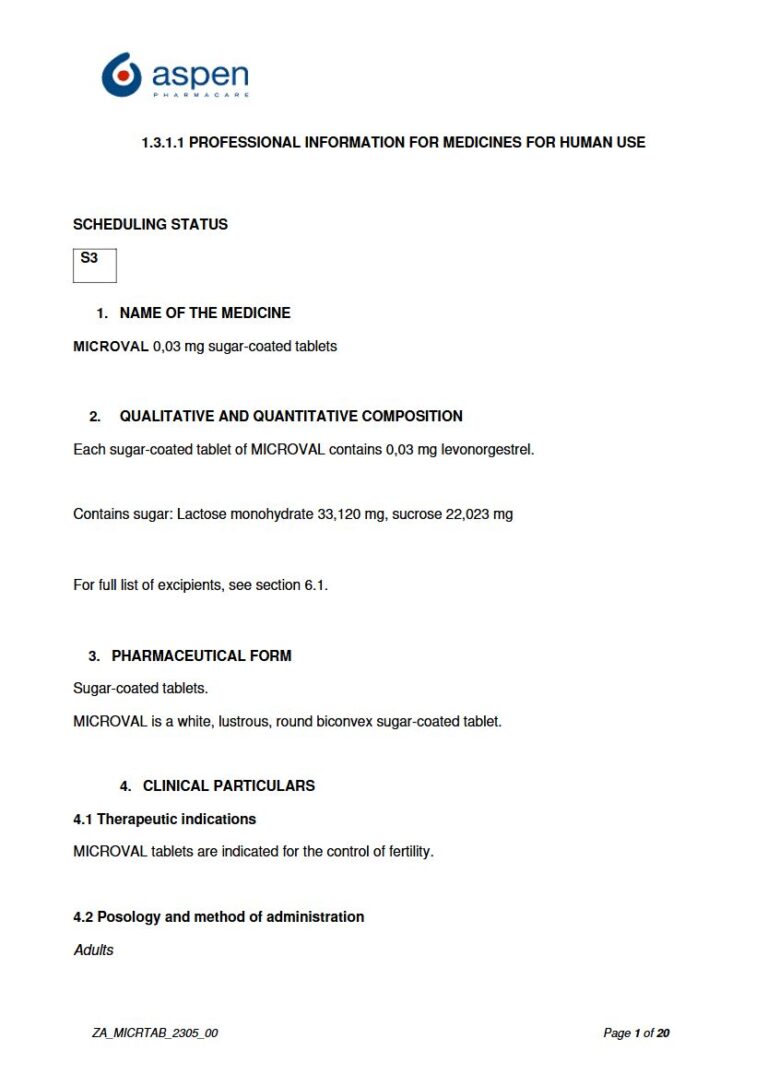
Microval 0,03 mg Sugar-coated tablets.
PDF Leaflet Revision Date: 20 May 2023
Clinical Summary
Quick overview from the medicine insert
Indication
Control of fertility.
Dosage (summary)
One tablet daily at the same time, starting on day 1 of the menstrual cycle.
Special Populations
- Renal impairment
- Hepatic impairment
Pregnancy & Breastfeeding
Contraindicated in pregnancy; can be used during breastfeeding after 6 weeks postpartum.
Key Drug Interactions
- Hepatic enzyme inducers
- Warfarin
- CYP3A4 inhibitors
Contraindications
- Hypersensitivity to levonorgestrel
- Known or suspected pregnancy
- Severe hepatic disease
- History of thromboembolic processes
- Depression not well controlled
Common side effects
- Uterine/vaginal bleeding
- Amenorrhea
- Migraine
- Dizziness
Counselling Points
- Take at the same time daily
- Use additional contraception if a tablet is missed
- Report any mood changes or severe headaches
Serious warnings
- Increased risk of serious cardiovascular side effects with smoking
- Discontinue if migraine becomes focal or vision is disturbed
- Does not protect against STIs
Important Disclaimer
The Microval 0,03 mg Sugar-coated tablets. professional information leaflet below is the property of Pharmacare and is provided on Medinsert exactly as issued, with no.. alterations or editorial changes. We make every effort to keep content current by updating documents as soon as new versions become available. Medinsert serves as a trusted access point for healthcare professionals, but does not replace official sources or clinical judgement. For more details, please read our full disclaimer. read more>>
 Healthcare Professionals Only
This content is for registered healthcare professionals
Sign in or create a free account to read the full package insert.
Free for HPCSA-registered professionals. Powered by Medinsert.
Clinical Particulars
Section 4 of the official insert — extracted exactly as issued, no alterations
4.1 Therapeutic indications
MICROVAL tablets are indicated for the control of fertility.
4.2 Posology and method of administration
Adults
Posology
MICROVAL must be taken exactly as directed and at intervals not exceeding 24 hours. Patients should be instructed to take the tablets at the same time every day, preferably after the evening meal or at bedtime. The patient begins MICROVAL on day 1 of her menstrual cycle, i.e. the first day of bleeding. One tablet is taken every day at the same time, without interruption, as long as contraception is desired. Tablets should be taken on this continuous daily regimen whether or not bleeding occurs. A mechanical method of contraception should be used until the first fourteen tablets have been taken.
Changing from a combined oral contraceptive (COC): The first tablet of MICROVAL should be taken on the first day after the last active tablet of the COC pack (In the case of every day (ED) tablet use, the inactive ones should be omitted). Additional contraceptive precautions are not required.
Changing from another progestogen-only pill (POP): The switch can be made at any time without interruption of contraceptive protection.
Changing from a progestogen-only parenteral method (implant, injection): The switch should be made before or when the next injection or implant is due.
Post-partum use: Hormonal contraceptives are not recommended as the contraceptive method of first choice during lactation, but progestogen-only methods are considered to comprise the next choice category after non-hormonal methods.
For women who are not breastfeeding: MICROVAL can be initiated up to 21 days post-partum (no additional contraceptive is required). If started after 21 days additional barrier contraceptive methods should be used for 7 days. However, if intercourse has already occurred, pregnancy should be excluded before the actual start of MICROVAL use or the woman has to wait for her first menstrual period.
For women who are breastfeeding: Progestogen-only pills, like MICROVAL, can be used by breast feeding women as there appears to be no evidence to suggest that progestogen-only pills have a detrimental effect on breast milk or infant growth or development, i.e., the risk to the infant is not known. In women who are breast feeding, tablet-taking may start six weeks after delivery. In addition, a nonhormonal back-up method of birth control should be used for the first 48 hours.
Post-abortion or miscarriage use: After a first trimester abortion, MICROVAL may be started at the time of the abortion or miscarriage. Additional contraceptive precautions will not then be required. If started after this time barrier contraceptive methods should be used for 7 days.
Special circumstances requiring additional contraception: Gastrointestinal upsets: If vomiting occurs within 2 hours of taking a tablet, another pill should be taken as soon as possible. If a replacement pill is not taken within 3 hours of the scheduled time, additional, barrier contraceptive methods should be used for 7 days. In cases of persistent vomiting and/or very severe diarrhoea, additional barrier contraceptive methods should be used during the illness and for 7 days after recovery.
Missed tablets: The risk of pregnancy increases with each tablet missed. If the patient misses one tablet she should be instructed to take it as soon as she remembers and to also take her next tablet at the regular time. If she misses two tablets, she should take one of the missed tablets as soon as she remembers, as well as taking her regular tablet for that day at the proper time. In either case, she should use a mechanical method of contraception until fourteen consecutive tablets have been taken. If she has missed one or two tablets and does not have a period within 45 days of her last, she should discontinue MICROVAL and depend upon a mechanical method of contraception until the possibility of pregnancy has been excluded. If more than two tablets have been missed, MICROVAL should be discontinued immediately and a mechanical method of contraception should be used until menses has appeared or the possibility of pregnancy has been excluded. Alternatively, if the patient has taken the tablets correctly and if menses does not appear within 60 days from the last period, a mechanical method of contraception should be substituted until an appropriate procedure is performed to exclude the possibility of pregnancy.
Special populations
Elderly population: Not applicable. MICROVAL is not indicated after menopause.
Renal impairment: MICROVAL has not been specifically studied in renally impaired patients.
Hepatic impairment: MICROVAL is contraindicated in women with severe hepatic diseases, see section 4.3.
Paediatric population: There is no relevant indication for the use of MICROVAL before menarche.
Method of administration: For oral administration
4.3 Contraindications
MICROVAL is contraindicated in:
- Patients with hypersensitivity to levonorgestrel or to any of the excipients in MICROVAL (see section 6.1).
- Known or suspected pregnancy.
- Presence or history of hepatic disease as long as liver function values have not returned to normal (active liver disease).
- History of or existing thromboembolic processes (e.g. stroke, myocardial infarction, previous proven deep-vein thrombosis (DVT), previous pulmonary embolism and inherited thrombophilia).
- Presence or history of liver tumours (benign or malignant).
- Depression not well controlled with treatment.
- A history of depression with the use of hormonal contraceptives.
- Undiagnosed abnormal vaginal bleeding.
- Severe diabetes with vascular changes.
- Recurrent cholestatic jaundice or markedly impaired liver-function.
- Hormone-dependent neoplasms (e.g. current or personal and family history of breast cancer).
- History of non-cancerous breast diseases (atypical hyperplasia or lobular carcinoma in situ).
- Severe migraine or cerebrovascular insufficiency.
- Patients known with inherited genetic mutations: BRCA1 and BRCA 2 genes.
- Early menstrual periods (before the age of 12 years).
- Previous treatment using radiation therapy to the chest or breast.
- Previous exposure to diethylstilbestrol (DES).
Relative contraindications include a history of diabetes mellitus, epilepsy, asthma, hypertension, depression or states in which fluid retention occur. Medication should be discontinued immediately if migraine becomes focal, or there is a loss of vision, or if there is an onset of unexplained chest pain.
4.4 Special warning and precautions for use
CIGARETTE SMOKING INCREASES THE RISK OF SERIOUS CARDIOVASCULAR SIDE EFFECTS FROM THE USE OF ORAL CONTRACEPTIVES, LIKE MICROVAL. THE RISK INCREASES WITH AGE AND WITH HEAVY SMOKING (15 OR MORE CIGARETTES PER DAY) AND IS MARKED IN WOMEN OVER 35 YEARS OF AGE. WOMEN WHO USE ORAL CONTRACEPTIVES SUCH MICROVAL SHOULD BE STRONGLY ADVISED NOT TO SMOKE.
NOTE: UNDER NO CIRCUMSTANCES SHOULD THE MICROVAL TABLET BE STOPPED WITHOUT HAVING ADOPTED A SATISFACTORY ALTERNATIVE METHOD OF CONTRACEPTION.
Medical examination/ consultation: Prior to the initiation or reinstitution of MICROVAL a complete medical history (including family history) should be taken and pregnancy must be ruled out. Blood pressure should be measured and a physical examination should be performed, guided by the contraindications (see sections 4.3). Laboratory tests and investigations should include but not be limited to Papanicolaou smears, blood glucose levels, liver- and kidney function tests, and monitoring of existing conditions. The frequency and nature of these assessments should be based upon relevant guidelines and should be adapted to the individual woman, but should include measurement of blood pressure and, breast, abdominal and pelvic examination including cervical cytology.
Patient education should include: recognition of VTE and ATE symptoms and associated risk factors, protection against contracting HIV and sexually transmitted diseases, informing a healthcare provider of MICROVAL use prior a major surgery and reporting of worsening of existing medical conditions or side effects.
Warnings: The benefits of using MICROVAL should be weighed against the possible risks for each individual woman and discussed with the woman before she decides to start using it. In the event of aggravation, exacerbation or first appearance of any of these conditions or risk factors, the woman should contact her healthcare provider. The healthcare provider should then decide on whether MICROVAL should be discontinued.
Women should be advised that MICROVAL does not protect against HIV infections (AIDS) and other sexually transmitted diseases. The onset or exacerbation of migraine or development of headache with a new pattern that is recurrent, persistent, or severe requires discontinuation of MICROVAL and evaluation of the cause. Women with migraine (particularly migraine with aura) may be at increased risk of stroke.
Reasons for stopping MICROVAL immediately: When stopping MICROVAL non-hormonal contraception should be used to ensure contraceptive protection is maintained.
- Occurrence for the first time, or exacerbation, of migrainous headaches (including loss of vision and onset of unexplained chest pain) or unusually frequent or unusually severe headaches.
- Sudden disturbances of vision or hearing or other perceptual disorders.
- First signs of thrombophlebitis or thromboembolic symptoms (for example, unusual pains in or swelling of the legs, stabbing pains on breathing or coughing for no apparent reason), feeling of pain and tightness in the chest.
- Six weeks before an elective major operation (e.g. abdominal, orthopaedic) any surgery to the legs, medical treatment for varicose veins or prolonged immobilisation e.g. after accidents or surgery. Do not restart until 2 weeks after full ambulation. In case of emergency surgery, thrombotic prophylaxis is usually indicated e.g. subcutaneous heparin. Surgery is more likely to be associated with an increased incidence of thrombotic side-effects. Adequate precaution should be taken.
- Onset of jaundice, hepatitis and itching of the whole body.
- Clear exacerbation of conditions known to be capable of deteriorating during oral contraception or pregnancy (e.g. recurrence of cholestatic jaundice and/or pruritus which occurred first during pregnancy or previous use of sex steroids).
- Pregnancy is a reason for stopping immediately because oral contraceptives such as MICROVAL taken in early pregnancy increase the risk of foetal malformations.
Circulatory disorders: The incidence of diseases of the circulatory system in women using combined oral contraceptives is significantly greater than that of controls, and the mortality is increased. Coronary thrombosis, cerebrovascular incident, pulmonary embolism, venous thromboembolism, including deep vein thrombosis and thrombophlebitis, retinal vascular thrombosis, myocardial infarction and stroke (and venous thrombosis) are more likely to occur in women aged 35 years or over, particularly if they have used the contraceptive for longer than five years, if they smoke, if they are obese or if they are hypertensive. Care should be taken when prescribing to women predisposed to thromboembolic disorders (e.g., a history of thromboembolic events, thromophilia, cardiovascular disease); women who are obese or experience prolonged immobilisation. Additional risk factors are diabetes, hypercholesterolaemia and familial hyperlipoproteinaemia. There is an association between progestogen only pills, such as MICROVAL and an increased risk of myocardial infarction and cerebral thromboembolism. The risk of cardiovascular and cerebral events is increased with increasing age, hypertension, and smoking. In women with hypertension the risk of stroke is enhanced by progestogen-only pills. There is an increased risk of venous thromboembolism (deep venous thrombosis, pulmonary embolism) associated with the use of progestogen-only pills. Generally recognised risk factors for venous thromboembolism (VTE) include a positive personal or family history (VTE in a sibling or a parent at a relatively early age), age, obesity and prolonged immobilisation, major surgery or major trauma.
4.5 Interaction with other medicines and other forms of interaction
Medicine interactions which result in an increased clearance of sex hormones can lead to breakthrough bleeding and OC failure. This has been established with many hepatic enzyme-inducing medicines (including, barbiturates, primidone, phenytoin, carbamazepine, rifampicin, oxcarbazepine, St. John's wort (Hypericum perforarum), griseofluvin, rifabutin, aprepitant, bosentan, nevirapine, rufinamide and topiramate). Enzyme induction can already be observed after a few days of treatment. Maximal enzyme induction is generally seen within a few weeks. After the cessation of medicines therapy enzyme induction may be sustained for about 4 weeks. For women receiving long-term therapy with hepatic enzyme inducers, another reliable, non-hormonal method of contraception should be used. Women receiving short courses of enzyme inducers should take additional non-hormonal (except rhythm or temperature methods) contraceptive precautions during the time of concurrent medication and for 28 days afterwards.
Progestogens such as MICROVAL may interfere with the metabolism of other medicines. Accordingly, plasma and tissue concentrations may be increased (e.g. ciclosporin) or decreased (e.g. lamotrigine). Progestogens such as MICROVAL may either enhance or reduce the anticoagulant effects of warfarin and may antagonize the anticoagulant effects of phenindione.
Note: The prescribing information on concomitant medications should be consulted to identify potential interactions.
Substances with variable effects on the clearance of MICROVAL: When co-administered with sex hormones, many HIV protease inhibitors and non-nucleoside reverse transcriptase inhibitors can increase or decrease plasma concentrations of the progestin. The net effect of these changes may be clinically relevant in some cases. Therefore, the prescribing information of concomitant HIV/HCV medications should be consulted to identify potential interactions and any related recommendations. In case of any doubt, an additional barrier contraceptive method should be used for those women on protease inhibitor or non-nucleoside reverse transcriptase inhibitor therapy.
Substances decreasing the clearance of MICROVAL (enzyme inhibitors): Strong and moderate CYP3A4 inhibitors such as azole antifungals (e.g. fluconazole, itraconazole, ketoconazole, voriconazole), verapamil, macrolides (e.g. clarithromycin, erythromycin), diltiazem and grapefruit juice can increase plasma concentrations of levonorgestrel, as in MICROVAL. The clinical relevance of potential interactions with enzyme inhibitors remains unknown.
Effect on blood chemistry: The use of MICROVAL may influence the results of certain laboratory tests including biochemical parameters of liver, thyroid, adrenal and renal function, plasma levels of carrier proteins and lipid/lipoprotein fractions, parameters of carbohydrate metabolism and parameters of coagulation and fibrinolysis. Laboratory staff should therefore be informed about MICROVAL use when laboratory tests are requested.
4.6 Fertility, pregnancy and lactation
Pregnancy: The use of MICROVAL is contraindicated in pregnancy (see section 4.3). If pregnancy occurs during treatment with MICROVAL, further intake must be stopped immediately.
Breastfeeding: MICROVAL is secreted in breastmilk. The safety of MICROVAL during lactation to the breastfeeding infant has not been established.
Fertility: No data are available.
4.7 Effects on ability to drive and use machines
MICROVAL has no known influence on ability to drive and use machines. Since adverse reactions such as migraine/headache, dizziness have been reported in patients receiving MICROVAL, patients should not drive, use machinery or perform any tasks that require concentration until they are certain that MICROVAL does not adversely affect their ability to do so safely (see section 4.4 and 4.8).
4.8 Undesirable effects
a) Summary of the safety profile: The most commonly reported adverse reactions with progestogen-only pills including MICROVAL are uterine/vaginal bleeding including spotting, menorrhagia and/or metrorrhagia and amenorrhea. They occur in u2265 10 % of users.
b) Tabulated list of adverse reactions
System organ class
Frequent
Less frequent
Frequency unknown (cannot be estimated from the available data)
Neoplasm benign, malignant and unspecified (including cysts and polyps)
Hepatic tumours, breast tumours
Benign and malignant liver tumours leading in isolated cases to life-threatening intra-abdominal haemorrhage
Immune system disorders
Allergic reactions
Metabolism and nutrition disorders
Mass gain, increased or decreased weight
Psychiatric disorders
Severe depression with a higher risk of suicidal thoughts/behavior and suicide, mood changes, depressed mood.
Nervous system disorders
Migraine/headache, dizziness
Vascular disorders
Hypertension, venous thromboembolic disorders, arterial thromboembolic disorders, strokes (e.g. transient ischemic attack, ischemic stroke, haemorrhagic stroke)
Gastrointestinal disorders
Lower abdominal pain, nausea, vomiting, gastrointestinal irritation, fluid retention, diarrhoea
Hepato-biliary disorders
Gall bladder disease
Skin and subcutaneous tissue disorders
Rash, urticaria, pruritus
Skin pigmentation
Reproductive system and breast disorders
Prolonged amenorrhoea, vaginal candidiasis, changes in vaginal bleeding pattern, decreased or increased libido, pelvic pain, dysmenorrhea
General disorders and administrative site conditions
Fatigue
Face oedema
1 adverse events reported post marketed.
Reporting of suspected adverse reactions: Reporting suspected adverse reactions after authorisation of the medicine is important. It allows continued monitoring of the benefit/risk balance of the medicine. Healthcare providers are asked to report any suspected adverse reactions to: SAHPRA: https://www.sahpra.org.za/Publications/Index/8. Aspen Pharmacare: E-mail: [email protected] Tel: 0800 118 088//+27(0)11 239-6200
4.9 Overdose
Symptoms: Overdosage may cause nausea, vomiting, breast tenderness, dizziness, somnolence, and withdrawal bleeding in females.
Treatment: Symptomatic treatment is recommended.
