
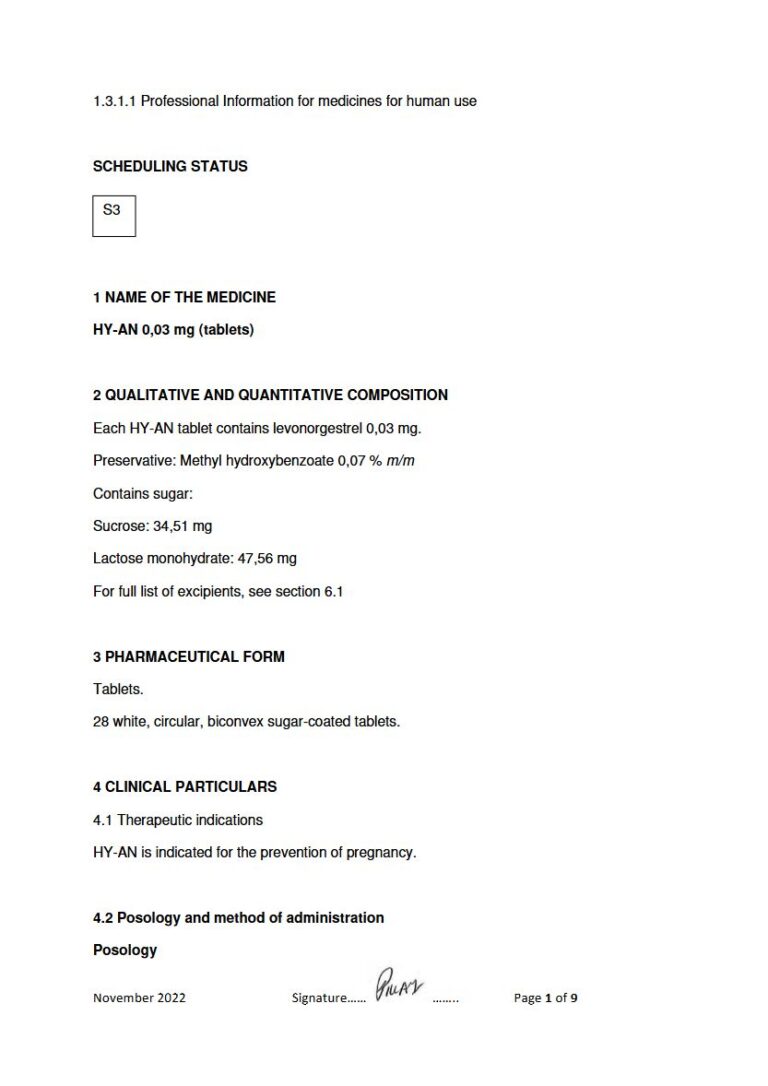
Hy-An 0,03 mg Tablets.
PDF Leaflet Revision Date: 11 November 2022
Clinical Summary
Quick overview from the medicine insert
Indication
Prevention of pregnancy.
Dosage (summary)
One tablet daily at the same time, starting on day 1 of the menstrual cycle.
Special Populations
- Asthma
- Cardiac insufficiency
- Epilepsy
- Hypertension
- Migraine
- Renal dysfunction
Pregnancy & Breastfeeding
Contraindicated in pregnancy; safe for breastfeeding.
Key Drug Interactions
- Hepatic enzyme inducers
- Oral retinoids
- Ciclosporin
- Antidiabetic medicines
Contraindications
- Hypersensitivity
- Hepatic disease
- Hormone-dependent neoplasms
- Cerebral vascular disease
- Undiagnosed genital bleeding
- Pregnancy
- Uncontrolled depression
Common side effects
- Mood changes
- Headache
- Fluid retention
- Abdominal pain
- Nausea
Counselling Points
- Take at the same time daily
- Use additional contraception if tablets are missed
- Contact doctor for mood changes
Serious warnings
- Increased risk of thromboembolism
- Mood changes may indicate severe depression
Important Disclaimer
The Hy-An 0,03 mg Tablets. professional information leaflet below is the property of Mylan and is provided on Medinsert exactly as issued, with no.. alterations or editorial changes. We make every effort to keep content current by updating documents as soon as new versions become available. Medinsert serves as a trusted access point for healthcare professionals, but does not replace official sources or clinical judgement. For more details, please read our full disclaimer. read more>>
 Healthcare Professionals Only
This content is for registered healthcare professionals
Sign in or create a free account to read the full package insert.
Free for HPCSA-registered professionals. Powered by Medinsert.
Clinical Particulars
Section 4 of the official insert — extracted exactly as issued, no alterations
4.1 Therapeutic indications
HY-AN is indicated for the prevention of pregnancy.
4.2 Posology and method of administration
Posology
HY-AN must be taken exactly as directed and at intervals not exceeding 24 hours. Patients should be instructed to take the tablets at the same time every day, preferably after the evening meal or at bedtime. The patient begins HY-AN on day 1 of her menstrual cycle, i.e. the first day of bleeding. One tablet is taken every day at the same time, without interruption, as long as contraception is desired. Tablets should be taken on this continuous daily regimen whether or not bleeding occurs. A mechanical method of contraception should be used until the first fourteen tablets have been taken.
Missed tablets
The risk of pregnancy increases with each tablet missed. If the patient misses one tablet, she should be instructed to take it as soon as she remembers and to also take her next tablet at the regular time. If she misses two tablets, she should take one of the missed tablets as soon as she remembers as well as taking her regular tablet for that day at the proper time. In either case, she should use a mechanical method of contraception for the next 7 days. If she has missed one or two tablets and does not have a period within 45 days of her last period, she should discontinue HY-AN and depend upon a mechanical method of contraception until the possibility of pregnancy has been excluded. If more than two tablets have been missed, HY-AN should be discontinued immediately and a mechanical method of contraception should be used until menses has appeared or the possibility of pregnancy has been excluded. Alternatively, if the patient has taken the tablets correctly and if menses does not appear within 60 days from the last period, a mechanical method of contraception should be substituted until an appropriate diagnostic procedure is performed to exclude the possibility of pregnancy.
Vomiting or diarrhoea
If vomiting occurs soon after a tablet has been taken, contraceptive protection can be maintained by taking another tablet, provided that it is taken within three hours of the normal time. If repeated, vomiting or diarrhoea endanger absorption of the oral contraceptive, additional contraceptive precautions should be used for 14 days after the symptoms have disappeared.
Method of administration
Take HY-AN tablets orally.
4.3 Contraindications
- Hypersensitivity to HY-AN or to any components of the formulation
- Hepatic disease or markedly impaired hepatic function
- Hormone-dependent neoplasms, known or suspected
- Cerebral vascular disease or thromboembolic disease, active or past history thereof
- Undiagnosed genital bleeding
- Pregnancy
- Depression not well controlled with treatment
- A history of depression with the use of hormonal contraceptives
4.4 Special warnings and precautions for use
Use HY-AN with caution in patients with:
- Asthma, cardiac insufficiency, epilepsy, hypertension, migraine or renal dysfunction u2013 HY-AN may cause fluid retention and may aggravate these conditions.
- Nervous System disorders such as depression u2013 HY-AN may worsen these conditions.
- Diabetes mellitus u2013 HY-AN may alter carbohydrate metabolism.
- Porphyria
Hypertension may occur in association with the use of oral contraceptives. Regular blood pressure checks, including a pre-treatment level, may be necessary.
HY-AN may increase the risk of thromboembolism. Treatment should be discontinued immediately if there is a loss or change in speech, coordination or vision or pain or numbness in chest, arm or leg.
HY-AN should be used with caution in patients with migraine and should be discontinued immediately if the migraine becomes focal.
HY-AN may interfere with some laboratory evaluations such as glucose tolerance tests, cholesterol and triglycerides, blood coagulation, thyroid function, liver function tests, gonadotropin and sex hormone binding globulins.
Surgery may increase the risk of thrombotic events. Adequate precaution should be taken.
Mood changes and depression are side effects reported with the use of hormonal contraceptives including HY-AN. There is some evidence that hormonal contraceptive use may be associated with severe depression and a higher risk of suicidal thoughts/behaviour (e.g. talking about suicide, withdrawing from social contact, having mood swings, being preoccupied with death or violence, feeling hopeless about a situation, increasing use of alcohol/drugs, doing self-destructive things, personality changes) and suicide. Prescribers should inform their patients to contact their doctor for advice if they experience mood changes and depression whilst on treatment with HY-AN.
Depressed mood and depression are well-known undesirable effects of hormonal contraceptive use (see section 4.8). Depression can be serious and is a well-known risk factor for suicidal behaviour and suicide. Women should be advised to contact their medical practitioner in case of mood changes and depressive symptoms, including shortly after initiating the treatment.
Excipients: Lactose and sucrose warning: HY-AN contains lactose and sucrose which may have an effect on the glycaemic control of patients with diabetes mellitus. Patients with the rare hereditary condition of galactose intolerance e.g. galactosaemia, Lapp lactase deficiency, glucose-galactose malabsorption, fructose intolerance or sucrose-isomaltase insufficiency should not take HY-AN.
4.5 Interaction with other medicines and other forms of interaction
Concomitant use of HY-AN with:
- Hepatic enzyme inducing medicines such as carbamazepine, phenobarbitone, phenytoin, rifabutin, rifampicin, griseofulvin and modafinil u2013 May lessen the efficacy of HY-AN. Additional or alternative methods of contraception are recommended.
- Oral retinoids u2013 May cause failure of HY-AN. May decrease effectiveness of HY-AN.
- Ciclosporin u2013 HY-AN may inhibit ciclosporin metabolism leading to increased plasma ciclosporin concentration and a risk of toxicity.
- Antidiabetic medicines u2013 HY-AN may alter carbohydrate metabolism. An adjustment in the dose of antidiabetic medication may be required.
HY-AN interacts with other medicines including lamotrigine, antihypertensives, clofibrate, corticosteroids, selegiline and xanthines.
4.6 Fertility, pregnancy and lactation
Pregnancy
HY-AN is contraindicated in pregnancy. See section 4.3.
Breastfeeding
HY-AN can be used in breast-feeding women when oral contraception is desired. No significant adverse effects on the quantity or quality of breast milk have been reported.
4.7 Effects on ability to drive and use machines
Based on the side effect profile of HY-AN, no effect is expected on the ability to drive and use machines.
4.8 Undesirable effects
Tabulated summary of adverse reactions: The undesirable effects are listed by system organ classes.
System organ class
Frequency Adverse reaction
Blood and lymphatic system disorders:
Less frequent: Thromboembolism or thrombus formation
Metabolism and nutrition disorders
Frequent: Hyperglycaemia, weight gain
Psychiatric disorders:
Frequent: Mood changes
Nervous system disorders:
Frequent: Headache, fatigue
Vascular disorders:
Frequent: Fluid retention
Gastrointestinal disorders:
Frequent: Abdominal pain or cramping, diarrhoea, nausea
Hepato-biliary disorders:
Less frequent: Increases in hepatic enzyme levels, jaundice
Skin and subcutaneous tissue disorders:
Less frequent: Melasma, acne, skin rash
Reproductive system and breast disorders:
Frequent: Amenorrhoea, breakthrough bleeding, menorrhagia, spotting
Less frequent: Breast pain or tenderness
Post marketing reported side effects: The following side effects have been reported with the post marketing use of hormonal contraceptives: Severe depression with a higher risk of suicidal thoughts/behaviour and suicide
Reporting of suspected adverse reactions
Reporting suspected adverse reactions after authorisation of the medicine is important. It allows continued monitoring of the benefit/risk balance of the medicine. Health care providers are asked to report any suspected adverse reactions to SAHPRA via the u201c6.04 Adverse Drug Reactions Reporting Formu201d, found online under SAHPRAu2019s publications: https://www.sahpra.org.za/Publications/Index/8
4.9 Overdose
Symptoms of overdose
See section 4.8
Treatment of overdose
Treatment is symptomatic and supportive.
