
Modafinil 100 Ipharma. 100 mg Tablets
PDF Leaflet Revision Date: 16 November 2021
Clinical Summary
Quick overview from the medicine insert
Indication
Improves wakefulness in patients with excessive daytime sleepiness associated with narcolepsy.
Dosage (summary)
200 mg/day as a single morning dose; consider lower doses in elderly and hepatic impairment.
Special Populations
- Elderly
- Hepatic impairment
- Renal impairment
Pregnancy & Breastfeeding
Not recommended during pregnancy or breastfeeding due to potential risks.
Key Drug Interactions
- Anticonvulsants
- Steroidal contraceptives
- Antidepressants
- Anticoagulants
Contraindications
- Hypersensitivity to modafinil
- Major anxiety
- Children under 16
- Severe renal impairment
- Uncontrolled hypertension
- Cardiac dysrhythmias
Common side effects
- Headache
- Dizziness
- Nausea
- Insomnia
- Anxiety
Counselling Points
- Maintain good sleep hygiene
- Monitor for psychiatric symptoms
- Use alternative contraception methods
- Avoid driving if affected by sleepiness
Serious warnings
- Serious rash (SJS, TEN)
- Psychiatric disorders
- Cardiovascular risks
- Multi-organ hypersensitivity
Important Disclaimer
The Modafinil 100 Ipharma. 100 mg Tablets professional information leaflet below is the property of Ipharma and is provided on Medinsert exactly as issued, with no.. alterations or editorial changes. We make every effort to keep content current by updating documents as soon as new versions become available. Medinsert serves as a trusted access point for healthcare professionals, but does not replace official sources or clinical judgement. For more details, please read our full disclaimer. read more>>
 Healthcare Professionals Only
This content is for registered healthcare professionals
Sign in or create a free account to read the full package insert.
Free for HPCSA-registered professionals. Powered by Medinsert.
Clinical Particulars
Section 4 of the official insert — extracted exactly as issued, no alterations
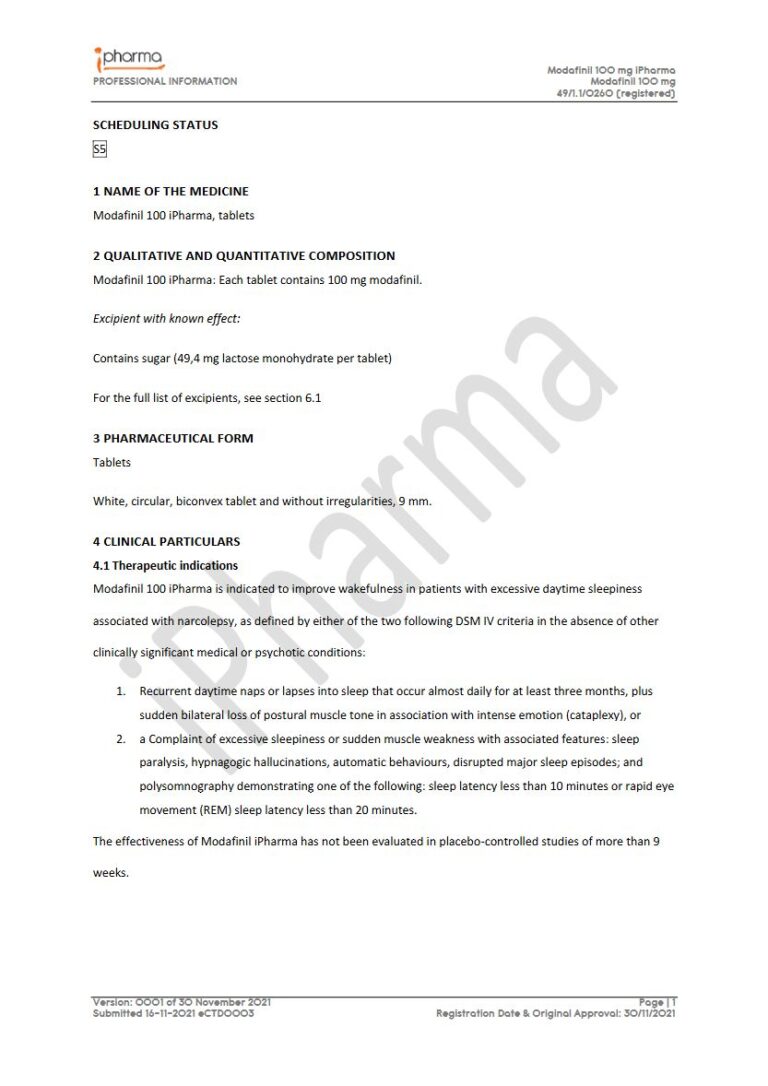
4.1 Therapeutic indications
Modafinil 100 iPharma is indicated to improve wakefulness in patients with excessive daytime sleepiness associated with narcolepsy, as defined by either of the two following DSM IV criteria in the absence of other clinically significant medical or psychotic conditions:
- Recurrent daytime naps or lapses into sleep that occur almost daily for at least three months, plus sudden bilateral loss of postural muscle tone in association with intense emotion (cataplexy), or
- a Complaint of excessive sleepiness or sudden muscle weakness with associated features: sleep paralysis, hypnagogic hallucinations, automatic behaviours, disrupted major sleep episodes; and polysomnography demonstrating one of the following: sleep latency less than 10 minutes or rapid eye movement (REM) sleep latency less than 20 minutes.
The effectiveness of Modafinil iPharma has not been evaluated in placebo-controlled studies of more than 9 weeks.
4.2 Posology and method of administration
Posology
ADULTS: The dose of Modafinil iPharma is 200 mg/day, given as a single dose in the morning. Doses of 400 mg/day, given as a single dose, have been well tolerated, but there is no consistent evidence that this dose confers additional benefit beyond that of the 200 mg dose.
ELDERLY: In elderly patients, elimination of Modafinil iPharma and its metabolites may be reduced as a consequence of aging. Therefore, consideration should be given to the use of lower doses in this population.
Hepatic failure: The dose in patients with hepatic failure should be reduced by half (100-200 mg/day).
Paediatric population: Modafinil iPharma should not be used in children aged less than 16 years old because of safety and efficacy concerns (see sections 4.3 and 4.4).
4.3 Contraindications
- Hypersensitivity to modafinil, or to any of the excipients listed in section 6.1
- Major anxiety (outside specialised units).
- Children and adolescents under the age of 16 years.
- Severe renal impairment.
- Uncontrolled moderate to severe hypertension.
- Cardiac dysrhythmias.
4.4 Special warnings and precautions for use
Diagnosis of sleep disorders: Modafinil iPharma should be used only in patients who have had a complete evaluation of their excessive sleepiness, and in whom a diagnosis of narcolepsy, has been made in accordance with ICSD diagnostic criteria. Such an evaluation usually consists, in addition to the patient's history, sleep measurements testing in a laboratory setting and exclusion of other possible causes of the observed hypersomnia.
Serious rash, including Stevens-Johnson Syndrome, Toxic Epidermal Necrolysis and Drug Rash with Eosinophilia and Systemic Symptoms: Serious rash requiring hospitalisation and discontinuation of treatment has been reported with the use of modafinil occurring within 1 to 5 weeks after treatment initiation. Isolated cases have also been reported after prolonged treatment (e.g., 3 months). In clinical trials of modafinil, the incidence of rash resulting in discontinuation was approximately 0,8 % (13 per 1 585) in paediatric patients (age <17 years); this includes serious rash. No serious skin rashes have been reported in adult clinical trials (0 per 4,264) of modafinil. Modafinil iPharma should be discontinued at the first sign of rash and not re-started (see section 4.8).
Rare cases of serious or life-threatening rash, including Stevens-Johnson Syndrome (SJS), Toxic Epidermal Necrolysis (TEN), and Drug Rash with Eosinophilia and Systemic Symptoms (DRESS) have been reported in adults and children in worldwide post-marketing experience.
Paediatric population: Because safety and effectiveness in controlled studies in children have not been established and because of the risk of serious cutaneous hypersensitivity and psychiatric adverse reactions, the use of Modafinil iPharma is not recommended in the paediatric population (below 16 years).
Multi-organ hypersensitivity reaction: Multi-organ hypersensitivity reactions, including at least one fatality in post-marketing experience, have occurred in close temporal association to the initiation of Modafinil iPharma. Although there have been a limited number of reports, multi-organ hypersensitivity reactions may result in hospitalisation or be life-threatening. There are no factors that are known to predict the risk of occurrence, or the severity of multi-organ hypersensitivity reactions associated with modafinil. Signs and symptoms of this disorder were diverse; however, patients typically, although not exclusively, presented with fever and rash associated with other organ system involvement. Other associated manifestations included myocarditis, hepatitis, liver function test abnormalities, haematological abnormalities (e.g., eosinophilia, leukopenia, thrombocytopenia), pruritus, and asthenia. Because multi-organ hypersensitivity is variable in its expression, other organ system symptoms and signs, not noted here, may occur. If a multi-organ hypersensitivity reaction is suspected, Modafinil iPharma should be discontinued.
Psychiatric disorders: Patients should be monitored for the development of de novo or exacerbation of pre-existing psychiatric disorders (see below and section 4.8) at every adjustment of dose and then regularly during treatment. If psychiatric symptoms develop in association with modafinil treatment, Modafinil iPharma should be discontinued and not restarted. Caution should be exercised in giving Modafinil iPharma to patients with a history of psychiatric disorders including psychosis, depression, mania, major anxiety, agitation, insomnia or substance abuse (see below).
One healthy male volunteer developed ideas of reference, paranoid delusions, and auditory hallucinations in association with multiple daily 600 mg doses of Modafinil iPharma and sleep deprivation. There was no evidence of psychosis 36 hours after medicine discontinuation. Caution should be exercised when Modafinil iPharma is given to patients with a history of psychosis.
Anxiety: Modafinil iPharma is associated with the onset or worsening of anxiety. Patients with major anxiety should only receive treatment with Modafinil iPharma in a specialist unit.
Suicide-related behaviour: Suicide-related behaviour (including suicide attempts and suicidal ideation) has been reported in patients treated with modafinil. Patients treated with Modafinil iPharma should be carefully monitored for the appearance or worsening of suicide related behaviour. If suicide-related symptoms develop in association with Modafinil iPharma, treatment should be discontinued.
Psychotic or manic symptoms: Modafinil is associated with the onset or worsening of psychotic symptoms or manic symptoms (including hallucinations, delusions, agitation or mania). Patients treated with Modafinil iPharma should be carefully monitored for the appearance or worsening of psychotic or manic symptoms. If psychotic or manic symptoms occur, discontinuation of Modafinil iPharma may be required.
Bipolar disorders: Care should be taken in using Modafinil iPharma in patients with co-morbid bipolar disorder because of concern for possible precipitation of a mixed/manic episode in such patients.
Aggressive or hostile behaviour: The onset or worsening of aggressive or hostile behaviour can be caused by treatment with Modafinil iPharma. Patients treated with Modafinil iPharma should be carefully monitored for the appearance or worsening of aggressive or hostile behaviour. If symptoms occur, discontinuation of Modafinil iPharma may be required.
Cardiovascular risks: An ECG is recommended in all patients before Modafinil iPharma treatment is initiated. Patients with abnormal findings should receive further specialist evaluation and treatment before Modafinil iPharma treatment is considered. Blood pressure and heart rate should be regularly monitored in patients receiving Modafinil iPharma. Modafinil iPharma should be discontinued in patients who develop dysrhythmia or moderate to severe hypertension and not restarted until the condition has been adequately evaluated and treated. Modafinil iPharma tablets are not recommended in patients with a history of left ventricular hypertrophy or cor pulmonale and in patients with mitral valve prolapse who have experienced the mitral valve prolapse syndrome when previously receiving CNS stimulants. This syndrome may present with ischaemic ECG changes, chest pain or dysrhythmia. Modafinil iPharma has not been evaluated or used to any appreciable extent in patients with a recent history of myocardial infarction or unstable angina, and such patients should be treated with caution. Modafinil iPharma has not been systematically evaluated in patients with hypertension. Periodic monitoring of hypertensive patients may be appropriate.
Insomnia: Because Modafinil iPharma promotes wakefulness, caution should be paid to signs of insomnia.
Maintenance of sleep hygiene: Patients should be advised that Modafinil iPharma is not a replacement for sleep and good sleep hygiene should be maintained. Steps to ensure good sleep hygiene may include a review of caffeine intake.
Patients using steroidal contraceptives: Sexually active women of child-bearing potential should be established on a contraceptive programme before taking Modafinil iPharma. Since the effectiveness of steroidal contraceptives may be reduced when used with modafinil, alternative or concomitant methods of contraception are recommended, and for two months after discontinuation of Modafinil iPharma (also see section 4.5 with respect to potential interaction with steroidal contraceptives).
Abuse, misuse, diversion: Whilst studies with modafinil have demonstrated a potential for dependence, the possibility of dependence with long-term use cannot be entirely excluded. Caution should be exercised in administering Modafinil iPharma to patients with history of alcohol, drug or illicit substance abuse.
Patients with severe renal impairment: In patients with severe renal impairment (mean creatinine clearance = 16,6 ml/min), a 200 mg single dose of Modafinil iPharma did not lead to increased exposure to modafinil but resulted in much higher exposure to the inactive metabolite, modafinil acid, than is seen in subjects with normal renal function. There is little information available about the safety of such levels of this metabolite (see section 5.2).
Patients with severe hepatic impairment: In patients with severe hepatic impairment, with or without cirrhosis (see section 5.2) Modafinil iPharma should be administered at a reduced dose as the clearance of modafinil was decreased compared to that in normal subjects (see section 4.2).
Elderly patients: To the extent that elderly patients may have diminished renal and/or hepatic function, dosage reductions should be considered (see section 4.2).
Lactose intolerance: Modafinil iPharma contains lactose monohydrate. Patients with rare hereditary problems of galactose intolerance, total lactase deficiency or glucose-galactose malabsorption should not take Modafinil iPharma.
4.5 Interaction with other medicines and other forms of interaction
Modafinil may increase its own metabolism via induction of CYP3A4/5 activity, but the effect is modest and unlikely to have significant clinical consequences. Chronic dosing of Modafinil iPharma at 400 mg/day once daily resulted in a ~20 % mean decrease in modafinil plasma trough concentrations by week 9, relative to those at week 3, suggesting that chronic administration of Modafinil iPharma might have caused induction of its metabolism.
Anticonvulsants: Co-administration of potent inducers of CYP activity, such as carbamazepine and phenobarbital, could reduce the plasma levels of modafinil. Due to a possible inhibition of CYP2C19 by modafinil and suppression of CYP2C9 the clearance of phenytoin may be decreased when modafinil is administered concomitantly. Patients should be monitored for signs of phenytoin toxicity, and repeated measurements of phenytoin plasma levels may be appropriate upon initiation or discontinuation of treatment with Modafinil iPharma.
Steroidal contraceptives: The effectiveness of steroidal contraceptives may be impaired due to induction of CYP3A4/5 by modafinil. Alternative or concomitant methods of contraception are recommended for patients treated with Modafinil iPharma. Adequate contraception will require continuation of these methods for two months after stopping Modafinil iPharma.
Antidepressants: A number of tricyclic antidepressants and selective serotonin reuptake inhibitors are largely metabolised by CYP2D6. In patients deficient in CYP2D6 (approximately 10 % of a Caucasian population) a normally ancillary metabolic pathway involving CYP2C19 becomes more important. As modafinil may inhibit CYP2C19, lower doses of antidepressants may be required in such patients.
Anticoagulants: Due to possible suppression of CYP2C9 by modafinil the clearance of warfarin may be decreased when modafinil is administered concomitantly. Prothrombin times should be monitored regularly during the first 2 months of Modafinil iPharma use and after changes in modafinil dosage.
Other medicines: Substances that are largely eliminated via CYP2C19 metabolism, such as diazepam, propranolol and omeprazole may have reduced clearance upon co-administration of modafinil and may thus require dosage reduction. In addition, in vitro induction of CYP1A2, CYP2B6 and CYP3A4/5 activities has been observed in human hepatocytes, which were it to occur in vivo, could decrease the blood levels of medicines metabolised by these enzymes, thereby possibly decreasing their therapeutic effectiveness. Results from clinical interaction studies suggest that the largest effects may be on substrates of CYP3A4/5 that undergo significant pre-systemic elimination, particularly via CYP3A enzymes in the gastrointestinal tract. Examples include ciclosporin, HIV-protease inhibitors, buspirone, triazolam, midazolam and most of the calcium channel blockers and statins. In a case report, a 50 % reduction in ciclosporin concentration was observed in a patient receiving ciclosporin in whom concurrent treatment with modafinil was initiated.
4.6 Fertility, pregnancy and lactation
Women of childbearing potential / Contraception in males and females: Women of childbearing potential have to use effective contraception. As Modafinil iPharma may reduce the effectiveness of oral contraception alternative additional methods of contraception are required (see section 4.4 and 4.5). Patients should be cautioned regarding the potential increased risk of pregnancy when using steroidal contraceptives (including depot or implantable contraceptives) with Modafinil iPharma tablets and for one month after discontinuation of therapy.
Pregnancy: Safety in pregnancy has not been established. Based on human experience from a pregnancy registry and spontaneous reporting modafinil is suspected to cause congenital malformations when administered during pregnancy. Studies in animals have shown reproductive toxicity (see section 5.3). Modafinil iPharma should not be used during pregnancy.
Lactation: Safety in lactation has not been established. Available pharmacodynamic/toxicological data in animals have shown excretion of modafinil/metabolites in milk (for details see section 5.3). Modafinil iPharma should not be used during breastfeeding.
Fertility: No data on fertility are available in humans. At exposures similar to human levels at the recommended human dose, modafinil slightly increased the time to mate in female rats. Patients should be advised to notify their doctor if they become pregnant or intend to become pregnant during therapy.
4.7 Effects on ability to drive and use machines
Patients with abnormal levels of sleepiness who take Modafinil iPharma should be advised that their level of wakefulness may not return to normal. Patients with excessive sleepiness, including those taking Modafinil iPharma should be frequently reassessed for their degree of sleepiness and, if appropriate, advised to avoid driving or any other potentially dangerous activity. Undesirable effects such as blurred vision or dizziness might also affect ability to drive (see section 4.8).
Patients should be cautioned about operating a vehicle or other hazardous machinery until they are reasonably certain that Modafinil iPharma therapy will not adversely affect their ability to engage in such activities.
4.8 Undesirable effects
Summary of the safety profile: The most commonly reported adverse drug reaction is headache.
Tabulated list of adverse reactions:
MedDRA System Organ Class
Infections and infestations
- Less frequent: Pharyngitis, sinusitis
- Frequency unknown: Infection, flu syndrome, fever/chills, hypothermia
Blood and lymphatic system disorders
- Less frequent: Eosinophilia, leukopenia
- Frequency unknown: Anaemia, leucocytosis
Immune system disorders
- Less frequent: Minor allergic reaction (e.g., hay fever symptoms)
- Frequency unknown: Angioedema, urticaria (hives), hypersensitivity reactions (characterised by features such as fever, rash, lymphadenopathy and evidence of other concurrent organ involvement), anaphylaxis
Metabolic and nutrition disorders
- Frequent: Decreased appetite
- Less frequent: Hypercholesterolaemia, hyperglycaemia, diabetes mellitus, increased appetite, albuminuria
Psychiatric disorders
- Frequent: Nervousness, insomnia, anxiety, depression, abnormal thinking, confusion, irritability
- Less frequent: Sleep disorder, emotional lability, decreased libido, hostility, depersonalisation, personality disorder, abnormal dreams, agitation, aggression, suicidal ideation, psychomotor hyperactivity, hallucinations, mania, psychosis
- Frequency unknown: Delusions
Nervous system disorders
- Frequent: Headache, dizziness, somnolence, paraesthesia
- Less frequent: Dyskinesia, hypertonia, hyperkinesia, amnesia, migraine, tremor, vertigo, CNS stimulation, hypoaesthesia, incoordination, movement disorder, speech disorder, taste perversion
- Frequency unknown: Cataplexy
Eye disorders
- Frequent: Blurred vision
- Less frequent: Abnormal vision, dry eye, amblyopia
Ear and labyrinth disorders
- Frequency unknown: Ear pain, ear disorders
Cardiac disorders
- Frequent: Tachycardia, palpitation
- Less frequent: Extrasystoles, dysrhythmia, bradycardia
Vascular disorders
- Frequent: Vasodilatation
- Less frequent: Hypertension, hypotension, syncope
Respiratory, thoracic and mediastinal disorders
- Less frequent: Dyspnoea, increased cough, asthma, epistaxis, rhinitis
- Frequency unknown: Bronchitis, pneumonia
Gastrointestinal disorders
- Frequent: Abdominal pain, nausea, dry mouth, diarrhoea, dyspepsia, constipation
- Less frequent: Flatulence, reflux, vomiting, dysphagia, glossitis, mouth ulcers
- Frequency unknown: Tooth disorders, vomiting, gingivitis, anorexia
Skin and subcutaneous tissue disorders
- Less frequent: Sweating, rash, acne, pruritus
- Frequency unknown: Serious skin reactions, including erythema multiforme, Stevens-Johnson Syndrome, Toxic Epidermal Necrolysis, and Drug Rash with Eosinophilia and Systemic Symptoms (DRESS), psoriasis, ecchymosis, dry skin
Musculoskeletal and connective tissue disorders
- Less frequent: Back pain, neck pain, myalgia, myasthenia, leg cramps, arthralgia, twitch
Renal and urinary disorders
- Less frequent: Abnormal urine, urinary frequency, abnormal ejaculation
- Frequency unknown: Urinary tract infections, pyuria, haematuria, cystitis
Reproductive system and breast disorders
- Less frequent: Menstrual disorder
- Frequency unknown: Dysmenorrhoea
General disorders and administration site conditions
- Frequent: Asthenia, chest pain
- Less frequent: Peripheral oedema, thirst
Investigations
- Frequent: Abnormal liver function tests, dose related increases in alkaline phosphatase and gamma-glutamyl transferase have been observed.
- Less frequent: Abnormal ECG, weight increase, weight decrease
- Frequency unknown: Increased AST
Injury, poisoning and procedural complications
- Frequency unknown: Accidental injury
Reporting of suspected adverse reactions: Reporting suspected adverse reactions after authorisation of the medicine is important. It allows continued monitoring of the benefit/risk balance of the medicine. Healthcare providers are asked to report any suspected adverse reactions to SAHPRA via the u201c6.04 Adverse Drug Reactions Reporting Formu201d, found online under SAHPRAu2019s publications: https://www.sahpra.org.za/Publications/Index/8.
4.9 Overdose
Symptoms: Death has occurred with Modafinil iPharma overdose alone or in combination with other medicines. Symptoms most often accompanying modafinil overdose, alone or in combination with other drugs have included: insomnia; central nervous system symptoms such as restlessness, disorientation, confusion, agitation, anxiety, excitation and hallucination; digestive changes such as nausea and diarrhoea; and cardiovascular changes such as tachycardia, bradycardia, hypertension and chest pain.
Management: Induced emesis should be considered. Hospitalisation and surveillance of psychomotor status; cardiovascular monitoring or surveillance until the patient's symptoms have resolved are recommended.
