
Montash 10 10 mg Tablet
PDF Leaflet Revision Date: 17 October 2023
Clinical Summary
Quick overview from the medicine insert
Indication
Prophylaxis and chronic treatment of atopic asthma.
Dosage (summary)
Adults: 1 tablet (10 mg) daily; Children 6-14 years: 1 chewable tablet (5 mg) daily; Children 2-5 years: 1 chewable tablet (4 mg) daily.
Onset of Action / Duration
Onset: 2 hours, Duration: 24 hours
Special Populations
- Elderly
- Renal impairment
- Hepatic impairment
Pregnancy & Breastfeeding
Safety in pregnancy and lactation not established; use with caution.
Key Drug Interactions
- Phenobarbital
- CYP inducers
- Warfarin
Contraindications
- Hypersensitivity to montelukast
- Children under 2 years
- Children under 6 years for certain formulations
Common side effects
- Abdominal pain
- Headache
- Dizziness
- Fatigue
Counselling Points
- Take in the evening
- Not a substitute for rescue inhalers
- Report any mood changes
Serious warnings
- Not for acute asthma attacks
- Risk of neuropsychiatric events
- Monitor for eosinophilia
Important Disclaimer
The Montash 10 10 mg Tablet professional information leaflet below is the property of Unicorn Pharmaceuticals and is provided on Medinsert exactly as issued, with no.. alterations or editorial changes. We make every effort to keep content current by updating documents as soon as new versions become available. Medinsert serves as a trusted access point for healthcare professionals, but does not replace official sources or clinical judgement. For more details, please read our full disclaimer. read more>>
 Healthcare Professionals Only
This content is for registered healthcare professionals
Sign in or create a free account to read the full package insert.
Free for HPCSA-registered professionals. Powered by Medinsert.
Clinical Particulars
Section 4 of the official insert — extracted exactly as issued, no alterations
4.1 Therapeutic indications
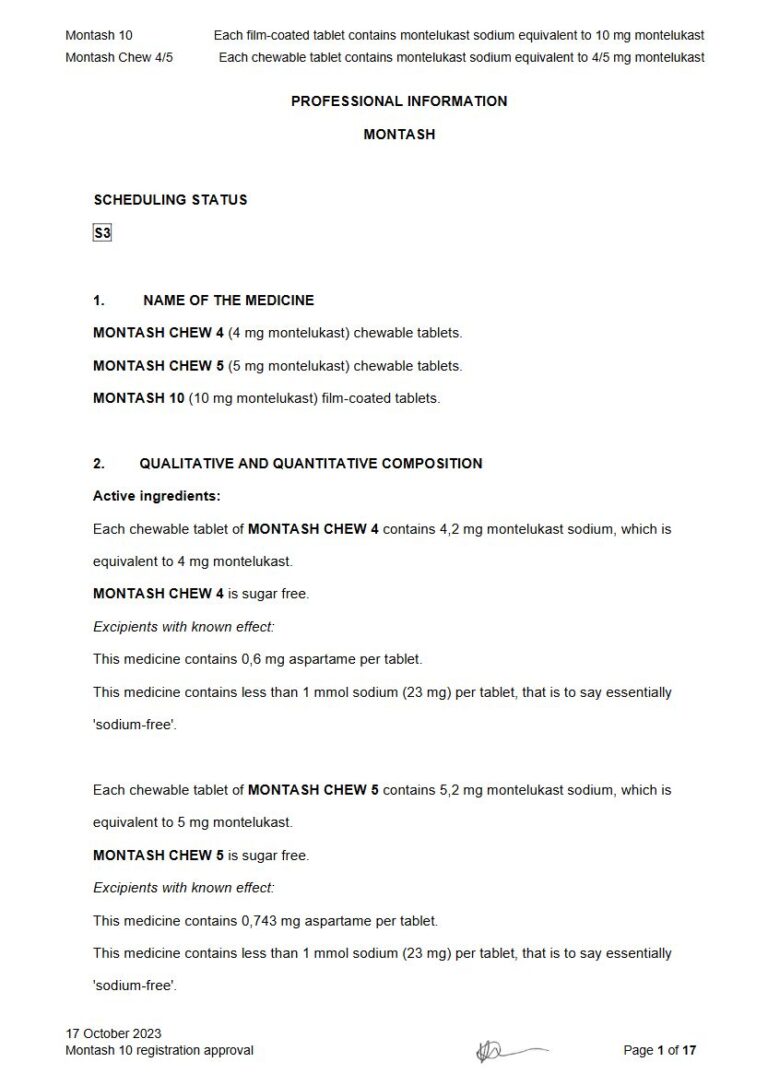
MONTASH CHEW 4 is indicated in paediatric patients 2 - 5 years of age for the prophylaxis and chronic treatment of atopic asthma. MONTASH CHEW 5 is indicated in paediatric patients over 6 years of age for the prophylaxis and chronic treatment of atopic asthma. MONTASH 10 is indicated in adults and children 15 years of age and older for the prophylaxis and chronic treatment of atopic asthma. MONTASH 10 may also provide some symptomatic relief of seasonal allergic rhinitis when used in those adult asthmatic patients (when indicated in asthma).
4.2 Posology and method of administration
Posology
MONTASH CHEW 4: Atopic asthma: The dosage for paediatric patients 2 - 5 years of age is one MONTASH CHEW 4 chewable tablet daily at bedtime. The dosage for paediatric patients 6 - 14 years of age is one MONTASH CHEW 5 chewable tablet daily at bedtime. MONTASH CHEW 5 has not been studied in seasonal allergic rhinitis in children with asthma.
Atopic Asthma with or without Seasonal Allergic Rhinitis: The dosage for adults 15 years of age and older is one MONTASH 10 film-coated tablet daily. Based on data from clinical studies in adults 15 years of age and older, there is no additional clinical benefit to montelukast doses above 10 mg once daily.
Therapy with MONTASH in Relation to Other Treatments for Asthma
MONTASH can be added to a patientu2019s existing treatment regimen. Reduction in Concomitant Therapy: Based on one randomized, placebo-controlled, parallel-group trial (n=226) which enrolled stable asthmatic adults, with a mean FEV 1 of approximately 84 % of predicted, who were previously maintained on various inhaled corticosteroids. During a 5- to 7-week placebo run-in period designed to titrate patients toward their lowest effective inhaled corticosteroid dose, the pre-study inhaled corticosteroid requirements were reduced by approximately 37 %. Treatment with montelukast resulted in a further 47 % reduction in mean inhaled corticosteroid dose compared with a mean reduction of 30 % in the placebo group over the 12- week active treatment period (p less than or equal to 0,05). Approximately 40 % of the montelukast-treated subjects and 29 % of the placebo-treated subjects could be tapered off inhaled corticosteroids and remained off inhaled corticosteroids at the end of the study (p=NS). It is not known whether the results of this study are generalizable to asthmatics that require higher doses of inhaled corticosteroids or systemic corticosteroids.
General recommendation
Within one day, the therapeutic effect of MONTASH should control the parameters of asthma. Even if the asthma is under control or during worsening periods of asthma, patients should be advised to keep taking MONTASH. For the paediatric patients, elderly, patients with renal insufficiency or mild to moderate hepatic impairment, no dose adjustment is required. Both male and female patients may take the same dosage. No safety and efficacy data has been established for therapy of more than 12 (twelve) weeks. Paediatric population: The safety and efficacy have not been demonstrated in children under the age of 2 years. MONTASH CHEW 4 is indicated for children between 2 and 5 years of age. MONTASH CHEW 5 is indicated for children between 6 - 14 years of age. MONTASH 10 is indicated for children over the age of 15 years.
Method of administration: Oral. MONTASH should be taken once daily in the evening.
4.3 Contraindications
- Hypersensitivity to montelukast sodium or any of the inactive excipients listed in section 6.1.
- MONTASH CHEW 4: The safety and efficacy have not been demonstrated in children under the age of 2 years.
- MONTASH CHEW 5 and MONTASH 10: The safety and efficacy have not been demonstrated in children under the age of 6 years.
4.4 Special warnings and precautions for use
The efficacy of oral MONTASH for the treatment of acute asthma attacks has not been established. MONTASH should not be used as monotherapy for the treatment and management of exercise-induced bronchospasm. MONTASH is not indicated for use in the reversal of bronchospasm in acute asthma attacks, including status asthmaticus. Patients should be advised to have appropriate rescue medicine readily available to treat acute asthma attacks, as oral montelukast is not advised for this. A short-acting u03b2-agonist inhaler should be used for acute attacks. If more inhalations than usual are required of a short-acting u03b2- inhaler, patients should be advised to consult their medical practitioner. MONTASH should not be used abruptly as a substitute for inhaled or oral corticosteroids. No data is available to indicate that oral corticosteroids can be reduced when given in combination with montelukast. Patients on therapy with anti-asthma medicines including montelukast, may in rare cases, present with systematic eosinophilia, sometimes presenting clinical features of vasculitis consistent with Churg-Strauss syndrome, a condition which is often treated with systematic corticosteroid therapy. Reduction or withdrawal of oral corticosteroids therapy has sometimes been associated with these cases. A causal relationship with leukotriene receptor antagonism has not been established. Medical practitioners should be alert to eosinophilia, vasculitic rash, worsening pulmonary symptoms, cardiac complications, and/or neuropathy presenting in their patients. Patients should be reassessed, and their treatment regimens evaluated. In patients with aspirin-sensitive asthma, the use of MONTASH does not alter the need to avoid aspirin or other non-steroidal anti-inflammatory medicine. Although montelukast is effective in improving airway function in asthmatics with documented aspirin sensitivity, it has not been demonstrated to shorten bronchoconstrictor response to aspirin and other non-steroidal anti-inflammatory drugs in aspirin-sensitive asthmatic patients. There have been reports of neuropsychiatric events in children, adolescents and adults using montelukast. Patients and medical practitioners should be alert for these neuropsychiatric events. Patients and/or caregivers should be instructed to contact their medical practitioners if these changes occur. If such events occur, carefully evaluate the risks and benefits before continuing therapy with MONTASH. Montelukast and its metabolites are not excreted in the urine, and therefore the pharmacokinetics of montelukast was not evaluated in patients with renal insufficiency. No dosage adjustment is recommended in these patients. Excipients MONTASH contains aspartame, a source of phenylalanine. This should be taken into account in patients with phenylketonuria. MONTASH CHEW 4 contains 0,6 mg aspartame per tablet. MONTASH CHEW 5 contains 0,743 mg aspartame per tablet. MONTASH 10 contains 1,5 mg aspartame per tablet.
4.5 Interaction with other medicinal products and other forms of interaction
MONTASH may be used concomitantly with other therapies used routinely in the prophylaxis and chronic treatment of asthma. The recommended clinical dose of montelukast did not have clinically important effects in drug-interactions studies, on the pharmacokinetics of the following medicines: theophylline, prednisone, prednisolone, oral contraceptives (ethinyl oestradiol/norethindrone 35/1), terfenadine, digoxin and warfarin. The co-administration of phenobarbital and montelukast resulted in approximately 40 % decrease of the area under the plasma concentration curve (AUC) for montelukast. When montelukast is co-administered with inducers of CYP 3A4, 2C8 and 2C9 such as phenytoin, phenobarbital and rifampicin, caution should be exercised, especially in children, since montelukast is metabolised by CYP 3A4, 2C8, and 2C9. Montelukast is a potent inhibitor of CYP 2C8 as shown in in vitro studies. Montelukast does not inhibit CYP 2C8 in in vivo studies, as demonstrated from data from a clinical interaction study involving montelukast and rosiglitazone (a probe substrate representative of medicines primarily metabolised by CYP 2C8). This concludes that MONTASH is not anticipated to markedly alter the metabolism of medicines metabolised by this enzyme, such as paclitaxel, rosiglitazone, and repaglinide. Montelukast is a substrate of CYP 2C8, and to a less significant extent, of 2C9, and 3A4 as shown in in vitro studies. The systematic exposure of montelukast by 4,4-fold was increased in a clinical interaction study involving montelukast and gemfibrozil (an inhibitor of both CYP 2C8 and 2C9). Co-administration of montelukast with gemfibrozil or other potent inhibitors of CYP 2C8 requires no routine dose adjustment of montelukast, however the medical practitioner should be made aware of the potential for an increase in adverse reactions. Clinically important medicine interactions, with less potent inhibitors of CYP 2C8 (for example, trimethropin) are not anticipated based on in vitro studies. No significant increase in the systematic exposure of montelukast resulted from the co-administration of montelukast with itraconazole, a strong inhibitor of CYP 3A4.
4.6 Fertility, pregnancy and lactation
Pregnancy
The safety of MONTASH in pregnant women has not been established. During worldwide marketing experience, congenital limb defects have been reported in offspring of women treated with montelukast during pregnancy. A causal relationship between these events and montelukast has not been established.
Lactation
The safety of MONTASH in breastfeeding women has not been established. There are no controlled studies in breastfeeding women, MONTASH should not be used by breastfeeding mothers. It is unknown if MONTASH is excreted in human milk.
Fertility
No data is available to indicate how MONTASH affects male and female fertility.
4.7 Effects on ability to drive and operate machinery
MONTASH has no or little influence on the ability to drive or use machinery. There have been reports of drowsiness and dizziness in individuals. Therefore it is advised that patients do not drive, operate complex machinery or engage in other potentially hazardous activities until it is known whether MONTASH affects their ability to perform such activities.
4.8 Undesirable effects
The following frequent side effects are from available clinical data for the use of montelukast:
- Montelukast 10 mg film coated tablets (4 000 adult and adolescent patients 15 years of age and older): abdominal pain and headaches.
- Montelukast 5 mg chewable tablets (1 750 paediatric patients 6 to 14 years of age): headache
- Montelukast 4 mg chewable tablets (851 paediatric patients 2 to 5 years of age): abdominal pain and thirst
Tabulated list of Adverse Reactions
Body System Class Frequency Adverse Reactions
Infections and infestations Frequent Upper respiratory infections
Blood and lymphatic system disorders Less frequent Increased bleeding tendency, thrombocytopenia
Immune system disorder Less frequent Hypersensitivity reactions including anaphylaxis, hepatic eosinophilic infiltration, angioedema
Psychiatric disorders Less frequent Abnormal dreams including nightmares, insomnia, somnambulism, anxiety, agitation including aggressive behaviour or hostility, depression, psychomotor hyperactivity (including irritability, restlessness, tremor), disturbance in attention, memory impairment, tic, hallucinations, disorientation, suicidal thinking and behaviour (suicidality), obsessive-compulsive symptoms, dysphemia
Nervous system disorders Less frequent Dizziness, drowsiness, paraesthesia/hypoesthesia, seizure
Cardiac disorders Less frequent Palpitations
Respiratory, thoracic and mediastinal disorders Less frequent Epistaxis, Churg-Strauss Syndrome (CSS) (see section 4.4), pulmonary eosinophilia
Gastrointestinal disorders Frequent: Diarrhoea, nausea, vomiting Less frequent Dry mouth, dyspepsia
Hepatobiliary disorders Frequent Elevated levels of serum transaminases (ALT, AST) Less frequent Hepatitis (including cholestatic, hepatocellular, and mixed pattern liver injury)
Skin and subcutaneous tissue disorders Frequent: Rash Less frequent: Bruising, erythema multiforma, erythema nodosum, pruritus, rash, urticaria
Musculoskeletal and connective tissue disorders Less frequent: Arthralgia, myalgia including muscle cramps
Renal and urinary disorders Less frequent: Enuresis in children
General disorders and administration site conditions Frequent: Pyrexia Less frequent: Asthenia/fatigue, malaise, oedema
Reporting of suspected adverse reactions
If you get side effects, talk to your doctor or, pharmacist or nurse. You can also report side effects to SAHPRA via the u201c6.04 Adverse Drug Reaction Reporting Formu201d, found online under SAHPRAu2019s publications: https://www.sahpra.org.za/Publications/Index/8. Report all side effects to Unicorn Pharmaceuticals (Pty) Ltd to [email protected]
4.9 Overdose
No clinically important adverse experiences were reported in chronic asthma studies when montelukast was administered at doses of up to 200 mg/day to adult patients for 22 weeks and in short-term studies when montelukast was administered at doses of up to 900 mg/per for approximately one week. Post-marketing experience and clinical studies with montelukast have reported acute overdoses. These reports included adults and children with a dose as high as 1 000 mg (approximately 61 mg/kg in a 42 month old child). These observations from clinical and laboratory findings were consistent with the safety profile in adults and children. No adverse findings were reported in the majority of the overdose reports. Symptoms: Frequent adverse reactions included abdominal pain, headache, psychomotor hyperactivity, somnolence, thirst and vomiting.
Management of overdose
No specific data is available on the treatment of montelukast, as in MONTASH, overdose. It is not known whether montelukast is dialysable by peritoneal- or haemo-dialysis.
