
Pariet 10 Mg/20 Mg Tablets
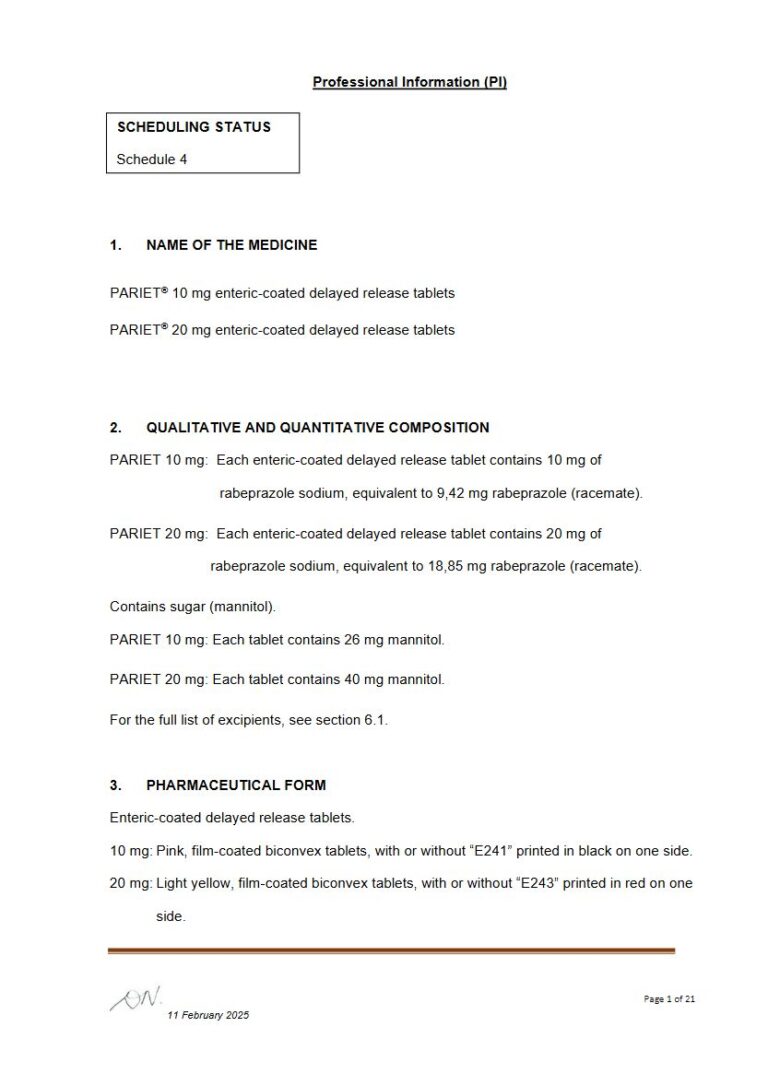
PDF Leaflet Revision Date: 11 February 2025
Clinical Summary
Quick overview from the medicine insert
Indication
Treatment of active duodenal and gastric ulcers, GORD, and Zollinger-Ellison Syndrome.
Dosage (summary)
20 mg once daily for duodenal/gastric ulcers; 10 mg for maintenance GORD.
Onset of Action / Duration
Onset: 1 hour, Duration: up to 48 hours
Special Populations
- Renal impairment
- Hepatic impairment
Pregnancy & Breastfeeding
Contraindicated in pregnancy and breastfeeding.
Key Drug Interactions
- Atazanavir
- Methotrexate
- Digoxin
Contraindications
- Hypersensitivity to rabeprazole
- Pregnancy
- Lactation
- Acute tubulointerstitial nephritis
Common side effects
- Headache
- Diarrhoea
- Abdominal pain
- Rash
- Dry mouth
Counselling Points
- Take in the morning before food
- Do not chew or crush tablets
- Monitor for magnesium levels if on long-term therapy
Serious warnings
- Hypomagnesaemia
- Increased risk of fractures
- Gastrointestinal infections
Important Disclaimer
The Pariet 10 Mg/20 Mg Tablets professional information leaflet below is the property of Janssen Pharmaceutica and is provided on Medinsert exactly as issued, with no.. alterations or editorial changes. We make every effort to keep content current by updating documents as soon as new versions become available. Medinsert serves as a trusted access point for healthcare professionals, but does not replace official sources or clinical judgement. For more details, please read our full disclaimer. read more>>
 Healthcare Professionals Only
This content is for registered healthcare professionals
Sign in or create a free account to read the full package insert.
Free for HPCSA-registered professionals. Powered by Medinsert.
Clinical Particulars
Section 4 of the official insert — extracted exactly as issued, no alterations
4.1 Therapeutic indications
PARIET tablets are indicated for the treatment of:
- Active duodenal ulcer.
- Active benign gastric ulcer.
- Symptomatic erosive or ulcerative gastro-oesophageal reflux disease (GORD).
- Maintenance treatment of healed erosive or ulcerative GORD. Efficacy has not been demonstrated for periods exceeding 12 months.
- Symptomatic treatment of gastro-oesophageal reflux disease (GORD).
- Zollinger-Ellison Syndrome and other pathological hypersecretory conditions.
- H.Pylori -positive duodenal ulcers, as part of the eradication programme with appropriate antibiotics.
4.2 Posology and method of administration
Posology
Adults and Elderly:
Active Duodenal Ulcer and Active Benign Gastric Ulcer: 20 mg to be taken once daily in the morning. Most patients with active duodenal ulcer heal within four weeks. However, 2 % of patients may require an additional four weeks of therapy to achieve healing. Some patients with active duodenal ulcer may respond to one 10 mg tablet to be taken once daily in the morning. Most patients with active benign gastric ulcer heal within six weeks. However, 9 % of patients may require an additional six weeks of therapy to achieve healing.
Erosive or Ulcerative Gastro-Oesophageal Reflux Disease (GORD): 20 mg to be taken once daily for four to eight weeks.
Gastro-Oesophageal Reflux Long u2013 term Management (GORD Maintenance): For long-term management up to 12 months, a maintenance dose of PARIET 10 mg or 20 mg once daily can be used. Some patients may respond to a maintenance dose of 10 mg/day.
Symptomatic treatment of gastro-oesophageal reflux disease (symptomatic GORD): 10 mg once daily in patients without oesophagitis. If symptom control has not been achieved after four weeks, the patient should be further investigated. Once symptoms have resolved; subsequent symptom control can be achieved using an on-demand regimen taking 10 mg once daily when needed.
Zollinger-Ellison Syndrome and other pathological hypersecretory conditions: The recommended adult starting dose is 60 mg once a day. The dose may be titrated upwards to 120 mg/day based on individual patient needs. Single daily doses up to 100 mg/day may be given. 120 mg dose may require divided doses, 60 mg twice daily. Treatment should continue for as long as clinically indicated.
Eradication of H.Pylori: PARIET is indicated for H.Pylori -positive duodenal ulcers, as part of the eradication programme with appropriate antibiotics.
Special populations
Paediatrics: PARIET is not recommended for use in paediatric patients, as there is no experience of its use in this group.
Renal impairment: No dosage adjustment is necessary for patients with renal impairment.
Hepatic impairment: No dosage adjustment is needed for patients with hepatic impairment. Caution is however advised when PARIET is first initiated in patients with severe hepatic dysfunction, refer section 4.4 u201cSpecial warnings and precautions for use- Patients with severe hepatic dysfunctionu201d).
Method of administration
PARIET tablets should be taken in the morning, before eating; and although neither the time of day nor food intake was shown to have any effect on rabeprazole sodium activity, this regimen will facilitate treatment compliance. Patients should be cautioned that the PARIET tablets should not be chewed or crushed, but should be swallowed whole.
4.3 Contraindications
PARIET is contraindicated in:
- Patients with known hypersensitivity to rabeprazole sodium, substituted benzimidazoles or to any of the excipients listed in section 6.1.
- Pregnancy and lactation. (See section 4.6, u201cPregnancy and Breastfeedingu201d).
- Co-administration with atazanavir and nelfinavir.
- Patients who previously experienced acute tubulointerstitial nephritis (TIN) while on treatment with a PPI.
4.4 Special warnings and precautions for use
Pre-existing malignancy
Symptomatic response to therapy with rabeprazole sodium does not preclude the presence of gastric or oesophageal malignancy, therefore the possibility of malignancy should be excluded prior to commencing treatment with PARIET.
Patients with severe hepatic dysfunction
Although no evidence of significant medicine related safety problems was seen in a study of patients with mild to moderate hepatic impairment versus normal age and sex matched controls, the prescriber is advised to exercise caution when treatment with PARIET is first initiated in patients with severe hepatic dysfunction.
Hypomagnesaemia
Hypomagnesaemia, symptomatic and asymptomatic, has been reported in patients treated with PARIET for at least three months, and in most cases after a year of therapy. Serious adverse events include tetany, dysrhythmias, and seizures. In most patients, treatment of hypomagnesaemia required magnesium replacement and discontinuation of PARIET. For patients expected to be on prolonged treatment or who take PARIET with medications such as digoxin or medicines that may cause hypomagnesaemia (e.g., diuretics), healthcare professionals may consider monitoring magnesium levels prior to initiation of PARIET treatment and periodically thereafter. (See section 4.8, u201cUndesirable Effectsu201d).
Fractures
Observational studies suggest that PARIET therapy may be associated with an increased risk for osteoporosis-related fractures of the hip, wrist or spine. The risk of fracture was increased in patients who received high-dose, and long-term PARIET therapy (a year or longer) (See section 4.8 u201cUndesirable Effectsu201d).
Concomitant use of PARIET with methotrexate
Literature suggests that concomitant use of PARIET with methotrexate (primarily at high dose; see methotrexate prescribing information) may elevate and prolong serum levels of methotrexate and/or its metabolite, possibly leading to methotrexate-related toxicities. In high-dose methotrexate administration, a temporary withdrawal of PARIET may be considered in some patients (See section 4.5 u201cInteractionsu201d).
Gastrointestinal infections
Treatment with PARIET may possibly increase the risk of gastrointestinal infections such as Clostridium difficile, Campylobacter and Salmonella.
Concomitant use of PARIET with atazanavir
Co-administration of atazanavir with PARIET is contraindicated. (See section 4.5, u201cInteractionsu201d).
Influence on vitamin B 12 absorption
PARIET may reduce the absorption of vitamin B 12 (cyanocobalamin) due to hypo- or achlorhydria. This should be considered in patients with reduced body stores or risk factors for reduced vitamin B 12 absorption on long-term therapy or if respective clinical symptoms are observed.
Subacute cutaneous lupus erythematosus
Subacute cutaneous lupus erythematosus (SCLE) has been reported with the use of Proton Pump Inhibitors (PPIs). If lesions occur, especially in sun-exposed areas of the skin, and if accompanied by arthralgia, the patient should seek medical help promptly and the healthcare professional should consider stopping PARIET. The occurrence of SCLE with previous PPI treatment may increase the risk of SCLE with other PPIs.
Blood dyscrasias
There have been post marketing reports of blood dyscrasias (thrombocytopaenia and neutropaenia). In the majority of cases where an alternative aetiology cannot be identified, the events were uncomplicated and resolved on discontinuation of PARIET.
Fundic gland polyps
Long-term use of PARIET is associated with an increased risk of fundic gland polyps (see section 4.8, u201cUndesirable effects u2013 Postmarketing data). Most fundic polyps are asymptomatic. Patients with large or ulcerated polyps may be at risk of gastrointestinal bleeding or small intestinal blockage. Use the lowest dose and the shortest duration of Proton Pump Inhibitors (PPI) therapy appropriate to the condition being treated.
Acute Tubulointerstitial Nephritis
Acute tubulointerstitial nephritis (TIN) has been observed in patients taking Proton Pump Inhibitors (PPIs) and may occur at any point during PPI therapy. Patients may present with varying signs and symptoms from symptomatic hypersensitivity reactions to non-specific symptoms of decreased renal function (e.g., malaise, nausea, anorexia). In reported case series, some patients were diagnosed on biopsy and in the absence of extra-renal manifestations (e.g., fever, rash, or arthralgia). Discontinue PARIET and evaluate patients with suspected acute TIN.
Mannitol intolerance
Patients with the rare hereditary condition of mannitol intolerance should not take PARIET.
4.5 Interaction with other medicinal products and other forms of interaction
Cytochrome P450 system
Rabeprazole sodium is metabolised through the cytochrome P450 (CYP450) hepatic metabolising system. Studies in healthy subjects have shown that rabeprazole sodium does not have clinically significant interactions with other medicines metabolised by the CYP450 system, such as warfarin, phenytoin, theophylline or diazepam.
Interactions due to inhibition of gastric acid secretion
Rabeprazole sodium produces a profound and long-lasting inhibition of gastric acid secretion. An interaction with compounds whose absorption is pH dependent may occur; therefore, the potential for such interaction was investigated. Co-administration of rabeprazole sodium with ketoconazole or itraconazole may result in a significant decrease in antifungal levels and a 22 % increase in trough digoxin levels in normal subjects. Therefore, individual patients may need to be monitored to determine if a dosage adjustment is necessary when such medicines are taken concomitantly with PARIET.
Antacids
In clinical trials, antacids were used concomitantly with the administration of PARIET and, in a specific interaction study, no interaction with liquid antacids was observed.
Food
There was no clinically relevant interaction with food.
Ciclosporin
In vitro studies with human liver microsomes indicated that rabeprazole sodium is metabolised by isoenzymes of CYP450 (CYP2C19 and CYP3A4). The studies suggest a low interaction potential; however, the effect on ciclosporin metabolism is similar to that observed for other proton pump inhibitors.
Atazanavir
Co-administration of atazanavir 300 mg/ritonavir 100 mg or atazanavir 400 mg with other proton pump inhibitors (PPIs) to healthy volunteers resulted in a substantial reduction in atazanavir exposure. The absorption of atazanavir is pH dependent. Although not studied, similar results are expected with rabeprazole. Therefore PPIs, including PARIET, should not be co-administered with atazanavir (See section 4.3, u201cContraindicationsu201d and section 4.4, u201cSpecial warnings and precautions for useu201d).
Methotrexate
Concomitant administration of PARIET and methotrexate (primarily at high dose; see methotrexate prescribing information) may elevate and prolong serum levels of methotrexate and/or its metabolite hydroxymethotrexate. However, no formal interaction studies of methotrexate with PARIET have been conducted.
Digoxin
In healthy subjects (n=16), co-administration of PARIET 20 mg at steady state with 2,5 mg once daily doses of digoxin at steady state resulted in approximately 29 % and 19 % increase in mean C max and AUC (0-24) of digoxin. Monitor digoxin concentrations for potential for increased exposure to digoxin. Dose adjustment of digoxin may be needed to maintain therapeutic medicine concentrations.
Interference with laboratory tests
PPI-induced decreases in gastric acidity may lead to increases in serum chromogranin A (CgA) levels, which may lead to erroneous interpretations of laboratory results in investigations for neuroendocrine tumours. To avoid this interference, temporarily stop PARIET treatment at least 14 days before assessing CgA levels and consider repeating the test if initial CgA levels are high.
4.6 Fertility, pregnancy and lactation
Safety in pregnancy and lactation has not been established.
Pregnancy
Low foeto-placental transfer occurs in rats. PARIET is contraindicated during pregnancy (see section 4.3, u201cContraindicationsu201d).
Breastfeeding
Excretion of rabeprazole sodium in human breast milk has not been studied. Rabeprazole sodium is excreted in rat mammary secretions. Therefore mothers on treatment with PARIET should not breastfeed their babies (See section 4.3, u201cContraindicationsu201d).
4.7 Effects on ability to drive and use machines
Based on pharmacodynamic properties and adverse events profile, it is unlikely that PARIET would cause an impairment of driving performance or compromise the ability to use machinery. If however, alertness is impaired due to somnolence, it is recommended that driving and operating complex machinery be avoided.
4.8 Undesirable effects
The most common adverse events, during controlled clinical trials with PARIET, were headache, diarrhoea, abdominal pain, asthenia, flatulence, rash and dry mouth.
The following adverse events have been reported from clinical trial experience by system organ class and frequency.
4.9 Overdose
Experience to date with deliberate or accidental overdose is limited. The maximum established exposure has not exceeded 60 mg twice daily, or 160 mg once daily. Effects are generally minimal, similar to the known adverse event profile, and usually reversible without further medical intervention. No specific antidote is known. Rabeprazole sodium is extensively protein bound and is, therefore, not readily dialysable. Treatment should be supportive and symptomatic.
