
Pholtex Forte 15 mg/5 ml Liquid
PDF Leaflet Revision Date: 20 May 2022
Clinical Summary
Quick overview from the medicine insert
Indication
For the relief of unproductive coughs.
Dosage (summary)
Adults: 5 ml two to three times a day; Children 5-12 years: 2.5 ml two to three times a day.
Special Populations
- Hepatic impairment
- Respiratory failure risk
Pregnancy & Breastfeeding
Contraindicated in pregnancy and lactation.
Key Drug Interactions
- MAOIs
- CNS depressants
- Antihypertensives
Contraindications
- Respiratory failure
- Chronic bronchitis
- COPD
- Children under 2 years
- Liver disease
Common side effects
- Dizziness
- Drowsiness
- Nausea
- Skin reactions
Counselling Points
- Avoid alcohol
- Monitor for skin reactions
- Do not drive if affected
Serious warnings
- Severe cutaneous adverse reactions
- Caution in asthmatics
Important Disclaimer
The Pholtex Forte 15 mg/5 ml Liquid professional information leaflet below is the property of Inova Pharmaceuticals and is provided on Medinsert exactly as issued, with no.. alterations or editorial changes. We make every effort to keep content current by updating documents as soon as new versions become available. Medinsert serves as a trusted access point for healthcare professionals, but does not replace official sources or clinical judgement. For more details, please read our full disclaimer. read more>>
 Healthcare Professionals Only
This content is for registered healthcare professionals
Sign in or create a free account to read the full package insert.
Free for HPCSA-registered professionals. Powered by Medinsert.
Clinical Particulars
Section 4 of the official insert — extracted exactly as issued, no alterations
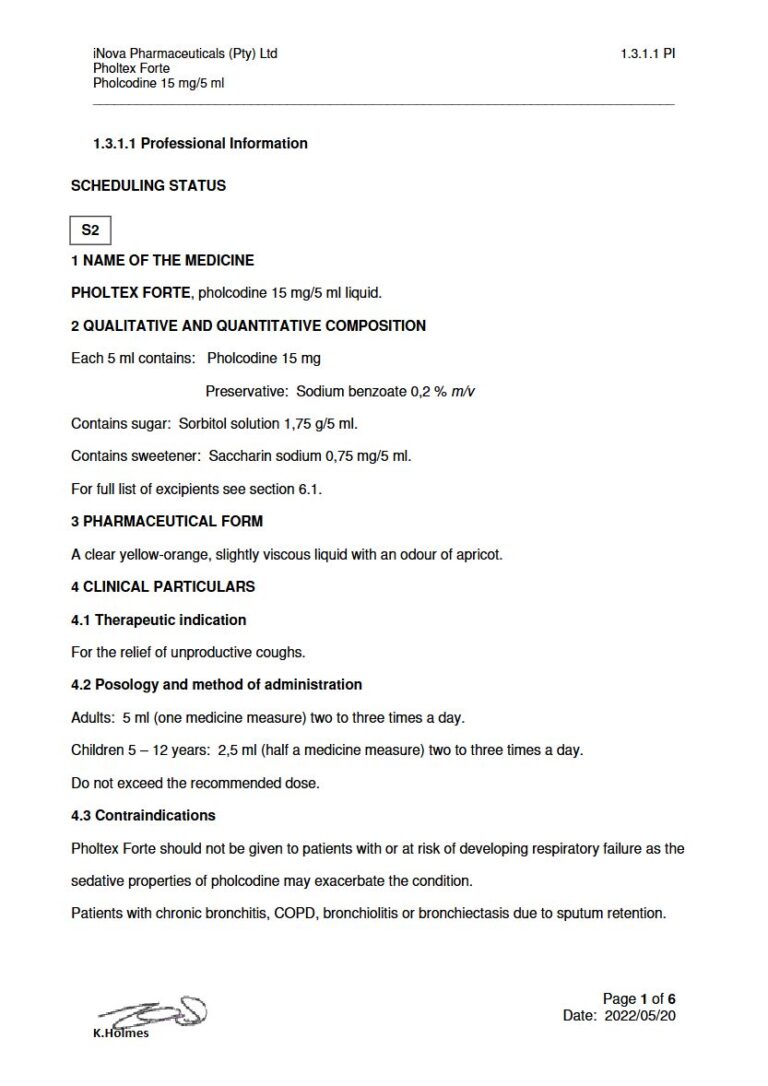
4.1 Therapeutic indication
For the relief of unproductive coughs.
4.2 Posology and method of administration
Adults: 5 ml (one medicine measure) two to three times a day.
Children 5 u2013 12 years: 2,5 ml (half a medicine measure) two to three times a day.
Do not exceed the recommended dose.
4.3 Contraindications
Pholtex Forte should not be given to patients with or at risk of developing respiratory failure as the sedative properties of pholcodine may exacerbate the condition.
Patients with chronic bronchitis, COPD, bronchiolitis or bronchiectasis due to sputum retention.
Patients taking monoamine oxidase inhibitors (MAOIs) or within 14 days of stopping such treatment (see 4.5).
Patients with hypersensitivity or idiosyncratic response to pholcodine or to any of the excipients.
Patients with liver disease since pholcodine is metabolised in the liver and the drug may accumulate.
Children under two years of age.
Pregnancy and lactation. Refer to 4.6.
4.4 Special warnings and precautions for use
Pholcodine should be used with caution in patients who have decreased respiratory reserve.
Pholcodine depresses the respiratory centre to some extent and should be used with caution in asthmatics.
Since pholcodine is metabolised in the liver, its action may be prolonged in hepatic insufficiency.
The dosage and frequency of administration may need to be reduced in patients with impaired liver function.
Use of pholcodine with alcohol or other central nervous system (CNS) depressants may increase the effects on the CNS and cause toxicity in relatively smaller doses.
Severe cutaneous adverse reactions (SCARs) including acute generalized exanthematous pustulosis (AGEP), which can be life-threatening or fatal, have been reported in patients treated with pholcodine, most likely in the first week. Patients should be advised of the signs and symptoms and monitored closely for skin reactions. If signs and symptoms suggestive of these reactions appear, this medicine should be withdrawn immediately.
Contains sorbitol which may have an effect on the glycaemic control of patients with diabetes mellitus.
Medicines containing sorbitol may have a laxative effect. Patients with the rare hereditary condition of sorbitol intolerance should not take Pholtex Forte.
4.5 Interaction with other medicines and other forms of interaction
The reduction in blood pressure caused by antihypertensives may accentuate the hypotensive effects of pholcodine. Diuretics may have a similar effect.
The sedative effects of central nervous system depressants may be increased by alcohol, barbiturates, hypnotics, narcotic analgesics, sedatives and tranquillisers (phenothiazines and tricyclic antidepressants).
Hypertensive crisis may be caused by concurrent use of pholcodine with monoamine u2013 oxidase inhibitors therefore not to be used in patients taking MAOIs or within 14 days of stopping treatment.
Interaction with neuromuscular blocking agents (anaphylaxis) has been reported.
4.6 Fertility, pregnancy and lactation
Pregnancy
PHOLTEX FORTE is contraindicated in pregnancy. Refer to 4.3.
Breastfeeding
PHOLTEX FORTE is contraindicated in lactation. Refer to 4.3.
Fertility
No data available.
4.7 Effects on ability to drive and use machines
Pholcodine may cause drowsiness and dizziness. Patients receiving this medication should not drive or operate machinery unless it has been shown not to affect mental or physical ability.
4.8 Undesirable effects
Immune system disorders
Frequency unknown: hypersensitivity reactions, anaphylaxis.
Nervous system disorders
Frequency unknown: Dizziness, drowsiness, confusion, excitation, restlessness, ataxia and respiratory depression.
Gastrointestinal disorder
Frequency unknown: Constipation, vomiting, nausea, sputum retention.
Skin and subcutaneous tissue disorder
Frequency unknown: Skin reactions including rash, acute generalized exanthematous pustulosis. (See 4.4).
Reporting suspected adverse reactions after authorisation of the medicine is important. It allows continued monitoring of the benefit/risk balance of the medicine. Health care providers are asked to report any suspected adverse reactions to SAHPRA via the u201c6.04 Adverse Drug Reactions Reporting Formu201d, found online under SAHPRAu2019s publications: https://www.sahpra.org.za/Publications/Index/8publications : Alternately you can contact iNova Pharmaceuticals (Pty) Ltd at +27 11 087 0000. Website: www.inovapharma.co.za.
4.9 Overdose
Symptoms include drowsiness, restlessness, excitement, ataxia and respiratory depression.
Ventilation may be required.
Management: Treatment of overdose should be symptomatic and supportive. Naloxone has been used successfully to reverse central or peripheral opioid effects in children (0.01 mg/kg body weight). Other treatment option is activated charcoal (1 g/kg body weight) if more than 4 mg/kg has been ingested within 1 hour, provided the airway can be protected.
