
Pyracet 125 mg and 250 mg Suppositories
PDF Leaflet Revision Date: 15 May 2023
Clinical Summary
Quick overview from the medicine insert
Indication
Relief of mild to moderate pain and fever when oral therapy is not feasible.
Dosage (summary)
Adults: 10-15 mg/kg; max 60 mg/kg/day. Infants: 125 mg up to 4x daily; Children: 250 mg up to 4x daily.
Onset of Action / Duration
Onset: 1.5-2.5 hours, Duration: 6-8 hours
Special Populations
- Hepatic insufficiency
- Mild renal insufficiency
- Severe renal insufficiency
- Elderly patients
Pregnancy & Breastfeeding
Safe in pregnancy at lowest effective dose; excreted in breast milk in negligible amounts.
Key Drug Interactions
- Increased hepatotoxicity with alcohol and enzyme inducers
- Enhanced anticoagulant effect with warfarin
- Neutropenia risk with zidovudine
Contraindications
- Hypersensitivity to paracetamol
Common side effects
- Fatigue
- Headache
- Hypersensitivity reactions
Counselling Points
- Do not exceed recommended dose
- Consult if symptoms persist beyond 3 days
- Store out of reach of children
Serious warnings
- Risk of severe liver damage in overdose
- Use with caution in liver and kidney impairment
Important Disclaimer
The Pyracet 125 mg and 250 mg Suppositories professional information leaflet below is the property of Forrester Pharma and is provided on Medinsert exactly as issued, with no.. alterations or editorial changes. We make every effort to keep content current by updating documents as soon as new versions become available. Medinsert serves as a trusted access point for healthcare professionals, but does not replace official sources or clinical judgement. For more details, please read our full disclaimer. read more>>
 Healthcare Professionals Only
This content is for registered healthcare professionals
Sign in or create a free account to read the full package insert.
Free for HPCSA-registered professionals. Powered by Medinsert.
Clinical Particulars
Section 4 of the official insert — extracted exactly as issued, no alterations
4.1 Therapeutic indications
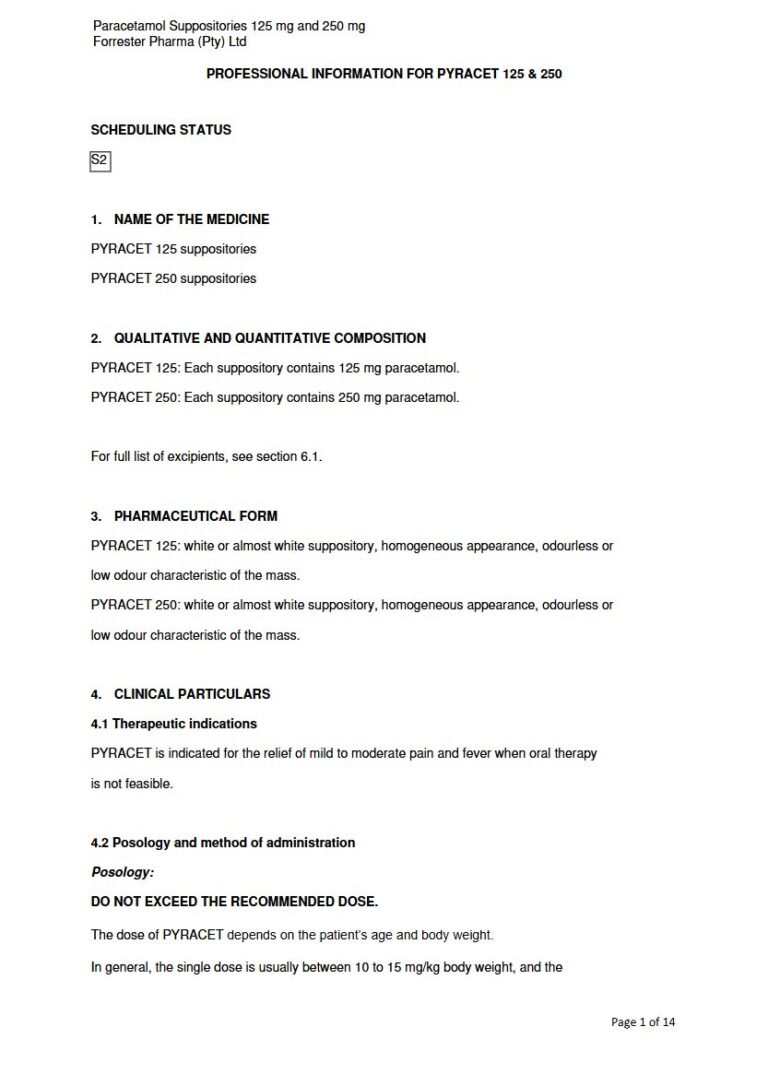
PYRACET is indicated for the relief of mild to moderate pain and fever when oral therapy is not feasible.
4.2 Posology and method of administration
Posology: DO NOT EXCEED THE RECOMMENDED DOSE. The dose of PYRACET depends on the patientu2019s age and body weight. In general, the single dose is usually between 10 to 15 mg/kg body weight, and the maximum daily dose is 60 mg/kg body weight. The dosage interval depends on the symptoms and the maximum daily dose, and should be at least 6 hours. A medical practitioner should be consulted if symptoms persist for more than three days.
Paediatric population
- Infants (6 months to u2264 2 years): One 125 mg suppository up to 4 times daily.
- Children (2 years to 8 years): One 250 mg suppository up to 4 times daily.
The suppository should be inserted per rectum.
Special populations
- Hepatic insufficiency and mild renal insufficiency: In patients with disorders of liver and kidney function or Gilbertu2019s syndrome, the dose should be reduced and the dosage interval should be increased. Without medical advice, a daily dose of 2 g should not be exceeded.
- Patients with severe renal insufficiency: In the presence of severe kidney failure (GFR u2264 30 mL/min) the dosage interval should be at least eight hours.
- Elderly patients: Dose adjustment is not necessary in the elderly. However, in debilitated, immobilized elderly patients with impaired liver / kidney function, a dose reduction or prolongation of the dosing interval may be required. Without medical advice, the maximum daily dose of 60 mg/kg body weight (up to a maximum of 2 g/day) should not be exceeded in the following cases:
- Body weight less than 50 kg
- Chronic alcoholism
- Dehydration
- Chronic malnutrition
Children and adolescents with low body weight: The use of PYRACET125 suppositories in children under six months or weighing less than 7 kg, or PYRACET 250 in children under two years or weighing less than 13 kg, is not recommended.
Method of administration: The suppository should be inserted per rectum (see section 6.6). Only whole suppositories should be administered u2013 do not break the suppository before administration. They may be warmed up in the hands or dipped for a short time into warm water to improve their sliding properties.
4.3 Contraindications
- Hypersensitivity to paracetamol or any of the other ingredients (see section 6.1).
4.4 Special warnings and precautions for use
This product contains paracetamol which may be fatal in overdose. In the event of overdosage or suspected overdose and notwithstanding the fact that the person may be asymptomatic, the nearest doctor, hospital or Poison Centre must be contacted immediately. Dosages of PYRACET in excess of those recommended may cause severe liver damage. Liver damage is also associated with certain risk factors (see sections 4.5 and 4.9). If liver damage is suspected, then liver function tests should be performed.
In the presence of the following disorders, PYRACET should be used with great caution (longer interval between doses or in reduced doses) and under careful medical supervision:
- hepatocellular insufficiency (Child-Pugh < 9),
- chronic alcohol abuse,
- severe renal insufficiency (GFR < 30 mL /min (see section 4.2), Gilbertu2019s syndrome (Meulengrachtu2019s disease),
- concomitant use of medicines impairing the liver function,
- disorders associated with reduced glutathione levels (dose adjustment, e.g. in patients with diabetes mellitus, HIV, Downu2019s syndrome, tumours, if applicable),
- Glucose-6-phosphate dehydrogenase deficiency (favism)
- Haemolytic anaemia
- Glutathione deficiency
- Dehydration
- Chronic malnutrition
- Body weight less than 50 kg
- Elderly patients
Consult a medical practitioner if pain or fever persists or gets worse at the recommended dosage, if new symptoms occur or if redness and swelling is present, as these could be signs of a more serious condition.
Do not use PYRACET continuously without consulting a medical practitioner:
- For pain u2013 for more than 5 days.
- For fever u2013 for more than 3 days.
If large amounts of analgesics are taken for extended periods of time, or if these medicines are not used properly, they may cause headache, which may not be treated with increased doses of PYRACET.
In general, the habitual use of analgesics, especially of those containing more than one active ingredient, may lead to permanent kidney damage, including the risk of kidney failure (analgesic nephropathy). Headache, fatigue, muscular pain, nervousness and vegetative symptoms may occur after abrupt discontinuation of prolonged, improper use of large amounts of analgesics. These symptoms will subside after a couple of days. No analgesics should be taken within this period. The use of analgesics should not be resumed without a medical practitioneru2019s advice.
Store in a safe place out of the reach of children. Patients suffering from hepatitis, or recovering from any form of liver disease, should not use excessive quantities of PYRACET. Use with caution in renal disease. The risk of neutropenia is increased with the concomitant use of PYRACET with zidovudine (see section 4.5). Use with caution in patients with impaired kidney or liver function. PYRACET should not be combined with other analgesic medications that contains paracetamol.
4.5 Interaction with other medicines and other forms of interaction
Hepatotoxic medicines u2013 increased risk of hepatotoxicity. Enzyme induced medicines u2013 increased risk of hepatotoxicity. Medicines which induce hepatic microsomal enzymes such as alcohol, barbiturates and other anticonvulsants, may increase the hepatotoxicity of paracetamol, particularly after overdosage. Enzyme-inducing medicines, such as some antiepileptic medicines (phenytoin, phenobarbital, carbamazepine, primidone) have been shown in pharmacokinetic studies to reduce the plasma AUC of paracetamol to approx. 60 %. Other medicines with enzyme-inducing properties, e.g. rifampicin and St. John's wort (hypericum) are also suspected of causing lowered concentrations of paracetamol. In addition, the risk of liver damage during treatment with maximum recommended doses of paracetamol will be higher in patients being treated with enzyme-inducing medicines.
Patients receiving PYRACET in combination with AZT (zidovudine), are more likely to develop a neutropenia. These substances should be used in combination with paracetamol only on medical advice (see section 4.4).
The anti-coagulant effect of warfarin and other coumarins may be enhanced by prolonged regular use of paracetamol with increased risk of bleeding. The effect appears to increase as the dose of paracetamol is increased, but can occur with doses as low as 1.5 u2013 2 g paracetamol per day for at least 5 u2013 7 days. Therefore, long-term administration of paracetamol (longer than 10 days) to patients treated with anticoagulants should only be done under medical supervision. Monitoring the INR values is recommended. Occasional doses have no significant effect.
Probenecid inhibits the glucuronidation of paracetamol which can affect the clearance of paracetamol. This should be considered when these medicines are administered concomitantly. Paracetamol may affect the pharmacokinetics of chloramphenicol. This interaction should be considered when these medications are administered concomitantly, especially in malnourished patients.
Possible decrease in therapeutic effects of PYRACET: Metoclopramide u2013 absorption of PYRACET may be accelerated. Cholestyramine u2013 absorption of PYRACET is reduced if given within one hour of cholestyramine. Prolonged concurrent use of PYRACET with Salicylates increases the risk of adverse renal effects.
Effect on laboratory tests: Paracetamol may influence tests for uric acid with phosphotungstic acid as well as blood glucose determination with glucose oxidase peroxidase.
4.6 Fertility, pregnancy and lactation
Pregnancy: A large amount of data on pregnant women indicates neither malformative, nor feto/neonatal toxicity. Epidemiological studies on neurodevelopment in children exposed to paracetamol in utero show inconclusive results. If clinically needed, paracetamol can be used during pregnancy, however, it should be used at the lowest effective dose for the shortest possible time, at the lowest possible frequency and not in combination with other medicines.
Breastfeeding: Paracetamol is excreted in breast milk but not in clinically significant amounts. Available published data do not contraindicate breastfeeding.
4.7 Effects on ability to drive and use machines
PYRACET may cause fatigue (see section 4.8). Caution is advised when driving a vehicle or operating machinery.
4.8 Undesirable effects
Tabulated list of adverse reactions:
System Organ Class Frequency Side effects
Blood and the lymphatic system disorders Less frequent Thrombocytopenia, leucopenia, agranulocytosis, pancytopenia, neutropenia, anaemia
Immune system disorders Less frequent Hypersensitivity reactions such as Quinckeu2019s oedema, dyspnoea, sweating, nausea, sharp fall in blood pressure including shock*
Nervous system disorders Frequent Less frequent Fatigue, mild headache Respiratory depression (after large doses and in patients with increase intracranial pressure or head trauma), sleep disturbances, euphoria (large doses). The prolonged administration of large amounts may lead to dependence
Respiratory, thoracic and mediastinal disorders Less frequent Bronchospasm (analgesic asthma)
Gastrointestinal disorders Frequent Redness of the rectal mucous membranes
Hepato-biliary disorders Less frequent Frequency unknown Hepatitis, liver damage Hepatic necrosis (may occur after overdosage)
Skin and subcutaneous tissue disorders Less frequent Dermatitis, reversible skin rashes and other allergic reactions^, exanthema, urticaria, angioedema
Frequency unknown Serious skin reactions
Renal and urinary disorders Less frequent Renal colic, renal failure, sterile pyuria
Endocrine disorders Less frequent Pancreatitis
Investigations Less frequent Increase in creatinine (mostly secondary to hepatorenal syndrome)
* Patients should be instructed to discontinue treatment and to contact a doctor at the first signs of hypersensitive reactions.
^ The rash is usually erythematous or urticarial but sometimes more serious and may be accompanied by drug fever and mucosal lesions.
Reporting of suspected adverse reactions: Reporting of suspected adverse reactions after authorisation of the medicine is important. It allows continued monitoring of the benefit/risk balance of the medicine. Health care providers are asked to report any suspected adverse reactions to SAHPRA via the u201c6.04 Adverse Drug Reactions Reporting Formu201d, found online under SAHPRAu2019s publications: https://www.sahpra.org.za/Publications/Index/8.
4.9 Overdose
Prompt treatment is essential. In the event of an overdosage, consult a doctor immediately, or take the person directly to a hospital. A delay in starting treatment may mean that the antidote is given too late to be effective. Evidence of liver damage is often delayed until after the time for effective treatment has lapsed. Susceptibility to paracetamol toxicity is increased in patients who have taken repeated high doses (greater than 5 -10 g/day) of paracetamol for several days, in chronic alcoholism, chronic liver disease, AIDS, malnutrition, and with the use of medicines that induce liver microsomal oxidation such as barbiturates, isoniazid, rifampicin, phenytoin and carbamazepine or other medicines that induce liver enzymes.
Symptoms of paracetamol overdose in the first 24 hours include pallor, nausea, vomiting, anorexia, and possibly abdominal pain. Mild symptoms during the first two days of acute poisoning, do not reflect the potential seriousness of the overdosage. Liver damage may become apparent 12 to 48 hours, or later after ingestion, initially by elevation of the serum transaminase and lactic dehydrogenase activity, increased serum bilirubin concentration and prolongation of the prothrombin time. Liver damage may lead to encephalopathy, coma and death. Acute renal failure with acute tubular necrosis may develop even in the absence of severe liver damage. Abnormalities of glucose metabolism and metabolic acidosis may occur. Cardiac dysrhythmias have been reported.
Treatment for paracetamol overdosage: N-acetylcysteine should be administered in all cases of suspected overdose as soon as possible, preferably within eight hours of overdose, although treatment up to 36 hours after ingestion may still be of benefit, especially if more than 150 mg/kg of paracetamol was taken. An initial dose of 150 mg/kg N-acetylcysteine in 200 mL dextrose injection given intravenously over 15 minutes, followed by an infusion of 50 mg/kg in 500 mL dextrose injection over the next four hours, and then 100 mg/kg in 1 000 mL dextrose injection over the next sixteen hours. The volume of intravenous fluid should be modified for children. Although the oral formulation is not the treatment of choice, 140 mg/kg dissolved in water may be administered initially, followed by 70 mg/kg every four hours for seventeen doses. A plasma paracetamol level should be determined four hours after ingestion in all cases of suspected overdosage. Levels done before four hours may be misleading. Patients at risk of liver damage, and hence requiring continued treatment with N-acetylcysteine, can be identified according to their 4-hour plasma paracetamol level. The plasma paracetamol level can be plotted against time since ingestion in the nomogram below. Figure 1 - Sweetman, Sean C, ed, 2009, Martindale u2013 The Complete Drug Reference (37th Edition). The nomogram should be used only in relation to a single acute ingestion. Those whose plasma paracetamol levels are above the u201cnormal treatment lineu201d, should continue N-acetylcysteine treatment with 100 mg/kg IV over sixteen hours repeatedly until recovery. Patients with increased susceptibility to liver damage as identified above, should continue treatment if concentrations are above the u201chigh risk treatment lineu201d. Prothrombin index correlates best with survival. For overdose with an extended/modified release preparation the value of the nomogram is unknown. As there is no information on the plasma levels of paracetamol after an overdose of extended/modified release paracetamol preparations, all patients with suspected or known overdose with such preparations should receive N-acetylcysteine. Because of lack of data for extended/modified release formulations, a level below the u201ctreatment lineu201d of the nomogram may not exclude the possibility of toxicity. Monitor all patients with significant ingestions for at least ninety six hours.
