
Renvela 800mg FC Tablets
PDF Leaflet Revision Date: 09 March 2022
Clinical Summary
Quick overview from the medicine insert
Indication
Control of hyperphosphataemia in adult patients on dialysis or with CKD.
Dosage (summary)
Starting dose: 2.4 g to 4.8 g per day, taken three times daily with meals.
Special Populations
- Elderly population
- Hepatic impairment
Pregnancy & Breastfeeding
Safety not established; not absorbed, minimal risk in breastfeeding.
Key Drug Interactions
- Ciprofloxacin
- Ciclosporin
- Mycophenolate mofetil
- Tacrolimus
- Levothyroxine
Contraindications
- Hypersensitivity to sevelamer
- Hypophosphataemia
- Bowel obstruction
Common side effects
- Nausea
- Vomiting
- Constipation
- Diarrhoea
- Fatigue
Counselling Points
- Take with meals
- Monitor phosphorus levels
- Assess swallowing ability
Serious warnings
- Serious gastrointestinal disorders
- Monitor for vitamin deficiencies
Important Disclaimer
The Renvela 800mg FC Tablets professional information leaflet below is the property of Sanofi-Aventis South Africa and is provided on Medinsert exactly as issued, with no.. alterations or editorial changes. We make every effort to keep content current by updating documents as soon as new versions become available. Medinsert serves as a trusted access point for healthcare professionals, but does not replace official sources or clinical judgement. For more details, please read our full disclaimer. read more>>
 Healthcare Professionals Only
This content is for registered healthcare professionals
Sign in or create a free account to read the full package insert.
Free for HPCSA-registered professionals. Powered by Medinsert.
Clinical Particulars
Section 4 of the official insert — extracted exactly as issued, no alterations
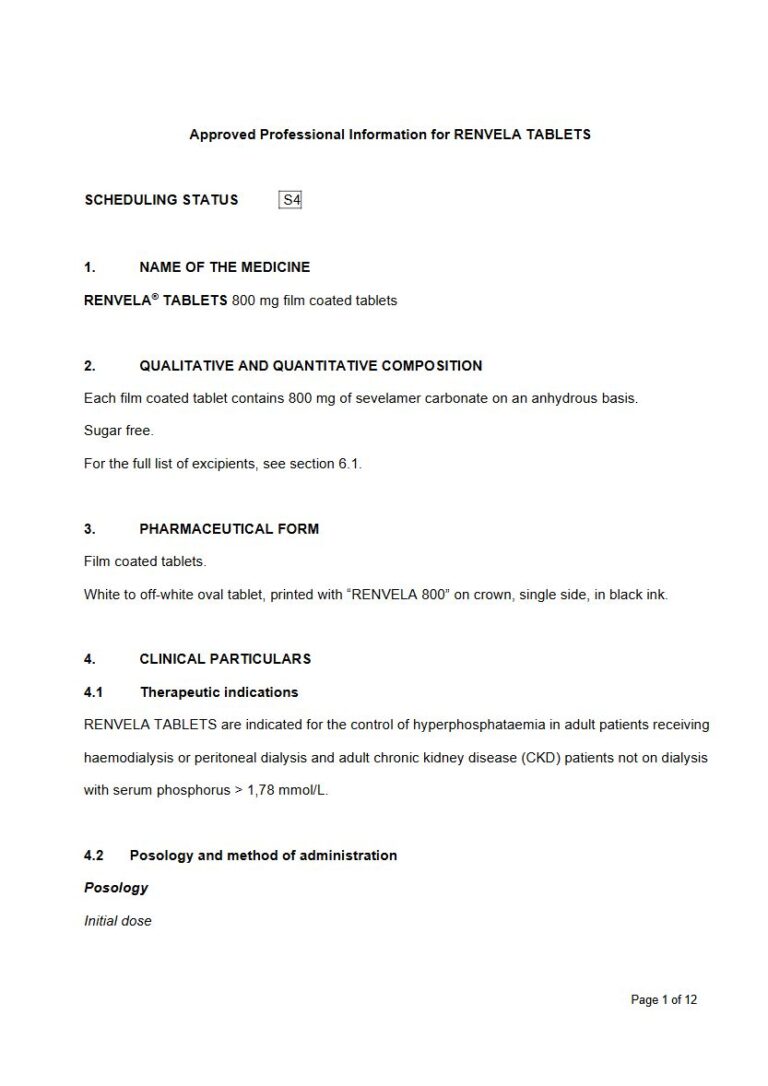
4.1 Therapeutic indications
RENVELA TABLETS are indicated for the control of hyperphosphataemia in adult patients receiving haemodialysis or peritoneal dialysis and adult chronic kidney disease (CKD) patients not on dialysis with serum phosphorus > 1,78 mmol/L.
4.2 Posology and method of administration
Posology
The recommended starting dose is 2,4 g to 4,8 g per day based on clinical needs and phosphorus level. RENVELA TABLETS must be taken three times per day with meals. For patients previously on phosphate binders, RENVELA TABLETS should be given on a gram for gram basis with monitoring of serum phosphorus levels to ensure optimal daily doses.
Titration and maintenance
Serum phosphorus levels must be monitored and the dose of RENVELA TABLETS titrated every 2 u2013 4 weeks until an acceptable serum phosphorus level is reached, with regular monitoring thereafter. Patients taking RENVELA TABLETS should adhere to their prescribed diets. In clinical practice, treatment will be continuous based on the need to control serum phosphorus levels and the daily dose is expected to be an average of approximately 6 g per day.
Special populations
Paediatric population
The safety and efficacy of RENVELA TABLETS have not been established in children below the age of 18 years. RENVELA TABLETS is not recommended for use in children below the age of 18 years.
Elderly population
There is no evidence for special considerations when RENVELA TABLETS is administered to elderly patients.
Hepatic impairment
No studies have been performed in patients with hepatic impairment.
Method of administration
Oral use. RENVELA tablets (800 mg) can be taken three times per day with meals at a dosage based on individual patient requirements to control phosphate levels. The tablets should be swallowed intact and should not be crushed, chewed, or broken into pieces prior to administration.
4.3 Contraindications
- Hypersensitivity to sevelamer carbonate or any other ingredients of RENVELA TABLETS (see section 6.1).
- Patients with hypophosphataemia or bowel obstruction.
4.4 Special warnings and precautions for use
The safety and efficacy of RENVELA TABLETS in patients with dysphagia, swallowing disorders, severe gastrointestinal motility disorders, including severe constipation, untreated or severe gastroparesis, retention of gastric contents and abnormal or irregular bowel motion, active inflammatory bowel disease or major gastrointestinal tract surgery, have not been established. Consequently, caution should be exercised when RENVELA TABLETS is used in patients with these disorders. RENVELA TABLETS treatment should be re-evaluated in patients who develop severe constipation or other severe gastrointestinal symptoms.
Swallowing and choking difficulties
Case reports of difficulty swallowing the tablet have been reported. Many of these cases involved patients with contributing co-morbid conditions affecting the ability to swallow, including swallowing disorders or oesophageal abnormalities. Proper swallowing ability should be carefully monitored in patients with co-morbid conditions. Caution should be exercised when RENVELA TABLETS are used in these patients.
Fat-soluble vitamins and folate deficiency
Patients with CKD may develop low vitamin A, D, E and K levels, depending on dietary intake and the severity of their disease. Treatment with sevelamer in preclinical studies has been shown to reduce the absorption of vitamins D, E and K and folic acid. Therefore, in patients not taking supplemental vitamins but on RENVELA TABLETS, serum vitamin A, D and E levels, and vitamin K status should be assessed regularly. It is recommended that vitamin supplements be given if necessary. It is recommended that CKD patients not on dialysis are given vitamin D supplements (approximately 400 IU of native vitamin D daily) which can be part of a multivitamin preparation to be taken apart from their dose of RENVELA TABLETS. In patients undergoing peritoneal dialysis additional monitoring of fat-soluble vitamins and folic acid is recommended, since vitamin A, D, E and K levels were not measured in a clinical study in these patients. There is at present insufficient data to exclude the possibility of folate deficiency during long term RENVELA TABLETS treatment. In patients not taking supplemental folic acid but on RENVELA TABLETS, folate level should be assessed regularly.
Peritonitis
Patients receiving dialysis are subject to certain risks for infection specific to dialysis modality. Peritonitis is a known complication in patients receiving peritoneal dialysis and in a clinical trial with sevelamer hydrochloride, a greater number of peritonitis cases were reported in the sevelamer group than in the control group. Patients on peritoneal dialysis should be closely monitored to ensure the correct use of appropriate aseptic technique with the prompt recognition and management of any signs and symptoms associated with peritonitis.
Hypothyroidism
Closer monitoring of patients with hypothyroidism co-administered with RENVELA TABLETS and levothyroxine is recommended (see section 4.5).
Inflammatory gastrointestinal disorders
Cases of serious inflammatory disorders of the gastrointestinal tract (complications including haemorrhage, perforation, ulceration, necrosis, colitis, and colonic/caecal mass) associated with the presence of sevelamer crystals have been reported (see section 4.8). Inflammatory disorders may resolve upon RENVELA TABLETS discontinuation. Treatment with RENVELA TABLETS should be re-evaluated in patients who develop severe gastrointestinal symptoms.
Excipients
RENVELA TABLETS contains less than 1 mmol sodium (23 mg) per tablet that is to say essentially u201csodium-freeu201d.
4.5 Interaction with other medicines and other forms of interaction
RENVELA has been studied in two medicine interaction studies. In interaction studies in healthy volunteers, sevelamer carbonate did not affect the bioavailability of either warfarin or digoxin. Sevelamer hydrochloride, which contains the same active moiety as sevelamer carbonate (RENVELA TABLETS), has been studied in medicine interaction studies. In interaction studies in healthy volunteers, sevelamer hydrochloride had no effect on the bioavailability of a single dose of digoxin, warfarin, enalapril, metoprolol or iron. However, the bioavailability of ciprofloxacin was decreased by approximately 50 % when co-administered with sevelamer hydrochloride in a single dose study. Consequently, sevelamer hydrochloride, and thus RENVELA TABLETS (sevelamer carbonate), should not be taken simultaneously with ciprofloxacin. During post-marketing experience, reduced concentrations of ciclosporin, mycophenolate mofetil and tacrolimus have been reported in transplant patients when co-administered with sevelamer hydrochloride, which contains the same active moiety as sevelamer carbonate, without any clinical consequences (for example, graft rejection). The possibility of an interaction cannot be excluded and close monitoring of blood concentrations of ciclosporin, mycophenolate mofetil and tacrolimus should be considered during the use of any of these medicines with RENVELA TABLETS and after its withdrawal. During post-marketing experience, cases of increased thyroid stimulating hormone (TSH) levels have been reported in patients co-administered sevelamer hydrochloride, which contains the same active moiety as sevelamer carbonate, and levothyroxine. Closer monitoring of TSH levels is therefore recommended in patients receiving RENVELA TABLETS and levothyroxine. During post-marketing experience, cases of increased phosphate levels have been reported in patients taking proton pump inhibitors co-administered with sevelamer carbonate. Caution should be exercised when prescribing proton pump inhibitors to patients concomitantly treated with RENVELA TABLETS. The phosphate serum level should be monitored and the RENVELA TABLETS dosage adjusted consequently. Sevelamer carbonate is not absorbed and may affect the bioavailability of other medicines. When administering an oral medicine where a reduction in the bioavailability of that medicine would have a clinically significant effect on its safety or efficacy, the medicine should be administered at least one hour before or three hours after taking RENVELA TABLETS, or the medical practitioner should consider monitoring blood levels of the medicine. Patients taking antidysrhythmic medicines for the control of dysrhythmias and anti-seizure medicines for the control of seizure disorders, were excluded from the clinical trials. Special precautions should be taken when prescribing RENVELA TABLETS to patients also taking these medicines. Possible reduction in absorption cannot be excluded. The antidysrhythmic medicine should be taken at least one hour before or three hours after RENVELA TABLETS, and blood monitoring can be considered.
4.6 Fertility, pregnancy and lactation
The safety of RENVELA TABLETS has not been established in pregnant or lactating women. Since sevelamer is not absorbed, excretion in breast milk is not expected. A decision on whether to continue/discontinue breastfeeding or to continue/discontinue therapy with RENVELA TABLETS should be made taking into account the benefit of breastfeeding to the child and the benefit of RENVELA TABLETS therapy to the woman.
4.7 Effects on ability to drive and use machines
No studies on the effects on the ability to drive a vehicle and use machines have been performed.
4.8 Undesirable effects
The safety of sevelamer (as either carbonate and hydrochloride salts) has been investigated in numerous clinical trials involving a total of 969 haemodialysis patients with treatment duration of 4 to 50 weeks (724 patients treated with sevelamer hydrochloride and 245 with sevelamer carbonate), 97 peritoneal dialysis patients with treatment duration of 12 weeks (all treated with sevelamer hydrochloride) and 128 patients with CKD not on dialysis with treatment duration of 8 to 12 weeks (79 patients treated with sevelamer hydrochloride and 49 with sevelamer carbonate). In a parallel study with a treatment duration of 12 weeks, the adverse events reported for sevelamer hydrochloride in peritoneal dialysis patients (N = 97) were similar to adverse events observed in haemodialysis patients. In a double-blind, placebo-controlled, dose titration study with a treatment duration of 8 weeks, the adverse events experienced by the patients in the sevelamer carbonate and placebo groups were similar. The most frequently occurring (u2265 5 % of patients) undesirable effects possibly or probably related to sevelamer, including RENVELA TABLETS, were in the gastrointestinal disorders system organ class. Most of these adverse reactions were mild to moderate in intensity.
The reporting rate is classified as very common (u2265 1/10), common (u2265 1/100 to < 1/10).
MedDRA system organ class
Very common
Gastrointestinal disorders Nausea, vomiting, upper abdominal pain, constipation, diarrhoea, dyspepsia
Common
Flatulence, abdominal pain, abdominal distension, anorexia, abdominal discomfort
Skin and subcutaneous tissue disorders
Pruritus
General disorders and administration site conditions
Fatigue
Post-marketing experience:
MedDRA system organ class
Frequency unknown
Immune system disorders Hypersensitivity
Gastrointestinal disorders Ileus, intestinal obstruction, intestinal perforation. Cases of serious inflammatory disorders of the gastrointestinal tract (with complications including haemorrhage, perforation, ulceration, necrosis, colitis and intestinal mass) associated with the presence of sevelamer crystals.
Skin and subcutaneous tissue disorders
Rash
Reporting of suspected adverse reactions
Reporting suspected adverse reactions after authorisation of RENVELA TABLETS is important. It allows continued monitoring of the benefit/risk balance of RENVELA TABLETS. Health care providers are asked to report any suspected adverse reactions to:
u2022 The Pharmacovigilance Unit at Sanofi: [email protected] (email) or 011 256 3700 (tel), or
u2022 SAHPRA via the u201cAdverse Drug Reactions Reporting Formu201d found online under SAHPRAu2019s publications: https://www.sahpra.org.za/Publications/Index/8.
4.9 Overdose
In CKD patients on dialysis, the maximum dose studied was 14,4 grams of sevelamer carbonate. There are no reports of overdosage with sevelamer carbonate in patients. Sevelamer is not systemically absorbed, the risk of systemic toxicity is low. Treatment is symptomatic and supportive.
