
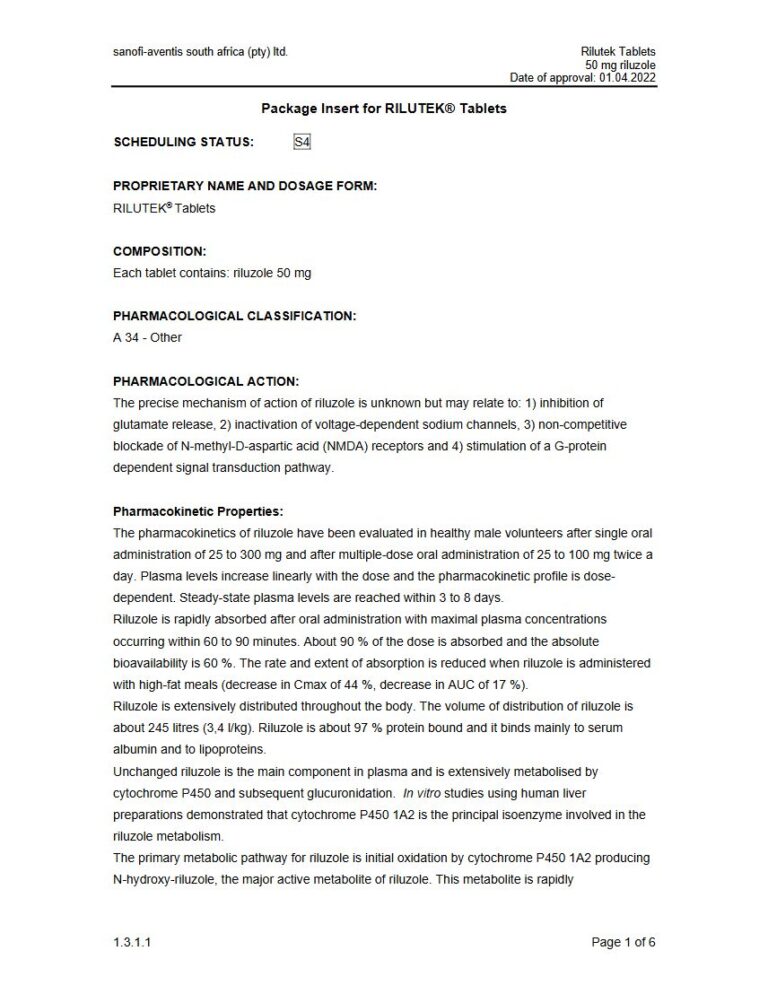
Rilutek Tablets 50 mg Tablets
PDF Leaflet Revision Date: 01.04.2022
Clinical Summary
Quick overview from the medicine insert
Indication
Extension of survival in bulbar variant of motor neuron disease.
Dosage (summary)
100 mg daily (50 mg every 12 hours), taken between meals.
Onset of Action / Duration
Onset: 60-90 mins, Duration: 9-15 hours
Special Populations
- Renal impairment
- Hepatic impairment
Pregnancy & Breastfeeding
Contraindicated in pregnancy and lactation.
Key Drug Interactions
- CYP 1A2 inhibitors (e.g., caffeine, diclofenac)
- CYP 1A2 inducers (e.g., rifampicin, omeprazole)
Contraindications
- Severe hypersensitivity to riluzole
- Hepatic disease
- Pregnancy
- Lactation
Common side effects
- Nausea
- Diarrhoea
- Headache
- Dizziness
- Increased ALT
Counselling Points
- Take between meals
- Report any febrile illness
- Avoid driving if experiencing dizziness
Serious warnings
- Risk of hepatitis
- Monitor ALT levels
- Dizziness may impair ability to drive
Important Disclaimer
The Rilutek Tablets 50 mg Tablets professional information leaflet below is the property of Sanofi-Aventis South Africa and is provided on Medinsert exactly as issued, with no.. alterations or editorial changes. We make every effort to keep content current by updating documents as soon as new versions become available. Medinsert serves as a trusted access point for healthcare professionals, but does not replace official sources or clinical judgement. For more details, please read our full disclaimer. read more>>
 Healthcare Professionals Only
This content is for registered healthcare professionals
Sign in or create a free account to read the full package insert.
Free for HPCSA-registered professionals. Powered by Medinsert.
Clinical Particulars
Section 4 of the official insert — extracted exactly as issued, no alterations
4.1 Therapeutic indications
RILUTEK is indicated for the extension of survival of patients with the bulbar variant of motor neuron disease.
4.2 Posology and method of administration
The recommended daily dose in adults is 100 mg (50 mg every 12 hours). RILUTEK should be taken between mealtimes i.e. at least one hour before or two hours after a meal. No significant increased benefit can be expected from higher daily doses.
4.3 Contraindications
Patients who have a history of severe hypersensitivity reactions to riluzole or any of the tablet components. Patients who have hepatic disease or who have baseline transaminases greater than 3 times the upper limit of normal. Patients who are pregnant or lactating (See u201cPregnancy and Lactationu201d).
4.4 Special warnings and precautions for use
Increased alanine-aminotransferase (ALT) usually appeared within 3 months after the start of therapy with RILUTEK; they were usually transient and levels returned to below 2 times the ULN after 2 to 6 months while treatment was continued. These increases could be associated with jaundice. In patients with increases in ALT to more than 5 times the ULN, treatment was discontinued and the levels returned to less than 2 times the ULN within 2 to 4 months.
Because of the risks of hepatitis, serum transaminases including ALT should be measured before and during therapy with RILUTEK. ALT should be measured every month during the first 3 months of treatment, every 3 months during the remainder of the first year, and periodically thereafter. ALT levels should be measured frequently in patients who developed elevated ALT levels.
RILUTEK should not be used in patients who have active hepatic disease.
Patients should be warned about the potential for dizziness, vertigo or somnolence, and advised not to drive or operate machinery if these symptoms occur.
4.5 Interactions with other medicines
There have been no clinical studies to evaluate the interactions of RILUTEK with other drugs. In vitro studies using human liver microsomal preparations suggest that CYP 1A2 is the principal isoenzyme involved in the initial oxidative metabolism of RILUTEK. Inhibitors of CYP 1A2 (e.g. caffeine, diclofenac, diazepam, nicergoline, clomipramine, imipramine, fluvoxamine, phenacetin, theophylline, amitriptyline and quinolones) could potentially decrease the rate of RILUTEK elimination, while inducers of CYP 1A2 (e.g. cigarette smoke, charcoal-broiled food, rifampicin and omeprazole) could increase the rate of RILUTEK elimination.
4.6 Fertility, pregnancy and lactation
RILUTEK is contra-indicated in pregnant and lactating patients, as safety has not been established.
4.7 Effects on ability to drive and use machines
Patients should be warned about the potential for dizziness, vertigo or somnolence, and advised not to drive or operate machinery if these symptoms occur.
4.8 Undesirable effects
Side-effects: Very common (u2265 1/10); common (u2265 1/100 to < 1/10); uncommon (u2265 1/1000 to < 1/100); rare (u2265 1/10 000 to < 1/1000); very rare (< 1/ 10 000); not known (cannot be estimated from the available data).
Gastrointestinal disorders : Very common : Nausea Common : Diarrhoea, abdominal pain, vomiting Uncommon : Pancreatitis Frequent : Anorexia Less frequent : Colitis, stomatitis, peritonitis, rectal disorder, pseudomembranous enterocolitis, peptic ulcer haemorrhage, dyspepsia, flatulence, oral moniliasis Nervous system disorder : Common : Headache, dizziness, oral paraesthesia, somnolence Frequent : Vertigo Less frequent : Amnesia, coma, depression, hypertonia General disorders and administration site conditions : Very common : Asthenia Common : Pain Less frequent : Chest pain, back pain, malaise and headache Skin and Appendages : Less frequent : Eczema, nail disorder, pruritus, alopecia, exfoliative dermatitis Cardiovascular: Common : Tachycardia Less frequent : Hypertension, arrhythmia, postural hypotension Respiratory system : Frequent : Decreased lung function, pneumonia Musculoskeletal system : Less frequent : Arthralgia Urogenital system : Less frequent : Urinary tract infection, dysuria Blood and lymphatic system disorders : Uncommon : Anaemia Not known : Neutropenia Metabolic and Nutritional : Less frequent : Peripheral oedema, weight loss Hepato-biliary disorders : Very common : Abnormal liver function tests Not known : Hepatitis Immune system disorders : Uncommon: Anaphylactoid reaction, angioedema Laboratory tests : Frequent : Increases in ALT, aspartate aminotransferase (AST) (see u201cWarningsu201d and u201cSpecial Precautionsu201d). Increases in lactate dehydrogenase (LDH), gamma-glutamate transferase (GGT), bilirubin, alkaline phosphatase, creatine phosphokinase (CPK).
4.9 Overdose
Refer to u201cSide Effectsu201d for possible symptoms of overdosage. Neurological and psychiatric symptoms, acute toxic encephalopathy with stupor, coma, and methemoglobinaemia have been observed. No specific treatment information or antidote is available. In case of overdosage, treatment is symptomatic and supportive. Severe methemoglobinaemia may be rapidly reversible after treatment with methylene blue.
