
Rivaroxaban 10 Mg Film-Coated Tablets
PDF Leaflet Revision Date: 28 February 2024
Clinical Summary
Quick overview from the medicine insert
Indication
Prevention of venous thromboembolism in major orthopaedic surgery.
Dosage (summary)
10 mg once daily, starting within 6-10 hours post-surgery.
Special Populations
- Elderly
- Renal impairment
- Hepatic impairment
Pregnancy & Breastfeeding
Contraindicated in pregnancy and breastfeeding due to bleeding risk.
Key Drug Interactions
- Strong CYP3A4 inhibitors (e.g., ketoconazole, ritonavir)
- Other anticoagulants
- NSAIDs
Contraindications
- Active bleeding
- Significant hepatic disease
- Hypersensitivity to rivaroxaban
Common side effects
- Anaemia
- Dizziness
- Gingival bleeding
- Gastrointestinal bleeding
Counselling Points
- Take with or without food.
- Report any signs of bleeding.
- Do not crush tablets unless necessary.
Serious warnings
- Increased risk of bleeding
- Monitor for signs of bleeding
- Use with caution in renal impairment
Important Disclaimer
The Rivaroxaban 10 Mg Film-Coated Tablets professional information leaflet below is the property of Shanur Healthcare and is provided on Medinsert exactly as issued, with no.. alterations or editorial changes. We make every effort to keep content current by updating documents as soon as new versions become available. Medinsert serves as a trusted access point for healthcare professionals, but does not replace official sources or clinical judgement. For more details, please read our full disclaimer. read more>>
 Healthcare Professionals Only
This content is for registered healthcare professionals
Sign in or create a free account to read the full package insert.
Free for HPCSA-registered professionals. Powered by Medinsert.
Clinical Particulars
Section 4 of the official insert — extracted exactly as issued, no alterations
4.1 Therapeutic indications
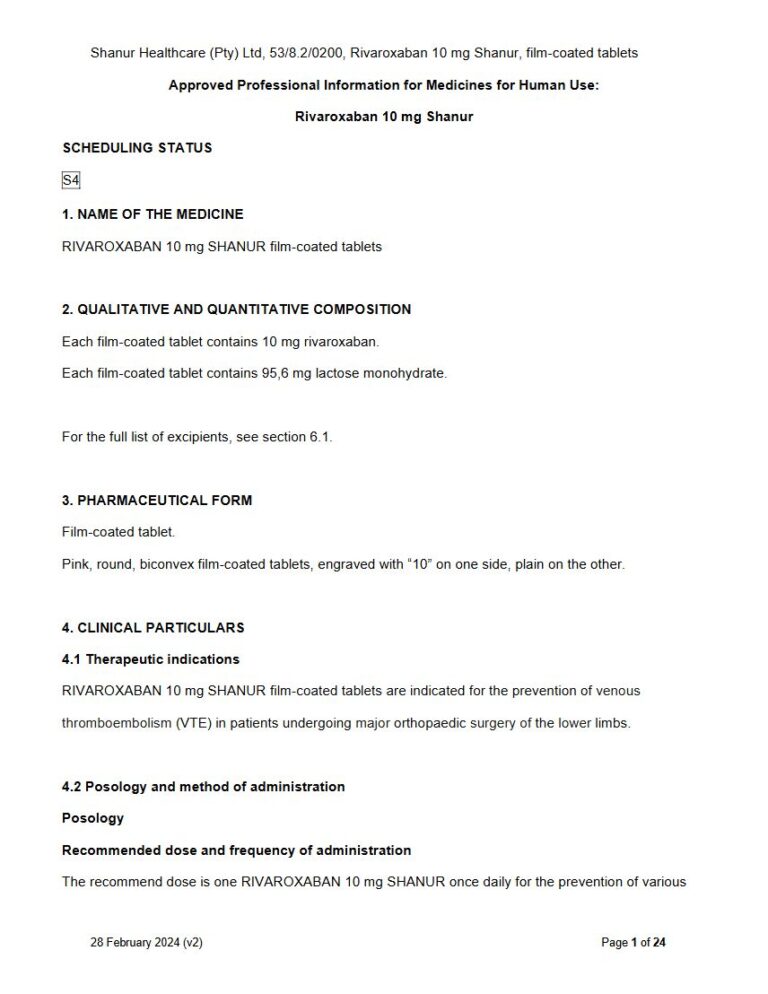
RIVAROXABAN 10 mg SHANUR film - coated tablets are indicated for the prevention of venous thromboembolism (VTE) in patients undergoing major orthopaedic surgery of the lower limbs.
4.2 Posology and method of administration
Posology
Recommended dose and frequency of administration
The recommend dose is one RIVAROXABAN 10 mg SHANUR once daily for the prevention of various thromboembolism (VTE) in major orthopaedic surgery. The initial dose should be taken within 6 u2013 10 hours after surgery provided that haemostasis has been established. If a dose is missed the patient should take RIVAROXABAN 10 mg SHANUR immediately and continue on the following day with the once daily intake as before.
Duration of treatment
The duration of treatment depends on the type of major orthopaedic surgery. After major hip surgery patients should be treated for 5 weeks. After major knee surgery patients should be treated for 2 weeks.
Special populations
Elderly (above 65 years), Gender and body Weight
No dose adjustment is required for these patient populations.
Patients with impaired liver function
RIVAROXABAN 10 mg SHANUR is contra - indicated in patients with significant hepatic disease which is associated with coagulopathy leading to clinically relevant bleeding risk (see section 4.3). No dose adjustment is necessary in patients with other hepatic diseases. Limited clinical data in patients with moderate hepatic impairment indicate a significant increase in the pharmacological activity. No clinical data are available for patients with severe hepatic impairment.
Patients with impaired renal function
No dose adjustment is required if RIVAROXABAN 10 mg SHANUR is administered in patients with mild (creatinine clearance 80 u2013 50 mL/min) or moderate (creatinine clearance < 50 u2013 30 mL/min) renal impairment. Limited clinical data for patient with severe renal impairment (creatinine clearance < 30 mL/min) indicated that rivaroxaban plasma levels are significantly increased in this patient population. Therefore RIVAROXABAN 10 mg SHANUR must be used with caution in these patients (see section 4.4)
Ethnic differences
No dose adjustment is required based on ethnic differences.
Paediatric population
Children (up to 18 years of age) The safety and efficacy of RIVAROXABAN 10 mg SHANUR has not been established in children. No clinical data is available for children.
Method of administration
RIVAROXABAN 10 mg SHANUR is for oral use. The tablets can be taken with or without food (see sections 4.5 and 5.2). For patients who are unable to swallow whole tablets, RIVAROXABAN 10 mg SHANUR may be crushed and mixed with water or apple puree immediately prior to use and administered orally. The crushed RIVAROXABAN 10 mg SHANUR tablet may also be given through gastric tubes after confirmation of the correct gastric placement of the tube. The crushed tablet should be administered in a small amount of water via a gastric tube after which it should be flushed with water (see section 5.2).
4.3 Contraindications
- Hypersensitivity to rivaroxaban or to any of the excipients listed in section 6.1.
- Clinically significant active bleeding (e.g. intracranial bleeding, gastrointestinal bleeding). This may include current or recent gastrointestinal ulceration, presence of malignant neoplasms at high risk of bleeding, recent brain or spinal injury, recent brain, spinal or ophthalmic surgery, recent intracranial haemorrhage, known or suspected oesophageal varices, arteriovenous malformations, vascular aneurysms or major intraspinal or intracerebral vascular abnormalities.
- Significant hepatic disease which is associated with coagulopathy leading to a clinically relevant bleeding risk.
- Pregnancy and lactation (see section 4.6).
- Concomitant treatment with any other anticoagulants, e.g. unfractionated heparin (UFH), low molecular weight heparins (enoxaparin, dalteparin, etc.), heparin derivatives (fondaparinux, etc.), oral anticoagulants (warfarin, dabigatran etexilate, apixaban, etc.) except under specific circumstances of switching anticoagulant therapy or when UFH is given at doses necessary to maintain an open central venous or arterial catheter (see section 4.5).
- Hepatic disease associated with coagulopathy and clinically relevant bleeding risk including cirrhotic patients with Child Pugh B and C (see section 5.2).
- Patients with persistent triple positive antiphospholipid syndrome (APS).
4.4 Special warnings and precautions for use
Clinical surveillance in line with anticoagulation practice is recommended throughout the treatment period. Haemorrhagic risk Patients taking RIVAROXABAN 10 mg SHANUR are to be carefully observed for signs of bleeding. It is recommended to be used with caution in conditions with increased risk of haemorrhage. RIVAROXABAN 10 mg SHANUR administration should be discontinued if severe haemorrhage occurs. Mucosal bleedings (i.e. epistaxis, gingival, gastrointestinal, genito - urinary including abnormal vaginal or increased menstrual bleeding) and anaemia were seen more frequently during long term rivaroxaban treatment compared with Vitamin K Antagonists (VKA) treatment. Thus, in addition to adequate clinical surveillance, laboratory testing of haemoglobin/haematocrit could be of value to detect occult bleeding and quantify the clinical relevance of overt bleeding, as judged to be appropriate. Several sub - groups of patients, as detailed below, are at increased risk of bleeding. These patients are to be carefully monitored for signs and symptoms of bleeding complications and anaemia after initiation of treatment (see section 4.8). In patients receiving RIVAROXABAN 10 mg SHANUR for venous thromboembolism (VTE) prevention following elective hip or knee replacement surgery, this may be done by regular physical examination of the patients, close observation of the surgical wound drainage and periodic measurements of haemoglobin. Any unexplained fall in haemoglobin or blood pressure should lead to a search for a bleeding site. Although treatment with rivaroxaban does not require routine monitoring of exposure, rivaroxaban levels measured with a calibrated quantitative anti - factor Xa assay may be useful in exceptional situations where knowledge of rivaroxaban exposure may help to inform clinical decisions, e.g. overdose and emergency surgery (see sections 5.1 and 5.2).
Renal impairment
In patients with severe renal impairment (creatinine clearance < 30 mL/min) rivaroxaban plasma levels may be significantly increased (1,6 fold on average) which may lead to an increased bleeding risk. RIVAROXABAN 10 mg SHANUR is to be used with caution in patients with creatinine clearance 15 - 29 mL/min. Use is not recommended in patients with creatinine clearance < 15 mL/min (see sections 4.2 and 5.2).
In patients with moderate renal impairment (creatinine clearance 30 - 49 mL/min) concomitantly receiving other medicinal products which increase rivaroxaban plasma concentrations RIVAROXABAN 10 mg SHANUR is to be used with caution (see section 4.5).
4.5 Interaction with other medicines and other forms of interaction
The use of RIVAROXABAN 10 mg SHANUR is not recommended in patients receiving concomitant systemic treatment with azole - antimycotics (such as ketoconazole, itraconazole, voriconazole and posaconazole) or HIV protease inhibitors (e.g. ritonavir). These active substances are strong inhibitors of both CYP3A4 and P - gp and therefore may increase rivaroxaban plasma concentrations to a clinically relevant degree (2,6 fold on average) which may lead to an increased bleeding risk (see section 4.5). Care is to be taken if patients are treated concomitantly with medicinal products affecting haemostasis such as non - steroidal anti - inflammatory drugs (NSAIDs), acetylsalicylic acid (ASA) and platelet aggregation inhibitors or selective serotonin reuptake inhibitors (SSRIs), and serotonin norepinephrine reuptake inhibitors (SNRIs). For patients at risk of ulcerative gastrointestinal disease an appropriate prophylactic treatment may be considered (see section 4.5).
Other haemorrhagic risk factors
Rivaroxaban is not recommended in patients with an increased bleeding risk such as:
- congenital or acquired bleeding disorders
- uncontrolled severe arterial hypertension
- other gastrointestinal disease without active ulceration that can potentially lead to bleeding complications (e.g. inflammatory bowel disease, oesophagitis, gastritis and gastroesophageal reflux disease)
- vascular retinopathy
- bronchiectasis or history of pulmonary bleeding
- recent intracranial or intracerebral haemorrhage
- shortly after brain, spinal or ophthalmological surgery.
Patients with prosthetic valves
Rivaroxaban should not be used for thromboprophylaxis in patients having recently undergone transcatheter aortic valve replacement (TAVR). Safety and efficacy of RIVAROXABAN 10 mg SHANUR have not been studied in patients with prosthetic heart valves; therefore, there are no data to support that RIVAROXABAN 10 mg SHANUR provides adequate anticoagulation in this patient population. Treatment with RIVAROXABAN 10 mg SHANUR is not recommended for these patients.
Patients with antiphospholipid syndrome
Direct acting Oral Anticoagulants (DOACs) including rivaroxaban are not recommended for patients with a history of thrombosis who are diagnosed with antiphospholipid syndrome (APS). In particular for patients that are triple positive (for lupus anticoagulant, anticardiolipin antibodies, and anti - beta 2 - glycoprotein I antibodies), treatment with DOACs could be associated with increased rates of recurrent thrombotic events compared with vitamin K antagonist therapy. Treatment of patients with established APS is not recommended (see section 4.3).
Hip fracture surgery
Rivaroxaban has not been studied in interventional clinical studies in patients undergoing hip fracture surgery to evaluate efficacy and safety.
Haemodynamically unstable PE patients or patients who require thrombolysis or pulmonary embolectomy.
RIVAROXABAN 10 mg SHANUR is not recommended as an alternative to unfractionated heparin in patients with pulmonary embolism who are haemodynamically unstable or may receive thrombolysis or pulmonary embolectomy since the safety and efficacy of RIVAROXABAN 10 mg SHANUR have not been established in these clinical situations.
Spinal/epidural anaesthesia or puncture
When neuraxial anaesthesia (spinal/epidural anaesthesia) or spinal/epidural puncture is employed, patients treated with antithrombotic medicines for prevention of thromboembolic complications are at risk of developing an epidural or spinal haematoma which can result in long - term or permanent paralysis. The risk of these events may be increased by the post - operative use of indwelling epidural catheters or the concomitant use of medicinal products affecting haemostasis. The risk may also be increased by traumatic or repeated epidural or spinal puncture. Patients are to be frequently monitored for signs and symptoms of neurological impairment (e.g. numbness or weakness of the legs, bowel or bladder dysfunction). If neurological compromise is noted, urgent diagnosis and treatment is necessary. Prior to neuraxial intervention the medical practitioner should consider the potential benefit versus the risk in anticoagulated patients or in patients to be anticoagulated for thromboprophylaxis. To reduce the potential risk of bleeding associated with the concurrent use of rivaroxaban and neuraxial (epidural/spinal) anaesthesia or spinal puncture, consider the pharmacokinetic profile of rivaroxaban. Placement or removal of an epidural catheter or lumbar puncture is best performed when the anticoagulant effect of rivaroxaban is estimated to be low (see section 5.2). At least 18 hours should elapse after the last administration of rivaroxaban before removal of an epidural catheter. Following removal of the catheter, at least 6 hours should elapse before the next rivaroxaban dose is administered. If traumatic puncture occurs the administration of rivaroxaban is to be delayed for 24 hours.
Dosing recommendations before and after invasive procedures and surgical intervention other than elective hip or knee replacement surgery
If an invasive procedure or surgical intervention is required, RIVAROXABAN 10 mg SHANUR should be stopped at least 24 hours before the intervention. If the procedure cannot be delayed the increased risk of bleeding should be assessed against the urgency of the intervention. RIVAROXABAN 10 mg SHANUR should be restarted as soon as possible after the invasive procedure or surgical intervention provided the clinical situation allows and adequate haemostasis has been established as determined by the treating medical practitioner (see section 5.2).
Elderly population
Increasing age may increase haemorrhagic risk (see section 5.2).
Dermatological reactions
Serious skin reactions, including Stevens - Johnson syndrome/toxic epidermal necrolysis and DRESS syndrome, have been reported during post - marketing surveillance in association with the use of rivaroxaban (see section 4.8). Patients appear to be at highest risk for these reactions early in the course of therapy: the onset of the reaction occurring in the majority of cases within the first weeks of treatment. Rivaroxaban should be discontinued at the first appearance of a severe skin rash (e.g. spreading, intense and/or blistering), or any other sign of hypersensitivity in conjunction with mucosal lesions.
Information about excipients
RIVAROXABAN 10 mg SHANUR contains lactose. Patients with rare hereditary problems of galactose intolerance, total lactase deficiency or glucose - galactose malabsorption should not take this medicinal product.
4.6 Fertility, pregnancy and lactation
Pregnancy
Safety and efficacy of RIVAROXABAN 10 mg SHANUR have not been established in pregnant women. Due to the potential reproductive toxicity, the intrinsic risk of bleeding and the evidence that rivaroxaban passes the placenta, RIVAROXABAN 10 mg SHANUR is contraindicated during pregnancy (see section 4.3). Women of child - bearing potential should avoid becoming pregnant during treatment with rivaroxaban.
Breastfeeding
Safety and efficacy of RIVAROXABAN 10 mg SHANUR have not been established in breast - feeding women. RIVAROXABAN 10 mg SHANUR is contraindicated during breast - feeding (see section 4.3).
Fertility
No specific studies with rivaroxaban in humans have been conducted to evaluate effects on fertility.
4.7 Effects on ability to drive and use machines
RIVAROXABAN 10 mg SHANUR has minor influence on the ability to drive and use machines. Adverse reactions like syncope and dizziness have been reported (see section 4.8). Patients experiencing these adverse reactions should not drive or use machines.
4.8 Undesirable effects
The frequencies of adverse reactions reported with RIVAROXABAN 10 mg SHANUR are summarised in Table 1 below by system organ class (in MedDRA) and by frequency.
Table 1: Tabulated list of adverse reactions
System Organ Class Adverse reactions Frequency
Blood and lymphatic system disorders Anaemia (incl. Respective laboratory parameters) Frequent
Thrombocytosis (incl. platelet count increase) A , thrombocytopenia Less frequent
Immune system disorder Allergic reaction, dermatitis allergic, angioedema, allergic oedema, anaphylactic reactions including anaphylactic shock Less frequent
Nervous system disorders Dizziness, headache Frequent
Cerebral and intracranial haemorrhage, syncope Less frequent
Eye disorders Eye haemorrhage (incl. conjunctival haemorrhage) Frequent
Cardiac disorders Tachycardia Less frequent
Vascular disorders Hypotension, haematoma Frequent
Respiratory, thoracic and mediastinal disorders Epistaxis, haemoptysis Frequent
Gastrointestinal disorders Gingival bleeding, gastrointestinal tract haemorrhage (incl. rectal haemorrhage), gastrointestinal and abdominal pains, dyspepsia, nausea, constipation A , diarrhoea, vomiting A Less frequent
Hepatobiliary disorders Increase in transaminases Frequent
Hepatic impairment, increased bilirubin, increased blood alkaline phosphatase A , increased GGTA, jaundice, bilirubin conjugated increased (with or without concomitant increase of ALT), cholestasis, hepatitis (incl. hepatocellular injury) Less frequent
Skin and subcutaneous tissues disorders Pruritus (incl. uncommon cases of generalised pruritus), rash, ecchymosis, cutaneous and subcutaneous haemorrhage syndrome Frequent
Urticaria, Stevens - Johnson syndrome/ Toxic Epidermal Necrolysis , DRESS Less frequent
Musculoskeletal and connective tissue disorders Pain in extremity A Frequent
Haemarthrosis, muscle haemorrhage Less frequent
Compartment syndrome secondary to a bleeding Unknown
Renal and urinary disorders Urogenital tract haemorrhage (incl. haematuria and menorrhagia B ), renal impairment (incl. increased blood creatinine, increased blood urea) Frequent
Renal failure/acute renal failure secondary to a bleeding sufficient to cause hypoperfusion Unknown
General disorders and administration site conditions Fever A , peripheral oedema, decreased general strength and energy (incl. fatigue and asthenia) Frequent
Feeling unwell (incl. malaise), localised oedema A Less frequent
Investigations Increased LDH A , increased lipase A , increased amylase A Less frequent
Injury, poisoning and procedural complications Postprocedural haemorrhage (incl. postoperative anaemia, and procedural complications and wound haemorrhage), contusion, wound secretion A Frequent
Vascular pseudoaneurysm C Less frequent
A: observed in prevention of VTE in adult patients undergoing elective hip or knee replacement surgery B: observed in treatment of DVT, PE and prevention of recurrence as frequent in women < 55 years C: observed as less frequent in prevention of atherothrombotic events in patients after an ACS (following percutaneous coronary intervention)
c. Description of selected adverse reactions
Due to the pharmacological mode of action, the use of RIVAROXABAN 10 mg SHANUR may be associated with an increased risk of occult or overt bleeding from any tissue or organ which may result in post haemorrhagic anaemia. The signs, symptoms, and severity (including fatal outcome) will vary according to the location and degree or extent of the bleeding and/or anaemia (see section 4.9 u201cManagement of bleedingu201d). Mucosal bleedings (i.e. epistaxis, gingival, gastrointestinal, genito - urinary including abnormal vaginal or increased menstrual bleeding) and anaemia were seen more frequently during long term rivaroxaban treatment compared with Vitamin K antagonist (VKA) treatment. Thus, in addition to adequate clinical surveillance, laboratory testing of haemoglobin/haematocrit could be of value to detect occult bleeding and quantify the clinical relevance of overt bleeding, as judged to be appropriate. The risk of bleedings may be increased in certain patient groups, e.g. those patients with uncontrolled severe arterial hypertension and/or on concomitant treatment affecting haemostasis (see section 4.4 u201cHaemorrhagic risku201d). Menstrual bleeding may be intensified and/or prolonged. Haemorrhagic complications may present as weakness, paleness, dizziness, headache or unexplained swelling, dyspnoea and unexplained shock. In some cases as a consequence of anaemia, symptoms of cardiac ischaemia like chest pain or angina pectoris have been observed. Known complications secondary to severe bleeding such as compartment syndrome and renal failure due to hypoperfusion have been reported for RIVAROXABAN 10 mg SHANUR. Therefore, the possibility of haemorrhage is to be considered in evaluating the condition in any anticoagulated patient.
4.9 Overdose
Cases of overdose up to 600 mg have been reported without bleeding complications or other adverse reactions. Due to limited absorption a ceiling effect with no further increase in average plasma exposure is expected at supratherapeutic doses of 50 mg rivaroxaban or above. A specific antidote antagonising the pharmacodynamic effect of rivaroxaban is not available. The use of activated charcoal to reduce absorption in case of rivaroxaban overdose may be considered.
Management of bleeding
Should a bleeding complication arise in a patient receiving rivaroxaban, the next rivaroxaban administration should be delayed or treatment should be discontinued as appropriate. Rivaroxaban has a half - life of approximately 5 to 13 hours (see section 5.2). Management should be individualised according to the severity and location of the haemorrhage. Appropriate symptomatic treatment could be used as needed, such as mechanical compression (e.g. for severe epistaxis), surgical haemostasis with bleeding control procedures, fluid replacement and haemodynamic support, blood products (packed red cells or fresh frozen plasma, depending on associated anaemia or coagulopathy) or platelets. If bleeding cannot be controlled by the above measures, administration of a specific procoagulant reversal agent should be considered, such as prothrombin complex concentrate (PCC), activated prothrombin complex concentrate (APCC) or recombinant factor VII a (r - FVIIa). However, there is currently very limited clinical experience with the use of these medicinal products in individuals receiving rivaroxaban. The recommendation is also based on limited non - clinical data. Re - dosing of recombinant factor VIIa shall be considered and titrated depending on improvement of bleeding. Depending on local availability, a consultation with a coagulation expert should be considered in case of major bleedings (see section 5.1). Protamine sulphate and vitamin K are not expected to affect the anticoagulant activity of rivaroxaban. There is limited experience with tranexamic acid and no experience with aminocaproic acid and aprotinin in individuals receiving rivaroxaban. There is neither scientific rationale for benefit nor experience with the use of the systemic haemostatic desmopressin in individuals receiving rivaroxaban. Due to the high plasma protein binding rivaroxaban is not expected to be dialysable.
